DEPARTMENT OF APPLIED SCIENCE & ADVANCED TECHNOLOGY
                                                                            UNIKL MIMET


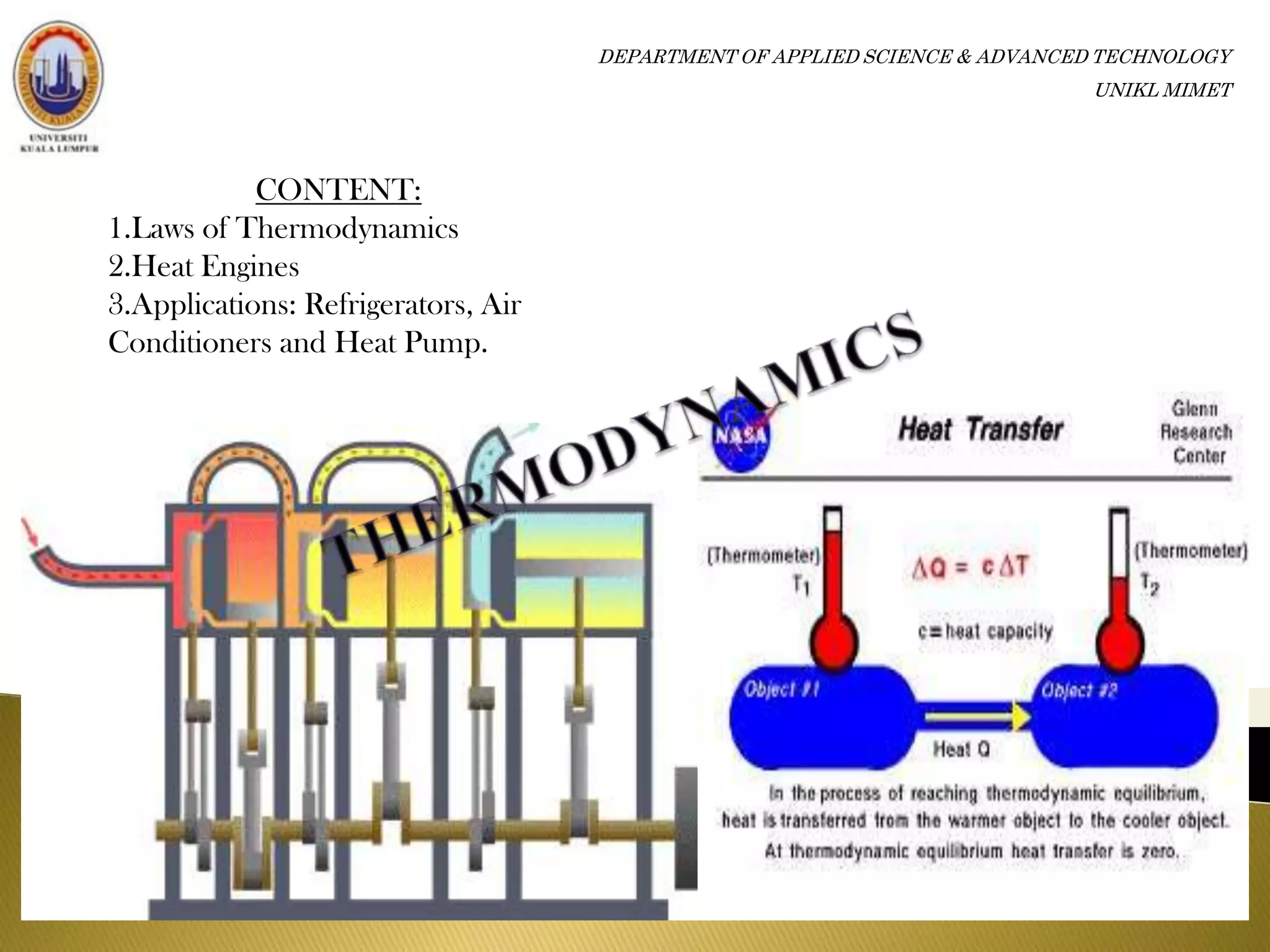
            CONTENT:
1.Laws of Thermodynamics
2.Heat Engines
3.Applications: Refrigerators, Air
Conditioners and Heat Pump.
DEPARTMENT OF APPLIED SCIENCE & ADVANCED TECHNOLOGY
                                                                      UNIKL MIMET


   The study of thermodynamics is concerned with the ways energy is
    stored within a body and how energy transformations (involve heat
    and work).

   One of the most fundamental laws of nature is the conservation of
    energy principle which states that during an energy interaction,
    energy can change from one form to another but the total amount
    of energy remains constant.

   That is, energy cannot be created or destroyed.
DEPARTMENT OF APPLIED SCIENCE & ADVANCED TECHNOLOGY
                                                                     UNIKL MIMET


   Thermodynamics is
     The science that examines the effects of energy transfer on
    macroscopic materials systems.

   Thermodynamics predicts
     Whether a process will occur given long enough time
       • driving force for the process

   Thermodynamics does not predict
     How fast a process will occur
       • mechanism of the process
DEPARTMENT OF APPLIED SCIENCE & ADVANCED TECHNOLOGY
                                                                         UNIKL MIMET


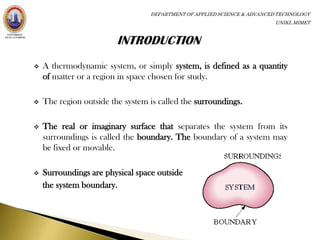
   A thermodynamic system, or simply system, is defined as a quantity
    of matter or a region in space chosen for study.

   The region outside the system is called the surroundings.

   The real or imaginary surface that separates the system from its
    surroundings is called the boundary. The boundary of a system may
    be fixed or movable.

   Surroundings are physical space outside
    the system boundary.
DEPARTMENT OF APPLIED SCIENCE & ADVANCED TECHNOLOGY
                                                                        UNIKL MIMET


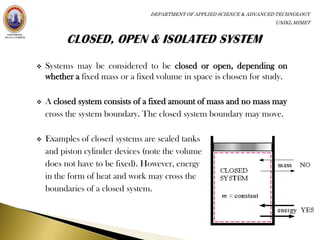
   Systems may be considered to be closed or open, depending on
    whether a fixed mass or a fixed volume in space is chosen for study.

   A closed system consists of a fixed amount of mass and no mass may
    cross the system boundary. The closed system boundary may move.

   Examples of closed systems are sealed tanks
    and piston cylinder devices (note the volume
    does not have to be fixed). However, energy
    in the form of heat and work may cross the
    boundaries of a closed system.
DEPARTMENT OF APPLIED SCIENCE & ADVANCED TECHNOLOGY
                                                                         UNIKL MIMET


   An open system, or control volume, has mass as well as energy
    crossing the boundary, called a control surface. Examples of open
    systems are pumps, compressors, turbines, valves, and heat
    exchangers.

   An isolated system is a general system of fixed mass where no heat or
    work may cross the boundaries.

   An isolated system is a closed system with no energy crossing the
    boundaries and is normally a collection of a main system and its
    surroundings that are exchanging mass and energy among themselves
    and no other system.
DEPARTMENT OF APPLIED SCIENCE & ADVANCED TECHNOLOGY
                                                                                  UNIKL MIMET


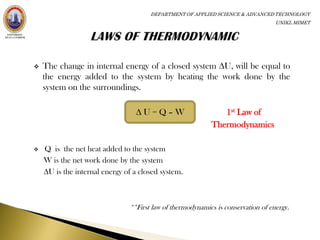
   The change in internal energy of a closed system U, will be equal to
    the energy added to the system by heating the work done by the
    system on the surroundings.

                                    U=Q–W                     1st Law of
                                                           Thermodynamics

   Q is the net heat added to the system
    W is the net work done by the system
     U is the internal energy of a closed system.


                               **First law of thermodynamics is conservation of energy.
DEPARTMENT OF APPLIED SCIENCE & ADVANCED TECHNOLOGY
                                                                  UNIKL MIMET


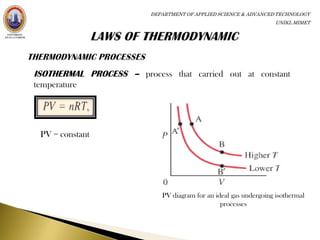
ISOTHERMAL PROCESS – process that carried out at constant
temperature


 PV = constant


                            PV diagram for an ideal gas undergoing isothermal
                                                processes
DEPARTMENT OF APPLIED SCIENCE & ADVANCED TECHNOLOGY
                                                                         UNIKL MIMET


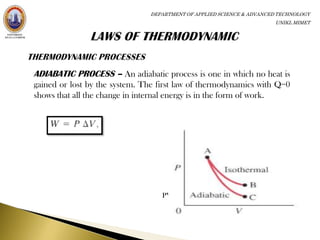
ADIABATIC PROCESS – An adiabatic process is one in which no heat is
gained or lost by the system. The first law of thermodynamics with Q=0
shows that all the change in internal energy is in the form of work.


                                   PV diagram for an ideal gas undergoing isothermal
                                                       processes
DEPARTMENT OF APPLIED SCIENCE & ADVANCED TECHNOLOGY
                                                                   UNIKL MIMET


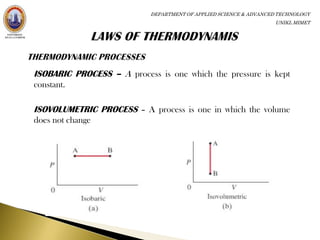
ISOBARIC PROCESS – A process is one which the pressure is kept
constant.

ISOVOLUMETRIC PROCESS – A process is one in which the volume
does not change
DEPARTMENT OF APPLIED SCIENCE & ADVANCED TECHNOLOGY
                                                                         UNIKL MIMET


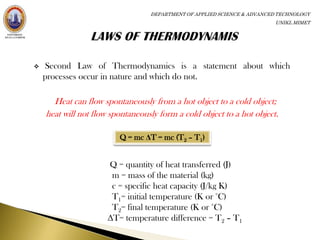
   Second Law of Thermodynamics is a statement about which
    processes occur in nature and which do not.

      Heat can flow spontaneously from a hot object to a cold object;
    heat will not flow spontaneously form a cold object to a hot object.

                         Q = mc ΔT = mc (T2 – T1)


                      Q = quantity of heat transferred (J)
                       m = mass of the material (kg)
                       c = specific heat capacity (J/kg K)
                       T1= initial temperature (K or °C)
                       T2= final temperature (K or °C)
                      ΔT= temperature difference = T2 – T1
DEPARTMENT OF APPLIED SCIENCE & ADVANCED TECHNOLOGY
                                                                                   UNIKL MIMET


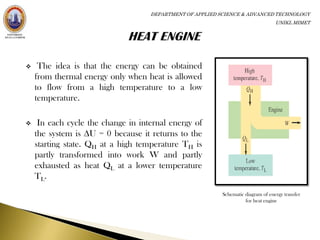
    The idea is that the energy can be obtained
    from thermal energy only when heat is allowed
    to flow from a high temperature to a low
    temperature.

    In each cycle the change in internal energy of
    the system is U = 0 because it returns to the
    starting state. QH at a high temperature TH is
    partly transformed into work W and partly
    exhausted as heat QL at a lower temperature
    T L.
                                                           Schematic diagram of energy transfer
                                                                     for heat engine
DEPARTMENT OF APPLIED SCIENCE & ADVANCED TECHNOLOGY
                                                                                     UNIKL MIMET


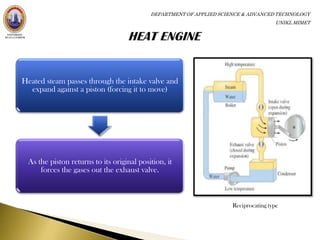
Heated steam passes through the intake valve and
  expand against a piston (forcing it to move)


 As the piston returns to its original position, it
     forces the gases out the exhaust valve.


                                                                     Reciprocating type
DEPARTMENT OF APPLIED SCIENCE & ADVANCED TECHNOLOGY
                                                                              UNIKL MIMET


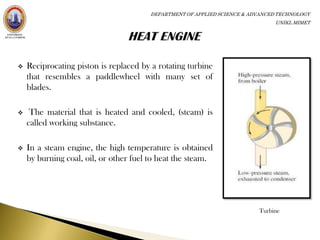
   Reciprocating piston is replaced by a rotating turbine
    that resembles a paddlewheel with many set of
    blades.

    The material that is heated and cooled, (steam) is
    called working substance.

   In a steam engine, the high temperature is obtained
    by burning coal, oil, or other fuel to heat the steam.


                                                                         Turbine
DEPARTMENT OF APPLIED SCIENCE & ADVANCED TECHNOLOGY
                                                                      UNIKL MIMET


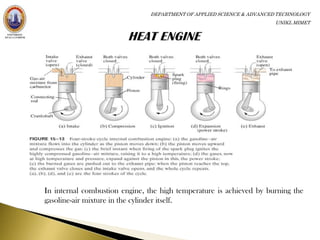
In internal combustion engine, the high temperature is achieved by burning the
gasoline-air mixture in the cylinder itself.
DEPARTMENT OF APPLIED SCIENCE & ADVANCED TECHNOLOGY
                                                                                                            UNIKL MIMET


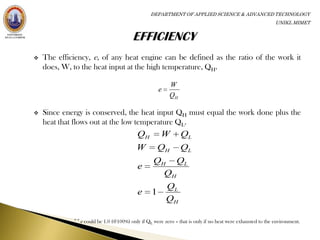
   The efficiency, e, of any heat engine can be defined as the ratio of the work it
    does, W, to the heat input at the high temperature, QH.

                                                          W
                                                      e
                                                          QH

   Since energy is conserved, the heat input QH must equal the work done plus the
    heat that flows out at the low temperature QL.
                                           QH         W        QL
                                           W          QH       QL
                                                   QH QL
                                           e
                                                     QH
                                                          QL
                                           e      1
                                                          QH

             ** e could be 1.0 (@100%) only if QL were zero – that is only if no heat were exhausted to the environment.
DEPARTMENT OF APPLIED SCIENCE & ADVANCED TECHNOLOGY
                                                                             UNIKL MIMET


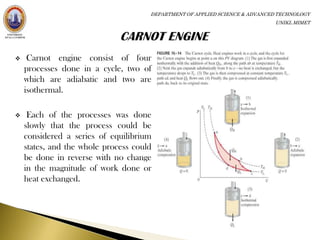
    Carnot engine consist of four
    processes done in a cycle, two of
    which are adiabatic and two are
    isothermal.

    Each of the processes was done
    slowly that the process could be
    considered a series of equilibrium
    states, and the whole process could
    be done in reverse with no change
    in the magnitude of work done or
    heat exchanged.
DEPARTMENT OF APPLIED SCIENCE & ADVANCED TECHNOLOGY
                                                                           UNIKL MIMET


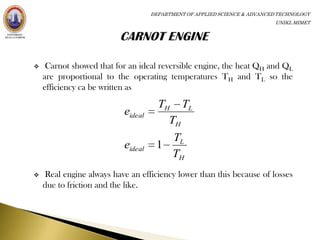
    Carnot showed that for an ideal reversible engine, the heat QH and QL
    are proportional to the operating temperatures TH and TL so the
    efficiency ca be written as
                                      TH TL
                           eideal
                                        TH
                                       TL
                           eideal    1
                                       TH
   Real engine always have an efficiency lower than this because of losses
    due to friction and the like.
DEPARTMENT OF APPLIED SCIENCE & ADVANCED TECHNOLOGY
                                       UNIKL MIMET
DEPARTMENT OF APPLIED SCIENCE & ADVANCED TECHNOLOGY
                                        UNIKL MIMET


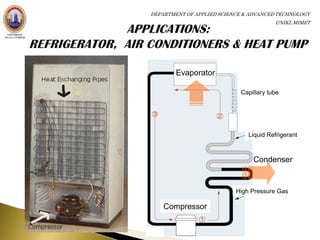
        Evaporator

                            Capillary tube


                               Liquid Refrigerant


                                Condenser


                           High Pressure Gas

    Compressor
DEPARTMENT OF APPLIED SCIENCE & ADVANCED TECHNOLOGY
                                                                         UNIKL MIMET


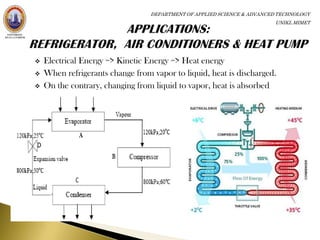
   Electrical Energy => Kinetic Energy => Heat energy
   When refrigerants change from vapor to liquid, heat is discharged.
   On the contrary, changing from liquid to vapor, heat is absorbed
DEPARTMENT OF APPLIED SCIENCE & ADVANCED TECHNOLOGY
                                                                          UNIKL MIMET


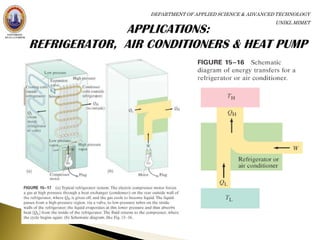
    The principle of refrigerators, air conditioners and heat pumps is just the
    reverse of a heat engine.

   Refrigerator: no work is required to take heat from the low-temperature
    region to high-temperature region [no device is possible whose sole effect
    is to transfer heat from one system at a temperature TL into a second
    system at a higher temperature TH.]

   The coefficient of performance (COP) of a refrigerator is defined as the
    heat QL removed from the low-temperature area divided by the work
    done W to remove the heat.

                             QL
                  COP                        [refrigerator and
                             W                 air conditioner]
DEPARTMENT OF APPLIED SCIENCE & ADVANCED TECHNOLOGY
                                                                                 UNIKL MIMET


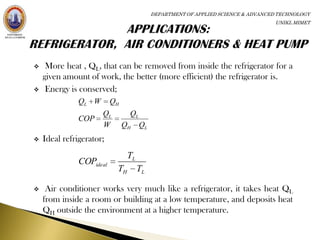
    More heat , QL, that can be removed from inside the refrigerator for a
    given amount of work, the better (more efficient) the refrigerator is.
    Energy is conserved;
               QL W       QH
                      QL        QL
               COP
                      W        QH    QL
   Ideal refrigerator;
                                TL
               COPideal
                           TH        TL

    Air conditioner works very much like a refrigerator, it takes heat QL
    from inside a room or building at a low temperature, and deposits heat
    QH outside the environment at a higher temperature.
DEPARTMENT OF APPLIED SCIENCE & ADVANCED TECHNOLOGY
                                                                         UNIKL MIMET


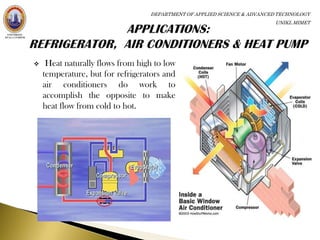
    Heat naturally flows from high to low
    temperature, but for refrigerators and
    air conditioners do work to
    accomplish the opposite to make
    heat flow from cold to hot.
DEPARTMENT OF APPLIED SCIENCE & ADVANCED TECHNOLOGY
                                                                        UNIKL MIMET


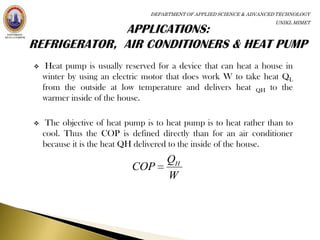
    Heat pump is usually reserved for a device that can heat a house in
    winter by using an electric motor that does work W to take heat QL
    from the outside at low temperature and delivers heat QH to the
    warmer inside of the house.

    The objective of heat pump is to heat pump is to heat rather than to
    cool. Thus the COP is defined directly than for an air conditioner
    because it is the heat QH delivered to the inside of the house.
                                      QH
                            COP
                                      W
DEPARTMENT OF APPLIED SCIENCE & ADVANCED TECHNOLOGY
                                                                         UNIKL MIMET


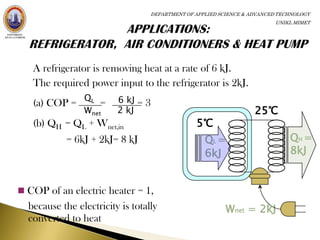
   A refrigerator is removing heat at a rate of 6 kJ.
   The required power input to the refrigerator is 2kJ.
                QL       6 kJ = 3
   (a) COP =        =
                Wnet     2 kJ                                      25℃
   (b) QH = QL + Wnet,in                        5℃
            = 6kJ + 2kJ= 8 kJ                      QL =                       QH =
                                                   6kJ                        8kJ


 COP of an electric heater = 1,
  because the electricity is totally                      Wnet = 2kJ
  converted to heat
DEPARTMENT OF APPLIED SCIENCE & ADVANCED TECHNOLOGY
                                                                                                  UNIKL MIMET


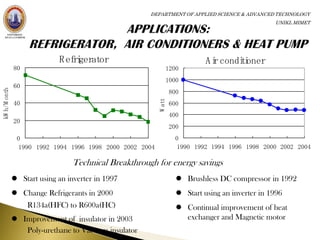
                            R ef gerator
                                ri                                           A i condi oner
                                                                               r     ti
              80                                                 1200
th


                                                                 1000


                                                         t
              60
kW h/M onth


                                                                 800


                                                         W att
              40                                                 600
                                                                 400
              20
                                                                 200
               0                                                   0
               1990 1992 1994 1996 1998 2000 2002 2004             1990 1992 1994 1996 1998 2000 2002 2004

                                Technical Breakthrough for energy savings
               Start using an inverter in 1997                      Brushless DC compressor in 1992
               Change Refrigerants in 2000                          Start using an inverter in 1996
                   R134a(HFC) to R600a(HC)                           Continual improvement of heat
               Improvement of insulator in 2003                      exchanger and Magnetic motor
                 Poly-urethane to Vacuum insulator
DEPARTMENT OF APPLIED SCIENCE & ADVANCED TECHNOLOGY
                                                                            UNIKL MIMET


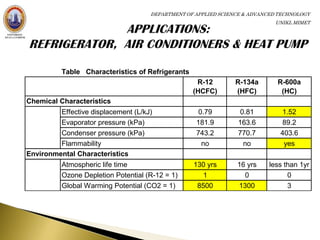
          Table Characteristics of Refrigerants
                                                   R-12         R-134a       R-600a
                                                  (HCFC)        (HFC)         (HC)
Chemical Characteristics
         Effective displacement (L/kJ)              0.79          0.81        1.52
         Evaporator pressure (kPa)                 181.9         163.6        89.2
         Condenser pressure (kPa)                  743.2         770.7        403.6
         Flammability                                no            no          yes
Environmental Characteristics
          Atmospheric life time                   130 yrs       16 yrs     less than 1yr
          Ozone Depletion Potential (R-12 = 1)       1            0              0
          Global Warming Potential (CO2 = 1)       8500         1300             3
DEPARTMENT OF APPLIED SCIENCE & ADVANCED TECHNOLOGY
                                       UNIKL MIMET

Thermodynamics

  • 1.
    DEPARTMENT OF APPLIEDSCIENCE & ADVANCED TECHNOLOGY UNIKL MIMET CONTENT: 1.Laws of Thermodynamics 2.Heat Engines 3.Applications: Refrigerators, Air Conditioners and Heat Pump.
  • 2.
    DEPARTMENT OF APPLIEDSCIENCE & ADVANCED TECHNOLOGY UNIKL MIMET  The study of thermodynamics is concerned with the ways energy is stored within a body and how energy transformations (involve heat and work).  One of the most fundamental laws of nature is the conservation of energy principle which states that during an energy interaction, energy can change from one form to another but the total amount of energy remains constant.  That is, energy cannot be created or destroyed.
  • 3.
    DEPARTMENT OF APPLIEDSCIENCE & ADVANCED TECHNOLOGY UNIKL MIMET  Thermodynamics is  The science that examines the effects of energy transfer on macroscopic materials systems.  Thermodynamics predicts  Whether a process will occur given long enough time • driving force for the process  Thermodynamics does not predict  How fast a process will occur • mechanism of the process
  • 4.
    DEPARTMENT OF APPLIEDSCIENCE & ADVANCED TECHNOLOGY UNIKL MIMET  A thermodynamic system, or simply system, is defined as a quantity of matter or a region in space chosen for study.  The region outside the system is called the surroundings.  The real or imaginary surface that separates the system from its surroundings is called the boundary. The boundary of a system may be fixed or movable.  Surroundings are physical space outside the system boundary.
  • 5.
    DEPARTMENT OF APPLIEDSCIENCE & ADVANCED TECHNOLOGY UNIKL MIMET  Systems may be considered to be closed or open, depending on whether a fixed mass or a fixed volume in space is chosen for study.  A closed system consists of a fixed amount of mass and no mass may cross the system boundary. The closed system boundary may move.  Examples of closed systems are sealed tanks and piston cylinder devices (note the volume does not have to be fixed). However, energy in the form of heat and work may cross the boundaries of a closed system.
  • 6.
    DEPARTMENT OF APPLIEDSCIENCE & ADVANCED TECHNOLOGY UNIKL MIMET  An open system, or control volume, has mass as well as energy crossing the boundary, called a control surface. Examples of open systems are pumps, compressors, turbines, valves, and heat exchangers.  An isolated system is a general system of fixed mass where no heat or work may cross the boundaries.  An isolated system is a closed system with no energy crossing the boundaries and is normally a collection of a main system and its surroundings that are exchanging mass and energy among themselves and no other system.
  • 7.
    DEPARTMENT OF APPLIEDSCIENCE & ADVANCED TECHNOLOGY UNIKL MIMET  The change in internal energy of a closed system U, will be equal to the energy added to the system by heating the work done by the system on the surroundings. U=Q–W 1st Law of Thermodynamics  Q is the net heat added to the system W is the net work done by the system U is the internal energy of a closed system. **First law of thermodynamics is conservation of energy.
  • 8.
    DEPARTMENT OF APPLIEDSCIENCE & ADVANCED TECHNOLOGY UNIKL MIMET ISOTHERMAL PROCESS – process that carried out at constant temperature PV = constant PV diagram for an ideal gas undergoing isothermal processes
  • 9.
    DEPARTMENT OF APPLIEDSCIENCE & ADVANCED TECHNOLOGY UNIKL MIMET ADIABATIC PROCESS – An adiabatic process is one in which no heat is gained or lost by the system. The first law of thermodynamics with Q=0 shows that all the change in internal energy is in the form of work. PV diagram for an ideal gas undergoing isothermal processes
  • 10.
    DEPARTMENT OF APPLIEDSCIENCE & ADVANCED TECHNOLOGY UNIKL MIMET ISOBARIC PROCESS – A process is one which the pressure is kept constant. ISOVOLUMETRIC PROCESS – A process is one in which the volume does not change
  • 11.
    DEPARTMENT OF APPLIEDSCIENCE & ADVANCED TECHNOLOGY UNIKL MIMET  Second Law of Thermodynamics is a statement about which processes occur in nature and which do not. Heat can flow spontaneously from a hot object to a cold object; heat will not flow spontaneously form a cold object to a hot object. Q = mc ΔT = mc (T2 – T1) Q = quantity of heat transferred (J) m = mass of the material (kg) c = specific heat capacity (J/kg K) T1= initial temperature (K or °C) T2= final temperature (K or °C) ΔT= temperature difference = T2 – T1
  • 12.
    DEPARTMENT OF APPLIEDSCIENCE & ADVANCED TECHNOLOGY UNIKL MIMET  The idea is that the energy can be obtained from thermal energy only when heat is allowed to flow from a high temperature to a low temperature.  In each cycle the change in internal energy of the system is U = 0 because it returns to the starting state. QH at a high temperature TH is partly transformed into work W and partly exhausted as heat QL at a lower temperature T L. Schematic diagram of energy transfer for heat engine
  • 13.
    DEPARTMENT OF APPLIEDSCIENCE & ADVANCED TECHNOLOGY UNIKL MIMET Heated steam passes through the intake valve and expand against a piston (forcing it to move) As the piston returns to its original position, it forces the gases out the exhaust valve. Reciprocating type
  • 14.
    DEPARTMENT OF APPLIEDSCIENCE & ADVANCED TECHNOLOGY UNIKL MIMET  Reciprocating piston is replaced by a rotating turbine that resembles a paddlewheel with many set of blades.  The material that is heated and cooled, (steam) is called working substance.  In a steam engine, the high temperature is obtained by burning coal, oil, or other fuel to heat the steam. Turbine
  • 15.
    DEPARTMENT OF APPLIEDSCIENCE & ADVANCED TECHNOLOGY UNIKL MIMET In internal combustion engine, the high temperature is achieved by burning the gasoline-air mixture in the cylinder itself.
  • 16.
    DEPARTMENT OF APPLIEDSCIENCE & ADVANCED TECHNOLOGY UNIKL MIMET  The efficiency, e, of any heat engine can be defined as the ratio of the work it does, W, to the heat input at the high temperature, QH. W e QH  Since energy is conserved, the heat input QH must equal the work done plus the heat that flows out at the low temperature QL. QH W QL W QH QL QH QL e QH QL e 1 QH ** e could be 1.0 (@100%) only if QL were zero – that is only if no heat were exhausted to the environment.
  • 17.
    DEPARTMENT OF APPLIEDSCIENCE & ADVANCED TECHNOLOGY UNIKL MIMET  Carnot engine consist of four processes done in a cycle, two of which are adiabatic and two are isothermal.  Each of the processes was done slowly that the process could be considered a series of equilibrium states, and the whole process could be done in reverse with no change in the magnitude of work done or heat exchanged.
  • 18.
    DEPARTMENT OF APPLIEDSCIENCE & ADVANCED TECHNOLOGY UNIKL MIMET  Carnot showed that for an ideal reversible engine, the heat QH and QL are proportional to the operating temperatures TH and TL so the efficiency ca be written as TH TL eideal TH TL eideal 1 TH  Real engine always have an efficiency lower than this because of losses due to friction and the like.
  • 19.
    DEPARTMENT OF APPLIEDSCIENCE & ADVANCED TECHNOLOGY UNIKL MIMET
  • 20.
    DEPARTMENT OF APPLIEDSCIENCE & ADVANCED TECHNOLOGY UNIKL MIMET Evaporator Capillary tube Liquid Refrigerant Condenser High Pressure Gas Compressor
  • 21.
    DEPARTMENT OF APPLIEDSCIENCE & ADVANCED TECHNOLOGY UNIKL MIMET  Electrical Energy => Kinetic Energy => Heat energy  When refrigerants change from vapor to liquid, heat is discharged.  On the contrary, changing from liquid to vapor, heat is absorbed
  • 22.
    DEPARTMENT OF APPLIEDSCIENCE & ADVANCED TECHNOLOGY UNIKL MIMET  The principle of refrigerators, air conditioners and heat pumps is just the reverse of a heat engine.  Refrigerator: no work is required to take heat from the low-temperature region to high-temperature region [no device is possible whose sole effect is to transfer heat from one system at a temperature TL into a second system at a higher temperature TH.]  The coefficient of performance (COP) of a refrigerator is defined as the heat QL removed from the low-temperature area divided by the work done W to remove the heat. QL COP [refrigerator and W air conditioner]
  • 23.
    DEPARTMENT OF APPLIEDSCIENCE & ADVANCED TECHNOLOGY UNIKL MIMET  More heat , QL, that can be removed from inside the refrigerator for a given amount of work, the better (more efficient) the refrigerator is.  Energy is conserved; QL W QH QL QL COP W QH QL  Ideal refrigerator; TL COPideal TH TL  Air conditioner works very much like a refrigerator, it takes heat QL from inside a room or building at a low temperature, and deposits heat QH outside the environment at a higher temperature.
  • 24.
    DEPARTMENT OF APPLIEDSCIENCE & ADVANCED TECHNOLOGY UNIKL MIMET  Heat naturally flows from high to low temperature, but for refrigerators and air conditioners do work to accomplish the opposite to make heat flow from cold to hot.
  • 25.
    DEPARTMENT OF APPLIEDSCIENCE & ADVANCED TECHNOLOGY UNIKL MIMET  Heat pump is usually reserved for a device that can heat a house in winter by using an electric motor that does work W to take heat QL from the outside at low temperature and delivers heat QH to the warmer inside of the house.  The objective of heat pump is to heat pump is to heat rather than to cool. Thus the COP is defined directly than for an air conditioner because it is the heat QH delivered to the inside of the house. QH COP W
  • 26.
    DEPARTMENT OF APPLIEDSCIENCE & ADVANCED TECHNOLOGY UNIKL MIMET A refrigerator is removing heat at a rate of 6 kJ. The required power input to the refrigerator is 2kJ. QL 6 kJ = 3 (a) COP = = Wnet 2 kJ 25℃ (b) QH = QL + Wnet,in 5℃ = 6kJ + 2kJ= 8 kJ QL = QH = 6kJ 8kJ  COP of an electric heater = 1, because the electricity is totally Wnet = 2kJ converted to heat
  • 27.
    DEPARTMENT OF APPLIEDSCIENCE & ADVANCED TECHNOLOGY UNIKL MIMET R ef gerator ri A i condi oner r ti 80 1200 th 1000 t 60 kW h/M onth 800 W att 40 600 400 20 200 0 0 1990 1992 1994 1996 1998 2000 2002 2004 1990 1992 1994 1996 1998 2000 2002 2004 Technical Breakthrough for energy savings  Start using an inverter in 1997  Brushless DC compressor in 1992  Change Refrigerants in 2000  Start using an inverter in 1996 R134a(HFC) to R600a(HC)  Continual improvement of heat  Improvement of insulator in 2003 exchanger and Magnetic motor Poly-urethane to Vacuum insulator
  • 28.
    DEPARTMENT OF APPLIEDSCIENCE & ADVANCED TECHNOLOGY UNIKL MIMET Table Characteristics of Refrigerants R-12 R-134a R-600a (HCFC) (HFC) (HC) Chemical Characteristics Effective displacement (L/kJ) 0.79 0.81 1.52 Evaporator pressure (kPa) 181.9 163.6 89.2 Condenser pressure (kPa) 743.2 770.7 403.6 Flammability no no yes Environmental Characteristics Atmospheric life time 130 yrs 16 yrs less than 1yr Ozone Depletion Potential (R-12 = 1) 1 0 0 Global Warming Potential (CO2 = 1) 8500 1300 3
  • 29.
    DEPARTMENT OF APPLIEDSCIENCE & ADVANCED TECHNOLOGY UNIKL MIMET