-:Entropy:-
Submitted to:- Mr. Mitesh Gohil
By:-Harsh Parmar(PG-18)
Akash Parikh(PG-02)
Devarsh Jadavanee(PG-22)
Moyun Sherasiya(PG-43)
Smith Parekh (PG-34)
Vivekkumar Boda (FOE-23
Yug TripathiI (FOE-21)
Harsh Dalsania(PG-11)
Entropy:- The Entropy is a thermodynamic property of a working
substance and serves as a valuable tool in the second law
analysis of engineering devices.
• Entropy is afunction of a quantity of heat which shows the
possibility of conversoin of that into work.
• Entropy is a thermodynamic property; it can be viewed as a
measure of disorder i.e. More disorganized a system the higher
its entropy.
Clausius Theorem
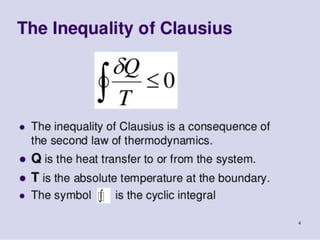
• Entropy is a thermodynamic property; it can be viewed as a
measure of disorder. i.e. More disorganized a system the
higher its entropy. Defined using Clausius inequality
• where Q is the differential heat transfer & T is the absolute
• temperature at the boundary where the heat transfer occurs
0 





revT
Q
th, from Carnot efficiceny 1 1 ,
Q Q
Therefore, 0 for a reversible Carnot cycle 0
T T
H L L L L L
H L H H H H
rev
Q Q Q Q T Q T
T T T Q T Q T


 
      
 
  
 

 
Ñ
Ñ Ñ
• Clausius inequality is valid for all cycles,
reversible and irreversible.
• Consider a reversible Carnot cycle:
• Since entropy is a thermodynamic property, it has
fixed values at a fixed thermodynamic states.
Hence, the change, S, is determined by the initial
and final state. BUT..
• The change is = only for a Reversible Process 





T
Q
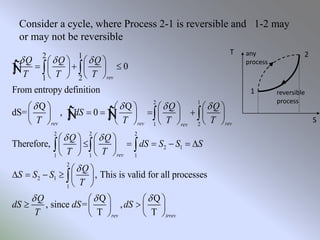
Consider a cycle, where Process 2-1 is reversible and 1-2 may
or may not be reversible
2 1
1 2
2 2 2
2 1
1 1 1
2 1
2 1
1 2
0
From entropy definition
Q Q
dS= , 0
Therefore,
rev
rev rev revrev
rev
Q Q Q
T T T
Q Q
dS
T T T T
Q Q
dS S S S
T T
Q
S S S
T
  
   
 

   
     
   
       
          
       
   
        
   
 
     
 
  
   
  
Ñ
Ñ Ñ
2
1
, This is valid for all processes
Q Q
, since = ,
T Trev irrev
Q
dS dS dS
T
     
    
   

1
2
reversible
process
any
process
T
S
Entropy change for Open System
Processes can be discussed profitably using the entropy concept.
For a reversible process:

B
A
AB
T
Q
SSS

• If the reversible process is isothermal:
STQ
T
Q
Q
T
SSS
B
A
AB  
1
S increases if the system absorbs heat, otherwise S decreases
00   S
T
Q
SSS
B
A
AB

Reversible isothermal processes are isentropic
But in irreversible ones the entropy may change
• If the reversible process is adiabatic:
Increase of Entropy Principle
2
2 1 gen
1
2 2
2 1
1 1
, define entropy generation S
where 0. If the system is isolated and "no" heat transfer
The entropy will still increase or stay
system gen
gen
Q
S S S
T
Q Q
S S S S
T T
S

 
 
     
 
   
        
   


 
the same but never decrease
0, entropy increase principlesystem genS S  
Entropy change
Entropy Transfer
(due to heat transfer)
Entropy Generation
The principle states that for an isolated Or a closed adiabatic Or
System + Surroundings.A process can only take place such that Sgen 0
where Sge = 0 for a reversible process only
And Sge can never be les than zero.
Increase of Entropy Principle
• Entropy, unlike energy, is non-conservative since it is always
increasing.
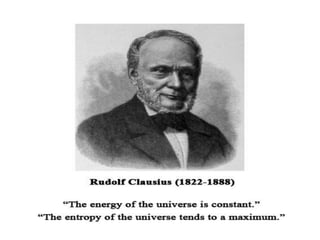
• The entropy of the universe is continuously increasing, in
other words, it is becoming disorganized and is
approaching chaotic.
• The entropy generation is due to the presence of
irreversibilities. Therefore, the higher the entropy generation
the higher the irreversibilities and, accordingly, the lower the
efficiency of a device since a reversible system is the most
efficient system.
• The above is another statement of the second law
Third law of Thermodynamics
• The Third Law of Thermodynamics was first
formulated by German chemist and physicist
Walther Nernst.
• The Third Law states, “The entropy of a
perfect crystal is zero when the temperature of
the crystal is equal to absolute zero (0 K).”
Applications of Third law of
Thermodynamics
• Provides an absolute reference point for the
determination of entropy.
• Explaining the behavior of solids at very low
temprature.
• Measurement of action of chemical forces of the
reacting substances.
• Analysing the chemical and Phase Equilibrium.
Entropy

Entropy

  • 1.
    -:Entropy:- Submitted to:- Mr.Mitesh Gohil By:-Harsh Parmar(PG-18) Akash Parikh(PG-02) Devarsh Jadavanee(PG-22) Moyun Sherasiya(PG-43) Smith Parekh (PG-34) Vivekkumar Boda (FOE-23 Yug TripathiI (FOE-21) Harsh Dalsania(PG-11)
  • 2.
    Entropy:- The Entropyis a thermodynamic property of a working substance and serves as a valuable tool in the second law analysis of engineering devices. • Entropy is afunction of a quantity of heat which shows the possibility of conversoin of that into work. • Entropy is a thermodynamic property; it can be viewed as a measure of disorder i.e. More disorganized a system the higher its entropy.
  • 5.
  • 6.
    • Entropy isa thermodynamic property; it can be viewed as a measure of disorder. i.e. More disorganized a system the higher its entropy. Defined using Clausius inequality • where Q is the differential heat transfer & T is the absolute • temperature at the boundary where the heat transfer occurs 0       revT Q
  • 7.
    th, from Carnotefficiceny 1 1 , Q Q Therefore, 0 for a reversible Carnot cycle 0 T T H L L L L L H L H H H H rev Q Q Q Q T Q T T T T Q T Q T                      Ñ Ñ Ñ • Clausius inequality is valid for all cycles, reversible and irreversible. • Consider a reversible Carnot cycle:
  • 8.
    • Since entropyis a thermodynamic property, it has fixed values at a fixed thermodynamic states. Hence, the change, S, is determined by the initial and final state. BUT.. • The change is = only for a Reversible Process       T Q
  • 10.
    Consider a cycle,where Process 2-1 is reversible and 1-2 may or may not be reversible 2 1 1 2 2 2 2 2 1 1 1 1 2 1 2 1 1 2 0 From entropy definition Q Q dS= , 0 Therefore, rev rev rev revrev rev Q Q Q T T T Q Q dS T T T T Q Q dS S S S T T Q S S S T                                                                                         Ñ Ñ Ñ 2 1 , This is valid for all processes Q Q , since = , T Trev irrev Q dS dS dS T                 1 2 reversible process any process T S
  • 12.
    Entropy change forOpen System
  • 13.
    Processes can bediscussed profitably using the entropy concept. For a reversible process:  B A AB T Q SSS  • If the reversible process is isothermal: STQ T Q Q T SSS B A AB   1 S increases if the system absorbs heat, otherwise S decreases 00   S T Q SSS B A AB  Reversible isothermal processes are isentropic But in irreversible ones the entropy may change • If the reversible process is adiabatic:
  • 14.
    Increase of EntropyPrinciple 2 2 1 gen 1 2 2 2 1 1 1 , define entropy generation S where 0. If the system is isolated and "no" heat transfer The entropy will still increase or stay system gen gen Q S S S T Q Q S S S S T T S                                   the same but never decrease 0, entropy increase principlesystem genS S   Entropy change Entropy Transfer (due to heat transfer) Entropy Generation The principle states that for an isolated Or a closed adiabatic Or System + Surroundings.A process can only take place such that Sgen 0 where Sge = 0 for a reversible process only And Sge can never be les than zero. Increase of Entropy Principle
  • 15.
    • Entropy, unlikeenergy, is non-conservative since it is always increasing. • The entropy of the universe is continuously increasing, in other words, it is becoming disorganized and is approaching chaotic. • The entropy generation is due to the presence of irreversibilities. Therefore, the higher the entropy generation the higher the irreversibilities and, accordingly, the lower the efficiency of a device since a reversible system is the most efficient system. • The above is another statement of the second law
  • 16.
    Third law ofThermodynamics • The Third Law of Thermodynamics was first formulated by German chemist and physicist Walther Nernst. • The Third Law states, “The entropy of a perfect crystal is zero when the temperature of the crystal is equal to absolute zero (0 K).”
  • 17.
    Applications of Thirdlaw of Thermodynamics • Provides an absolute reference point for the determination of entropy. • Explaining the behavior of solids at very low temprature. • Measurement of action of chemical forces of the reacting substances. • Analysing the chemical and Phase Equilibrium.