Thermodynamics
By admin on May 26, 2024
Thermodynamics
Thermodynamics
Outline
1. Introduction
○ Definition of Thermodynamics
○ Importance in Science and Engineering
2. Basic Concepts and Definitions
○ System and Surroundings
○ State and Process
○ Types of Systems
3. Laws of Thermodynamics
○ Zeroth Law of Thermodynamics
○ First Law of Thermodynamics
■ Energy Conservation
■ Work and Heat
○ Second Law of Thermodynamics
■ Entropy
■ Spontaneous Processes
○ Third Law of Thermodynamics
■ Absolute Zero
4. Thermodynamic Properties
○ Intensive and Extensive Properties
○ State Functions
○ Path Functions
5. Thermodynamic Processes
○ Isothermal Process
○ Adiabatic Process
○ Isobaric Process
○ Isochoric Process
6. Thermodynamic Cycles
○ Carnot Cycle
○ Rankine Cycle
○ Refrigeration Cycle
7. Applications of Thermodynamics
○ Power Generation
○ Refrigeration and Air Conditioning
○ Chemical Reactions
○ Biological Systems
8. Heat Transfer Mechanisms
○ Conduction
○ Convection
○ Radiation
9. Phase Transitions
○ Phase Diagrams
○ Critical Point
○ Triple Point
10. Entropy and Disorder
○ Concept of Entropy
○ Entropy in Natural Processes
○ Entropy and Information Theory
11. Energy and Work
○ Different Forms of Energy
○ Work in Thermodynamic Systems
○ Efficiency
12. Thermodynamics in Everyday Life
○ Household Appliances
○ Automobiles
○ Environmental Control
13. Advanced Topics in Thermodynamics
○ Statistical Thermodynamics
○ Non-equilibrium Thermodynamics
○ Quantum Thermodynamics
14. Thermodynamic Equilibrium
○ Types of Equilibrium
○ Conditions for Equilibrium
○ Le Chatelier’s Principle
15. Conclusion
○ Recap of Key Points
○ Future of Thermodynamics
16. FAQs
Introduction to Thermodynamics
Thermodynamics is a fascinating branch of physics that delves into the relationships between
heat, work, and energy. It’s all about understanding how energy is transferred and transformed in
various processes, making it a cornerstone of both science and engineering. But why should you
care about thermodynamics? Simply put, it’s everywhere. From the engine in your car to the
refrigerator in your kitchen, thermodynamics is at play, making our modern conveniences
possible.
Basic Concepts and Definitions
System and Surroundings
In thermodynamics, we often talk about a “system” and its “surroundings.” The system is the
part of the universe we’re interested in, while everything else is the surroundings. Imagine you
have a pot of boiling water on the stove. The water, pot, and steam form the system, and the
kitchen air and stove are the surroundings.
State and Process
The “state” of a system refers to its specific conditions at a given time, described by properties
like temperature, pressure, and volume. A “process” is what happens when the system changes
from one state to another. For example, heating the pot of water changes its state by increasing
its temperature and possibly converting water to steam.
Types of Systems
● Open System: Can exchange both energy and matter with its surroundings.
Example: A boiling pot of water without a lid.
● Closed System: Can exchange energy but not matter with its surroundings.
Example: A sealed pot of boiling water.
● Isolated System: Cannot exchange energy or matter with its surroundings.
Example: An insulated thermos bottle.
Laws of Thermodynamics
Zeroth Law of Thermodynamics
The Zeroth Law states that if two systems are each in thermal equilibrium with a third system,
they are in thermal equilibrium with each other. This is the foundation of temperature
measurement.
First Law of Thermodynamics
The First Law is all about energy conservation. It tells us that energy cannot be created or
destroyed, only transformed from one form to another. Mathematically, it’s expressed as ΔU = Q
– W, where ΔU is the change in internal energy, Q is heat added to the system, and W is work
done by the system.
Second Law of Thermodynamics
The Second Law introduces the concept of entropy, a measure of disorder. It states that in any
spontaneous process, the total entropy of a system and its surroundings always increases. This
law explains why some processes are irreversible, like why you can’t un mix cream from your
coffee.
Third Law of Thermodynamics
The Third Law states that as the temperature of a system approaches absolute zero, the entropy
approaches a minimum value. This principle helps us understand the behavior of substances at
very low temperatures.
Thermodynamic Properties
Intensive and Extensive Properties
● Intensive Properties: Do not depend on the amount of matter present. Examples:
temperature, pressure.
● Extensive Properties: Depend on the amount of matter present. Examples:
volume, mass.
State Functions
State functions are properties that depend only on the current state of the system, not on how it
got there. Examples include internal energy, enthalpy, and entropy.
Path Functions
Path functions depend on the specific path taken to reach one state from another. Examples
include work and heat.
Thermodynamic Processes
Isothermal Process
An isothermal process occurs at constant temperature. Heat exchange with the surroundings
happens in such a way that the system’s temperature remains unchanged.
Adiabatic Process
In an adiabatic process, no heat is transferred to or from the system. The system’s temperature
can change due to work being done on or by the system.
Isobaric Process
An isobaric process happens at constant pressure. An example is the heating of water in an open
vessel.
Isochoric Process
An isochoric process takes place at constant volume. An example is heating a gas in a sealed,
rigid container.
Thermodynamic Cycles
Carnot Cycle
The Carnot cycle is a theoretical cycle that is the most efficient possible. It consists of two
isothermal and two adiabatic processes and sets the benchmark for the efficiency of real engines.
Rankine Cycle
The Rankine cycle is used in power plants to convert heat into work. It involves the vaporization
and condensation of a working fluid, typically water.
Refrigeration Cycle
The refrigeration cycle is used in refrigerators and air conditioners to transfer heat from a cool
space to a warm space, effectively cooling the interior of the device.
Applications of Thermodynamics
Power Generation
Thermodynamics is crucial in designing power plants, where heat energy is converted into
electrical energy. Processes like the Rankine cycle are central to this application.
Refrigeration and Air Conditioning
Thermodynamic principles enable the cooling of spaces and food preservation. Refrigeration
cycles are engineered to achieve efficient heat transfer.
Chemical Reactions
Understanding thermodynamics helps predict whether reactions will occur spontaneously, and
how much energy will be released or absorbed.
Biological Systems
In biological systems, thermodynamics helps explain processes like metabolism and energy
transfer within cells.
Heat Transfer Mechanisms
Conduction
Conduction is the transfer of heat through a material without the movement of the material itself.
Think of a metal spoon getting hot from one end to the other when placed in a hot drink.
Convection
Convection involves the movement of fluid (liquid or gas) to transfer heat. This is how hot air
rises and circulates in a room.
Radiation
Radiation is the transfer of heat through electromagnetic waves. The warmth you feel from the
sun on your face is due to thermal radiation.
Phase Transitions
Diagrams
Phase diagrams map the state of a substance (solid, liquid, gas) under different conditions of
temperature and pressure.
Critical Point
The critical point is where the properties of the liquid and gas phases become indistinguishable.
Beyond this point, the substance forms a supercritical fluid.
Triple Point
The triple point is the unique set of conditions where all three phases (solid, liquid, gas) coexist
in equilibrium.
Entropy and Disorder
Concept of Entropy
Entropy is a measure of disorder or randomness in a system. Higher entropy means greater
disorder.
Entropy in Natural Processes
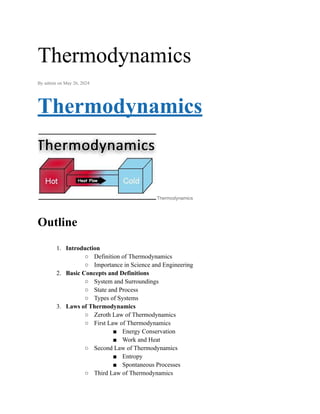
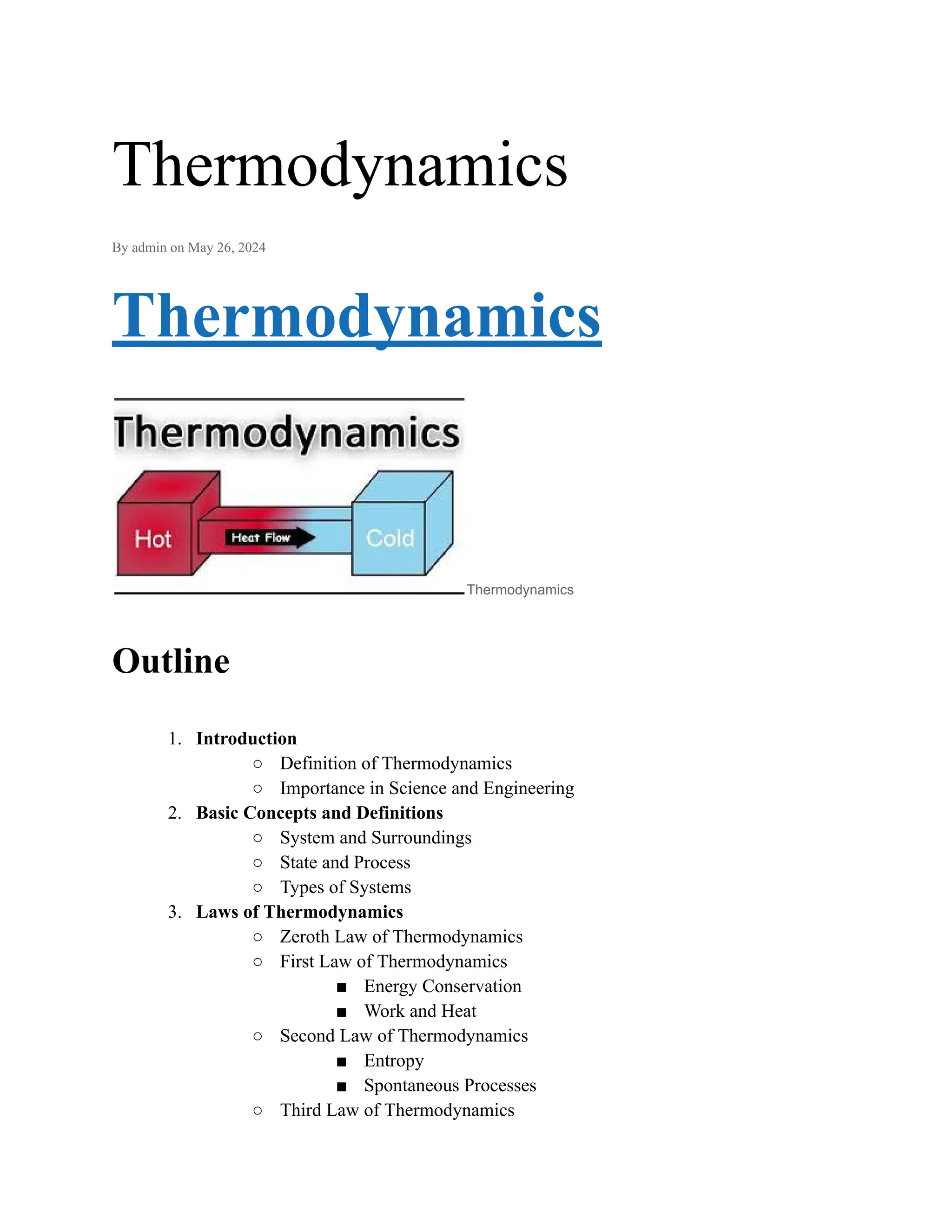
Natural processes tend to increase entropy. For example, heat naturally flows from hot to cold
objects, increasing overall entropy.
Entropy and Information Theory
In information theory, entropy quantifies the amount of uncertainty or information content. This
concept parallels thermodynamic entropy.
Energy and Work
Different Forms of Energy
Energy can take many forms, including kinetic, potential, thermal, chemical, and nuclear energy.
Thermodynamics focuses on how these forms convert into one another.
Work in Thermodynamic Systems
Work is energy transferred by a system to its surroundings. In thermodynamics, work is often
done by gases expanding or contracting.
Efficiency
Efficiency measures how well a system converts energy into work. No process is 100% efficient
due to inevitable energy losses, primarily as heat.
Thermodynamics in Everyday Life
Household Appliances
From refrigerators to microwaves, household appliances rely on thermodynamic principles to
function efficiently.
Automobiles
Car engines convert chemical energy from fuel into mechanical work, with thermodynamic
cycles driving this process.
Environmental Control
Thermodynamics plays a role in heating and cooling buildings, ensuring comfortable living and
working conditions.
Advanced Topics in Thermodynamics
Statistical Thermodynamics
This field connects microscopic properties of molecules to macroscopic thermodynamic
quantities, providing a deeper understanding of thermodynamic behavior.
Non-equilibrium Thermodynamics
Non-equilibrium thermodynamics studies systems not in equilibrium, where properties change
with time.
Quantum Thermodynamics
This emerging field examines how quantum effects influence thermodynamic processes, crucial
for developing new technologies like quantum computers.
Thermodynamic Equilibrium
Types of Equilibrium
● Thermal Equilibrium: No temperature gradient within the system.
● Mechanical Equilibrium: No pressure gradient within the system.
● Chemical Equilibrium: No chemical potential gradient within the system.
Conditions for Equilibrium
For a system to be in equilibrium, it must be in thermal, mechanical, and chemical equilibrium
simultaneously.
Le Chatelier’s Principle
This principle states that if a system in equilibrium is disturbed, it will adjust to minimize the
disturbance, shifting the equilibrium position.
Conclusion
Thermodynamics is an essential field that explains how energy is transferred and transformed in
various processes, from engines to biological systems. Understanding its principles helps us
design more efficient systems and solve practical problems in everyday life. As technology
advances, the role of thermodynamics continues to evolve, offering new insights and
applications.
FAQs
1. What is the importance of thermodynamics? Thermodynamics is crucial for
understanding energy transfer and transformation, which is essential in fields like
engineering, chemistry, biology, and environmental science.
2. How does the First Law of Thermodynamics apply in real life? The First Law,
or energy conservation, is seen in everything from powering engines to
calculating the energy needs of our homes.
3. What is entropy? Entropy is a measure of disorder or randomness in a system,
reflecting the number of ways a system can be arranged.
4. How does refrigeration work? Refrigeration relies on thermodynamic cycles to
transfer heat from a cool space to a warmer space, keeping the interior of the
refrigerator cold.
5. What are some everyday examples of thermodynamics? Everyday examples
include using a car engine, boiling water, using a refrigerator, and even the natural
heat exchange in our bodies.

thermodynamics, equilibrium, energy, Work

  • 1.
    Thermodynamics By admin onMay 26, 2024 Thermodynamics Thermodynamics Outline 1. Introduction ○ Definition of Thermodynamics ○ Importance in Science and Engineering 2. Basic Concepts and Definitions ○ System and Surroundings ○ State and Process ○ Types of Systems 3. Laws of Thermodynamics ○ Zeroth Law of Thermodynamics ○ First Law of Thermodynamics ■ Energy Conservation ■ Work and Heat ○ Second Law of Thermodynamics ■ Entropy ■ Spontaneous Processes ○ Third Law of Thermodynamics
  • 2.
    ■ Absolute Zero 4.Thermodynamic Properties ○ Intensive and Extensive Properties ○ State Functions ○ Path Functions 5. Thermodynamic Processes ○ Isothermal Process ○ Adiabatic Process ○ Isobaric Process ○ Isochoric Process 6. Thermodynamic Cycles ○ Carnot Cycle ○ Rankine Cycle ○ Refrigeration Cycle 7. Applications of Thermodynamics ○ Power Generation ○ Refrigeration and Air Conditioning ○ Chemical Reactions ○ Biological Systems 8. Heat Transfer Mechanisms ○ Conduction ○ Convection ○ Radiation 9. Phase Transitions ○ Phase Diagrams ○ Critical Point ○ Triple Point 10. Entropy and Disorder ○ Concept of Entropy ○ Entropy in Natural Processes ○ Entropy and Information Theory 11. Energy and Work ○ Different Forms of Energy ○ Work in Thermodynamic Systems ○ Efficiency 12. Thermodynamics in Everyday Life ○ Household Appliances ○ Automobiles ○ Environmental Control 13. Advanced Topics in Thermodynamics
  • 3.
    ○ Statistical Thermodynamics ○Non-equilibrium Thermodynamics ○ Quantum Thermodynamics 14. Thermodynamic Equilibrium ○ Types of Equilibrium ○ Conditions for Equilibrium ○ Le Chatelier’s Principle 15. Conclusion ○ Recap of Key Points ○ Future of Thermodynamics 16. FAQs Introduction to Thermodynamics Thermodynamics is a fascinating branch of physics that delves into the relationships between heat, work, and energy. It’s all about understanding how energy is transferred and transformed in various processes, making it a cornerstone of both science and engineering. But why should you care about thermodynamics? Simply put, it’s everywhere. From the engine in your car to the refrigerator in your kitchen, thermodynamics is at play, making our modern conveniences possible. Basic Concepts and Definitions System and Surroundings In thermodynamics, we often talk about a “system” and its “surroundings.” The system is the part of the universe we’re interested in, while everything else is the surroundings. Imagine you have a pot of boiling water on the stove. The water, pot, and steam form the system, and the kitchen air and stove are the surroundings. State and Process The “state” of a system refers to its specific conditions at a given time, described by properties like temperature, pressure, and volume. A “process” is what happens when the system changes
  • 4.
    from one stateto another. For example, heating the pot of water changes its state by increasing its temperature and possibly converting water to steam. Types of Systems ● Open System: Can exchange both energy and matter with its surroundings. Example: A boiling pot of water without a lid. ● Closed System: Can exchange energy but not matter with its surroundings. Example: A sealed pot of boiling water. ● Isolated System: Cannot exchange energy or matter with its surroundings. Example: An insulated thermos bottle. Laws of Thermodynamics Zeroth Law of Thermodynamics The Zeroth Law states that if two systems are each in thermal equilibrium with a third system, they are in thermal equilibrium with each other. This is the foundation of temperature measurement. First Law of Thermodynamics The First Law is all about energy conservation. It tells us that energy cannot be created or destroyed, only transformed from one form to another. Mathematically, it’s expressed as ΔU = Q – W, where ΔU is the change in internal energy, Q is heat added to the system, and W is work done by the system. Second Law of Thermodynamics The Second Law introduces the concept of entropy, a measure of disorder. It states that in any spontaneous process, the total entropy of a system and its surroundings always increases. This law explains why some processes are irreversible, like why you can’t un mix cream from your coffee.
  • 5.
    Third Law ofThermodynamics The Third Law states that as the temperature of a system approaches absolute zero, the entropy approaches a minimum value. This principle helps us understand the behavior of substances at very low temperatures. Thermodynamic Properties Intensive and Extensive Properties ● Intensive Properties: Do not depend on the amount of matter present. Examples: temperature, pressure. ● Extensive Properties: Depend on the amount of matter present. Examples: volume, mass. State Functions State functions are properties that depend only on the current state of the system, not on how it got there. Examples include internal energy, enthalpy, and entropy. Path Functions Path functions depend on the specific path taken to reach one state from another. Examples include work and heat. Thermodynamic Processes Isothermal Process An isothermal process occurs at constant temperature. Heat exchange with the surroundings happens in such a way that the system’s temperature remains unchanged.
  • 6.
    Adiabatic Process In anadiabatic process, no heat is transferred to or from the system. The system’s temperature can change due to work being done on or by the system. Isobaric Process An isobaric process happens at constant pressure. An example is the heating of water in an open vessel. Isochoric Process An isochoric process takes place at constant volume. An example is heating a gas in a sealed, rigid container. Thermodynamic Cycles Carnot Cycle The Carnot cycle is a theoretical cycle that is the most efficient possible. It consists of two isothermal and two adiabatic processes and sets the benchmark for the efficiency of real engines. Rankine Cycle The Rankine cycle is used in power plants to convert heat into work. It involves the vaporization and condensation of a working fluid, typically water. Refrigeration Cycle
  • 7.
    The refrigeration cycleis used in refrigerators and air conditioners to transfer heat from a cool space to a warm space, effectively cooling the interior of the device. Applications of Thermodynamics Power Generation Thermodynamics is crucial in designing power plants, where heat energy is converted into electrical energy. Processes like the Rankine cycle are central to this application. Refrigeration and Air Conditioning Thermodynamic principles enable the cooling of spaces and food preservation. Refrigeration cycles are engineered to achieve efficient heat transfer. Chemical Reactions Understanding thermodynamics helps predict whether reactions will occur spontaneously, and how much energy will be released or absorbed. Biological Systems In biological systems, thermodynamics helps explain processes like metabolism and energy transfer within cells. Heat Transfer Mechanisms Conduction Conduction is the transfer of heat through a material without the movement of the material itself. Think of a metal spoon getting hot from one end to the other when placed in a hot drink.
  • 8.
    Convection Convection involves themovement of fluid (liquid or gas) to transfer heat. This is how hot air rises and circulates in a room. Radiation Radiation is the transfer of heat through electromagnetic waves. The warmth you feel from the sun on your face is due to thermal radiation. Phase Transitions Diagrams Phase diagrams map the state of a substance (solid, liquid, gas) under different conditions of temperature and pressure. Critical Point The critical point is where the properties of the liquid and gas phases become indistinguishable. Beyond this point, the substance forms a supercritical fluid. Triple Point The triple point is the unique set of conditions where all three phases (solid, liquid, gas) coexist in equilibrium. Entropy and Disorder Concept of Entropy
  • 9.
    Entropy is ameasure of disorder or randomness in a system. Higher entropy means greater disorder. Entropy in Natural Processes Natural processes tend to increase entropy. For example, heat naturally flows from hot to cold objects, increasing overall entropy. Entropy and Information Theory In information theory, entropy quantifies the amount of uncertainty or information content. This concept parallels thermodynamic entropy. Energy and Work Different Forms of Energy Energy can take many forms, including kinetic, potential, thermal, chemical, and nuclear energy. Thermodynamics focuses on how these forms convert into one another. Work in Thermodynamic Systems Work is energy transferred by a system to its surroundings. In thermodynamics, work is often done by gases expanding or contracting. Efficiency Efficiency measures how well a system converts energy into work. No process is 100% efficient due to inevitable energy losses, primarily as heat.
  • 10.
    Thermodynamics in EverydayLife Household Appliances From refrigerators to microwaves, household appliances rely on thermodynamic principles to function efficiently. Automobiles Car engines convert chemical energy from fuel into mechanical work, with thermodynamic cycles driving this process. Environmental Control Thermodynamics plays a role in heating and cooling buildings, ensuring comfortable living and working conditions. Advanced Topics in Thermodynamics Statistical Thermodynamics This field connects microscopic properties of molecules to macroscopic thermodynamic quantities, providing a deeper understanding of thermodynamic behavior. Non-equilibrium Thermodynamics Non-equilibrium thermodynamics studies systems not in equilibrium, where properties change with time. Quantum Thermodynamics
  • 11.
    This emerging fieldexamines how quantum effects influence thermodynamic processes, crucial for developing new technologies like quantum computers. Thermodynamic Equilibrium Types of Equilibrium ● Thermal Equilibrium: No temperature gradient within the system. ● Mechanical Equilibrium: No pressure gradient within the system. ● Chemical Equilibrium: No chemical potential gradient within the system. Conditions for Equilibrium For a system to be in equilibrium, it must be in thermal, mechanical, and chemical equilibrium simultaneously. Le Chatelier’s Principle This principle states that if a system in equilibrium is disturbed, it will adjust to minimize the disturbance, shifting the equilibrium position. Conclusion Thermodynamics is an essential field that explains how energy is transferred and transformed in various processes, from engines to biological systems. Understanding its principles helps us design more efficient systems and solve practical problems in everyday life. As technology advances, the role of thermodynamics continues to evolve, offering new insights and applications. FAQs
  • 12.
    1. What isthe importance of thermodynamics? Thermodynamics is crucial for understanding energy transfer and transformation, which is essential in fields like engineering, chemistry, biology, and environmental science. 2. How does the First Law of Thermodynamics apply in real life? The First Law, or energy conservation, is seen in everything from powering engines to calculating the energy needs of our homes. 3. What is entropy? Entropy is a measure of disorder or randomness in a system, reflecting the number of ways a system can be arranged. 4. How does refrigeration work? Refrigeration relies on thermodynamic cycles to transfer heat from a cool space to a warmer space, keeping the interior of the refrigerator cold. 5. What are some everyday examples of thermodynamics? Everyday examples include using a car engine, boiling water, using a refrigerator, and even the natural heat exchange in our bodies.