Types of Network and
Transmission Media
Mr. Roshan Bhattarai
Kathmandu, Nepal
Types of Network (Area Coverage)
1. LAN (Local Area Network)
• Designed to connect personal computers and other
digital devices within 500 meter radius
• Connects few computers in a building/several buildings in
close proximity
• LAN can connect to long distance networks through
Internet
• Lowest network setup cost
• Highest bandwidth of data transfer, usually supports
data transfer rates of 100 Mbps to 1 Gbps
• Eg: Ethernet, wifi
2. MAN (Metropolitan Area Network)
• Network that spans a metropolitan area, usually a city
(within 50 km radius)
• Geographic scope falls between a LAN and a WAN
• Moderate network setup cost
• Moderate bandwidth of data transfer, usually supports
data transfer rates 50 to 100 Mbps
• Eg: Cable TV network, Traffic light monitoring system etc
3. WAN (Wide Area Network)
• Network spans broad geographical distances- entire
region, states, country or the entire world
• Computers connect through public networks, such as
telephone systems, leased lines or satellites
• Network is more vulnerable to threats
• Lowest bandwidth of data transfer, usually supports 10
to 50 Mbps
• Highest network setup cost
• Eg: The most universal and powerful WAN in the
Internet, Telecommunication network etc
Transmission Media
• Transmission media is a pathway that carries
the data from sender to receiver device.
• We use different types of cables or waves to transmit
data
• Data is transmitted normally through electrical or
electromagnetic signals
• Electrical signal is in the form of current
• Electromagnetic signal is series of electromagnetic
energy pulses at various frequencies
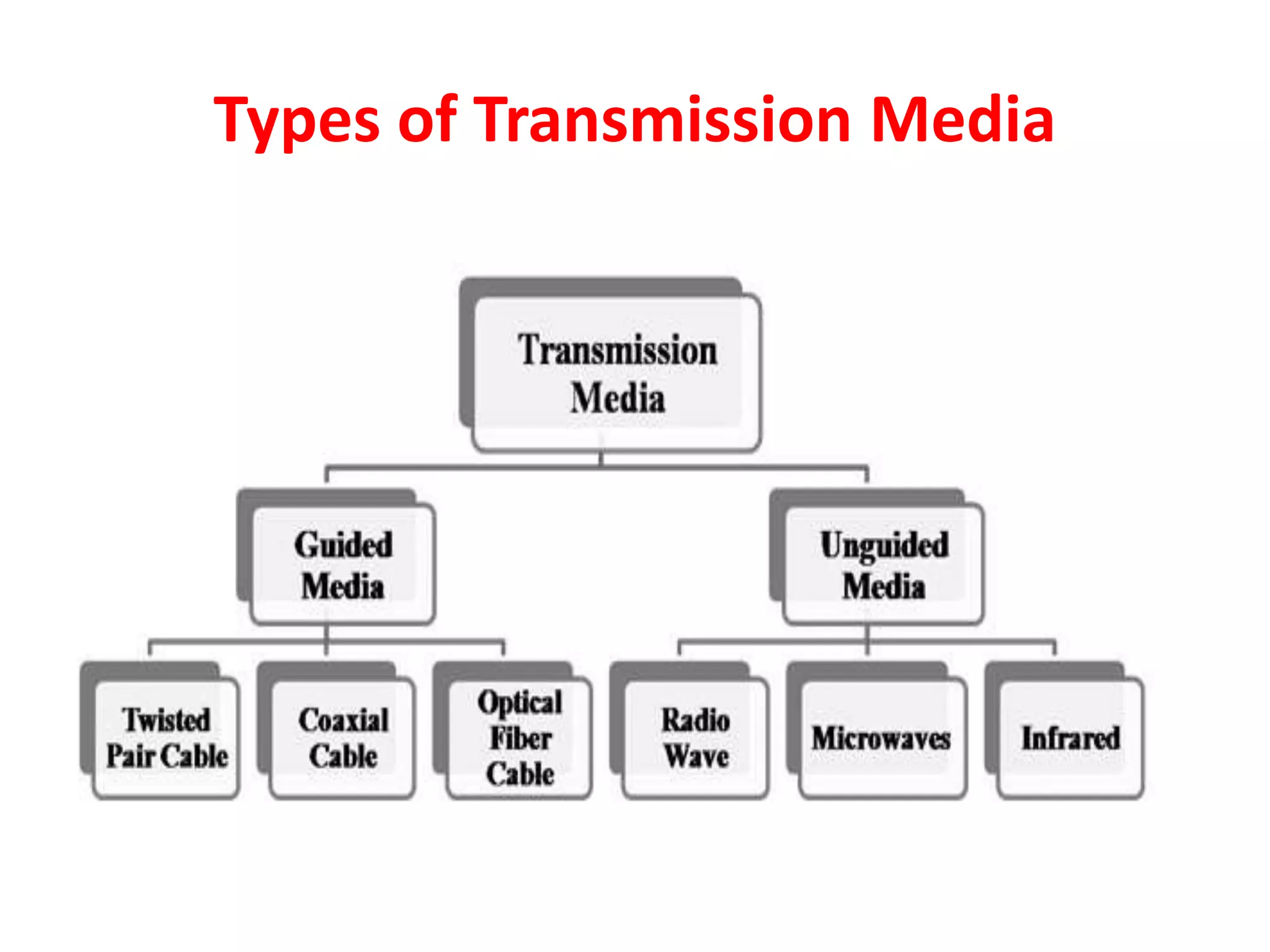
Types of Transmission Media
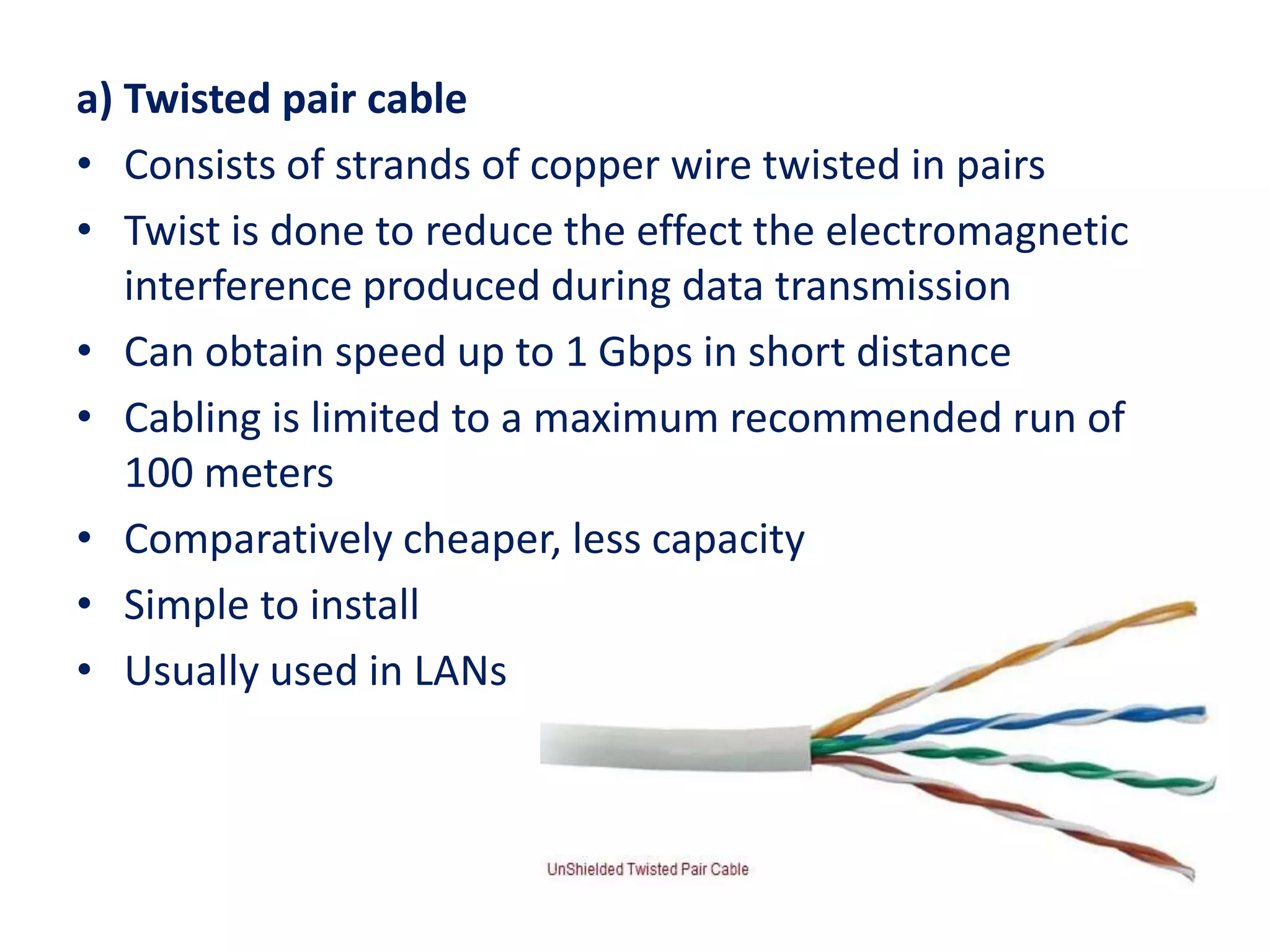
a) Twisted pair cable
• Consists of strands of copper wire twisted in pairs
• Twist is done to reduce the effect the electromagnetic
interference produced during data transmission
• Can obtain speed up to 1 Gbps in short distance
• Cabling is limited to a maximum recommended run of
100 meters
• Comparatively cheaper, less capacity
• Simple to install
• Usually used in LANs
b) Coaxial Cable
• Consists of thickly insulated copper wire
• Can transmit larger volume of data than TPC
• Can obtain speed up to 1 Gbps
• Comparatively expensive and higher quality than TPC
• Simple to install
• Usually used in LANs and MANs
c) Fiber-Optics (Optical fiber)
• Consists of strands of hair thin plastic/glass filaments
• Data are transmitted into pulses of light by a laser device
(Total Internal Reflection technology is used)
• Very high data transfer speed compared to other cables
• Expensive and better quality transfer
• Can obtain speed up to several trillions bits per second
• installation & maintenance is difficult
• Used in MANs and WANs
a) Microwave (Terrestrial and Satellite)
• Electromagnetic waves ranging in frequencies between 1
to 300 GHz are normally called micro waves
• Microwaves are considered to be very short radio waves
(high frequency and high-energy waves)
• Transmits high frequency signals through the atmosphere
• Widely used for high volume, long distance
communication
• Microwave signals follow straight line and do not bend
with curvature of the earth
• Transmissions (Relay) stations be positioned about 30
miles apart for long distance (terrestrial microwave)
• For very long and geographically dispersed transmission,
Communication satellites are used as relay stations
• Satellites are in the geostationary orbit which is 22000
miles above the earth
• Satellites operates as repeaters with receiving antenna,
transponder and transmitting of signals
b) Radio Waves
• Electromagnetic waves ranging in frequencies between 3
KHz and 1 GHz are normally called radio waves
• Radio waves are the lowest-energy, lowest-frequency
and longest-wavelength electromagnetic waves.
• Radio waves are Omni-directional
• When an antenna transmits radio waves, they are
propagated in all directions, sending and receiving
antennas do not have to be aligned.
• A sending antenna send waves that can be received by
any receiving antenna.
• Radio waves, particularly with those of low and medium
frequencies, can penetrate walls.
• The Omni-directional characteristics of radio waves make
them useful for multicasting in which there is one sender
but many receivers.
• AM and FM radio, television, cordless phones etc are
examples of multicasting.
c) Infrared Waves
• Infrared waves are used in extremely small distance
communication as they cannot go through obstacles
• The range of frequency of these waves is 300GHz to
400THz.
• These waves are used in TV remotes, keyboards, wireless
mouse, printer, etc.
• When we use infrared remote control, we do not
interfere with the use of the remote by our neighbours.
• useless for long-range communication.
• cannot use infrared waves outside a building because the
sun's rays contain infrared waves that can interfere with
the communication.

Types of Network and Transmission Media

  • 1.
    Types of Networkand Transmission Media Mr. Roshan Bhattarai Kathmandu, Nepal
  • 2.
    Types of Network(Area Coverage) 1. LAN (Local Area Network) • Designed to connect personal computers and other digital devices within 500 meter radius • Connects few computers in a building/several buildings in close proximity • LAN can connect to long distance networks through Internet • Lowest network setup cost • Highest bandwidth of data transfer, usually supports data transfer rates of 100 Mbps to 1 Gbps • Eg: Ethernet, wifi
  • 3.
    2. MAN (MetropolitanArea Network) • Network that spans a metropolitan area, usually a city (within 50 km radius) • Geographic scope falls between a LAN and a WAN • Moderate network setup cost • Moderate bandwidth of data transfer, usually supports data transfer rates 50 to 100 Mbps • Eg: Cable TV network, Traffic light monitoring system etc
  • 4.
    3. WAN (WideArea Network) • Network spans broad geographical distances- entire region, states, country or the entire world • Computers connect through public networks, such as telephone systems, leased lines or satellites • Network is more vulnerable to threats • Lowest bandwidth of data transfer, usually supports 10 to 50 Mbps • Highest network setup cost • Eg: The most universal and powerful WAN in the Internet, Telecommunication network etc
  • 5.
    Transmission Media • Transmissionmedia is a pathway that carries the data from sender to receiver device. • We use different types of cables or waves to transmit data • Data is transmitted normally through electrical or electromagnetic signals • Electrical signal is in the form of current • Electromagnetic signal is series of electromagnetic energy pulses at various frequencies
  • 6.
  • 7.
    a) Twisted paircable • Consists of strands of copper wire twisted in pairs • Twist is done to reduce the effect the electromagnetic interference produced during data transmission • Can obtain speed up to 1 Gbps in short distance • Cabling is limited to a maximum recommended run of 100 meters • Comparatively cheaper, less capacity • Simple to install • Usually used in LANs
  • 8.
    b) Coaxial Cable •Consists of thickly insulated copper wire • Can transmit larger volume of data than TPC • Can obtain speed up to 1 Gbps • Comparatively expensive and higher quality than TPC • Simple to install • Usually used in LANs and MANs
  • 9.
    c) Fiber-Optics (Opticalfiber) • Consists of strands of hair thin plastic/glass filaments • Data are transmitted into pulses of light by a laser device (Total Internal Reflection technology is used) • Very high data transfer speed compared to other cables • Expensive and better quality transfer • Can obtain speed up to several trillions bits per second • installation & maintenance is difficult • Used in MANs and WANs
  • 10.
    a) Microwave (Terrestrialand Satellite) • Electromagnetic waves ranging in frequencies between 1 to 300 GHz are normally called micro waves • Microwaves are considered to be very short radio waves (high frequency and high-energy waves) • Transmits high frequency signals through the atmosphere • Widely used for high volume, long distance communication • Microwave signals follow straight line and do not bend with curvature of the earth • Transmissions (Relay) stations be positioned about 30 miles apart for long distance (terrestrial microwave) • For very long and geographically dispersed transmission, Communication satellites are used as relay stations
  • 11.
    • Satellites arein the geostationary orbit which is 22000 miles above the earth • Satellites operates as repeaters with receiving antenna, transponder and transmitting of signals
  • 12.
    b) Radio Waves •Electromagnetic waves ranging in frequencies between 3 KHz and 1 GHz are normally called radio waves • Radio waves are the lowest-energy, lowest-frequency and longest-wavelength electromagnetic waves. • Radio waves are Omni-directional • When an antenna transmits radio waves, they are propagated in all directions, sending and receiving antennas do not have to be aligned. • A sending antenna send waves that can be received by any receiving antenna. • Radio waves, particularly with those of low and medium frequencies, can penetrate walls.
  • 13.
    • The Omni-directionalcharacteristics of radio waves make them useful for multicasting in which there is one sender but many receivers. • AM and FM radio, television, cordless phones etc are examples of multicasting.
  • 14.
    c) Infrared Waves •Infrared waves are used in extremely small distance communication as they cannot go through obstacles • The range of frequency of these waves is 300GHz to 400THz. • These waves are used in TV remotes, keyboards, wireless mouse, printer, etc. • When we use infrared remote control, we do not interfere with the use of the remote by our neighbours. • useless for long-range communication. • cannot use infrared waves outside a building because the sun's rays contain infrared waves that can interfere with the communication.