Filmon Habtemichael
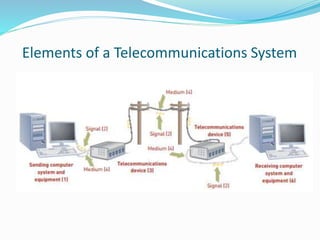
Elements of a Telecommunications System
Synchronous And Asynchronous Communications
 Synchronous communications: A form of
communications where the receiver gets the message
instantaneously, when it is sent
 Asynchronous communications: A form of
communications where the receiver gets the message
after some delay—sometimes hours or days after the
message is sent
Basic Telecommunications Channel Characteristics
 Telecommunications channels can be classified as simplex, half-
duplex, or full-duplex
 Simplex channel: A communications channel that can
transmit data in only one direction.
 E.g. Doorbells and the radio
 Half-duplex channel: A communications channel that can
transmit data in either direction, but not simultaneously.
 For example, A can begin transmitting to B over a half-duplex
line, but B must wait until A is finished to transmit back to A.
 Personal computers are usually connected to a remote
computer over a half-duplex channel.
cont
Full-duplex channel: A communications
channel that permits data transmission in
both directions at the same time, so a
full-duplex channel is like two simplex
channels
Two standard phone lines are required
for full-duplex transmission
Channel Bandwidth
 Channel bandwidth: The rate at which data is exchanged
over a telecommunications channel, usually measured in
bits per second (bps).
 Broadband Communications: A telecommunications
system in which a very high rate of data exchange is
possible
 For example, for wireless networks, broadband
lets you send and receive data at a rate greater than 1.5 Mbps
 Shannon’s Fundamental Law of Information Theory- The
information carrying capacity of a channel is directly
proportional to its bandwidth
Telecommunications Media
 Transmission media can be divided into two broad
categories:
 Guided transmission media, in which
telecommunications signals are guided along a solid
medium, and
 Wireless, in which the telecommunications signal is
broadcast over airwaves as a form of electromagnetic
radiation.
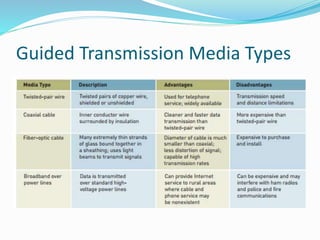
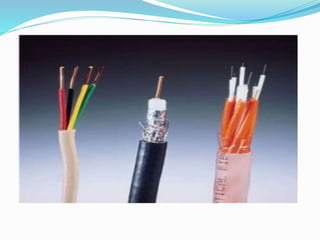
Guided Transmission Media Types
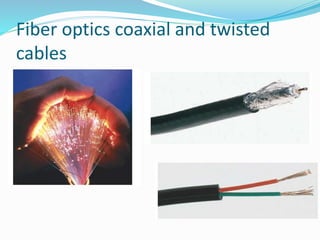
Fiber optics coaxial and twisted
cables
Wireless Communications Options
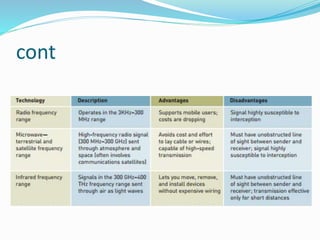
 Wireless transmission involves the broadcast of
communications in one of three frequency ranges:
 radio,
 microwave,
 infrared frequencies
cont
Short Range Wireless Options
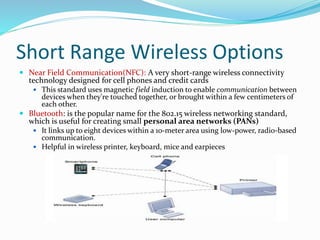
 Near Field Communication(NFC): A very short-range wireless connectivity
technology designed for cell phones and credit cards
 This standard uses magnetic field induction to enable communication between
devices when they're touched together, or brought within a few centimeters of
each other.
 Bluetooth: is the popular name for the 802.15 wireless networking standard,
which is useful for creating small personal area networks (PANs)
 It links up to eight devices within a 10-meter area using low-power, radio-based
communication.
 Helpful in wireless printer, keyboard, mice and earpieces
cont
 Ultra wideband (UWB): A wireless communications
technology that transmits large amounts of digital
data over short distances of up to 30 feet using a wide
spectrum of frequency bands and very low power.
 Infrared transmission: A wireless communications
technology that operates at a frequency of 300 GHz
and above that requires line-of-sight transmission and
operates over short distances— such as a few meters.
cont
 ZigBee: is a form of wireless communications
frequently used in security systems and heating
and cooling control systems.
 ZigBee is a relatively low-cost technology and requires
little power, which allows longer life with smaller
batteries.
Medium Range Wireless Options
 Wi-Fi is a wireless telecommunications technology
brand owned by the Wi-Fi Alliance, which consists of
about 300 technology companies including AT&T,
Dell, Microsoft, Nokia, and Qualcomm.
 The area covered by one or more interconnected
wireless access points is called a “hot spot.”
Wide Area Wireless Network Options
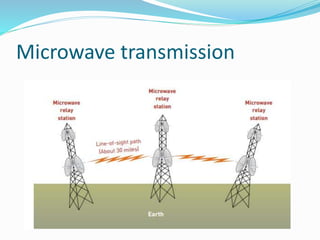
 Microwave Transmission: Microwave is a high-
frequency (300 MHz–300 GHz) signal sent through
the air .
 Terrestrial (Earth-bound) microwaves are transmitted
by line-of-sight devices, so that the line of sight
between the transmitter and receiver must be
unobstructed.
Microwave transmission
Satellite Transmission
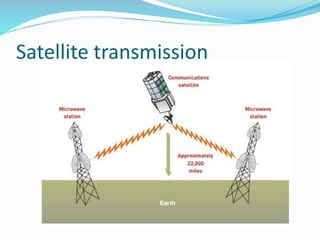
 Satellite Transmission :Communications satellites are relay
stations that receive signals from one Earth station and
rebroadcast them to another
 A geostationary satellite orbits the Earth directly over the
equator so that it appears stationary.
 Low earth orbit (LEO) satellite system employs many satellites,
each in an orbit at an altitude of less than 3000 km.
 A very small aperture terminal (VSAT) is a satellite ground
station with a dish antenna smaller than 3 meters in diameter.
 News organizations employ VSAT dishes that run on battery power
to quickly establish communications and transmit news stories
from remote locations.
 Many people are also investing in VSAT technology in their homes
to receive TV and send and receive computer communications.
Satellite transmission
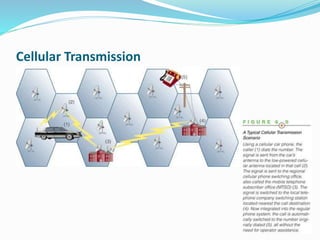
Cellular Transmission
3G Wireless Communications
 Established in 1999 by The International
Telecommunications Union (ITU).
 Provides for faster transmission speeds in the range of
2–4 Mbps
 3G wireless communication is useful for business
travelers, people on the go, and people who need to get
or stay connected.
 Originally, 3G was supposed to be a single, unified,
worldwide standard, but the 3G standards effort split
into several different standards.
Cont 3G
 One standard is the Universal Mobile Telephone
System (UMTS), which is the preferred solution for
European countries that use Global System for Mobile
(GSM) communications.
 GSM is the de facto wireless telephone standard in
Europe with more than 120 million users worldwide in
120 countries.
 GSM’s strength is its international roaming capability
Cont 3G
 Another 3G-based standard is Code-Division Multiple
Access (CDMA), which is used in Australia, Canada,
China, India, Israel, Mexico, South Korea, the United
States, and Venezuela.
 CDMA was developed by the military during WW II.
 It transmits over several frequencies, occupies the entire
spectrum, and randomly assigns users to a range
of frequencies over time, making it more efficient than
GSM
4G Wireless Communications
 4G stands for fourth-generation broadband mobile
wireless.
 Also called Long Term Evolution (LTE) networks
 Delivers more advanced versions of enhanced
multimedia, smooth streaming video, universal access,
portability across all types of devices, and eventually,
worldwide roaming capability.
 4G have much higher speeds: 100 megabits/second
download, and 50 megabits upload speed
.
Worldwide Interoperability for
Microwave Access (WiMAX)
 Worldwide Interoperability for Microwave Access
(WiMAX): The common name for a set of IEEE 802.16
wireless metropolitan area network standards that
support different types of communications access
 WiMAX operates like Wi-Fi, only over greater
distances(above 70 kms) and at faster transmission
speeds(7 0 Mbps)
 WiMAX is an attractive option for developing
countries with little or no wireless telephone
infrastructure
Future Wireless Communications
Development
 Shift from Analogue signal to Digital
 This shift to digital broadcasting might have a long-
term benefit to the public as it frees up portions of the
700 MHz frequency band so it can be reallocated for
other purposes.
 At the 700 MHz frequency, signals travel about four
times farther than the signals at the higher frequencies
used by Wi-Fi and WiMAX.
 Also, the lower frequency penetrates walls more
effectively.
Telecommunications Hardware
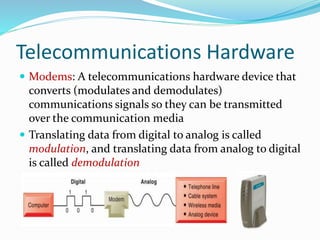
 Modems: A telecommunications hardware device that
converts (modulates and demodulates)
communications signals so they can be transmitted
over the communication media
 Translating data from digital to analog is called
modulation, and translating data from analog to digital
is called demodulation
 Switch: A telecommunications device that uses the physical
device address in each incoming message on the network
to determine to which output port it should forward the
message to reach another device on the same network.
BRIDGE: A telecommunications device that connects one
LAN to another LAN using the same telecommunications
protocol.
Router: A telecommunications device that forwards data
packets across two or more distinct networks toward their
destinations, through a process known as routing.
Gateway: A telecommunications device that serves as an
entrance to another network.
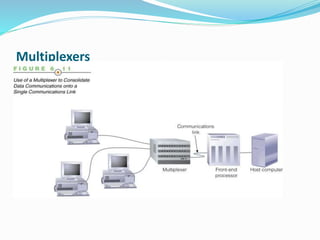
Multiplexers
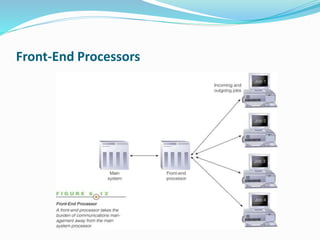
Front-End Processors
Virtual Private Network (VPN)
 A private network that uses a public network (usually
the Internet) to connect multiple remote locations
 A VPN provides network connectivity over a
potentially long physical distance and thus can be
considered a form of wide area network.
 VPNs support secure, encrypted connections between
a company’s private network and remote users through
a third-party service provider.
Digital Subscriber Line (DSL)
Service
 A telecommunications service that delivers high-speed Internet
access to homes and small businesses over
the existing phone lines of the local telephone network
 Most home and small business users are connected to an
asymmetric DSL (ADSL) line designed to provide a connection
speed from the Internet to the user (download speed) that is
three to four times faster than the connection from the user
back to the Internet (upload speed).
 ADSL does not require an additional phone line and
yet provides “always-on” Internet access.
 A drawback of ADSL is that the farther the subscriber is from the
local telephone office, the poorer the signal quality and the
slower the transmission speed.
cont
 Symmetric DSL (SDSL) is used mainly by small
businesses and does not allow you to use the phone at
the same time, but the speed of receiving and sending
data is the same.
Voice over Internet Protocol (VoIP)
Services
 A collection of technologies and communications
protocols that enables your voice to be converted
into packets of data that can be sent over a data
network such as the Internet, a WAN or LAN
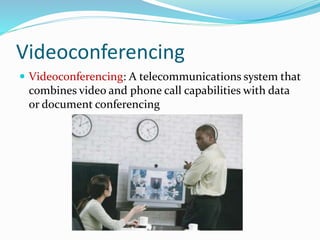
Videoconferencing
 Videoconferencing: A telecommunications system that
combines video and phone call capabilities with data
or document conferencing
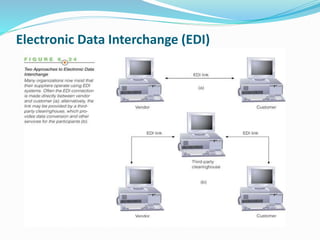
Electronic Data Interchange (EDI)
Global Positioning System
Applications
 The Global Positioning System (GPS) is a satellite-based
navigation system made up of a network of 31(6 satellites
added very recently) satellites placed into orbit by the U.S.
Department of Defense.
 GPS was originally intended for military applications, but
in the 1980s, the government made the system available for
civilian use.
 The satellites transmit microwave signals so a GPS receiver
can precisely determine their location, speed, direction,
and time.
 A GPS receiver must have a clear line of sight to the satellite
to operate, so dense tree cover and buildings can keep it
from operating.
Mis chapter 7b

Mis chapter 7b

  • 1.
  • 2.
    Elements of aTelecommunications System
  • 3.
    Synchronous And AsynchronousCommunications  Synchronous communications: A form of communications where the receiver gets the message instantaneously, when it is sent  Asynchronous communications: A form of communications where the receiver gets the message after some delay—sometimes hours or days after the message is sent
  • 4.
    Basic Telecommunications ChannelCharacteristics  Telecommunications channels can be classified as simplex, half- duplex, or full-duplex  Simplex channel: A communications channel that can transmit data in only one direction.  E.g. Doorbells and the radio  Half-duplex channel: A communications channel that can transmit data in either direction, but not simultaneously.  For example, A can begin transmitting to B over a half-duplex line, but B must wait until A is finished to transmit back to A.  Personal computers are usually connected to a remote computer over a half-duplex channel.
  • 5.
    cont Full-duplex channel: Acommunications channel that permits data transmission in both directions at the same time, so a full-duplex channel is like two simplex channels Two standard phone lines are required for full-duplex transmission
  • 6.
    Channel Bandwidth  Channelbandwidth: The rate at which data is exchanged over a telecommunications channel, usually measured in bits per second (bps).  Broadband Communications: A telecommunications system in which a very high rate of data exchange is possible  For example, for wireless networks, broadband lets you send and receive data at a rate greater than 1.5 Mbps  Shannon’s Fundamental Law of Information Theory- The information carrying capacity of a channel is directly proportional to its bandwidth
  • 7.
    Telecommunications Media  Transmissionmedia can be divided into two broad categories:  Guided transmission media, in which telecommunications signals are guided along a solid medium, and  Wireless, in which the telecommunications signal is broadcast over airwaves as a form of electromagnetic radiation.
  • 8.
  • 10.
    Fiber optics coaxialand twisted cables
  • 11.
    Wireless Communications Options Wireless transmission involves the broadcast of communications in one of three frequency ranges:  radio,  microwave,  infrared frequencies
  • 12.
  • 13.
    Short Range WirelessOptions  Near Field Communication(NFC): A very short-range wireless connectivity technology designed for cell phones and credit cards  This standard uses magnetic field induction to enable communication between devices when they're touched together, or brought within a few centimeters of each other.  Bluetooth: is the popular name for the 802.15 wireless networking standard, which is useful for creating small personal area networks (PANs)  It links up to eight devices within a 10-meter area using low-power, radio-based communication.  Helpful in wireless printer, keyboard, mice and earpieces
  • 14.
    cont  Ultra wideband(UWB): A wireless communications technology that transmits large amounts of digital data over short distances of up to 30 feet using a wide spectrum of frequency bands and very low power.  Infrared transmission: A wireless communications technology that operates at a frequency of 300 GHz and above that requires line-of-sight transmission and operates over short distances— such as a few meters.
  • 15.
    cont  ZigBee: isa form of wireless communications frequently used in security systems and heating and cooling control systems.  ZigBee is a relatively low-cost technology and requires little power, which allows longer life with smaller batteries.
  • 16.
    Medium Range WirelessOptions  Wi-Fi is a wireless telecommunications technology brand owned by the Wi-Fi Alliance, which consists of about 300 technology companies including AT&T, Dell, Microsoft, Nokia, and Qualcomm.  The area covered by one or more interconnected wireless access points is called a “hot spot.”
  • 17.
    Wide Area WirelessNetwork Options  Microwave Transmission: Microwave is a high- frequency (300 MHz–300 GHz) signal sent through the air .  Terrestrial (Earth-bound) microwaves are transmitted by line-of-sight devices, so that the line of sight between the transmitter and receiver must be unobstructed.
  • 18.
  • 19.
    Satellite Transmission  SatelliteTransmission :Communications satellites are relay stations that receive signals from one Earth station and rebroadcast them to another  A geostationary satellite orbits the Earth directly over the equator so that it appears stationary.  Low earth orbit (LEO) satellite system employs many satellites, each in an orbit at an altitude of less than 3000 km.  A very small aperture terminal (VSAT) is a satellite ground station with a dish antenna smaller than 3 meters in diameter.  News organizations employ VSAT dishes that run on battery power to quickly establish communications and transmit news stories from remote locations.  Many people are also investing in VSAT technology in their homes to receive TV and send and receive computer communications.
  • 20.
  • 21.
  • 22.
    3G Wireless Communications Established in 1999 by The International Telecommunications Union (ITU).  Provides for faster transmission speeds in the range of 2–4 Mbps  3G wireless communication is useful for business travelers, people on the go, and people who need to get or stay connected.  Originally, 3G was supposed to be a single, unified, worldwide standard, but the 3G standards effort split into several different standards.
  • 23.
    Cont 3G  Onestandard is the Universal Mobile Telephone System (UMTS), which is the preferred solution for European countries that use Global System for Mobile (GSM) communications.  GSM is the de facto wireless telephone standard in Europe with more than 120 million users worldwide in 120 countries.  GSM’s strength is its international roaming capability
  • 24.
    Cont 3G  Another3G-based standard is Code-Division Multiple Access (CDMA), which is used in Australia, Canada, China, India, Israel, Mexico, South Korea, the United States, and Venezuela.  CDMA was developed by the military during WW II.  It transmits over several frequencies, occupies the entire spectrum, and randomly assigns users to a range of frequencies over time, making it more efficient than GSM
  • 25.
    4G Wireless Communications 4G stands for fourth-generation broadband mobile wireless.  Also called Long Term Evolution (LTE) networks  Delivers more advanced versions of enhanced multimedia, smooth streaming video, universal access, portability across all types of devices, and eventually, worldwide roaming capability.  4G have much higher speeds: 100 megabits/second download, and 50 megabits upload speed .
  • 26.
    Worldwide Interoperability for MicrowaveAccess (WiMAX)  Worldwide Interoperability for Microwave Access (WiMAX): The common name for a set of IEEE 802.16 wireless metropolitan area network standards that support different types of communications access  WiMAX operates like Wi-Fi, only over greater distances(above 70 kms) and at faster transmission speeds(7 0 Mbps)  WiMAX is an attractive option for developing countries with little or no wireless telephone infrastructure
  • 27.
    Future Wireless Communications Development Shift from Analogue signal to Digital  This shift to digital broadcasting might have a long- term benefit to the public as it frees up portions of the 700 MHz frequency band so it can be reallocated for other purposes.  At the 700 MHz frequency, signals travel about four times farther than the signals at the higher frequencies used by Wi-Fi and WiMAX.  Also, the lower frequency penetrates walls more effectively.
  • 28.
    Telecommunications Hardware  Modems:A telecommunications hardware device that converts (modulates and demodulates) communications signals so they can be transmitted over the communication media  Translating data from digital to analog is called modulation, and translating data from analog to digital is called demodulation
  • 29.
     Switch: Atelecommunications device that uses the physical device address in each incoming message on the network to determine to which output port it should forward the message to reach another device on the same network. BRIDGE: A telecommunications device that connects one LAN to another LAN using the same telecommunications protocol. Router: A telecommunications device that forwards data packets across two or more distinct networks toward their destinations, through a process known as routing. Gateway: A telecommunications device that serves as an entrance to another network.
  • 30.
  • 31.
  • 32.
    Virtual Private Network(VPN)  A private network that uses a public network (usually the Internet) to connect multiple remote locations  A VPN provides network connectivity over a potentially long physical distance and thus can be considered a form of wide area network.  VPNs support secure, encrypted connections between a company’s private network and remote users through a third-party service provider.
  • 33.
    Digital Subscriber Line(DSL) Service  A telecommunications service that delivers high-speed Internet access to homes and small businesses over the existing phone lines of the local telephone network  Most home and small business users are connected to an asymmetric DSL (ADSL) line designed to provide a connection speed from the Internet to the user (download speed) that is three to four times faster than the connection from the user back to the Internet (upload speed).  ADSL does not require an additional phone line and yet provides “always-on” Internet access.  A drawback of ADSL is that the farther the subscriber is from the local telephone office, the poorer the signal quality and the slower the transmission speed.
  • 34.
    cont  Symmetric DSL(SDSL) is used mainly by small businesses and does not allow you to use the phone at the same time, but the speed of receiving and sending data is the same.
  • 35.
    Voice over InternetProtocol (VoIP) Services  A collection of technologies and communications protocols that enables your voice to be converted into packets of data that can be sent over a data network such as the Internet, a WAN or LAN
  • 36.
    Videoconferencing  Videoconferencing: Atelecommunications system that combines video and phone call capabilities with data or document conferencing
  • 37.
  • 38.
    Global Positioning System Applications The Global Positioning System (GPS) is a satellite-based navigation system made up of a network of 31(6 satellites added very recently) satellites placed into orbit by the U.S. Department of Defense.  GPS was originally intended for military applications, but in the 1980s, the government made the system available for civilian use.  The satellites transmit microwave signals so a GPS receiver can precisely determine their location, speed, direction, and time.  A GPS receiver must have a clear line of sight to the satellite to operate, so dense tree cover and buildings can keep it from operating.