A network consists of 2 or more computers
connected together, and they can communicate
and share resources (e.g. information)
•Depending on one’s perspective, we can classify
networks in different ways
 Based on transmission media: Wired (UTP,
coaxial cables, fiber-optic cables) and Wireless
• Based on network size: LAN and WAN (and MAN)
• Based on management method: Peer-to-peer and
Client/Server
• Based on topology (connectivity): Bus, Star, Ring
,Mesh
 In data communication terminology, a transmission
medium is a physical path between the transmitter and
the receiver i.e, it is the channel through which data is
sent from one place to another.
 Transmission Media is broadly classified into the
following types:
It is also referred to as Wired or Bounded transmission media.
Signals being transmitted are directed and confined in a narrow
pathway by using physical links.
Features:
High Speed
Secure
Used for comparatively shorter distances
There are 3 major types of Guided Media:
(i) Twisted Pair Cable –
(ii) Coaxial Cable –
(iii) Optical Fibre Cable –
It consists of 2 separately insulated conductor wires
wound about each other. Generally, several such pairs
are bundled together in a protective sheath. They are the
most widely used Transmission Media. Twisted Pair is
of two types:
A. Unshielded Twisted Pair (UTP):
This type of cable has the ability to block interference
and does not depend on a physical shield for this
purpose. It is used for telephonic applications.
B. Shielded Twisted Pair (STP):
This type of cable consists of a special jacket to block
external interference. It is used in fast-data-rate
Ethernet and in voice and data channels of telephone
lines.
It has an outer plastic covering containing 2 parallel conductors
each having a separate insulated protection cover. Coaxial cable
transmits information in two modes: Baseband mode(dedicated
cable bandwidth) and Broadband mode(cable bandwidth is split
into separate ranges). Cable TVs and analog television networks
widely use Coaxial cables.
.Advantages:
High Bandwidth
Better noise Immunity
Easy to install and expand
Inexpensive
.Disadvantages:
Single cable failure can disrupt the entire network
It uses the concept of reflection of light through a core made up of
glass or plastic. The core is surrounded by a less dense glass or
plastic covering called the cladding. It is used for transmission of
large volumes of data.
.Advantages:
Increased capacity and bandwidth
Light weight
Less signal attenuation
Immunity to electromagnetic interference
Resistance to corrosive materials
.Disadvantages:
Difficult to install and maintain
High cost
Fragile
unidirectional, i.e, will need another fibre, if we need bidirectional
communication
It is also referred to as Wireless or Unbounded
transmission media. No physical medium is required for
the transmission of electromagnetic signals.
Features:
Signal is broadcasted through air
Less Secure
Used for larger distances
There are 3 major types of Unguided Media:
(i) Radiowaves
(ii) Microwaves
(iii) Infrared
These are easy to generate and can penetrate through
buildings. The sending and receiving antennas need not
be aligned. Frequency Range:3KHz – 1GHz. AM and FM
radios and cordless phones use Radiowaves for
transmission.
Further Categorized as (i) Terrestrial and (ii) Satellite.
It is a line of sight transmission i.e. the sending and
receiving antennas need to be properly aligned with
each other. The distance covered by the signal is directly
proportional to the height of the antenna. Frequency
Range:1GHz – 300GHz. These are majorly used for
mobile phone communication and television
distribution.
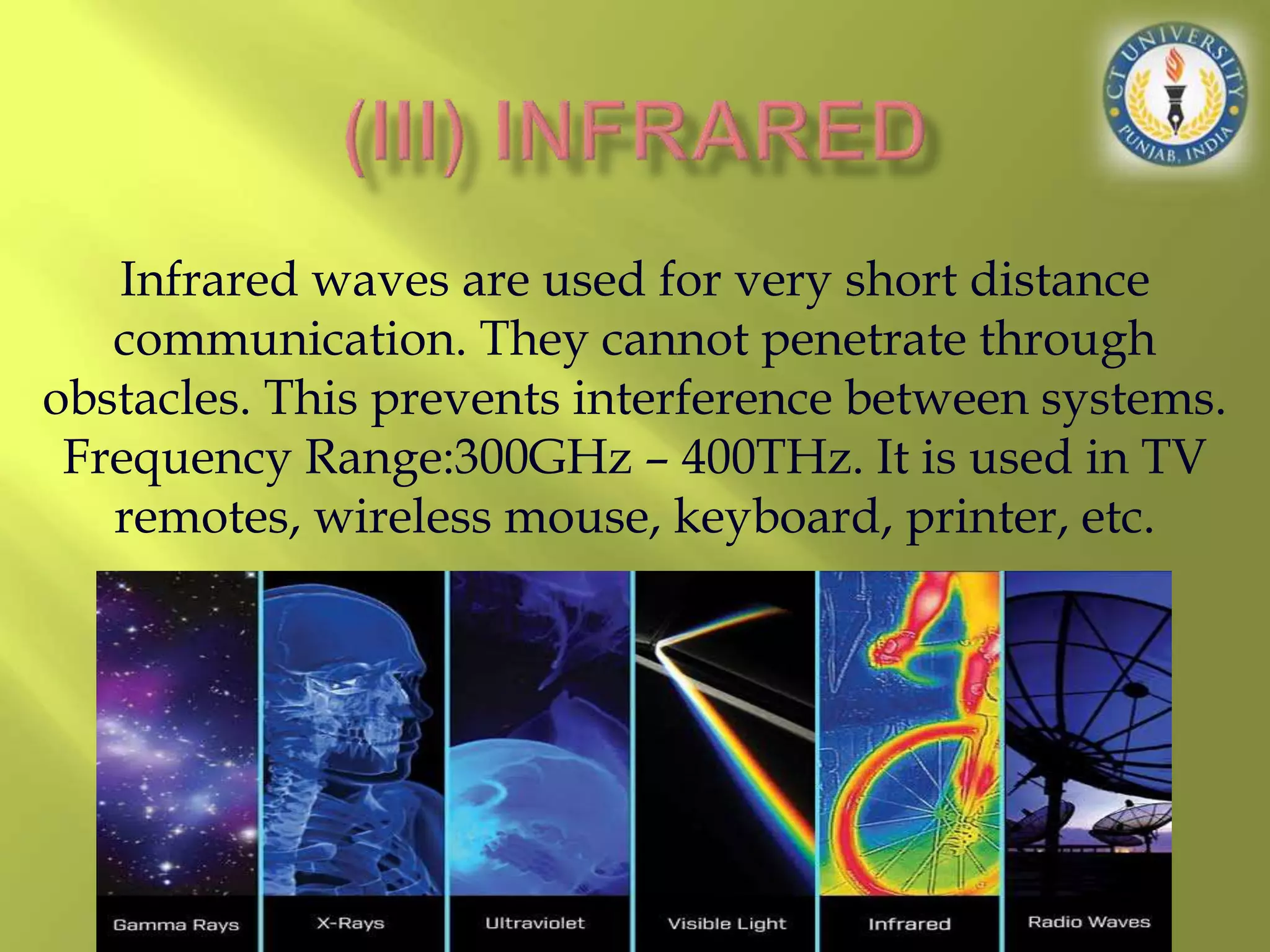
Infrared waves are used for very short distance
communication. They cannot penetrate through
obstacles. This prevents interference between systems.
Frequency Range:300GHz – 400THz. It is used in TV
remotes, wireless mouse, keyboard, printer, etc.
Network.ppt

Network.ppt

  • 2.
    A network consistsof 2 or more computers connected together, and they can communicate and share resources (e.g. information)
  • 3.
    •Depending on one’sperspective, we can classify networks in different ways  Based on transmission media: Wired (UTP, coaxial cables, fiber-optic cables) and Wireless • Based on network size: LAN and WAN (and MAN) • Based on management method: Peer-to-peer and Client/Server • Based on topology (connectivity): Bus, Star, Ring ,Mesh
  • 4.
     In datacommunication terminology, a transmission medium is a physical path between the transmitter and the receiver i.e, it is the channel through which data is sent from one place to another.  Transmission Media is broadly classified into the following types:
  • 5.
    It is alsoreferred to as Wired or Bounded transmission media. Signals being transmitted are directed and confined in a narrow pathway by using physical links. Features: High Speed Secure Used for comparatively shorter distances There are 3 major types of Guided Media: (i) Twisted Pair Cable – (ii) Coaxial Cable – (iii) Optical Fibre Cable –
  • 6.
    It consists of2 separately insulated conductor wires wound about each other. Generally, several such pairs are bundled together in a protective sheath. They are the most widely used Transmission Media. Twisted Pair is of two types:
  • 7.
    A. Unshielded TwistedPair (UTP): This type of cable has the ability to block interference and does not depend on a physical shield for this purpose. It is used for telephonic applications. B. Shielded Twisted Pair (STP): This type of cable consists of a special jacket to block external interference. It is used in fast-data-rate Ethernet and in voice and data channels of telephone lines.
  • 8.
    It has anouter plastic covering containing 2 parallel conductors each having a separate insulated protection cover. Coaxial cable transmits information in two modes: Baseband mode(dedicated cable bandwidth) and Broadband mode(cable bandwidth is split into separate ranges). Cable TVs and analog television networks widely use Coaxial cables. .Advantages: High Bandwidth Better noise Immunity Easy to install and expand Inexpensive .Disadvantages: Single cable failure can disrupt the entire network
  • 9.
    It uses theconcept of reflection of light through a core made up of glass or plastic. The core is surrounded by a less dense glass or plastic covering called the cladding. It is used for transmission of large volumes of data. .Advantages: Increased capacity and bandwidth Light weight Less signal attenuation Immunity to electromagnetic interference Resistance to corrosive materials .Disadvantages: Difficult to install and maintain High cost Fragile unidirectional, i.e, will need another fibre, if we need bidirectional communication
  • 10.
    It is alsoreferred to as Wireless or Unbounded transmission media. No physical medium is required for the transmission of electromagnetic signals. Features: Signal is broadcasted through air Less Secure Used for larger distances There are 3 major types of Unguided Media: (i) Radiowaves (ii) Microwaves (iii) Infrared
  • 11.
    These are easyto generate and can penetrate through buildings. The sending and receiving antennas need not be aligned. Frequency Range:3KHz – 1GHz. AM and FM radios and cordless phones use Radiowaves for transmission. Further Categorized as (i) Terrestrial and (ii) Satellite.
  • 12.
    It is aline of sight transmission i.e. the sending and receiving antennas need to be properly aligned with each other. The distance covered by the signal is directly proportional to the height of the antenna. Frequency Range:1GHz – 300GHz. These are majorly used for mobile phone communication and television distribution.
  • 13.
    Infrared waves areused for very short distance communication. They cannot penetrate through obstacles. This prevents interference between systems. Frequency Range:300GHz – 400THz. It is used in TV remotes, wireless mouse, keyboard, printer, etc.