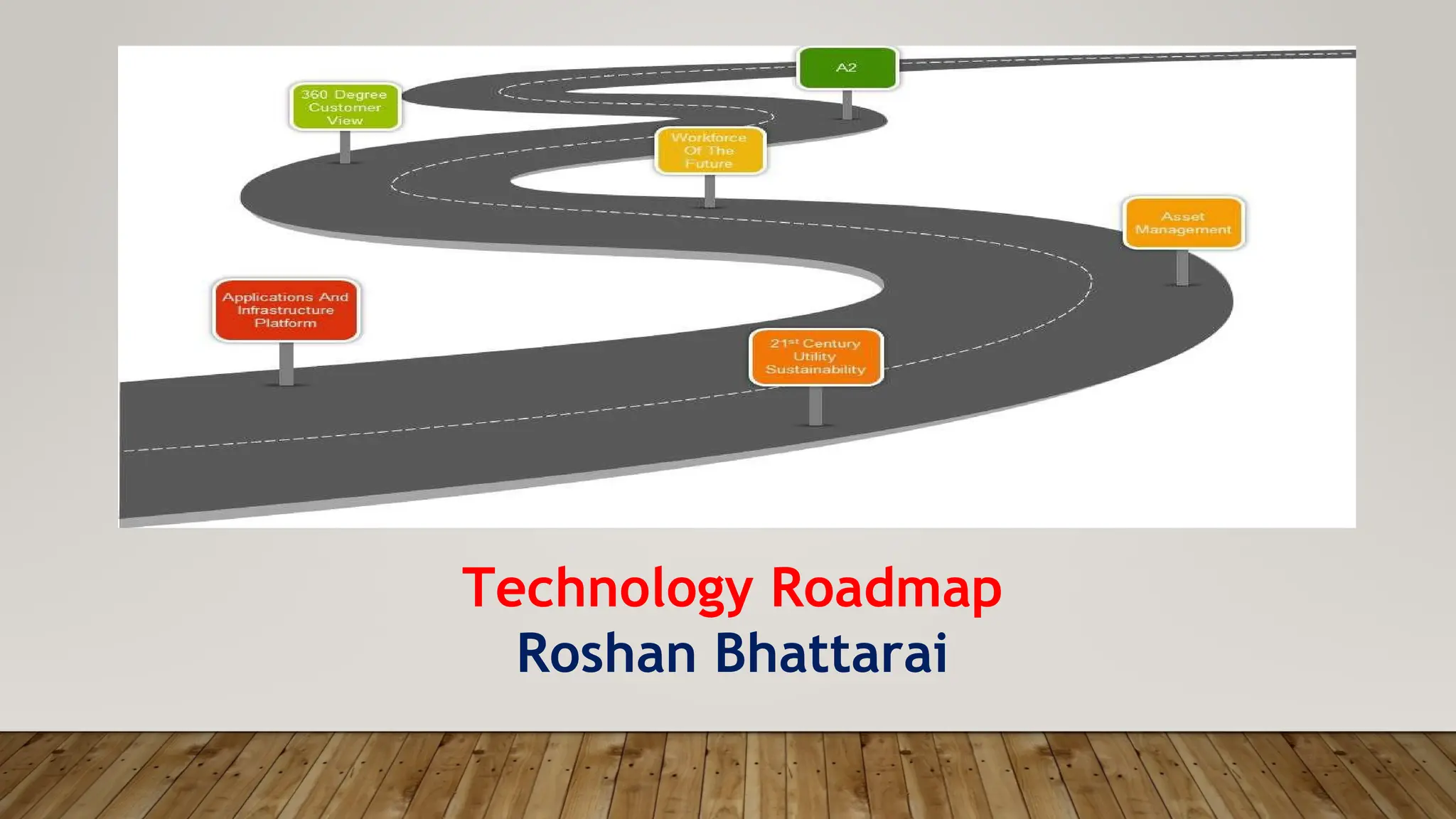
WHAT IS ATECHNOLOGY ROADMAP?
• A technology roadmap is a display, document, or diagram that illustrates the
technology adoption plan at a given organization
• A technology roadmap illustrates the technology presently available and
emphasizes scheduled improvements
• It should also consider which technologies will become obsolete or are scheduled
for end of life
• As organizations lay out their strategy and implementation to help execute on their
vision,
• a technology roadmap will help them determine which technologies to invest in and
how to implement them
3.
WHY DO YOUNEED A TECHNOLOGY
ROADMAP?
Creating a thorough technology roadmap gives us the ability to:
• Align stakeholders by creating a course of action to onboard new technology
solutions or maintain existing ones
• Have a clear picture of your company’s technological infrastructure abilities
and how they align with business outcomes
• Address any current technological issues
• Cut costs by removing any unnecessary technologies and applications
• Increase productivity by implementing technology that serves your immediate
needs
• Avoid or mitigate against technological failures by learning any weaknesses in
your technological infrastructure
4.
KEY COMPONENTS OFA TECHNOLOGY ROADMAP
The following are the eight key elements of a technology roadmap:
Goals: Your technology roadmap should include both long-term and short-term
goals that the business or organization wishes to achieve through the
technology implementation.
New system capabilities: These are the new capabilities provided by the
implementation of the technology enhancement.
• As an example,
• adding a chat-box to a customer-facing platform like a website or mobile app
will enhance customer interactions
5.
Release plans: Releaseplans highlight the requirements to enhance the systems
to support new capabilities provided by the new technology. Release plans
should be shared throughout the business or organization.
Milestones: Milestones are the key benchmarks achieved in the technology on-
boarding process. When stakeholders track milestones, they can assess and
understand the progress toward their long-term goals, plus evaluate the success of
the new technology in achieving those goals
• Milestones are usually tied to specific dates are function as performance
checkpoints to ensure that the business or organization is on track to hit their
projected outcomes.
6.
Resources: Resources exhibitthe time, capital, energy, and personnel needed
to onboard new technologies and maintain existing technology systems.
Training : Whenever rolling out a new technology system, a training period
must take place to ensure that personnel is adopting the new system
efficiently. In fact, your technology roadmap should always account for
training time, as training includes the guidance needed for internal teams to
adopt and support a new system.
7.
Risk factors: Riskfactors describe the potential internal or external threats
that may prevent successful implementation of new technologies. Risk
factors may include limitations in the technology itself, difficulty adopting
the new technology such, or market disruptions
Status reports: Status reports are necessary to keep all relevant stakeholders
informed of the progress of the new technology adoption. For example, a
logistics company on-boarding new logistics software could have their
delivery teams slowed down or even halted by a delayed on-boarding
process.
8.
TECHNOLOGY ROADMAP PROCESS
•A technology roadmap is created by a group of individuals from relevant
departments.
• These individuals are tasked with building a roadmap that takes into
consideration technology needs, departmental needs, the corporate strategy
and overall business goals.
• The technology road mapping process may be conducted in three phases:
• The preliminary phase,
• the development phase, and
• the follow-up phase
9.
Preliminary phase:
• Inthe first phase of creating a technology roadmap, it’s important to
establish leadership for the roadmap.
• Committed leadership is needed because of the time and effort involved in
creating a technology roadmap.
• The organization must drive the process and use the roadmap to
make resource allocation decisions.
• The boundaries and the scope of the roadmap should be specified.
10.
Development phase:
• Thesecond phase is when your organization will create the physical roadmap document.
• It’s important to establish
• what product to focus on,
• what critical systems that product interacts with,
• specify all the key technology areas, drivers and targets and
• recommend potential technology alternatives
• create the technology roadmap report
Follow-up activity phase:
• The third phase is when the completed roadmap is evaluated to see whether it needs
improvements or changes.
• The roadmap is then used to create a plan for evolving the business’ technology.



![Technology Management and Strategy [Part IV]](https://cdn.slidesharecdn.com/ss_thumbnails/technologymanagementandstrategypartiv-140803030243-phpapp02-thumbnail.jpg?width=640&height=640&fit=bounds)


![Vibe Coding vs. Spec-Driven Development [Free Meetup]](https://cdn.slidesharecdn.com/ss_thumbnails/vibecodingvsspecdrivendevelopment-251209105622-43f455e7-thumbnail.jpg?width=640&height=640&fit=bounds)


