Business Analytics
Roshan Bhattarai
Business Analytics
Introduction
• Business analytics is the process of transforming business data into
business insights to improve business decisions
• It refers to the statistical methods and computing technologies for
processing, mining and visualizing data to uncover patterns,
relationships and insights
By definition, business analytics refers to:
• Taking in and processing historical business data
• Analyzing that data to identify trends, patterns, and root causes
• Making data-driven business decisions based on those insights
• Some of the tools used to create insights from data are:
– data modeling (creating a simplified visual diagram of a software
system),
– data mining (identifying new patterns and relationships),
– forecasting (future business needs, performance, and industry
trends),
– optimization and
– data visualization (representation of data by using graphics) etc
Steps Involved in Data Analytics
1. Understand the problem:
Understanding the business problems, defining the organizational goals, and
planning a lucrative solution is the first step in the analytics process. For
example: E-commerce companies often encounter issues such as predicting the
return of items, giving relevant product recommendations, cancellation of
orders, identifying frauds, optimizing vehicle routing, etc.
2. Data Collection:
A business need to collect transactional data and customer-related information
from the past few years to address the problems the business is facing. The data
can have information about the total units that were sold for a product, the sales,
and profit that were made, and also when was the order placed. Past data plays a
crucial role in shaping the future of a business.
3. Data Cleaning:
The data collected may be disorderly, messy, and contain unwanted or missing
values. Such data is not suitable or relevant for performing data analysis. Hence,
it is needed to clean the data to remove unwanted, redundant, and missing
values to make it ready for analysis.
4. Data Exploration and Analysis:
A business uses data visualization and business intelligence tools, data
mining techniques, and predictive modeling to analyze, visualize, and
predict future outcomes from this data. Applying these methods can tell
the impact and relationship of a certain feature as compared to other
variables.
5. Interpret the results:
The final step is to interpret the results and validate if the outcomes meet
business expectations. Businesses can find out hidden patterns and future
trends. This will help business gaining business insights that will support
appropriate data-driven decision making.
Benefits of business analytics
• The key benefit of business analytics is that it can help organizations
identify patterns in data and generate new insights. With this
information, they can improve existing processes and identify new
strategies. Some of the key benefits of business analytics include the
following:
• Improved decision-making. Business analytics provides actionable
insights that spur (drive) organizations to make more informed,
data-driven decisions.
• Business optimization. Business analytics can identify and help
mitigate recurring issues that keep processes from operating
smoothly, such as steps in a workflow that take longer than they
should. Also, resource allocation and use can be monitored to
identify ways to cut costs.
• Competitive advantage. Data on market trends can be analyzed to
identify patterns and trends that lead to better strategies for reaching
customers and responding quickly to demand trends.
• Personalized customer service and marketing. Business analytics
provides metrics on different types of customers and their buying
preferences that can be used to create more personalized service and
marketing strategies that improve customer engagement and provide
a better customer experience.
Data Analytics Applications
• Data analytics is used in almost every sector of business, let’s
discuss a few of them:
1. Retail: Data analytics helps retailers understand their customer
needs and buying habits to predict trends, recommend new products,
and boost their business. They optimize the supply chain, and retail
operations at every step of the customer journey.
2. Healthcare: Healthcare industries analyze patient data to provide
lifesaving diagnosis and treatment options. Data analytics help in
discovering new drug development methods as well.
3. Manufacturing: Using data analytics, manufacturing sectors can
discover new cost-saving opportunities. They can solve complex
supply chain issues, labor constraints, and equipment breakdowns.
4. Banking sector: Banking and financial institutions use analytics to
find out probable loan defaulters and customer churn out rate (rate
at which customers stop doing business with an entity) . It also helps
in detecting fraudulent transactions immediately.
5. Logistics: Logistics companies use data analytics to develop new
business models and optimize routes. This, in turn, ensures that the
delivery reaches on time in a cost-efficient manner.
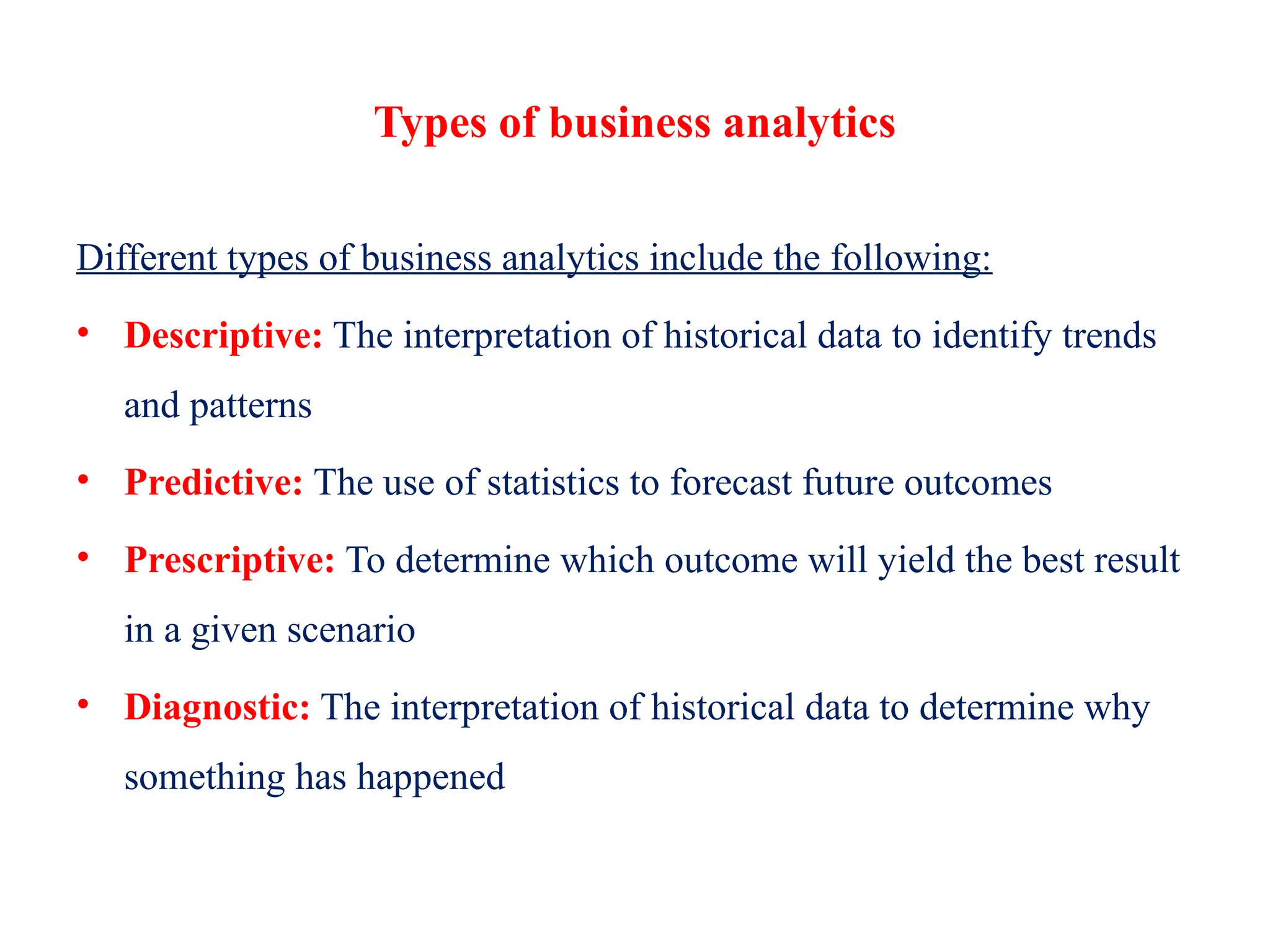
Types of business analytics
Different types of business analytics include the following:
• Descriptive: The interpretation of historical data to identify trends
and patterns
• Predictive: The use of statistics to forecast future outcomes
• Prescriptive: To determine which outcome will yield the best result
in a given scenario
• Diagnostic: The interpretation of historical data to determine why
something has happened
1. Descriptive analytics:
• Descriptive analytics is used to summarize past data and
understand “what has happened in the past”
• It involves examining historical data to gain insights into customer
behavior, identify trends, uncover key performance indicators etc
• This is the most fundamental type of business analytics.
• This describes what has happened over a given period of time. Eg:
Have the number of views gone up? Are sales stronger this month
than last?
• Descriptive statistics (measures of central tendency-mean median,
mode, measures of dispersion- range, standard deviation etc), data
visualization (charts, graphs, dashboards), Time series analysis,
Frequency distributions, Percentages etc are used
• Uses: sales analysis, performance analysis, marketing analytics, HR
analytics, customer analytics, financial analytics etc
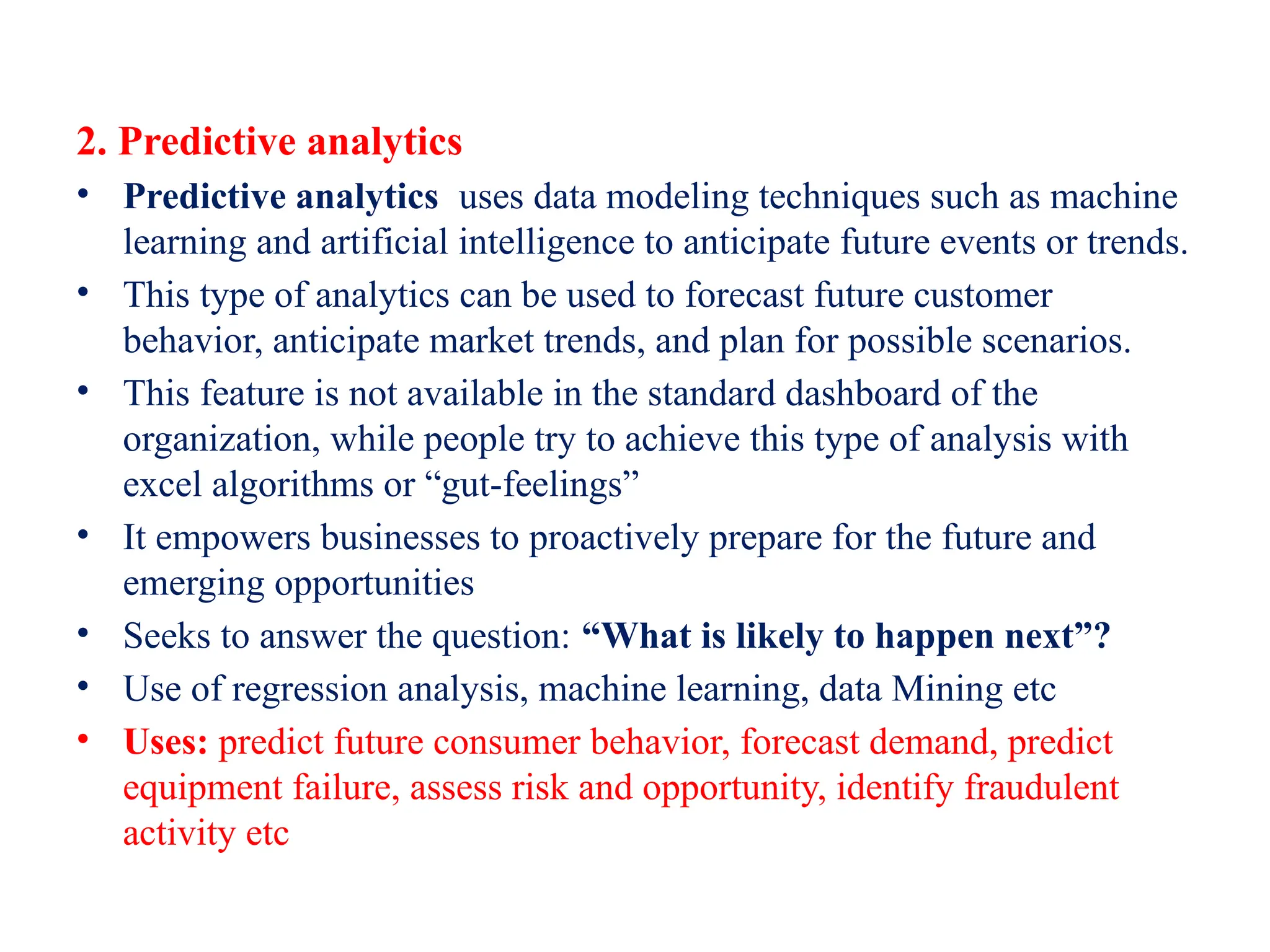
2. Predictive analytics
• Predictive analytics uses data modeling techniques such as machine
learning and artificial intelligence to anticipate future events or trends.
• This type of analytics can be used to forecast future customer
behavior, anticipate market trends, and plan for possible scenarios.
• This feature is not available in the standard dashboard of the
organization, while people try to achieve this type of analysis with
excel algorithms or “gut-feelings”
• It empowers businesses to proactively prepare for the future and
emerging opportunities
• Seeks to answer the question: “What is likely to happen next”?
• Use of regression analysis, machine learning, data Mining etc
• Uses: predict future consumer behavior, forecast demand, predict
equipment failure, assess risk and opportunity, identify fraudulent
activity etc
3. Prescriptive analytics
• Prescriptive analytics takes predictive analytics a step further by
suggesting potential actions and outcomes.
• It helps business users decide which strategies to pursue, how to optimize
operations, and which investments to make.
• Prescriptive analytics can also be used to provide personalized
recommendations to customers.
• This suggests a course of action. For example, we should add an evening
shift to the brewery and rent an additional tank to increase output.
• Use of advanced mathematical algorithms, optimization techniques (linear
programming, non linear programming, integer programming etc),
machine learning, simulation techniques, decision trees, to analyze what
should happen next?
• Provide decision makers with actionable recommendations for achieving
desired outcomes and maximizing performances
4. Diagnostic analytics
• Diagnostic analytics takes descriptive analytics a step further by
using data mining techniques to look for patterns and uncover
correlations.
• It can be used to identify the root cause of a problem, discover
opportunities, and understand how changes affect other areas of the
business. Diagnostic analytics requires the ability to drill down into
the data to understand correlation.
• This focuses more on “why something happened”. It involves
more diverse data inputs and a bit of hypothesizing. Did the weather
affect beer sales? Did that latest marketing campaign impact sales?
Presentation Tools
THANK YOU!!

Business Analytics, Types of Business Analytics

  • 1.
  • 2.
    Business Analytics Introduction • Businessanalytics is the process of transforming business data into business insights to improve business decisions • It refers to the statistical methods and computing technologies for processing, mining and visualizing data to uncover patterns, relationships and insights By definition, business analytics refers to: • Taking in and processing historical business data • Analyzing that data to identify trends, patterns, and root causes • Making data-driven business decisions based on those insights
  • 3.
    • Some ofthe tools used to create insights from data are: – data modeling (creating a simplified visual diagram of a software system), – data mining (identifying new patterns and relationships), – forecasting (future business needs, performance, and industry trends), – optimization and – data visualization (representation of data by using graphics) etc
  • 4.
    Steps Involved inData Analytics 1. Understand the problem: Understanding the business problems, defining the organizational goals, and planning a lucrative solution is the first step in the analytics process. For example: E-commerce companies often encounter issues such as predicting the return of items, giving relevant product recommendations, cancellation of orders, identifying frauds, optimizing vehicle routing, etc. 2. Data Collection: A business need to collect transactional data and customer-related information from the past few years to address the problems the business is facing. The data can have information about the total units that were sold for a product, the sales, and profit that were made, and also when was the order placed. Past data plays a crucial role in shaping the future of a business. 3. Data Cleaning: The data collected may be disorderly, messy, and contain unwanted or missing values. Such data is not suitable or relevant for performing data analysis. Hence, it is needed to clean the data to remove unwanted, redundant, and missing values to make it ready for analysis.
  • 5.
    4. Data Explorationand Analysis: A business uses data visualization and business intelligence tools, data mining techniques, and predictive modeling to analyze, visualize, and predict future outcomes from this data. Applying these methods can tell the impact and relationship of a certain feature as compared to other variables. 5. Interpret the results: The final step is to interpret the results and validate if the outcomes meet business expectations. Businesses can find out hidden patterns and future trends. This will help business gaining business insights that will support appropriate data-driven decision making.
  • 6.
    Benefits of businessanalytics • The key benefit of business analytics is that it can help organizations identify patterns in data and generate new insights. With this information, they can improve existing processes and identify new strategies. Some of the key benefits of business analytics include the following: • Improved decision-making. Business analytics provides actionable insights that spur (drive) organizations to make more informed, data-driven decisions. • Business optimization. Business analytics can identify and help mitigate recurring issues that keep processes from operating smoothly, such as steps in a workflow that take longer than they should. Also, resource allocation and use can be monitored to identify ways to cut costs.
  • 7.
    • Competitive advantage.Data on market trends can be analyzed to identify patterns and trends that lead to better strategies for reaching customers and responding quickly to demand trends. • Personalized customer service and marketing. Business analytics provides metrics on different types of customers and their buying preferences that can be used to create more personalized service and marketing strategies that improve customer engagement and provide a better customer experience.
  • 8.
    Data Analytics Applications •Data analytics is used in almost every sector of business, let’s discuss a few of them: 1. Retail: Data analytics helps retailers understand their customer needs and buying habits to predict trends, recommend new products, and boost their business. They optimize the supply chain, and retail operations at every step of the customer journey. 2. Healthcare: Healthcare industries analyze patient data to provide lifesaving diagnosis and treatment options. Data analytics help in discovering new drug development methods as well. 3. Manufacturing: Using data analytics, manufacturing sectors can discover new cost-saving opportunities. They can solve complex supply chain issues, labor constraints, and equipment breakdowns.
  • 9.
    4. Banking sector:Banking and financial institutions use analytics to find out probable loan defaulters and customer churn out rate (rate at which customers stop doing business with an entity) . It also helps in detecting fraudulent transactions immediately. 5. Logistics: Logistics companies use data analytics to develop new business models and optimize routes. This, in turn, ensures that the delivery reaches on time in a cost-efficient manner.
  • 10.
    Types of businessanalytics Different types of business analytics include the following: • Descriptive: The interpretation of historical data to identify trends and patterns • Predictive: The use of statistics to forecast future outcomes • Prescriptive: To determine which outcome will yield the best result in a given scenario • Diagnostic: The interpretation of historical data to determine why something has happened
  • 11.
    1. Descriptive analytics: •Descriptive analytics is used to summarize past data and understand “what has happened in the past” • It involves examining historical data to gain insights into customer behavior, identify trends, uncover key performance indicators etc • This is the most fundamental type of business analytics. • This describes what has happened over a given period of time. Eg: Have the number of views gone up? Are sales stronger this month than last? • Descriptive statistics (measures of central tendency-mean median, mode, measures of dispersion- range, standard deviation etc), data visualization (charts, graphs, dashboards), Time series analysis, Frequency distributions, Percentages etc are used • Uses: sales analysis, performance analysis, marketing analytics, HR analytics, customer analytics, financial analytics etc
  • 12.
    2. Predictive analytics •Predictive analytics uses data modeling techniques such as machine learning and artificial intelligence to anticipate future events or trends. • This type of analytics can be used to forecast future customer behavior, anticipate market trends, and plan for possible scenarios. • This feature is not available in the standard dashboard of the organization, while people try to achieve this type of analysis with excel algorithms or “gut-feelings” • It empowers businesses to proactively prepare for the future and emerging opportunities • Seeks to answer the question: “What is likely to happen next”? • Use of regression analysis, machine learning, data Mining etc • Uses: predict future consumer behavior, forecast demand, predict equipment failure, assess risk and opportunity, identify fraudulent activity etc
  • 13.
    3. Prescriptive analytics •Prescriptive analytics takes predictive analytics a step further by suggesting potential actions and outcomes. • It helps business users decide which strategies to pursue, how to optimize operations, and which investments to make. • Prescriptive analytics can also be used to provide personalized recommendations to customers. • This suggests a course of action. For example, we should add an evening shift to the brewery and rent an additional tank to increase output. • Use of advanced mathematical algorithms, optimization techniques (linear programming, non linear programming, integer programming etc), machine learning, simulation techniques, decision trees, to analyze what should happen next? • Provide decision makers with actionable recommendations for achieving desired outcomes and maximizing performances
  • 14.
    4. Diagnostic analytics •Diagnostic analytics takes descriptive analytics a step further by using data mining techniques to look for patterns and uncover correlations. • It can be used to identify the root cause of a problem, discover opportunities, and understand how changes affect other areas of the business. Diagnostic analytics requires the ability to drill down into the data to understand correlation. • This focuses more on “why something happened”. It involves more diverse data inputs and a bit of hypothesizing. Did the weather affect beer sales? Did that latest marketing campaign impact sales?
  • 15.
  • 16.