WHAT IS STRATEGYAND STRATEGIC MANAGEMENT?
• A company's strategy is its plan for victory in competition with other companies
• coordinated set of actions that fulfill a firm’s objectives, purposes, and goals
• Strategic Management is a process for formulating, implementing and
evaluating a strategy
3.
For example:
Polaroid Corporation,founded in 1937, revolutionized photography with the
introduction of instant photography.
• The company, initially focused on polarizing light technology,
• gained fame for its instant cameras and film,
• particularly after the launch of the Polaroid Land camera in 1947 and the SX-70 in 1972
• Polaroid faced challenges with the rise of digital technology and filed for bankruptcy in
2001.
• A group of enthusiasts known as "The Impossible Project" acquired the last Polaroid
factory in the Netherlands and revived instant film production, leading to the eventual re-
emergence of the Polaroid brand.
4.
Swiss watch manufacturersheld a dominant position in the global watch
industry for over a century
• Reputation for quality, precision, and craftsmanship has solidified their leadership in
the luxury watch market
• Swiss companies commanding a significant share of the high-end market
• Brands like Patek Philippe, Rolex, Breitling, and Omega are well-known examples of
Swiss watchmakers that have shaped the industry's history
5.
United States steelindustry was the world leader
• United States industry generally refused to believe that air-fusion technology would
impact that dominant position
• The United States steel industry today is in a weak competitive position
• Technology is not a passive component of a firm
• Technology is a critical part of a firm’s strategic success that should be planned,
actively chosen, and constantly evaluated and adjusted as necessary.
6.
STRATEGIC TECHNOLOGY MANAGEMENT(STM)
• Strategic Technology Management (STM) is the process of planning,
developing, and managing technology within an organization
• to achieve long-term business goals and maintain competitive advantage
• Bridges the gap between technology and business strategy,
• ensuring that technological capabilities align with the overall vision and direction of
the company
7.
Example:
A company likeApple uses STM by:
• Strategically investing in microprocessor design (Apple Silicon)
• Managing R&D in-house while forecasting future computing trends
• Aligning product innovation with customer experience strategy
8.
IMPORTANCE OF STRATEGICTECHNOLOGY
MANAGEMENT
• StrategicTechnology Management (STM) is crucial for businesses because
• it aligns technology investments with overall business goals,
• raising innovation, and ensuring a competitive edge in a rapidly evolving
technological landscape
• By strategically managing technology, companies can optimize resource
allocation, mitigate risks, and drive sustainable growth
9.
IMPORTANCE OF STM
1.Driving Innovation and Competitive Advantage:
• STM helps businesses identify and leverage emerging technologies to develop
innovative products and services, differentiating them from competitors
• By proactively exploring new technologies and trends, companies can gain a
competitive edge and capture market opportunities before their rivals
• A strategic approach to technology ensures that investments are aligned with
business objectives, leading to more impactful and relevant innovations
10.
2. Optimizing ResourceAllocation and Reducing Risks:
• STM provides a framework for making informed decisions about technology
investments, ensuring that resources are allocated effectively
• By assessing potential risks and developing mitigation strategies, STM helps
businesses navigate uncertainties and avoid costly mistakes
• A strategic approach to technology can also streamline operations, improve
efficiency, and reduce the overall cost of technology adoption
11.
3. Fostering Agilityand Adaptability
• In today's dynamic business environment, STM is essential for building agile (able to
move quickly and easily) and adaptable organizations
• By continuously monitoring technological advancements and market trends, businesses
can respond quickly to change and seize new opportunities
• STM enables organizations to develop the capabilities needed to adapt to evolving
customer needs and maintain a competitive advantage
12.
4. Enhancing Decision-Makingand Long-Term Planning
• STM provides a structured approach to technology management, improving
decision-making at all levels of the organization.
• By aligning technology strategy with overall business goals, STM helps leadership
make informed decisions about technology investments and resource allocation
• A well-defined STM framework can also facilitate long-term planning, enabling
businesses to anticipate future challenges and opportunities
13.
5. Ensuring Alignmentand Integration
• STM ensures that technology initiatives are integrated with the company's overall
business strategy, creating a cohesive and purposeful direction
• By aligning technology with business objectives, organizations can maximize
the impact of their technology investments and achieve their strategic goals
• STM also promotes collaboration and communication between different
departments, fostering a culture of innovation and continuous improvement
14.
Integrating “Management ofTechnology” and “Strategy”
• Capabilities are skills that a firm develops
• These capabilities are the building blocks for the firm’s strategy.
• Business ultimately develops its competitive advantage over other firms from its
capabilities.
15.
The capabilities ofa firm can be classified as either technical or market.
a) Technical Capabilities
• Technical capabilities address how the firm approaches technology it already has
or wishes to have in the future.
• Therefore, the firm’s approach to these capabilities can be classified in one of
three ways: Destroy, Preserve, or Develop.
• The approach to technology is a strategic decision that must be implemented
through the firm’s choices, including its people, structure, and processes.
16.
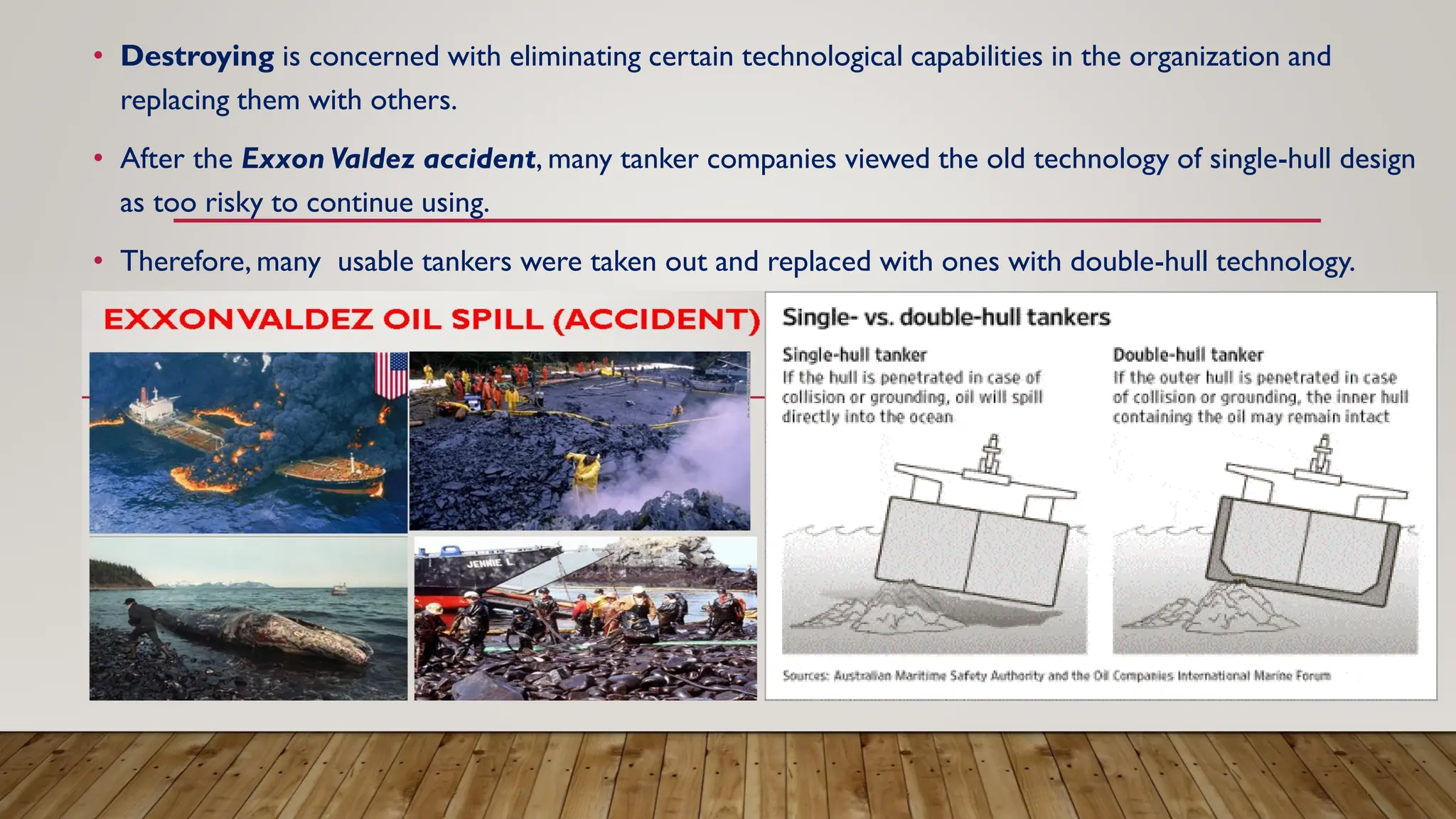
• Destroying isconcerned with eliminating certain technological
capabilities in the organization and replacing them with others.
• After the Exxon Valdez accident, many tanker companies viewed the old
technology of single-hull design as too risky to continue using.
• Therefore, many usable tankers were taken out and replaced with ones
with double-hull technology.
17.
• Destroying isconcerned with eliminating certain technological capabilities in the organization and
replacing them with others.
• After the Exxon Valdez accident, many tanker companies viewed the old technology of single-hull design
as too risky to continue using.
• Therefore, many usable tankers were taken out and replaced with ones with double-hull technology.
18.
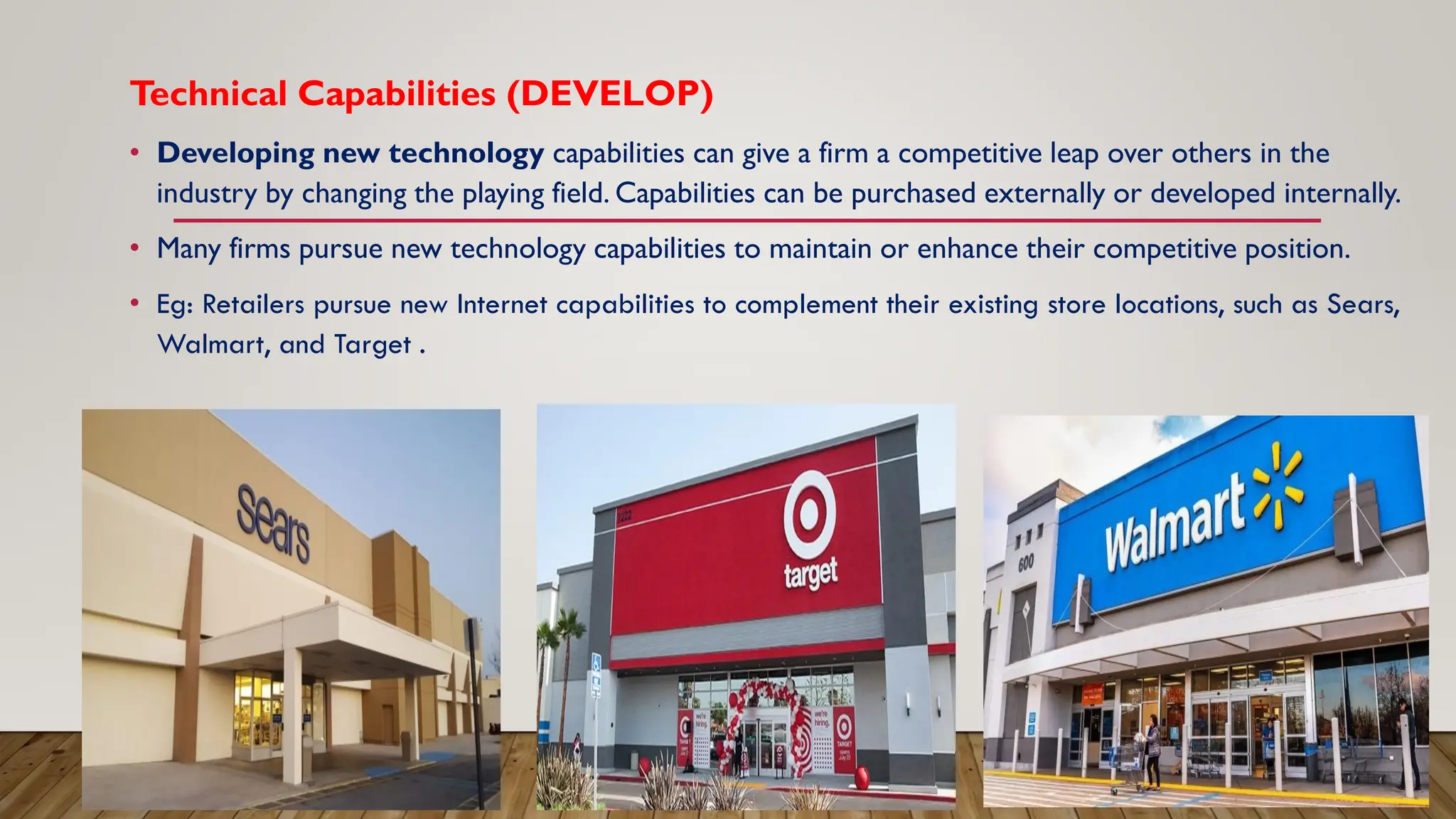
Technical Capabilities (DEVELOP)
•Developing new technology capabilities can give a firm a competitive leap over others in the
industry by changing the playing field. Capabilities can be purchased externally or developed internally.
• Many firms pursue new technology capabilities to maintain or enhance their competitive position.
• Eg: Retailers pursue new Internet capabilities to complement their existing store locations, such as Sears,
Walmart, and Target .
19.
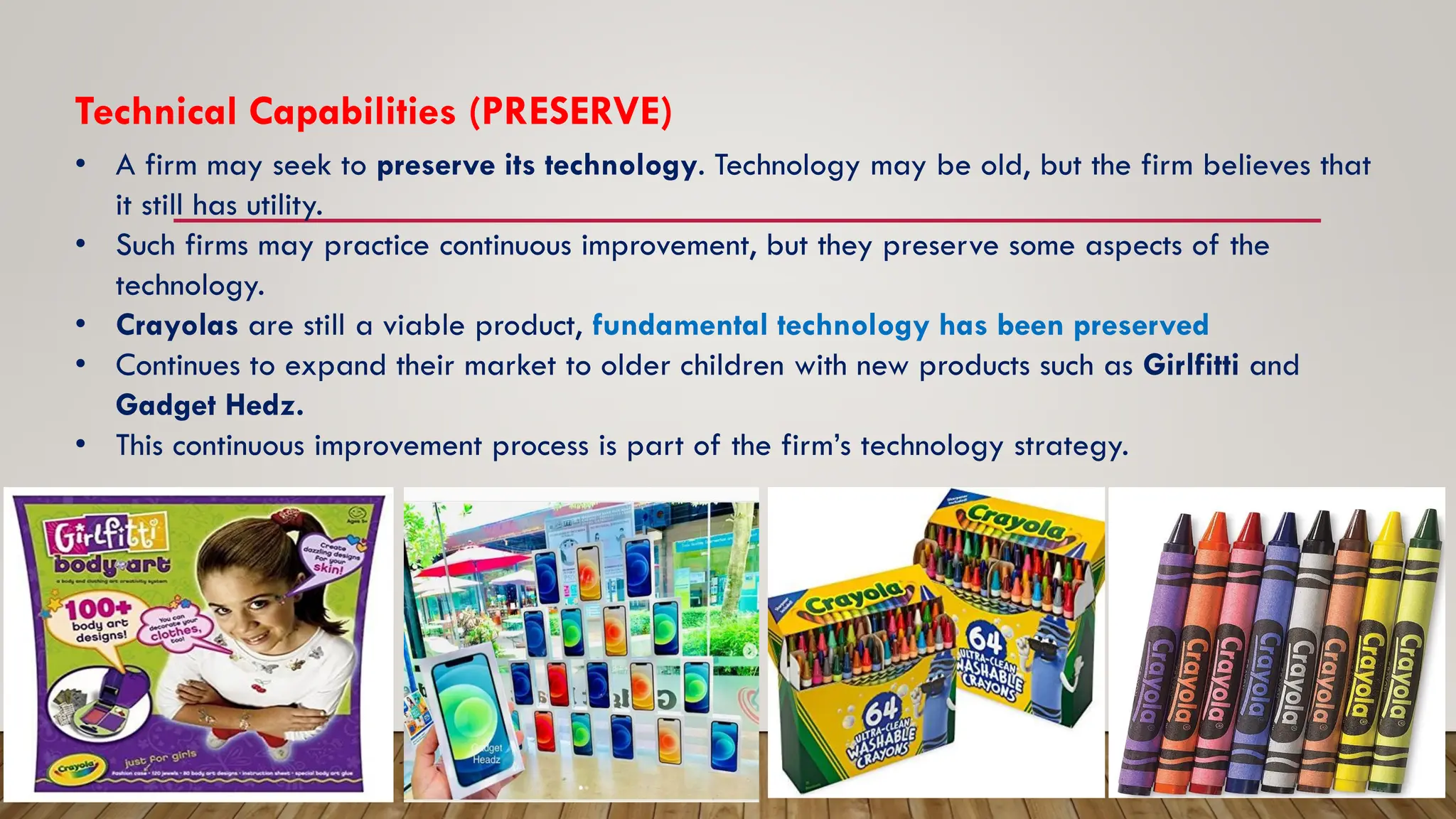
Technical Capabilities (PRESERVE)
•A firm may seek to preserve its technology. Technology may be old, but the firm believes that
it still has utility.
• Such firms may practice continuous improvement, but they preserve some aspects of the
technology.
• Crayolas are still a viable product, fundamental technology has been preserved
• Continues to expand their market to older children with new products such as Girlfitti and
Gadget Hedz.
• This continuous improvement process is part of the firm’s technology strategy.
20.
b) Market Capabilities
•To illustrate,
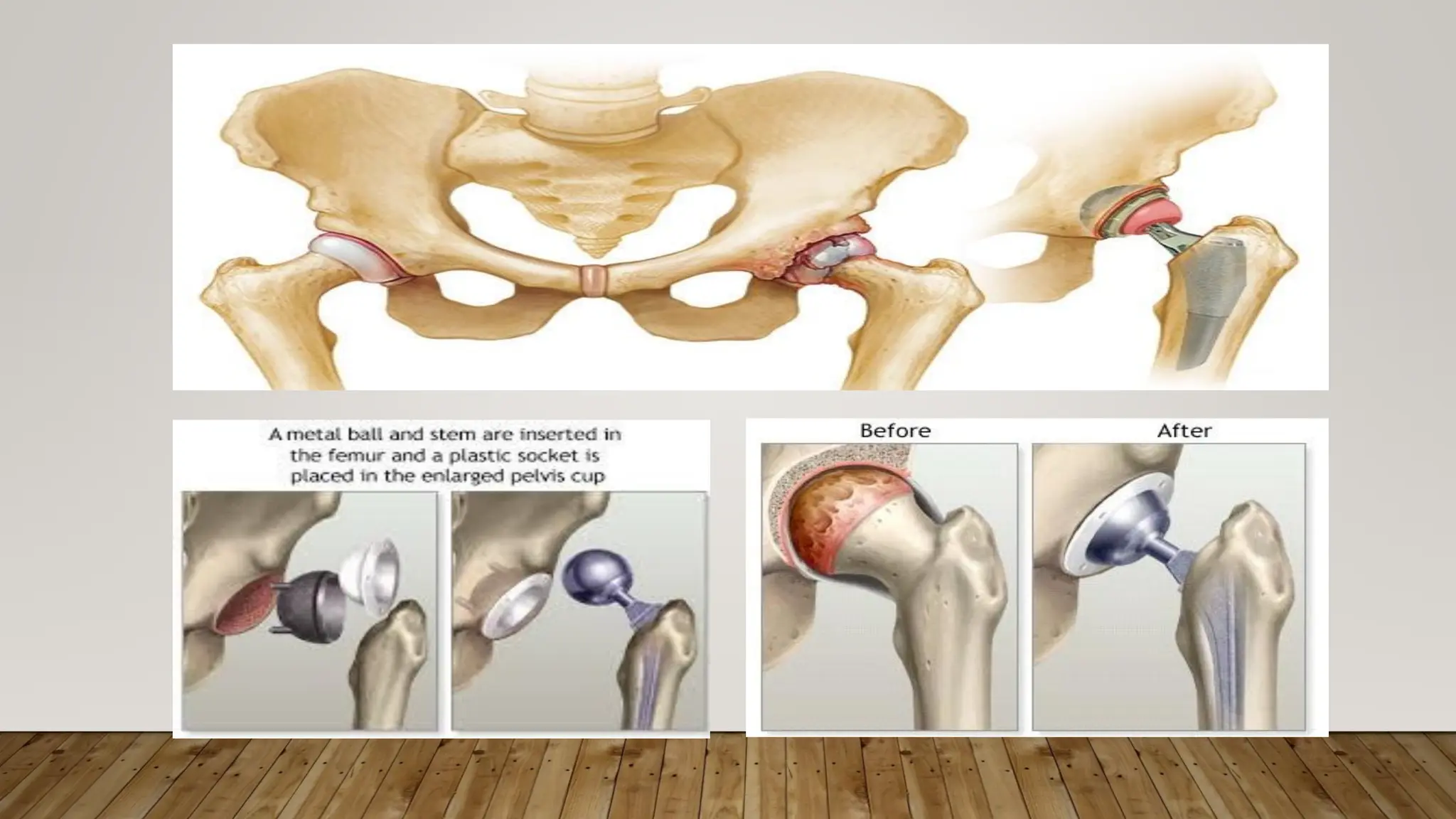
• a start-up medical device firm developed a product associated with hip
replacement
• The firm had good technology, but it could not get orthopedic surgeons to use its
products
• The firm could not understand why they had this problem
• since the company representing it and doing the marketing of the product was
one of the leading distributors of orthopedic products in the country
22.
• The start-upfirm realized only later that the sales representatives of the firm with which
it had partnered to distribute the product
• focused on orthopedic doctors who treat sports injuries
• Orthopedic doctors who treat sports injuries often do not perform surgery, and
• when they do, the standard is that the sales representative is not in the operating
room
• In contrast, orthopedic doctors who do hip replacement are all surgeons, and
• commonly have the sales representative come into the operating room and
coach them through the use of a new product.
23.
• The firm’sfailure to have sufficient market knowledge led to its decline
• A fresh management team was hired to rescue the firm, and they addressed
this critical difference by obtaining new distributors.
• The start-up firm started doing well
• Concludes, technological capability without market capability typically will
not succeed
24.
In summary, technologyis viewed in some texts as an input to strategy
but not as a central factor.
• The argument here is that technology should be considered a central
component of the firm’s strategy
• The firm’s capabilities, including technology, provide the firm with its
competitive advantage
• The goal is that the competitive advantage be sustainable by the business
over a significant period of time.
• Thus, the goal is a “Sustainable Competitive Advantage”
25.
THE STRATEGIC MANAGEMENT
PROCESS
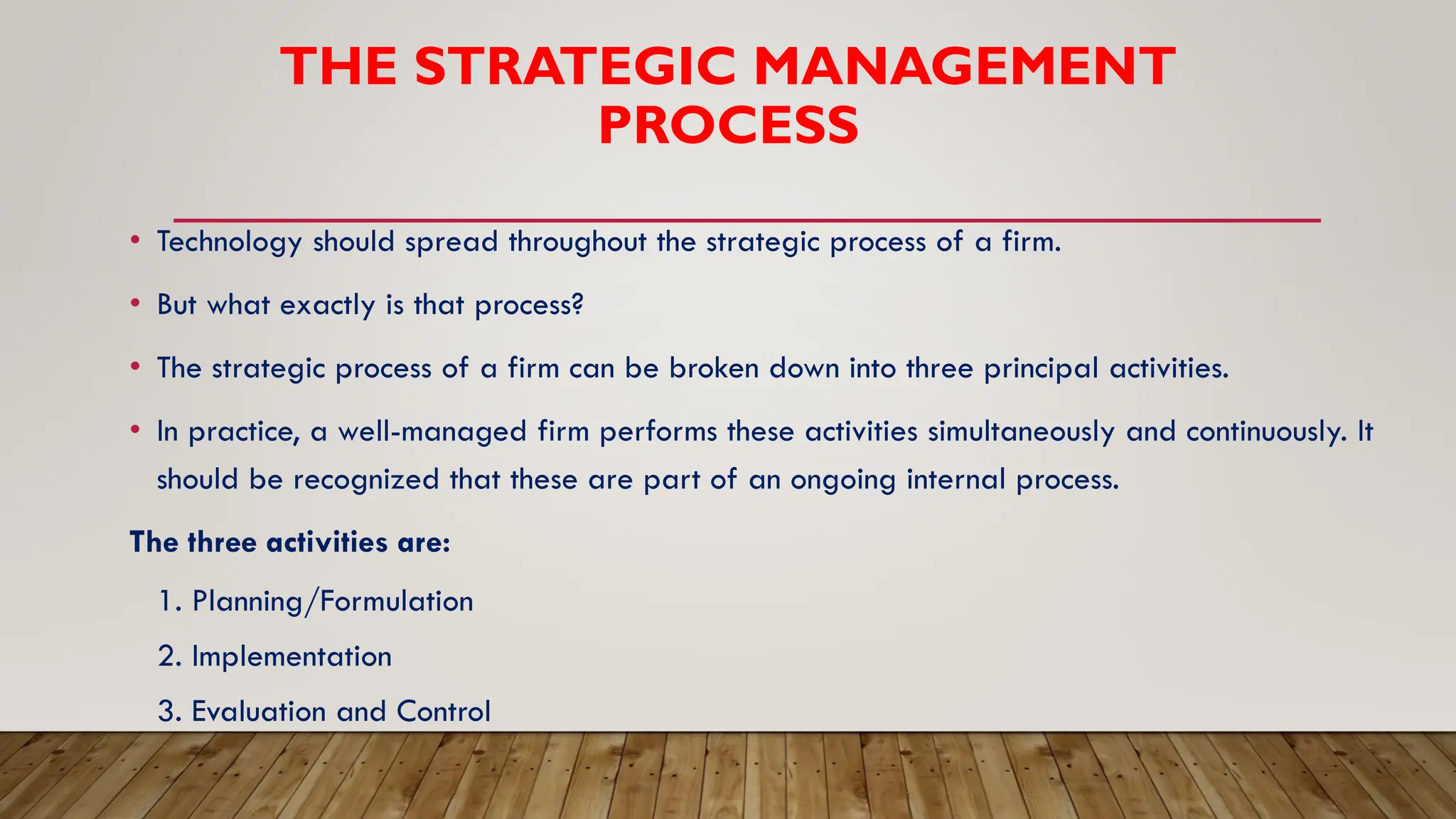
•Technology should spread throughout the strategic process of a firm.
• But what exactly is that process?
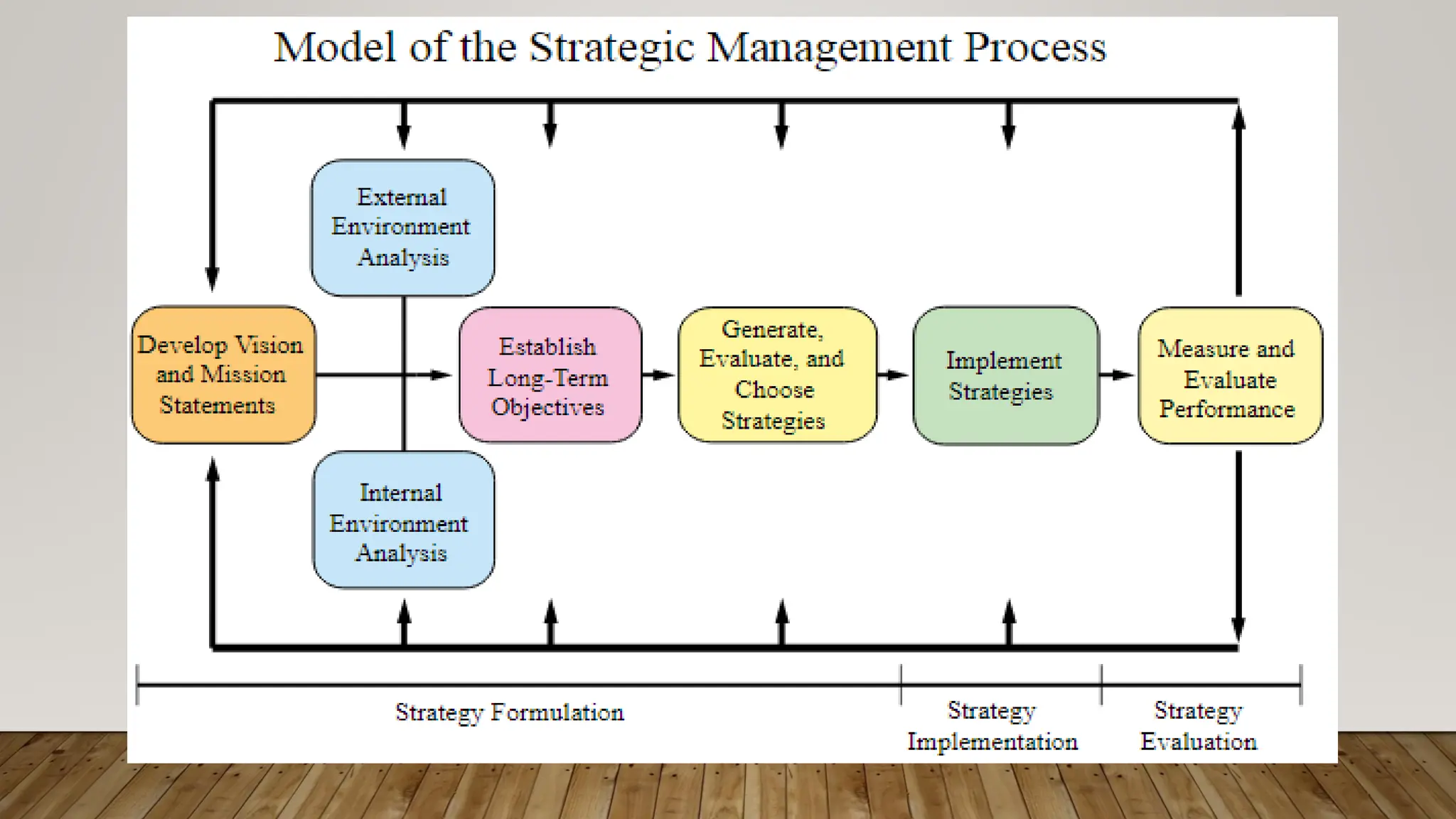
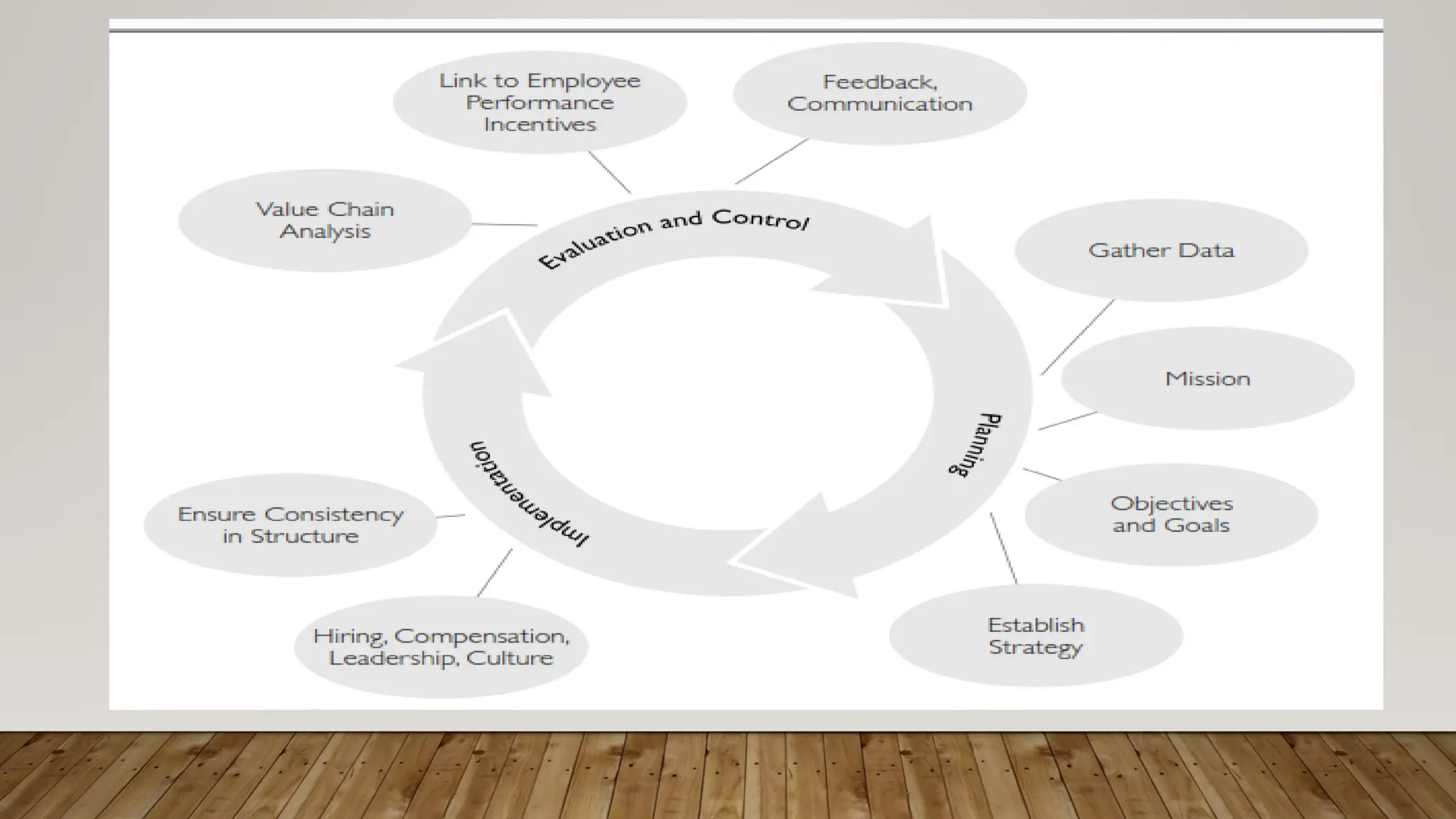
• The strategic process of a firm can be broken down into three principal activities.
• In practice, a well-managed firm performs these activities simultaneously and continuously. It
should be recognized that these are part of an ongoing internal process.
The three activities are:
1. Planning/Formulation
2. Implementation
3. Evaluation and Control
28.
Planning/ Formulation
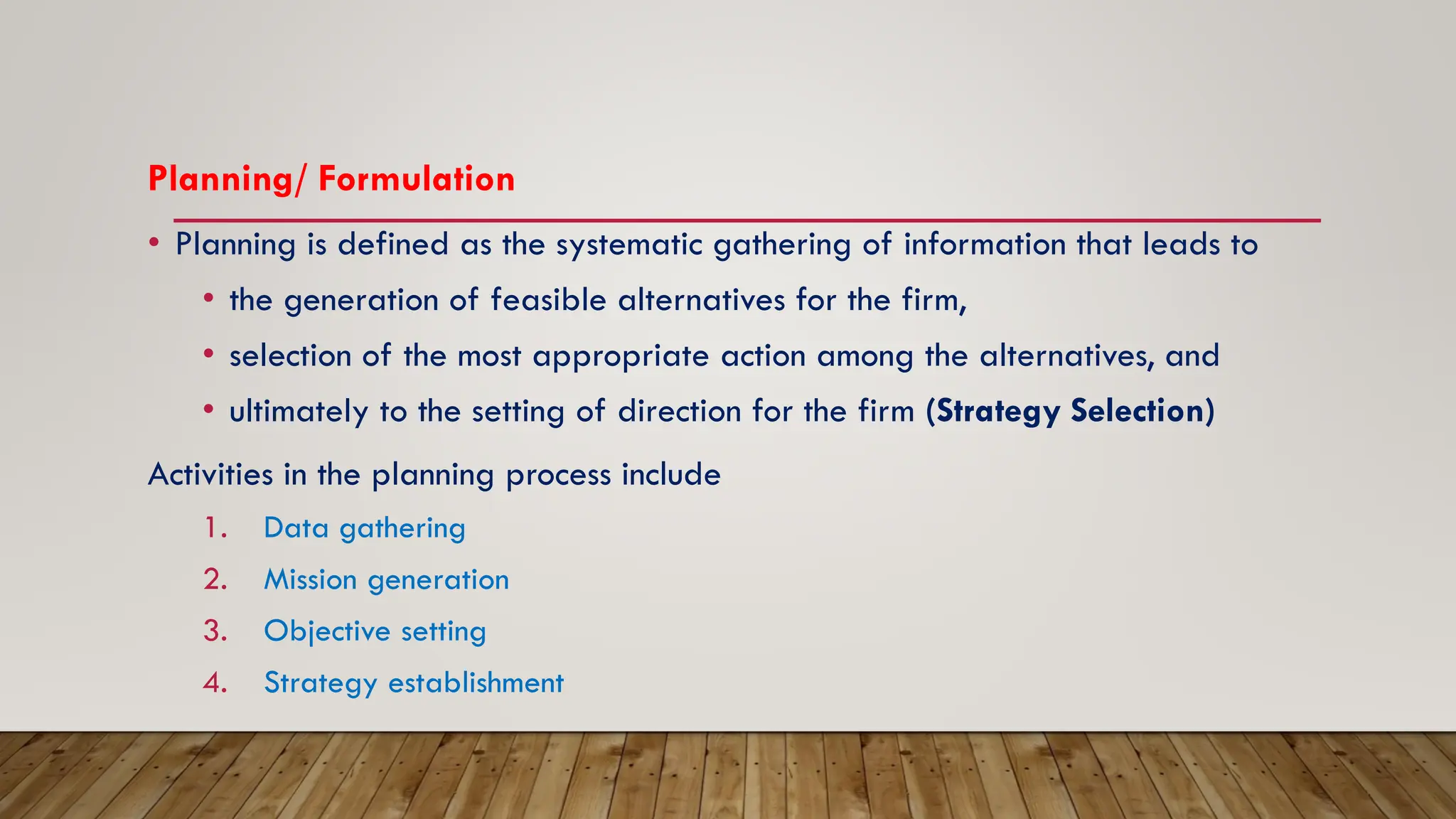
• Planningis defined as the systematic gathering of information that leads to
• the generation of feasible alternatives for the firm,
• selection of the most appropriate action among the alternatives, and
• ultimately to the setting of direction for the firm (Strategy Selection)
Activities in the planning process include
1. Data gathering
2. Mission generation
3. Objective setting
4. Strategy establishment
29.
Implementation
• After thestrategic planning (information gathering, mission generation, objective
setting, and strategy selection), the firm must implement the plans/strategy
• The firm’s common implementation concerns include:
• Organizational Structure, Organizational Culture, Leadership, Employee hiring,
Employee incentives etc.
• There is a need for a fit between all of the actions that the firm takes to
implement the strategy
• The true impact of a strategy comes from the firm setting a clear direction and
taking actions that are consistent with that strategy
30.
Evaluation and Control
•Once the strategy is implemented, the firm must make sure that its strategy is working
• The firm, through planning, establishes goals and objectives
• After the strategy is implemented, the firm must ensure that the goals and objectives are
met
• If they are not met, then adjustments are required
• This process is referred to as evaluation (comparison of actual outcomes with expected
outcomes) and control (adjustments, as needed)
32.
CONCEPT: COMPETITIVE ADVANTAGE
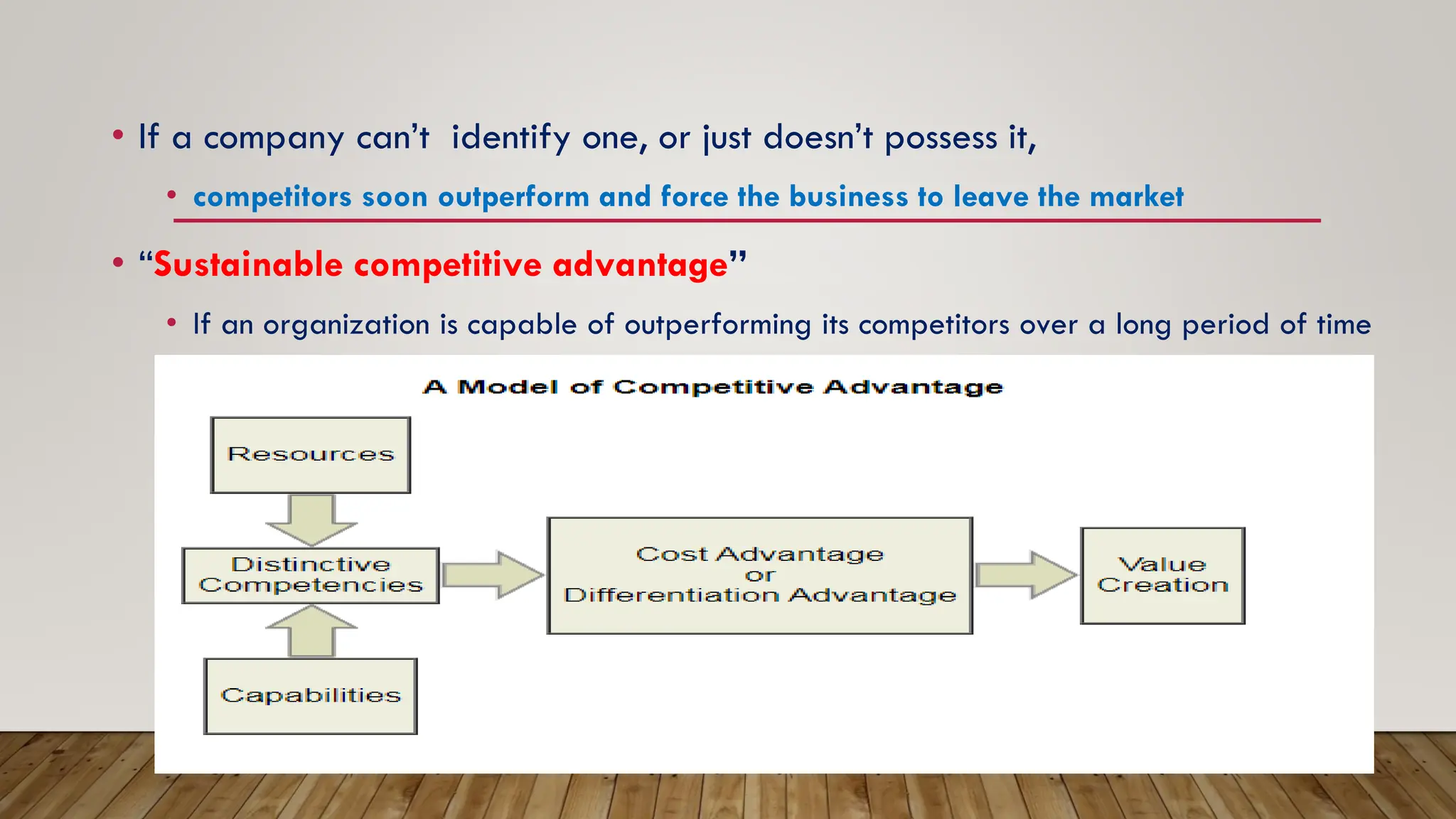
•CA is an attribute that enables a company to outperform its competitors, i.e.
superior performance relative to other competitors or the industry average
• Every company must have at least one advantage to compete in the market
Examples of Competitive Advantage
• A unique geographic location
• Access to new “proprietary technology”
• Ability to manufacture products at the lowest cost
• Brand image recognition
• Access to natural resources that are restricted for others etc
33.
• If acompany can’t identify one, or just doesn’t possess it,
• competitors soon outperform and force the business to leave the market
• “Sustainable competitive advantage”
• If an organization is capable of outperforming its competitors over a long period of time
35.
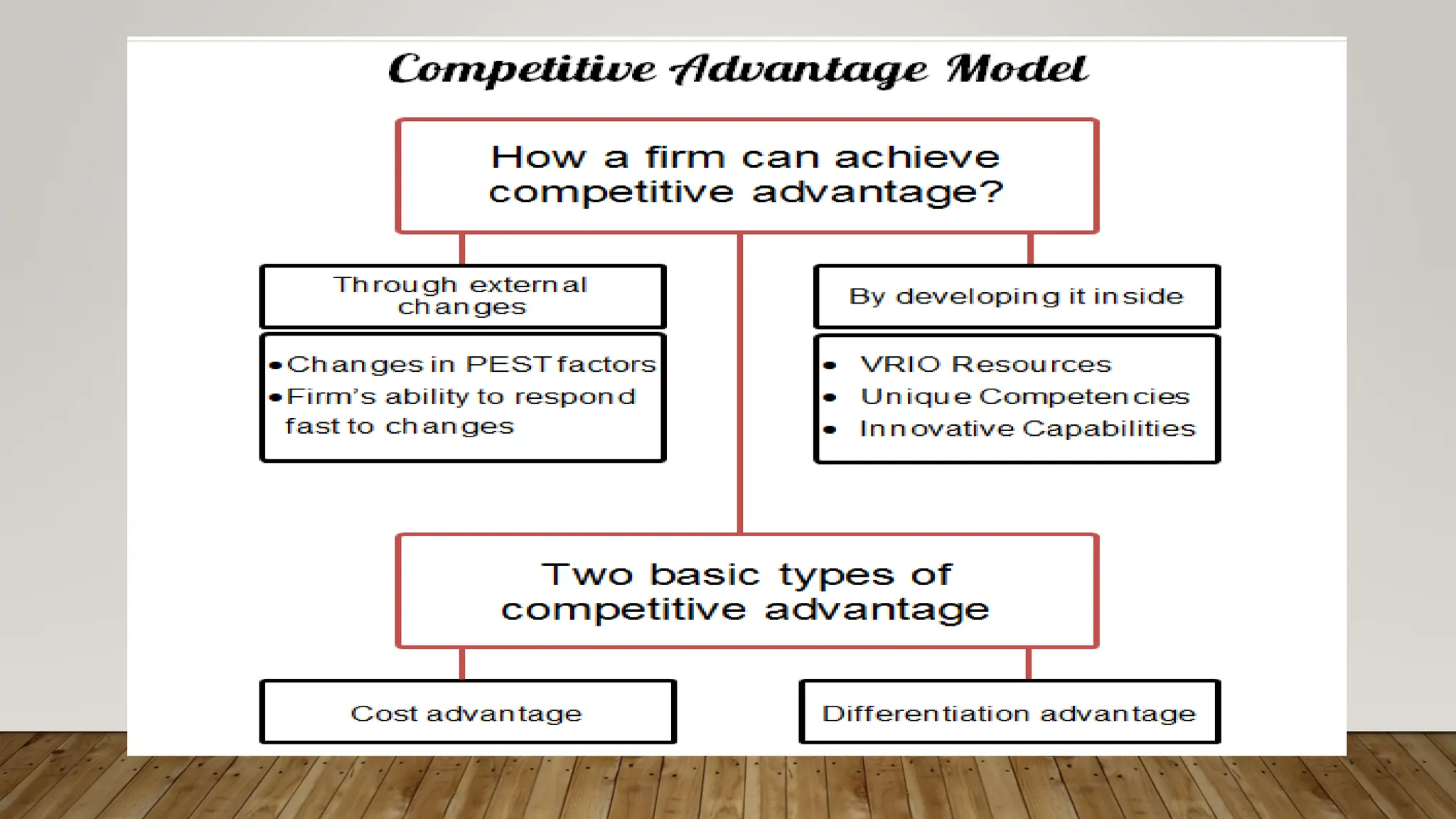
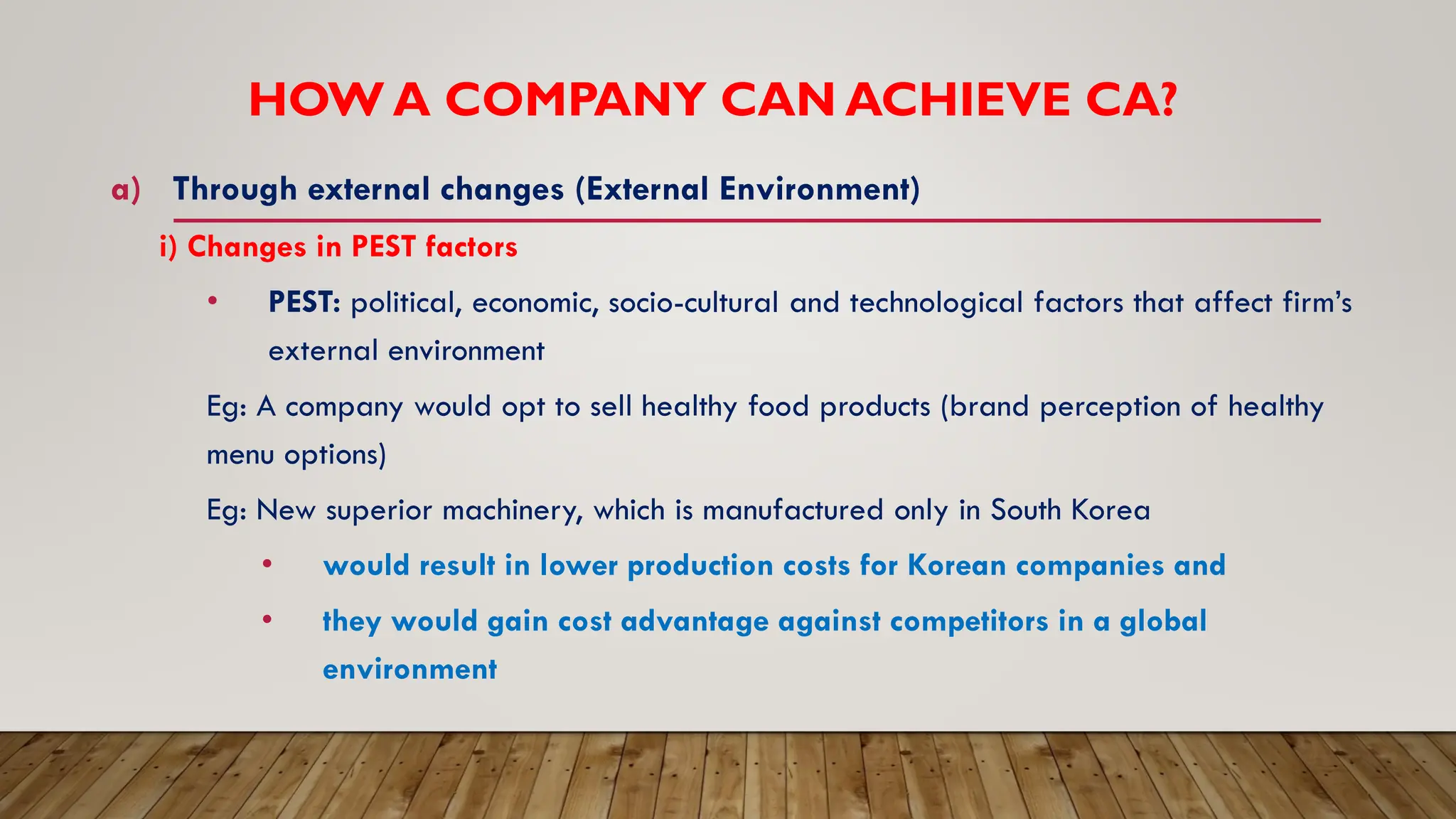
HOW A COMPANYCAN ACHIEVE CA?
a) Through external changes (External Environment)
i) Changes in PEST factors
• PEST: political, economic, socio-cultural and technological factors that affect firm’s
external environment
Eg: A company would opt to sell healthy food products (brand perception of healthy
menu options)
Eg: New superior machinery, which is manufactured only in South Korea
• would result in lower production costs for Korean companies and
• they would gain cost advantage against competitors in a global
environment
36.
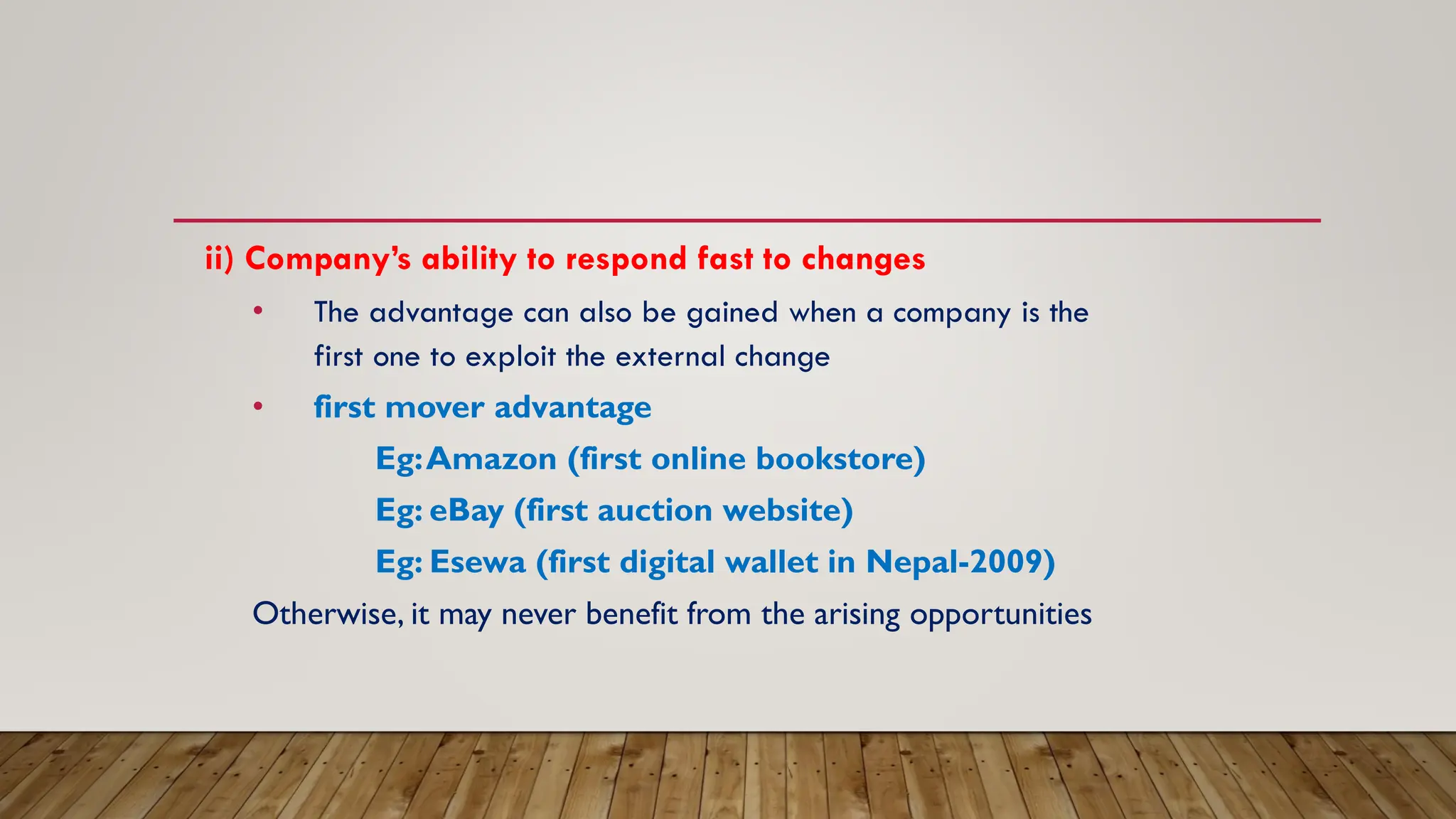
ii) Company’s abilityto respond fast to changes
• The advantage can also be gained when a company is the
first one to exploit the external change
• first mover advantage
Eg:Amazon (first online bookstore)
Eg: eBay (first auction website)
Eg: Esewa (first digital wallet in Nepal-2009)
Otherwise, it may never benefit from the arising opportunities
37.
b) By developinginside (Internal Environment)
i) VRIO (valuable, rare, hard to imitate and organized) resources
• superiority of such resources
• other companies cannot easily acquire it (at least temporarily)
• The following resources have VRIO attributes:
• Intellectual property (patents, copyrights, trademarks)
• Brand equity (value premium) and Reputation (perception)
• Organizational work culture etc
38.
ii) Unique competences
•Competence is an ability to perform tasks successfully with skills, knowledge and
capabilities
• A company that has developed a unique competence in producing something
would get advantage (at least temporary)
• as other companies would find it very hard to replicate the processes,
skills, knowledge and capabilities needed for that competence
39.
iii) Innovative capabilities
•Company gains superiority through innovation
• Innovative products, processes or business models provide strong
competitive edge due to the first mover advantage
• For eg: Apple’s introduction of iPad in 2010, revolutionized the tablet
market
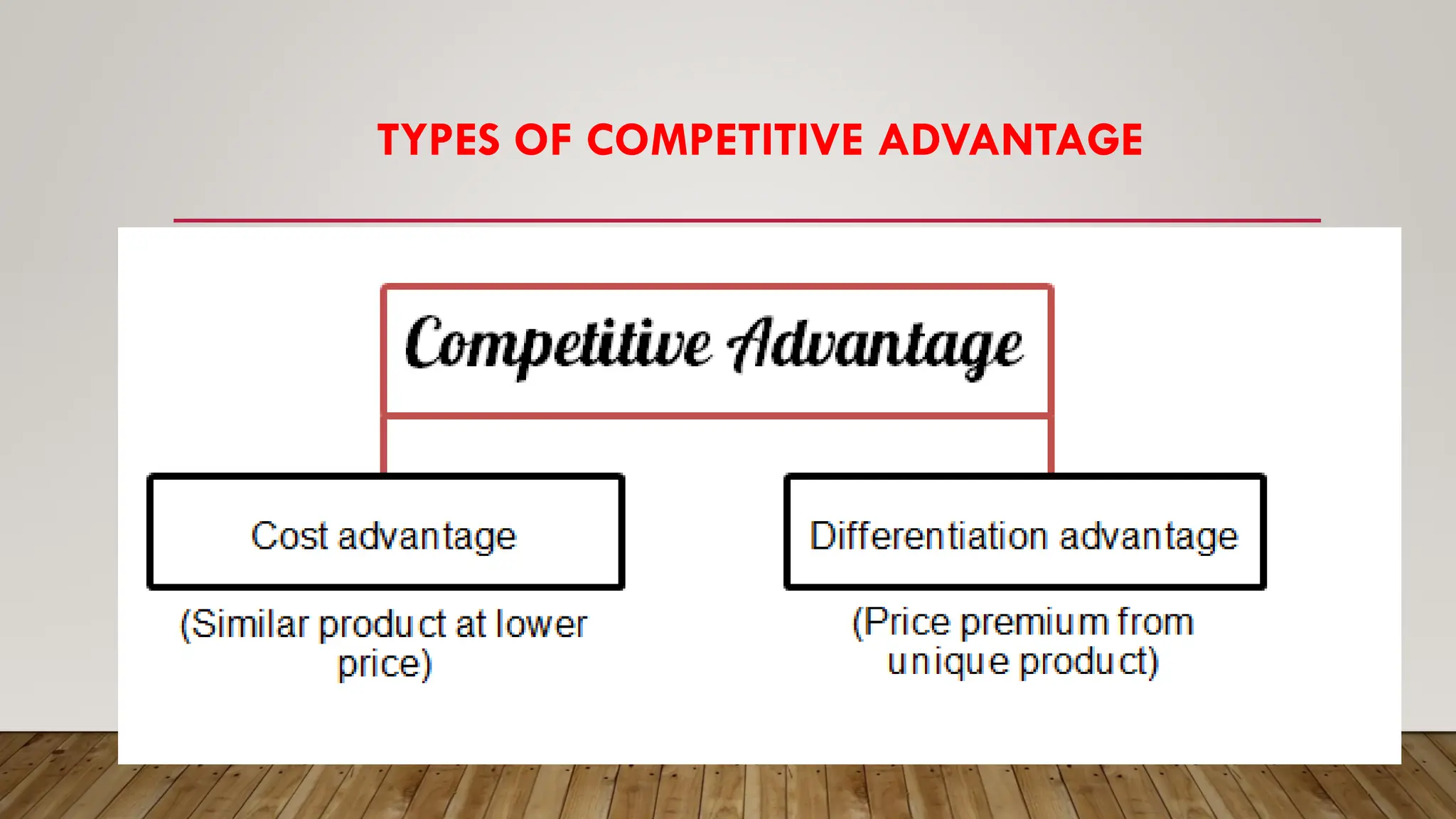
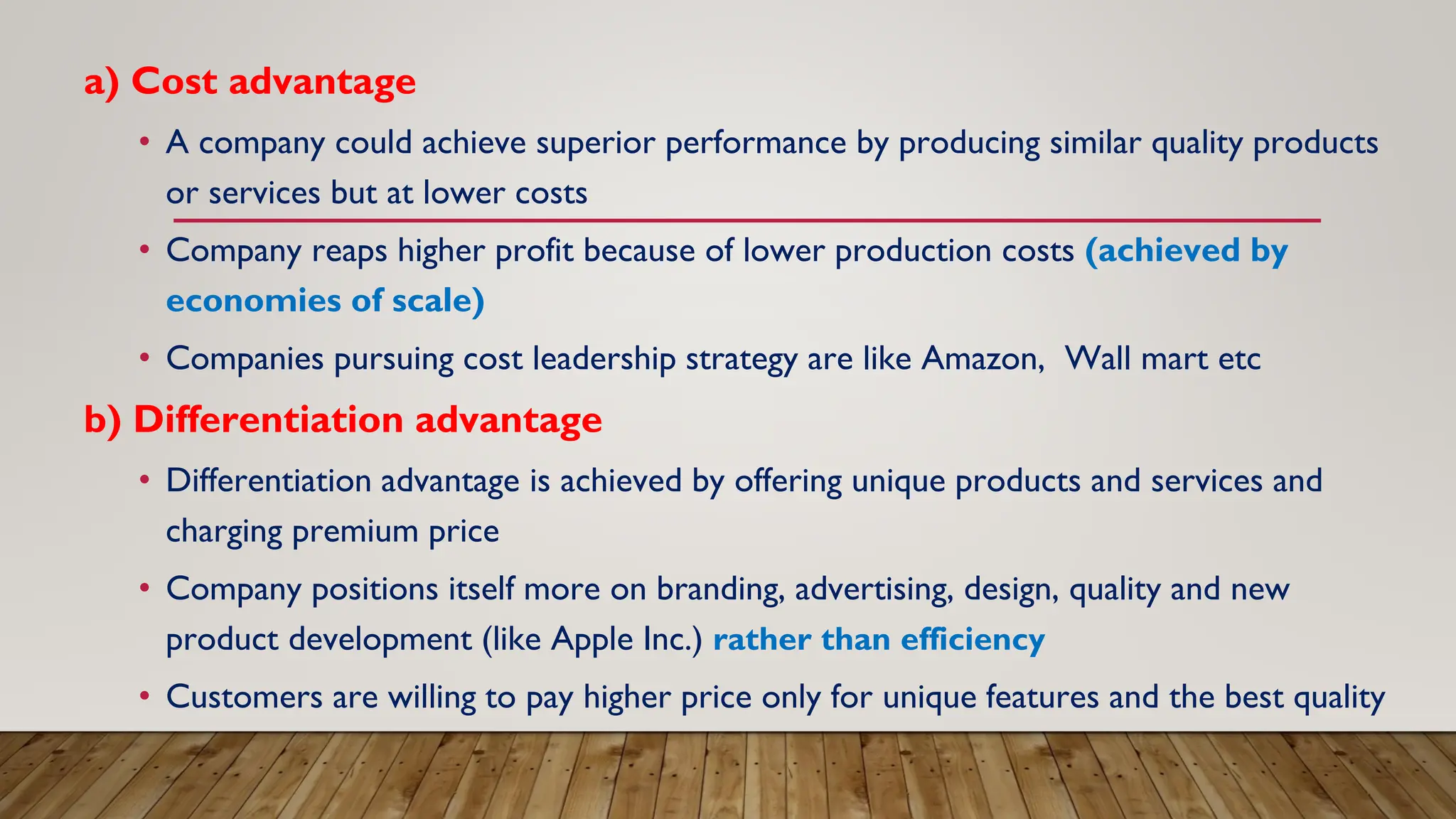
a) Cost advantage
•A company could achieve superior performance by producing similar quality products
or services but at lower costs
• Company reaps higher profit because of lower production costs (achieved by
economies of scale)
• Companies pursuing cost leadership strategy are like Amazon, Wall mart etc
b) Differentiation advantage
• Differentiation advantage is achieved by offering unique products and services and
charging premium price
• Company positions itself more on branding, advertising, design, quality and new
product development (like Apple Inc.) rather than efficiency
• Customers are willing to pay higher price only for unique features and the best quality
42.
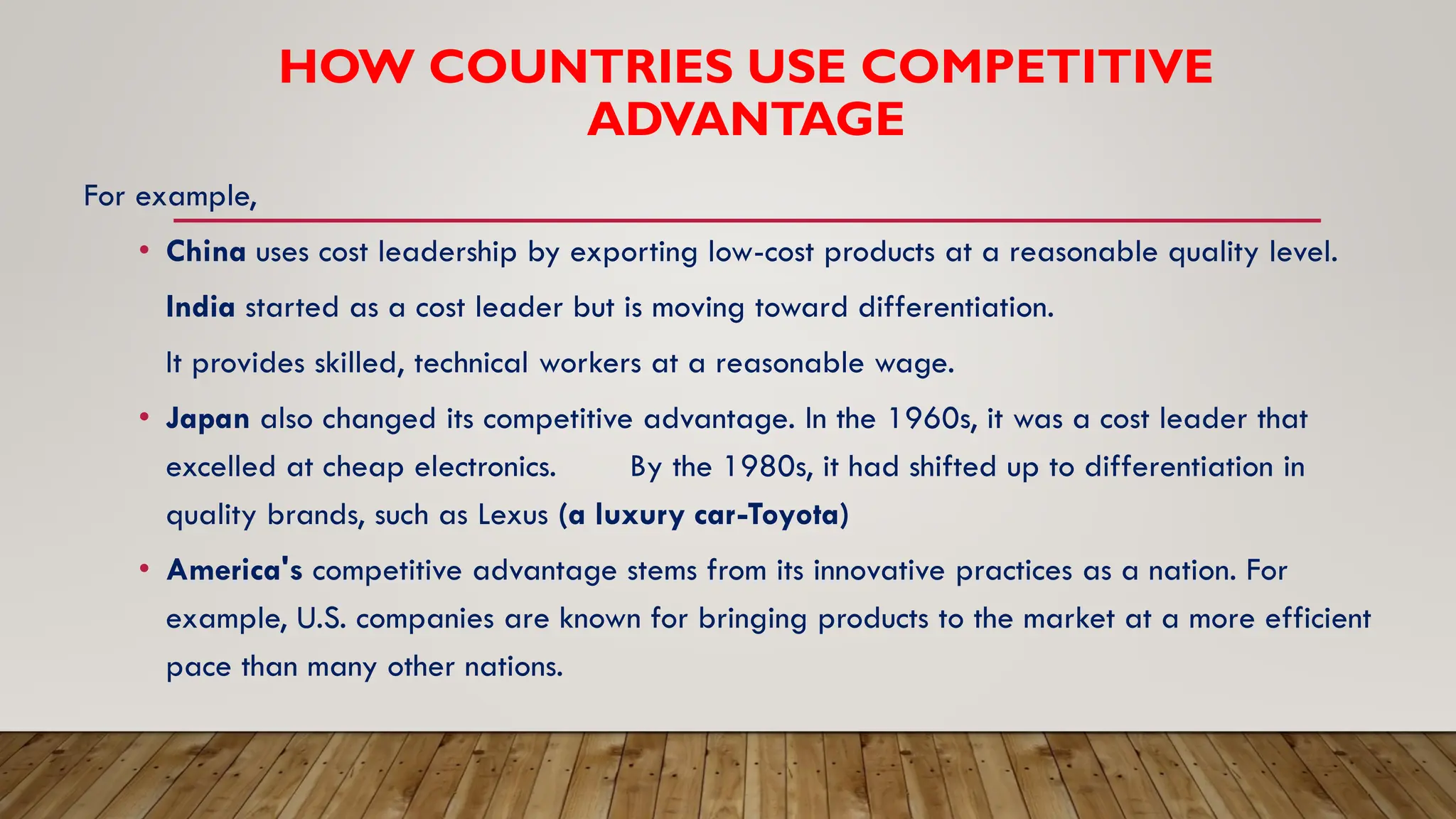
HOW COUNTRIES USECOMPETITIVE
ADVANTAGE
For example,
• China uses cost leadership by exporting low-cost products at a reasonable quality level.
India started as a cost leader but is moving toward differentiation.
It provides skilled, technical workers at a reasonable wage.
• Japan also changed its competitive advantage. In the 1960s, it was a cost leader that
excelled at cheap electronics. By the 1980s, it had shifted up to differentiation in
quality brands, such as Lexus (a luxury car-Toyota)
• America's competitive advantage stems from its innovative practices as a nation. For
example, U.S. companies are known for bringing products to the market at a more efficient
pace than many other nations.
43.
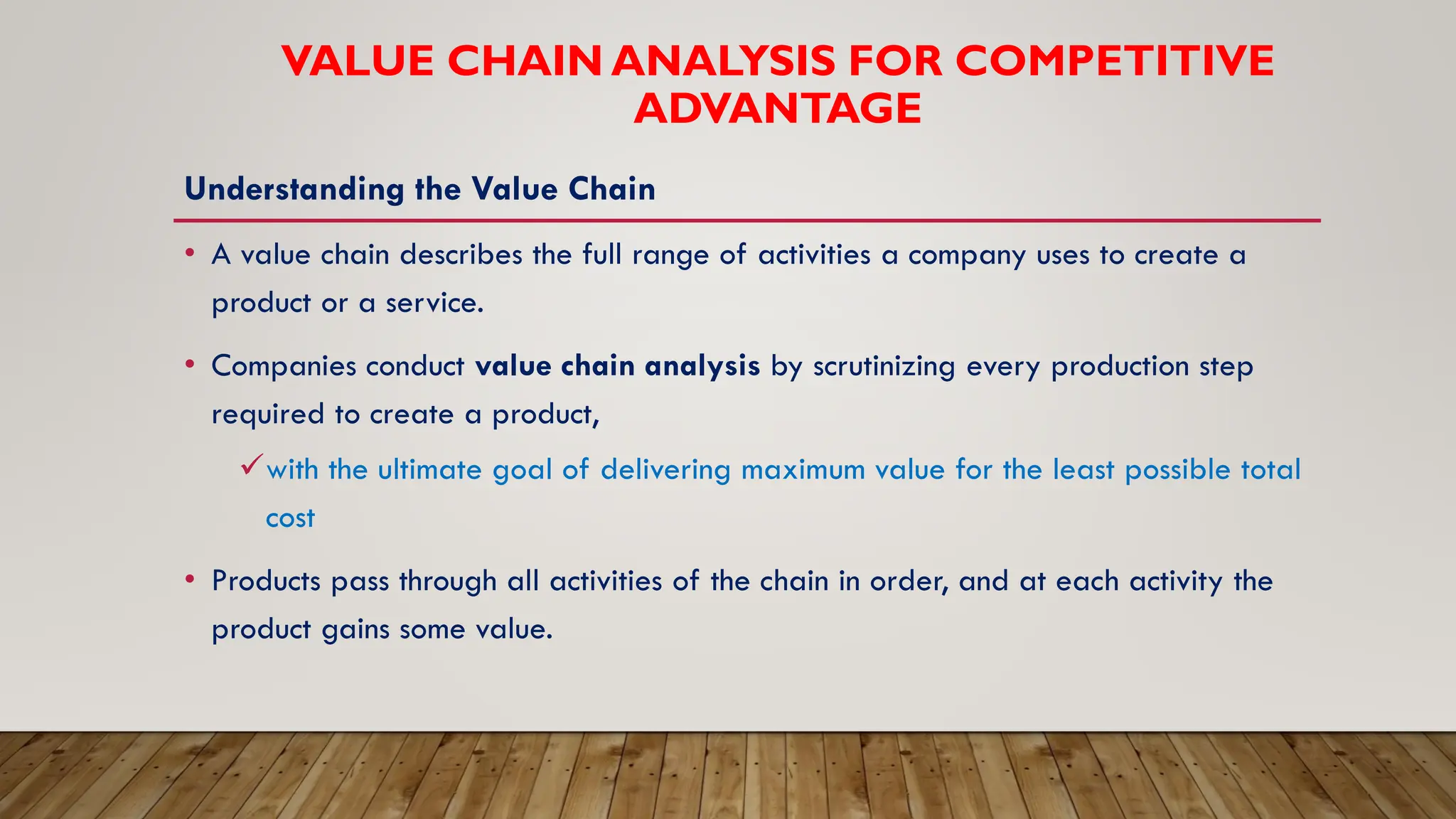
VALUE CHAIN ANALYSISFOR COMPETITIVE
ADVANTAGE
Understanding the Value Chain
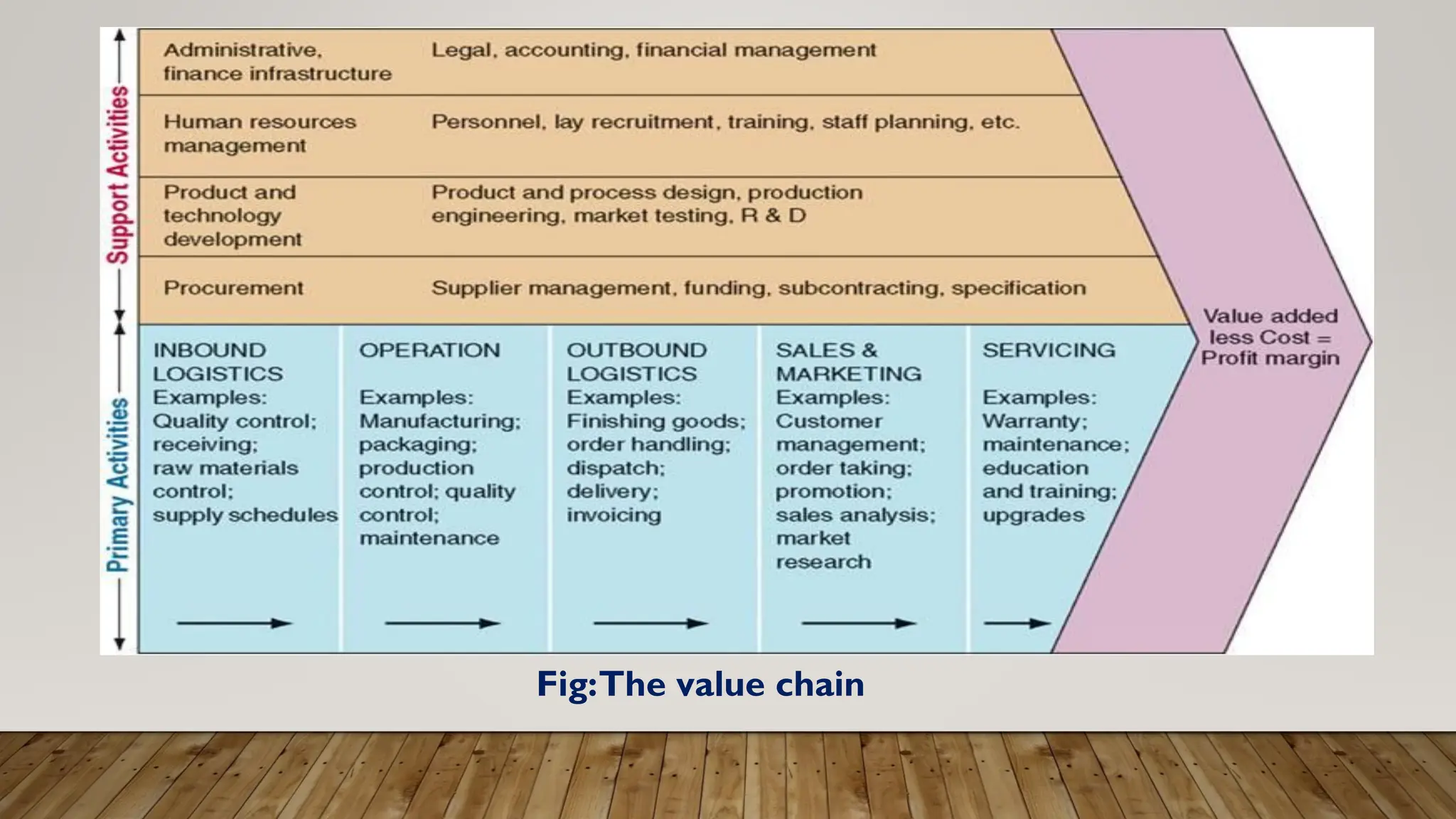
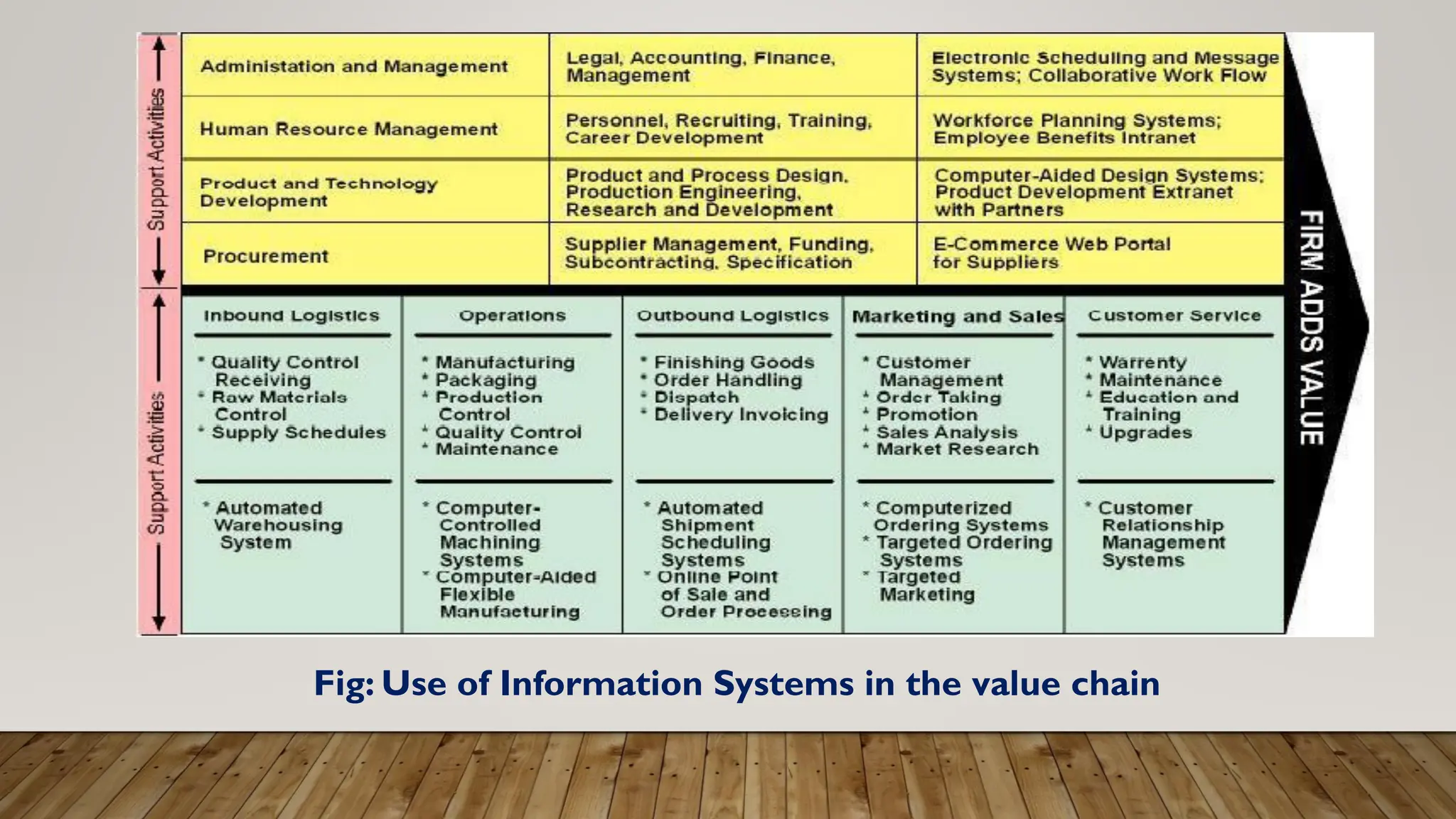
• A value chain describes the full range of activities a company uses to create a
product or a service.
• Companies conduct value chain analysis by scrutinizing every production step
required to create a product,
✓with the ultimate goal of delivering maximum value for the least possible total
cost
• Products pass through all activities of the chain in order, and at each activity the
product gains some value.
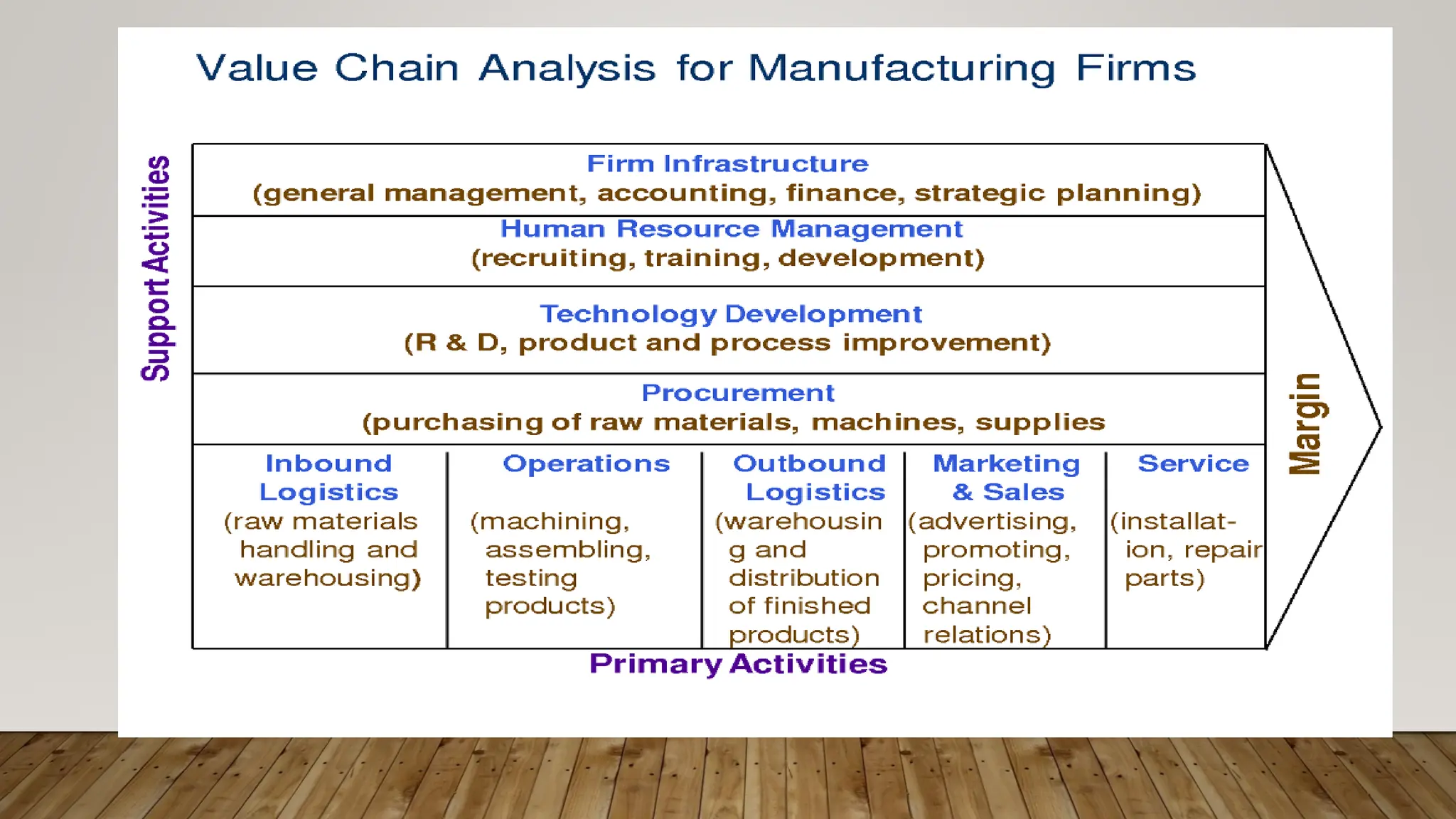
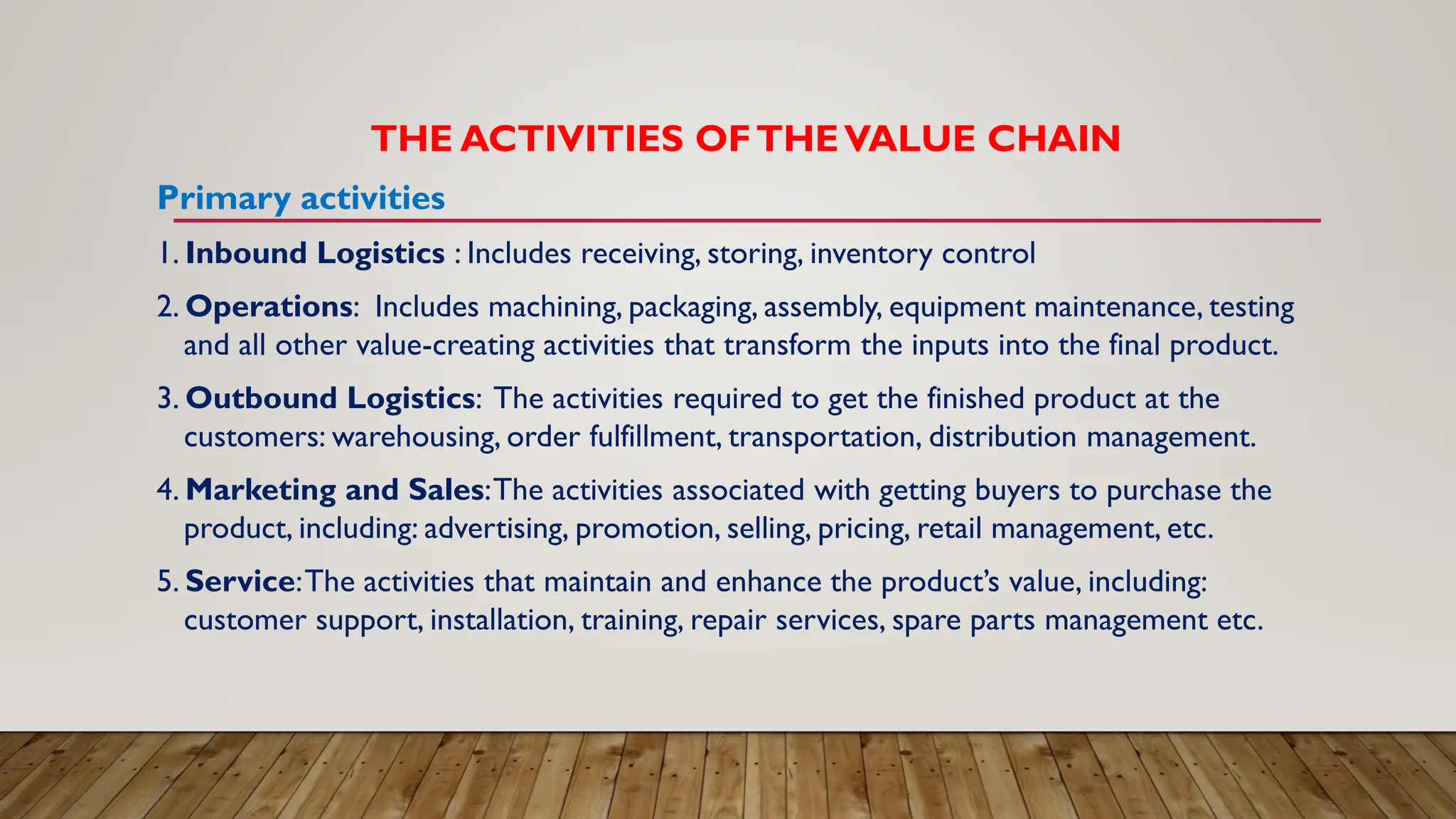
THE ACTIVITIES OFTHEVALUECHAIN
Primary activities
1. Inbound Logistics : Includes receiving, storing, inventory control
2. Operations: Includes machining, packaging, assembly, equipment maintenance, testing
and all other value-creating activities that transform the inputs into the final product.
3. Outbound Logistics: The activities required to get the finished product at the
customers: warehousing, order fulfillment, transportation, distribution management.
4. Marketing and Sales:The activities associated with getting buyers to purchase the
product, including: advertising, promotion, selling, pricing, retail management, etc.
5. Service:The activities that maintain and enhance the product’s value, including:
customer support, installation, training, repair services, spare parts management etc.
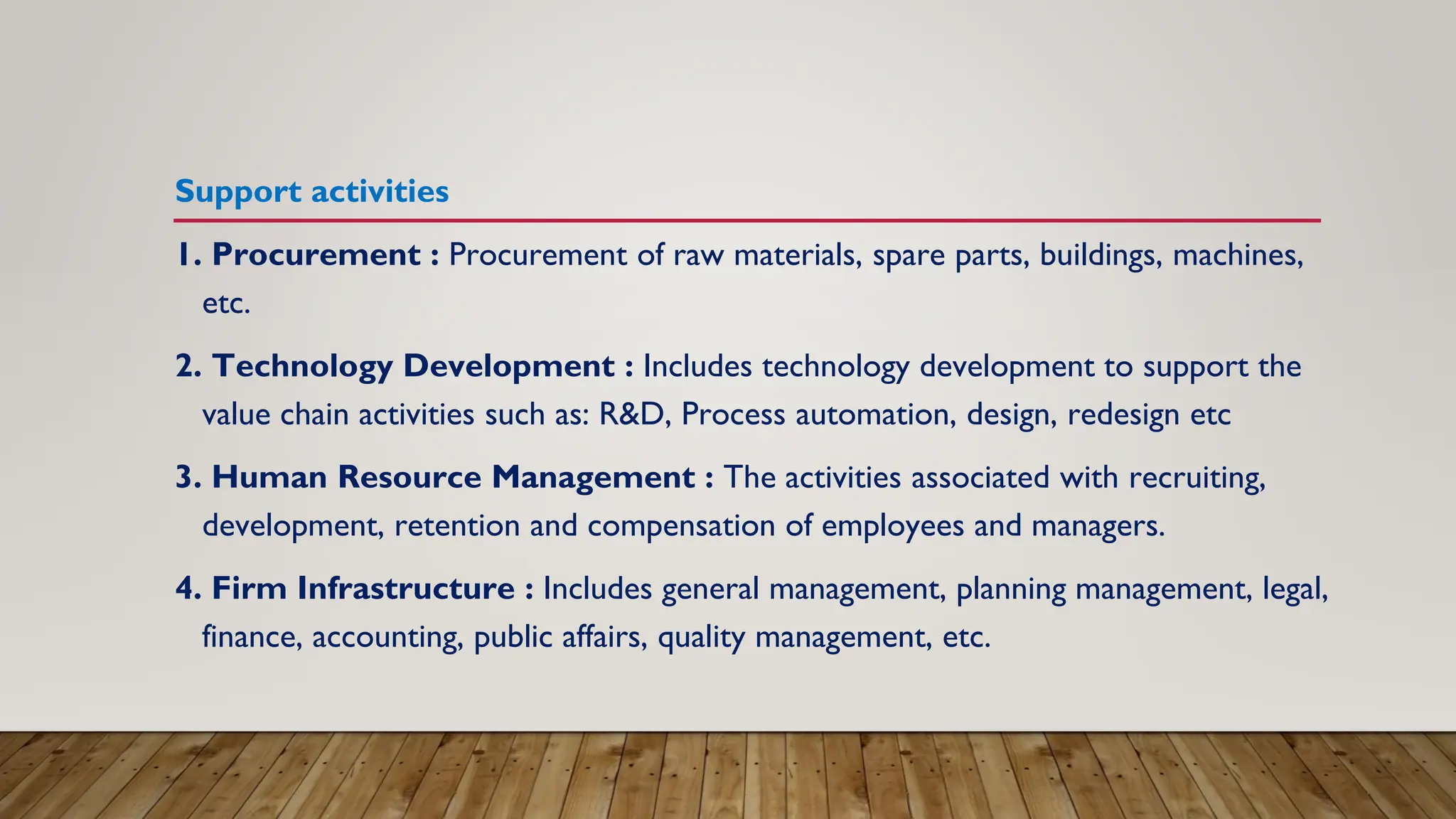
48.
Support activities
1. Procurement: Procurement of raw materials, spare parts, buildings, machines,
etc.
2. Technology Development : Includes technology development to support the
value chain activities such as: R&D, Process automation, design, redesign etc
3. Human Resource Management : The activities associated with recruiting,
development, retention and compensation of employees and managers.
4. Firm Infrastructure : Includes general management, planning management, legal,
finance, accounting, public affairs, quality management, etc.
49.
A COST ADVANTAGEBASED ONTHEVALUE CHAIN
A firm may create a cost advantage:
• by reducing the cost of individual value chain activities or
• by reconfiguring the value chain (eg: cheaper production process, cheaper
distribution channel etc)
• A firm develops a cost advantage by analyzing and controlling primary and
support activities better than its competitors do.
50.
A DIFFERENTIATION ADVANTAGEBASED ONTHE
VALUE CHAIN
• A differentiation advantage can arise from any part of the chain
• For example: procurement of inputs that are unique and not widely available to
competitors , distribution channels that offer higher service levels
• Differentiation always stems from uniqueness
• Organization may implement new process technologies or utilize new distribution
channels
• The firm may need to be creative in order to develop a novel value chain
configuration that increases product differentiation




![Vibe Coding vs. Spec-Driven Development [Free Meetup]](https://cdn.slidesharecdn.com/ss_thumbnails/vibecodingvsspecdrivendevelopment-251209105622-43f455e7-thumbnail.jpg?width=640&height=640&fit=bounds)


