Electronic Banking in Nepal
Mr. Roshan Bhattarai
Kathmandu, Nepal
Electronic Banking
• E-banking is a process by which
– a customer performs banking transactions electronically
– without visiting the physical premises of the financial institutions
• It uses the internet as the delivery channel
– to conduct banking activity for eg transfer funds, paying bills etc.
• Banking activities conventionally done by visiting a bank
– can now be done through a computer with internet access
• Service production and service delivery will be fully automated,
– which significantly lowers per unit cost associated with high
volume transactions
History of E-banking in Nepal
• Establishment of Nepal Bank Limited in1937
– as a first bank of Nepal
• After almost 53 years credit card is introduced by The Nabil Bank
Ltd in early 1990s
• Establishment of first ISP (Mercantile office systems) took place in
1994
• Automated Teller Machine (ATM) and Telebanking was introduced
The Himalayan Bank Ltd in 1995 and 1997 respectively
• IT policy was formulated in the year 2000
• The Kumari Bank Ltd started Internet banking in 2002
• The Laxmi Bank Ltd introduced SMS Banking (Mobile Banking) in
the year 2004
• Electronic transaction and digital signature Act was revised on 2005
• Internet banking is still not much popular in Nepal,
– people still rely on traditional ways of banking
– Lack of knowledge of internet and digital technology might be
the reason
• Major cities like Kathmandu, Biratnagar, Pokhara, Birjung have
good internet facilities
• Majority of the banks provides the internet banking in urban
cities
– but it is in its early stage and is not utilized by most of the bank’s
customers.
• Few e-banking frauds have been found yet,
• E-banking is in its infancy right now, it means the system is not
perfectly secure and precautions must be taken.
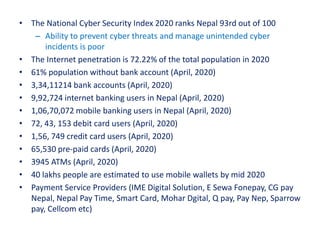
• The National Cyber Security Index 2020 ranks Nepal 93rd out of 100
– Ability to prevent cyber threats and manage unintended cyber
incidents is poor
• The Internet penetration is 72.22% of the total population in 2020
• 61% population without bank account (April, 2020)
• 3,34,11214 bank accounts (April, 2020)
• 9,92,724 internet banking users in Nepal (April, 2020)
• 1,06,70,072 mobile banking users in Nepal (April, 2020)
• 72, 43, 153 debit card users (April, 2020)
• 1,56, 749 credit card users (April, 2020)
• 65,530 pre-paid cards (April, 2020)
• 3945 ATMs (April, 2020)
• 40 lakhs people are estimated to use mobile wallets by mid 2020
• Payment Service Providers (IME Digital Solution, E Sewa Fonepay, CG pay
Nepal, Nepal Pay Time, Smart Card, Mohar Dgital, Q pay, Pay Nep, Sparrow
pay, Cellcom etc)
Current channels of e-banking in Nepal
• ATM (Cash withdrawals, balance and statement inquiry etc)
• ECC (Electronic Cheque Clearance) by NCHL
• Point of Sale -PoS Machine (financial transactions through
cards)
• Telephone Banking (Balance inquiry, account status check etc)
• Mobile banking (SMS alerts for deposits, withdrawals and
account status)
• Internet banking/online banking (funds transfer within
accounts, utility bill payments, get statement online, recharge
NTC and eSewa accounts, request checkbook etc)
– IPS( Interbank Payment System), SWIFT (Society for worldwide
Interbank Financial Telecommunications)
• Mobile (digital) wallet (Esewa, Khalti, Prabhu pay etc to load
money from bank account and use it for payment of goods or
services)
Few general precautions while using e-banking facilities:
• Never give your cards or card number to anyone
• Don’t use public computer for e-transactions
• Don’t give your information to unknown websites
• Use passwords which are difficult to guess
• Regularly check your account status
• Inform your service provider if you feel something
wrong/abnormal
• Change PIN or password regularly
• Set few incorrect password submissions options
• Never click embedded links in email, social sites carelessly
• Don’t transfer funds without verification of the recipient
• Don’t store password or other sensitive information in written
form
About eSewa
• eSewa is a secured online payment service (digital wallet)
offered by F1Soft International Pvt Ltd.
• Founded by Mr. Himal Niraula and Biswas Dhakal
• Objective of eSewa is to allow payment of bills to various
merchants or companies from one place
• This saves from travelling to each company and wait in long
lines to pay your bills
• In addition, the payment is done through secured channel
– without exposing bank account or card number to the company
where you want to pay your bills to
• It is in operation since 2009 and
– has recently been licensed by Nepal Rastra Bank as Payment
Service Provider
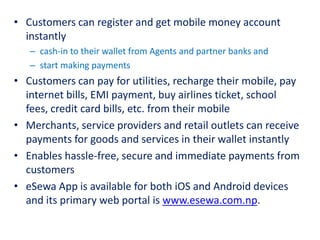
• Customers can register and get mobile money account
instantly
– cash-in to their wallet from Agents and partner banks and
– start making payments
• Customers can pay for utilities, recharge their mobile, pay
internet bills, EMI payment, buy airlines ticket, school
fees, credit card bills, etc. from their mobile
• Merchants, service providers and retail outlets can receive
payments for goods and services in their wallet instantly
• Enables hassle-free, secure and immediate payments from
customers
• eSewa App is available for both iOS and Android devices
and its primary web portal is www.esewa.com.np.
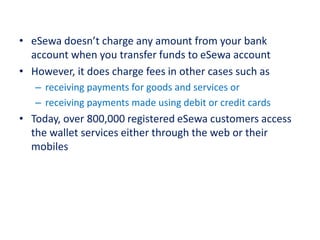
• eSewa doesn’t charge any amount from your bank
account when you transfer funds to eSewa account
• However, it does charge fees in other cases such as
– receiving payments for goods and services or
– receiving payments made using debit or credit cards
• Today, over 800,000 registered eSewa customers access
the wallet services either through the web or their
mobiles
SECURITY
• eSewa is secured by 128 bit VeriSign SSL Certificate,
– which means personal information like user id and password, and
– the information about your transactions
– are encrypted before being transmitted through the internet
• When you deposit/transfer funds from partner banks to
eSewa,
– communication between the bank and eSewa is carried out via
secured VPN connection
– All the data are stored in state-of-the-art data center
• https://esewa.com.np (secure hypertext transfer protocol)
• Valid mail id and Mobile number is used for identification
• Regulated by the Nepal Rastra Bank’s rules and regulations
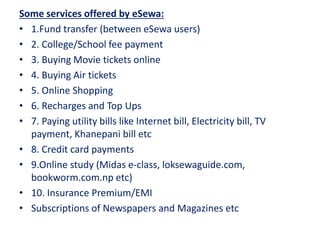
Some services offered by eSewa:
• 1.Fund transfer (between eSewa users)
• 2. College/School fee payment
• 3. Buying Movie tickets online
• 4. Buying Air tickets
• 5. Online Shopping
• 6. Recharges and Top Ups
• 7. Paying utility bills like Internet bill, Electricity bill, TV
payment, Khanepani bill etc
• 8. Credit card payments
• 9.Online study (Midas e-class, loksewaguide.com,
bookworm.com.np etc)
• 10. Insurance Premium/EMI
• Subscriptions of Newspapers and Magazines etc
THANK YOU!!

Electronic Banking in Nepal

  • 1.
    Electronic Banking inNepal Mr. Roshan Bhattarai Kathmandu, Nepal
  • 2.
    Electronic Banking • E-bankingis a process by which – a customer performs banking transactions electronically – without visiting the physical premises of the financial institutions • It uses the internet as the delivery channel – to conduct banking activity for eg transfer funds, paying bills etc. • Banking activities conventionally done by visiting a bank – can now be done through a computer with internet access • Service production and service delivery will be fully automated, – which significantly lowers per unit cost associated with high volume transactions
  • 3.
    History of E-bankingin Nepal • Establishment of Nepal Bank Limited in1937 – as a first bank of Nepal • After almost 53 years credit card is introduced by The Nabil Bank Ltd in early 1990s • Establishment of first ISP (Mercantile office systems) took place in 1994 • Automated Teller Machine (ATM) and Telebanking was introduced The Himalayan Bank Ltd in 1995 and 1997 respectively • IT policy was formulated in the year 2000 • The Kumari Bank Ltd started Internet banking in 2002 • The Laxmi Bank Ltd introduced SMS Banking (Mobile Banking) in the year 2004 • Electronic transaction and digital signature Act was revised on 2005
  • 4.
    • Internet bankingis still not much popular in Nepal, – people still rely on traditional ways of banking – Lack of knowledge of internet and digital technology might be the reason • Major cities like Kathmandu, Biratnagar, Pokhara, Birjung have good internet facilities • Majority of the banks provides the internet banking in urban cities – but it is in its early stage and is not utilized by most of the bank’s customers. • Few e-banking frauds have been found yet, • E-banking is in its infancy right now, it means the system is not perfectly secure and precautions must be taken.
  • 5.
    • The NationalCyber Security Index 2020 ranks Nepal 93rd out of 100 – Ability to prevent cyber threats and manage unintended cyber incidents is poor • The Internet penetration is 72.22% of the total population in 2020 • 61% population without bank account (April, 2020) • 3,34,11214 bank accounts (April, 2020) • 9,92,724 internet banking users in Nepal (April, 2020) • 1,06,70,072 mobile banking users in Nepal (April, 2020) • 72, 43, 153 debit card users (April, 2020) • 1,56, 749 credit card users (April, 2020) • 65,530 pre-paid cards (April, 2020) • 3945 ATMs (April, 2020) • 40 lakhs people are estimated to use mobile wallets by mid 2020 • Payment Service Providers (IME Digital Solution, E Sewa Fonepay, CG pay Nepal, Nepal Pay Time, Smart Card, Mohar Dgital, Q pay, Pay Nep, Sparrow pay, Cellcom etc)
  • 6.
    Current channels ofe-banking in Nepal • ATM (Cash withdrawals, balance and statement inquiry etc) • ECC (Electronic Cheque Clearance) by NCHL • Point of Sale -PoS Machine (financial transactions through cards) • Telephone Banking (Balance inquiry, account status check etc) • Mobile banking (SMS alerts for deposits, withdrawals and account status) • Internet banking/online banking (funds transfer within accounts, utility bill payments, get statement online, recharge NTC and eSewa accounts, request checkbook etc) – IPS( Interbank Payment System), SWIFT (Society for worldwide Interbank Financial Telecommunications) • Mobile (digital) wallet (Esewa, Khalti, Prabhu pay etc to load money from bank account and use it for payment of goods or services)
  • 7.
    Few general precautionswhile using e-banking facilities: • Never give your cards or card number to anyone • Don’t use public computer for e-transactions • Don’t give your information to unknown websites • Use passwords which are difficult to guess • Regularly check your account status • Inform your service provider if you feel something wrong/abnormal • Change PIN or password regularly • Set few incorrect password submissions options • Never click embedded links in email, social sites carelessly • Don’t transfer funds without verification of the recipient • Don’t store password or other sensitive information in written form
  • 8.
    About eSewa • eSewais a secured online payment service (digital wallet) offered by F1Soft International Pvt Ltd. • Founded by Mr. Himal Niraula and Biswas Dhakal • Objective of eSewa is to allow payment of bills to various merchants or companies from one place • This saves from travelling to each company and wait in long lines to pay your bills • In addition, the payment is done through secured channel – without exposing bank account or card number to the company where you want to pay your bills to • It is in operation since 2009 and – has recently been licensed by Nepal Rastra Bank as Payment Service Provider
  • 9.
    • Customers canregister and get mobile money account instantly – cash-in to their wallet from Agents and partner banks and – start making payments • Customers can pay for utilities, recharge their mobile, pay internet bills, EMI payment, buy airlines ticket, school fees, credit card bills, etc. from their mobile • Merchants, service providers and retail outlets can receive payments for goods and services in their wallet instantly • Enables hassle-free, secure and immediate payments from customers • eSewa App is available for both iOS and Android devices and its primary web portal is www.esewa.com.np.
  • 10.
    • eSewa doesn’tcharge any amount from your bank account when you transfer funds to eSewa account • However, it does charge fees in other cases such as – receiving payments for goods and services or – receiving payments made using debit or credit cards • Today, over 800,000 registered eSewa customers access the wallet services either through the web or their mobiles
  • 11.
    SECURITY • eSewa issecured by 128 bit VeriSign SSL Certificate, – which means personal information like user id and password, and – the information about your transactions – are encrypted before being transmitted through the internet • When you deposit/transfer funds from partner banks to eSewa, – communication between the bank and eSewa is carried out via secured VPN connection – All the data are stored in state-of-the-art data center • https://esewa.com.np (secure hypertext transfer protocol) • Valid mail id and Mobile number is used for identification • Regulated by the Nepal Rastra Bank’s rules and regulations
  • 12.
    Some services offeredby eSewa: • 1.Fund transfer (between eSewa users) • 2. College/School fee payment • 3. Buying Movie tickets online • 4. Buying Air tickets • 5. Online Shopping • 6. Recharges and Top Ups • 7. Paying utility bills like Internet bill, Electricity bill, TV payment, Khanepani bill etc • 8. Credit card payments • 9.Online study (Midas e-class, loksewaguide.com, bookworm.com.np etc) • 10. Insurance Premium/EMI • Subscriptions of Newspapers and Magazines etc
  • 13.