IN THIS PRESENTATION
• BROADCASTING
• DVB
• DVB-STANDARDS
• FREQUENCY BANDS
• BLOCK DIAGRAM OF DIGITAL NETWORK
• INTRODUCTION TO DVB-S, C, T
• DIFFERENT DEVICES USED IN DIGITAL
NETWORK
Broadcasting:
• InTelecommunication, broadcasting refers to a method of transferring a
message to all recipients simultaneously
DigitalVideo Broadcasting (DVB)
• DVB is a set of standards that define digital broadcasting using existing
satellite, cable, and terrestrial infrastructures.
• The term digital television is sometimes used as a synonym for DVB
DVB Standards
• DVB-S
• DVB-C
• DVB-T
• DVB-S2
• DVB-C2
• DVB-T2
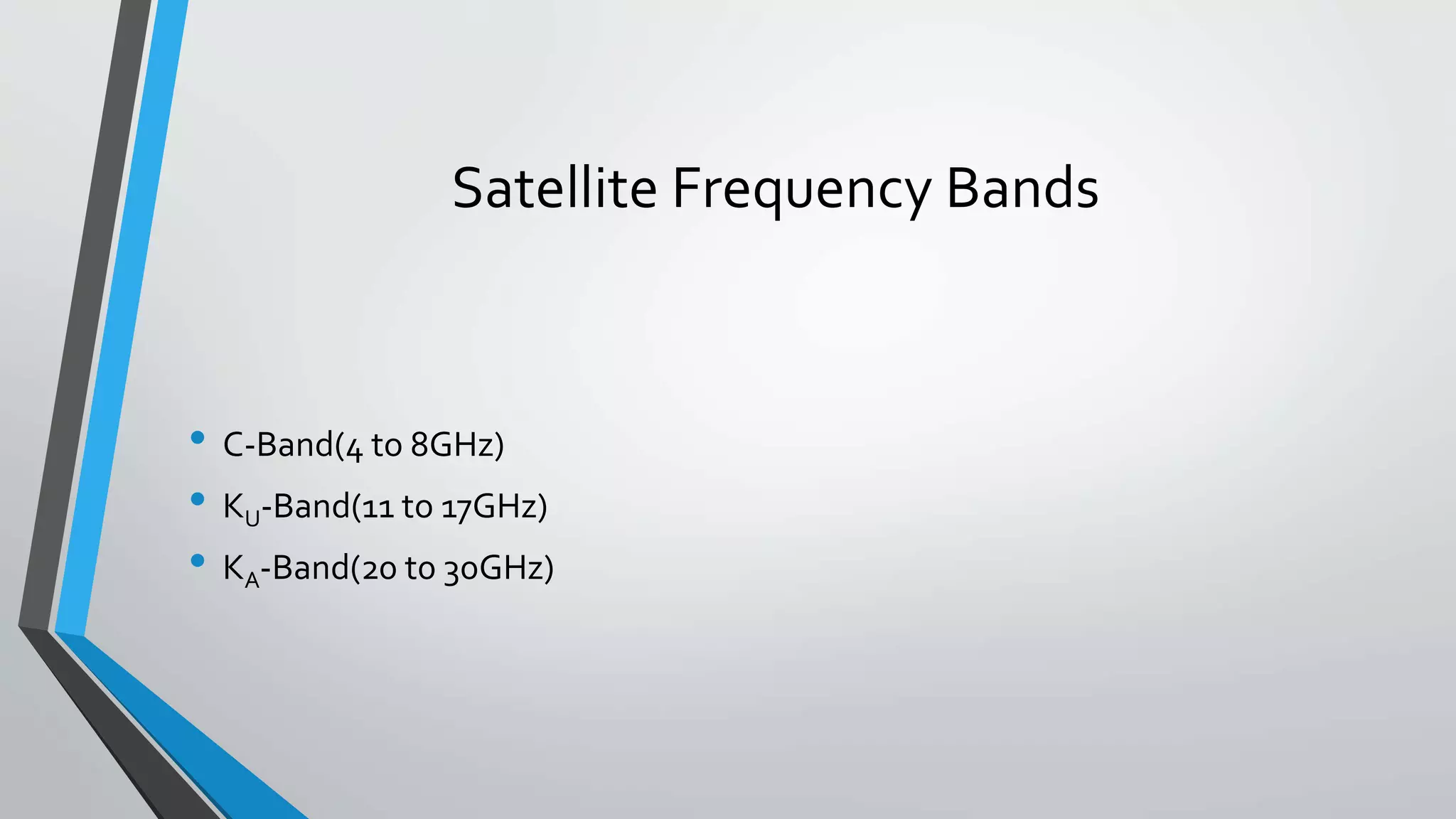
Satellite Frequency Bands
• C-Band(4 to 8GHz)
• KU-Band(11 to 17GHz)
• KA-Band(20 t0 30GHz)
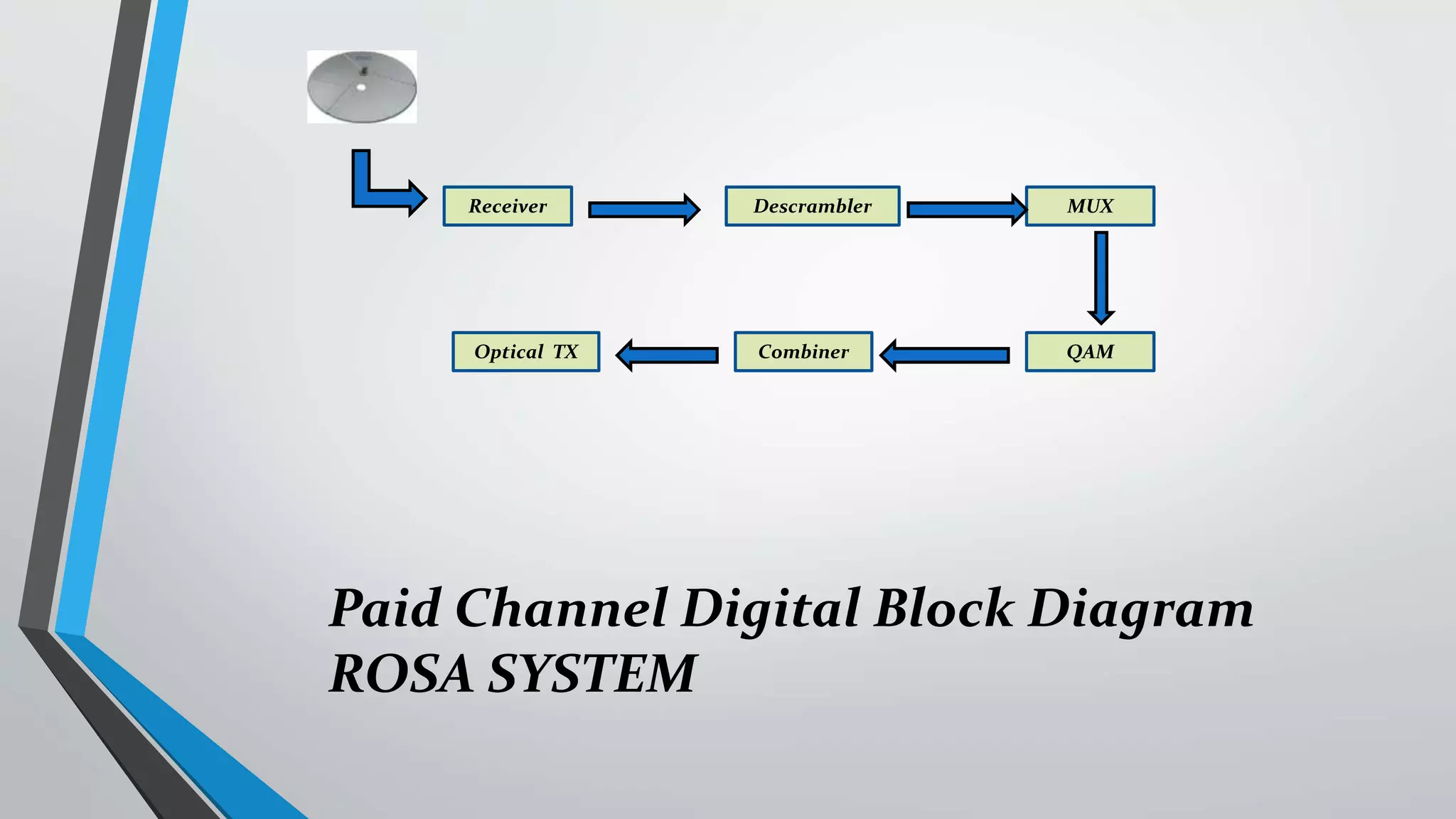
Receiver MUX
CombinerOptical TX
Free To Air Digital Channel Block
ROSA SYSTEM
QAM
Receiver MUX
QAMCombinerOptical TX
Descrambler
Paid Channel Digital Block Diagram
ROSA SYSTEM
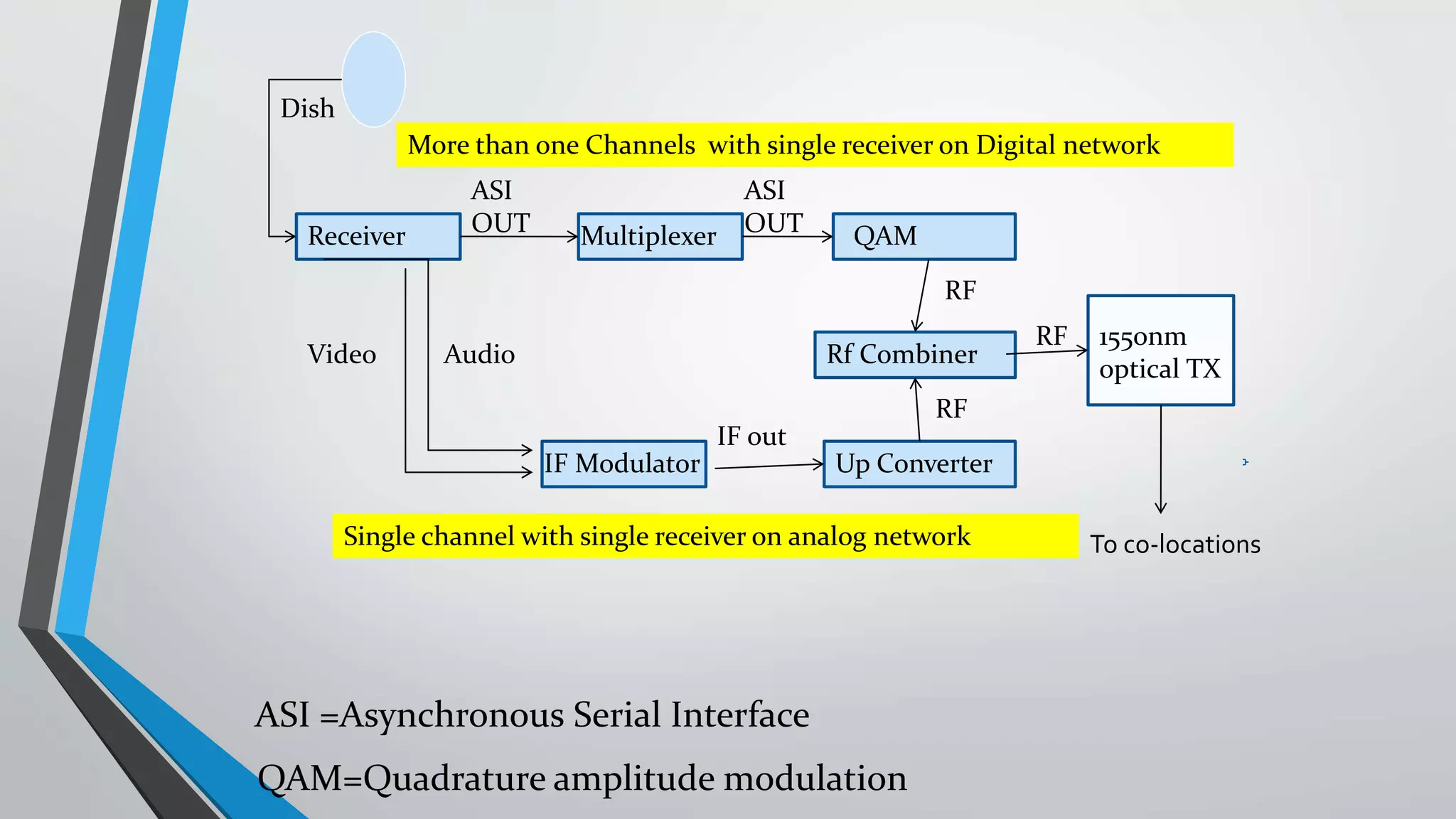
Receiver Multiplexer QAM
IF Modulator
AudioVideo
IF out
Up Converter
ASI
OUT
ASI
OUT
ASI =Asynchronous Serial Interface
Rf Combiner
1550nm
optical TX
More than one Channels with single receiver on Digital network
Dish
Single channel with single receiver on analog network
RF
RF
RF
To co-locations
QAM=Quadrature amplitude modulation
DVB-S
• DVB-S is an abbreviation for "DigitalVideo Broadcasting — Satellite“.
• It is the original DigitalVideo Broadcasting Forward error correction and
demodulation standard for Satellite Television.
• Dates from 1995, in its first release, while development lasted from 1993 to
1997.
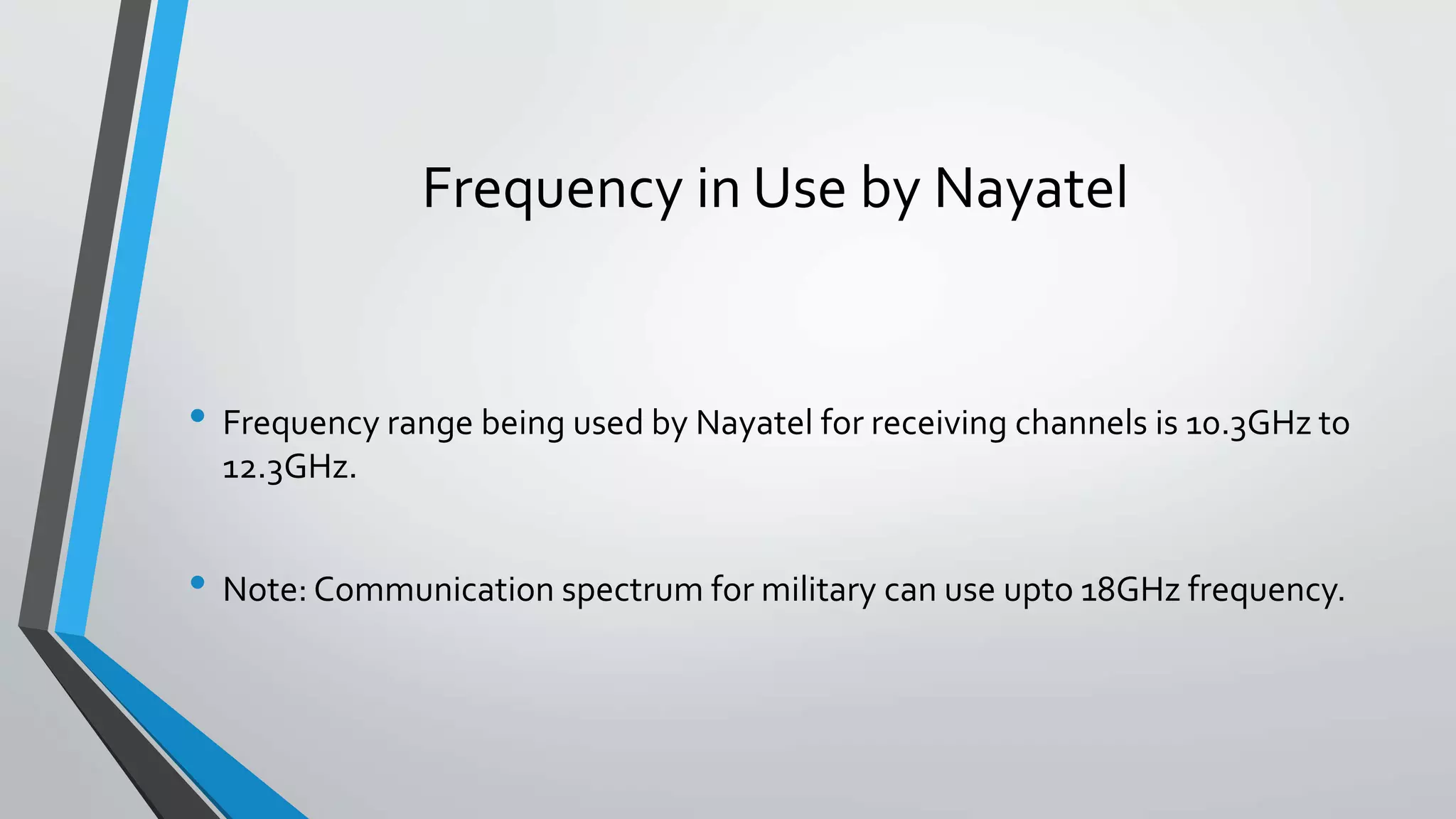
Frequency in Use by Nayatel
• Frequency range being used by Nayatel for receiving channels is 10.3GHz to
12.3GHz.
• Note: Communication spectrum for military can use upto 18GHz frequency.
DVB-S2
DigitalVideo Broadcasting - Satellite - Second
Generation
• designed as a successor for the popular DVB-S system.
• Developed in 2003
• Impact2 and Impact4 Encoding Schemes are used to lessen the Bandwidth
• The development of DVB-S2 coincided with the introduction of HDTV
and H.264 (MPEG-4 AVC)
Difference Between DVB-S, DVB-S2
• DVBS is basically SD (NOT HD) and DVBS2 is HD
• DVBS sends in MPEG2 (like what you find in DVD`s) and DVBS2 sends in
MPEG4 which is a better compression algorithm
• DVB-S use QPSK as Modulation Mode while DVB-S2 uses QPSK, 8PSK,
16PSK modulation modes.
Improvements:
• In March 2014, DVB-S2X specification has been published by DVB Project
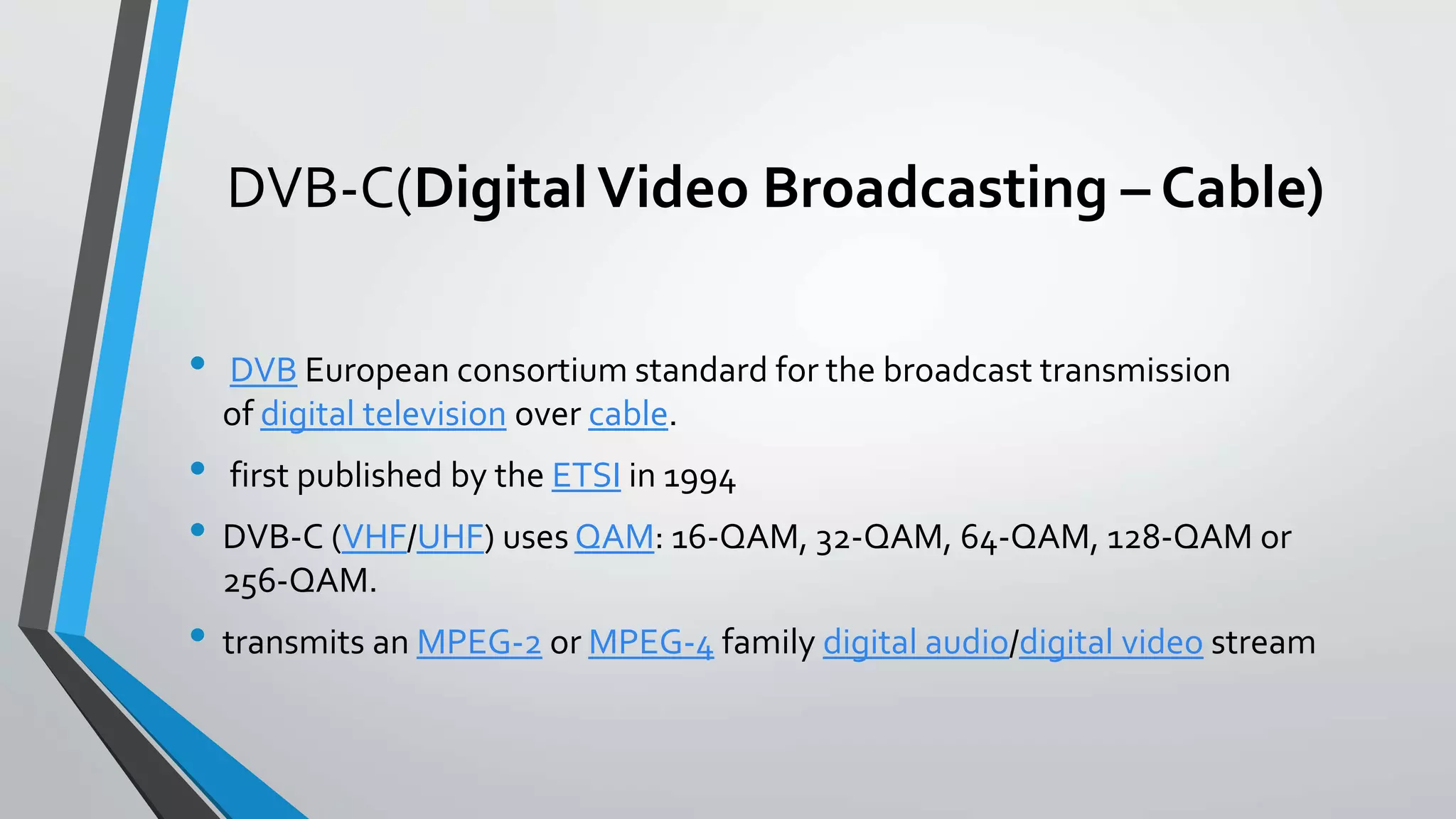
DVB-C(DigitalVideo Broadcasting – Cable)
• DVB European consortium standard for the broadcast transmission
of digital television over cable.
• first published by the ETSI in 1994
• DVB-C (VHF/UHF) uses QAM: 16-QAM, 32-QAM, 64-QAM, 128-QAM or
256-QAM.
• transmits an MPEG-2 or MPEG-4 family digital audio/digital video stream
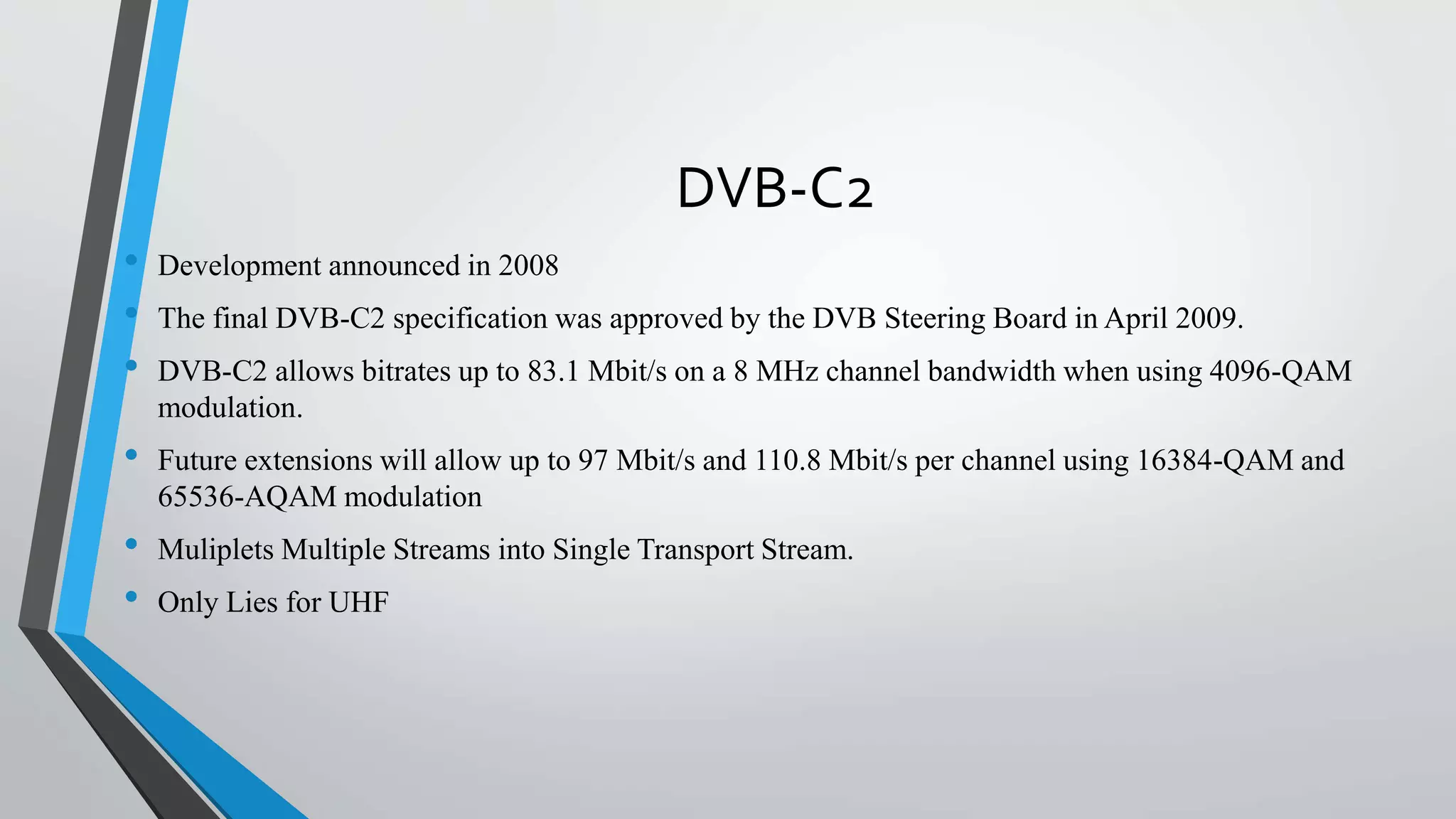
DVB-C2
• Development announced in 2008
• The final DVB-C2 specification was approved by the DVB Steering Board in April 2009.
• DVB-C2 allows bitrates up to 83.1 Mbit/s on a 8 MHz channel bandwidth when using 4096-QAM
modulation.
• Future extensions will allow up to 97 Mbit/s and 110.8 Mbit/s per channel using 16384-QAM and
65536-AQAM modulation
• Muliplets Multiple Streams into Single Transport Stream.
• Only Lies for UHF
Being Used in Nayatel
• Nayatel is using 64QAM with 8MHz gap, using which total of 38.2Mbps of
data can be streamed.
DVB-C DVB-C2
Input Interface
SingleTransport
Stream(TS)
MultipleTransport Stream andGeneric Stream Encapsulation(GSE)
Modes
Constant
Coding &Modulati
on
Variable Coding & Modulation and AdaptiveCoding & Modulation
FEC
Reed
Solomon (RS)
LDPC + BCH 1/2, 2/3, 3/4, 4/5, 5/6, 8/9, 9/10[4]
Modulation
Single
Carrier QAM
absolute OFDM[5]
Modulation
Schemes
16- to 256-QAM 16- to 4096-QAM
Guard Interval Not Applicable 1/64 or 1/128
Inverse Fast
Fourier
transform (IFFT)
size
Not Applicable 4k[6]
Interleaving Bit-Interleaving Bit-Time- and Frequency-Interleaving
Pilots Not Applicable Scattered andContinual Pilots
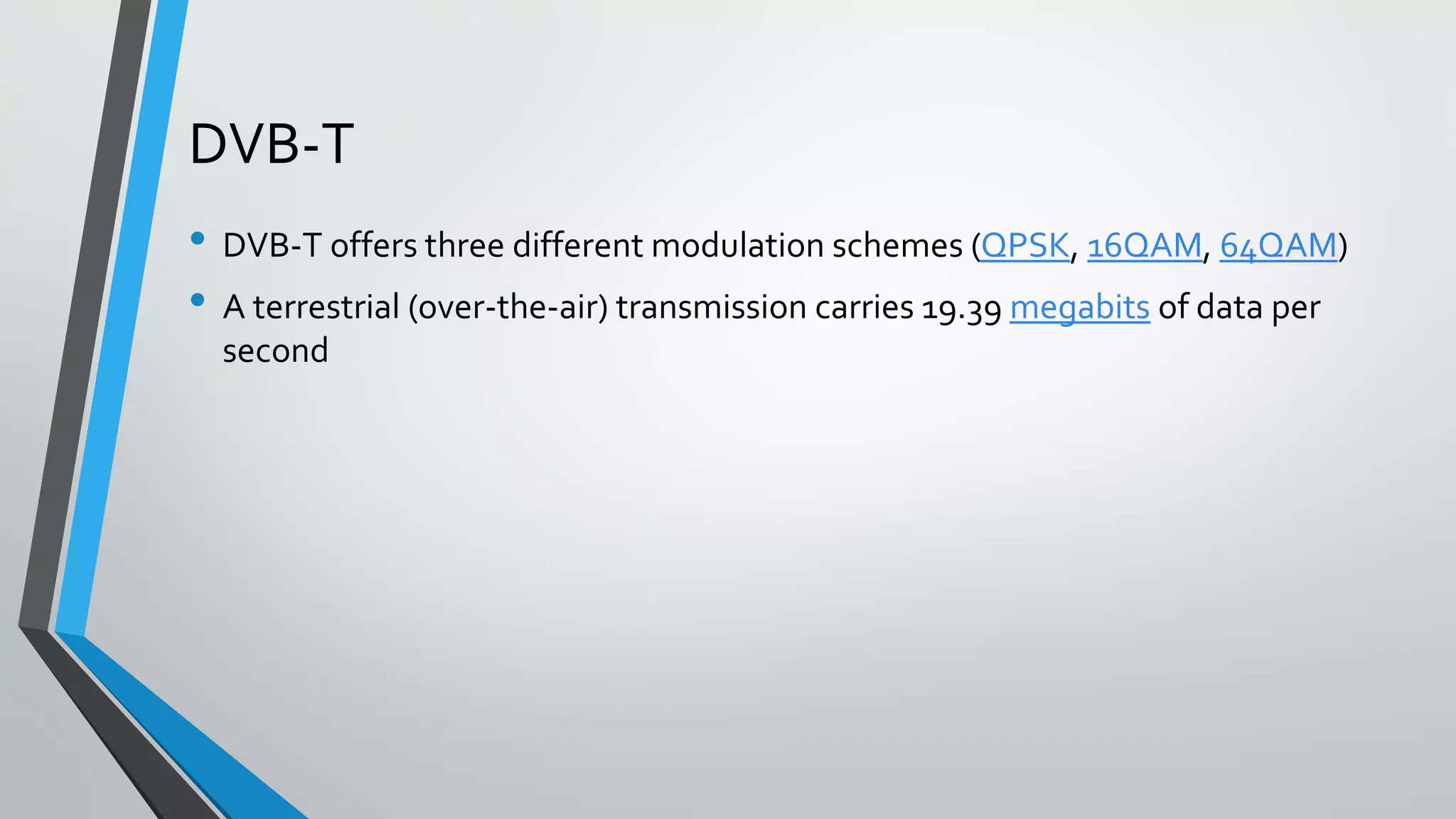
DVB-T
• DVB-T offers three different modulation schemes (QPSK, 16QAM, 64QAM)
• A terrestrial (over-the-air) transmission carries 19.39 megabits of data per
second
DVB-H
• Sub-standard of DVB-T, introduced for Hand Held devices like Mobile
• Was not successful.
• Transmission made through DVB is not onlyVideo, but Data as well
• It contains:
• Network InformationTable(NIT)
• Transport Stream ID (TS-ID)
• Service DescriptionTable (SDT)
The IRD is the interface between a receiving satellite dish and a
broadcasting facility video/audio infrastructure.
Integrated receiver decoder
INPUT RF
OUTPUT ASI/AV
CAPABLE TO DESECRAMBLE PAID CHANNELS
IRD
Advantages:
• DVB
• - High bandwidth outbound or broadcast
• - Designed and built forVideo Broadcast
• - Lower Cost of RemoteTerminals
Disadvantages:
• - Generally Power-Limited satellite requirement
• - Very inefficient when use of transponder capacity
• - Not designed forTCP/IP traffic. IP is encapsulated within MPEG
• - Very high Hub equipment cost
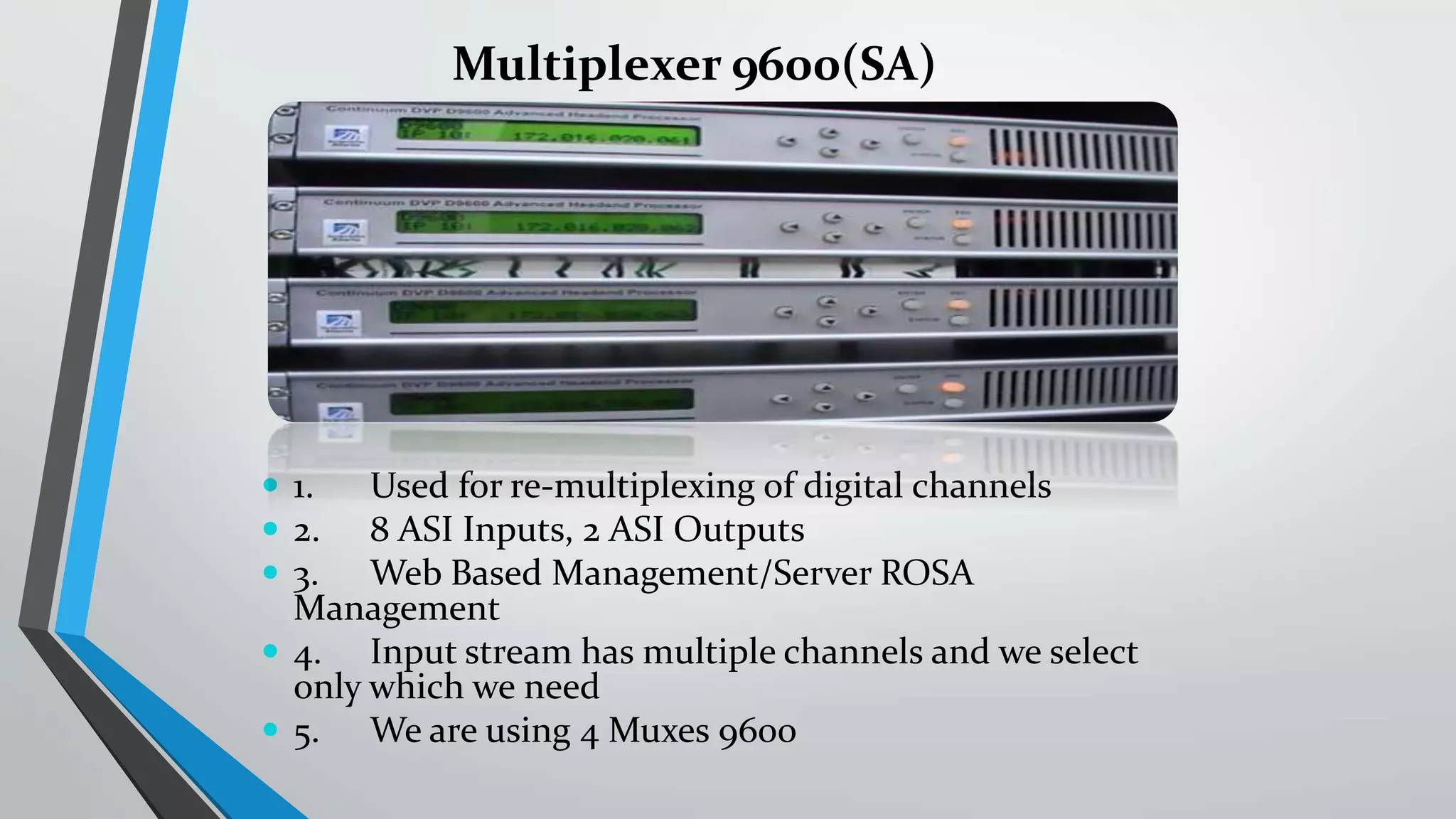
 1. Used for re-multiplexing of digital channels
 2. 8 ASI Inputs, 2 ASI Outputs
 3. Web Based Management/Server ROSA
Management
 4. Input stream has multiple channels and we select
only which we need
 5. We are using 4 Muxes 9600
Multiplexer 9600(SA)
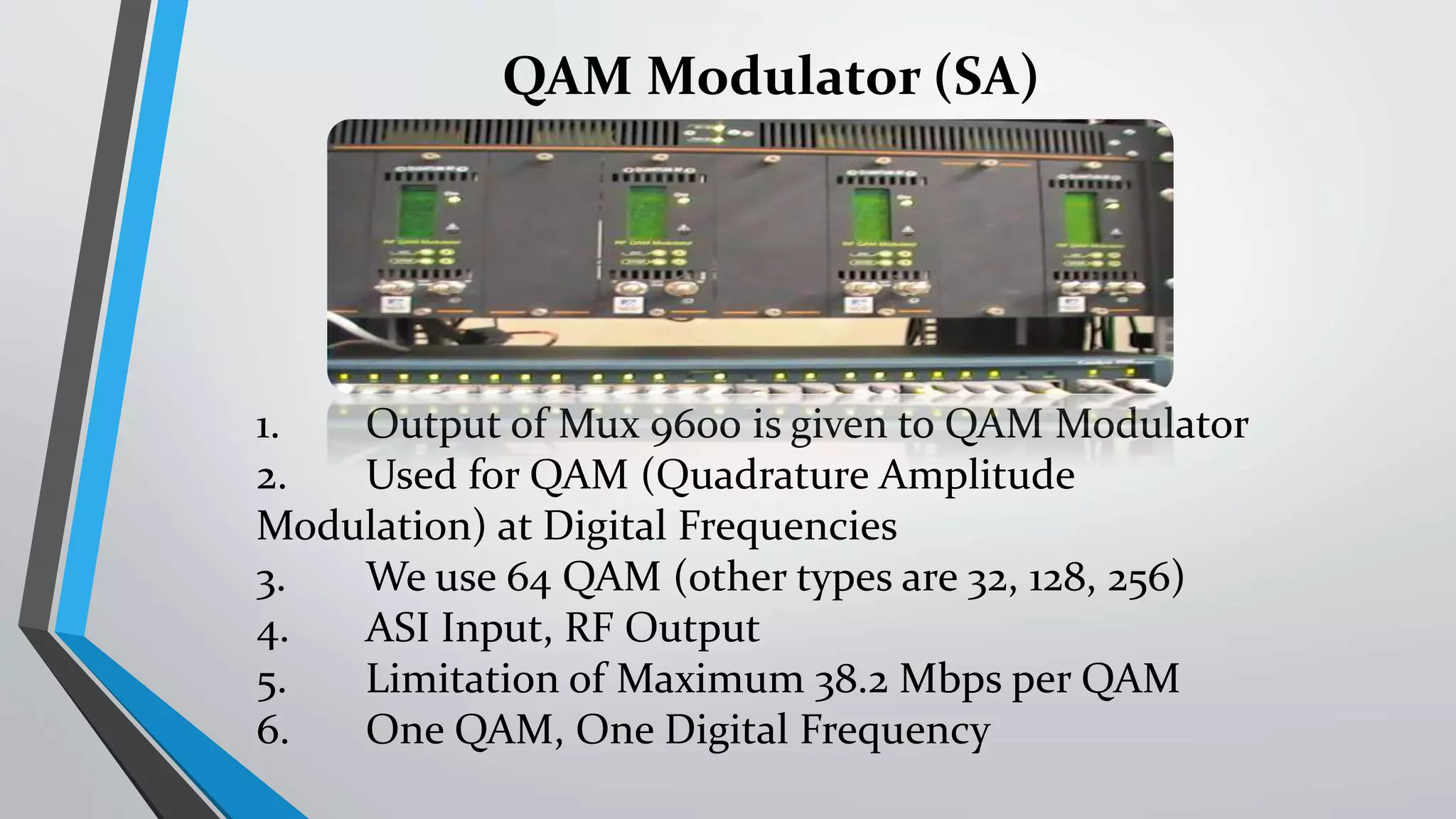
1. Output of Mux 9600 is given to QAM Modulator
2. Used for QAM (Quadrature Amplitude
Modulation) at Digital Frequencies
3. We use 64 QAM (other types are 32, 128, 256)
4. ASI Input, RF Output
5. Limitation of Maximum 38.2 Mbps per QAM
6. One QAM, One Digital Frequency
QAM Modulator (SA)
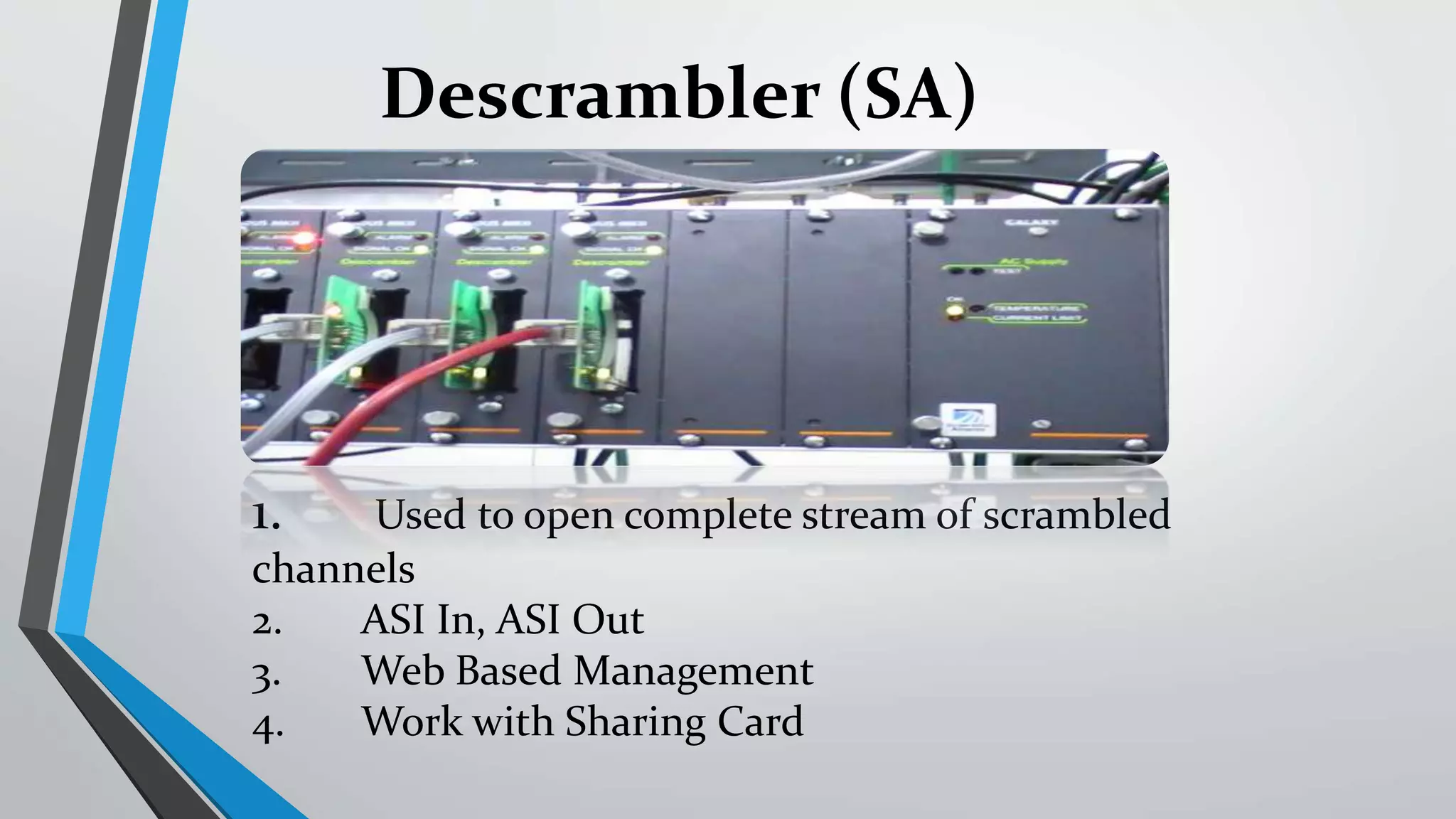
1. Used to open complete stream of scrambled
channels
2. ASI In, ASI Out
3. Web Based Management
4. Work with Sharing Card
Descrambler (SA)
1. Enhanced Multimedia Router (EMR) by Sumavision
2.Major Purpose is to add AV channels in Digital
3.6 cards per chassis
4.5 Analog MPEG2 AV Input cards, 2 AV inputs per card
5.1 Output Card, 2 ASI In, 2 ASI Out
6.Total Inputs: 10 AV and 2 ASI
7.Total Outputs: 2 ASI
8.Management through Application ‘Netmanager’
9.Other cards are ASI Combiners, HDMI Input, Satellite
Tuner, IP Output
EMR
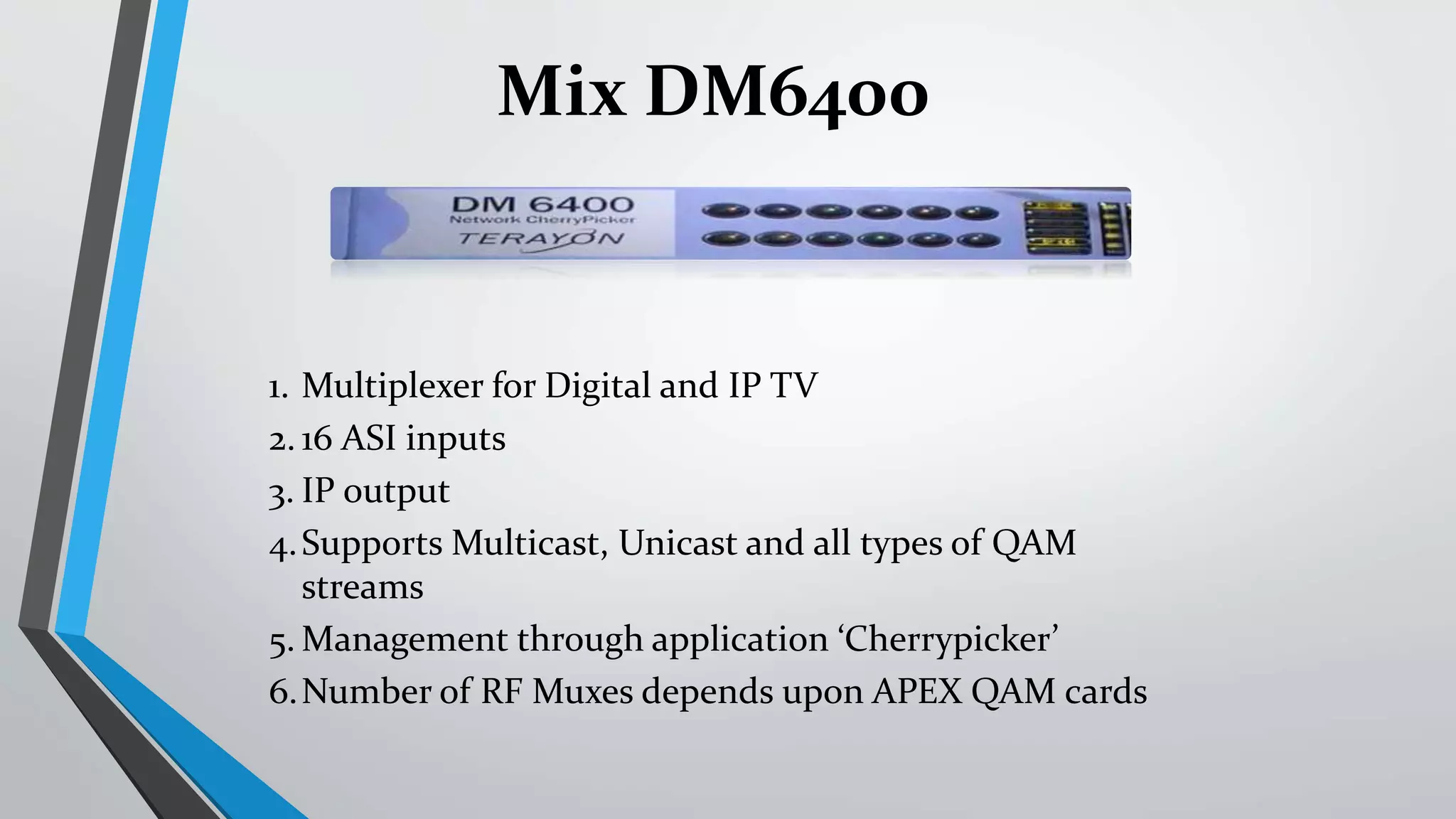
1. Multiplexer for Digital and IP TV
2. 16 ASI inputs
3. IP output
4.Supports Multicast, Unicast and all types of QAM
streams
5. Management through application ‘Cherrypicker’
6.Number of RF Muxes depends upon APEX QAM cards
Mix DM6400
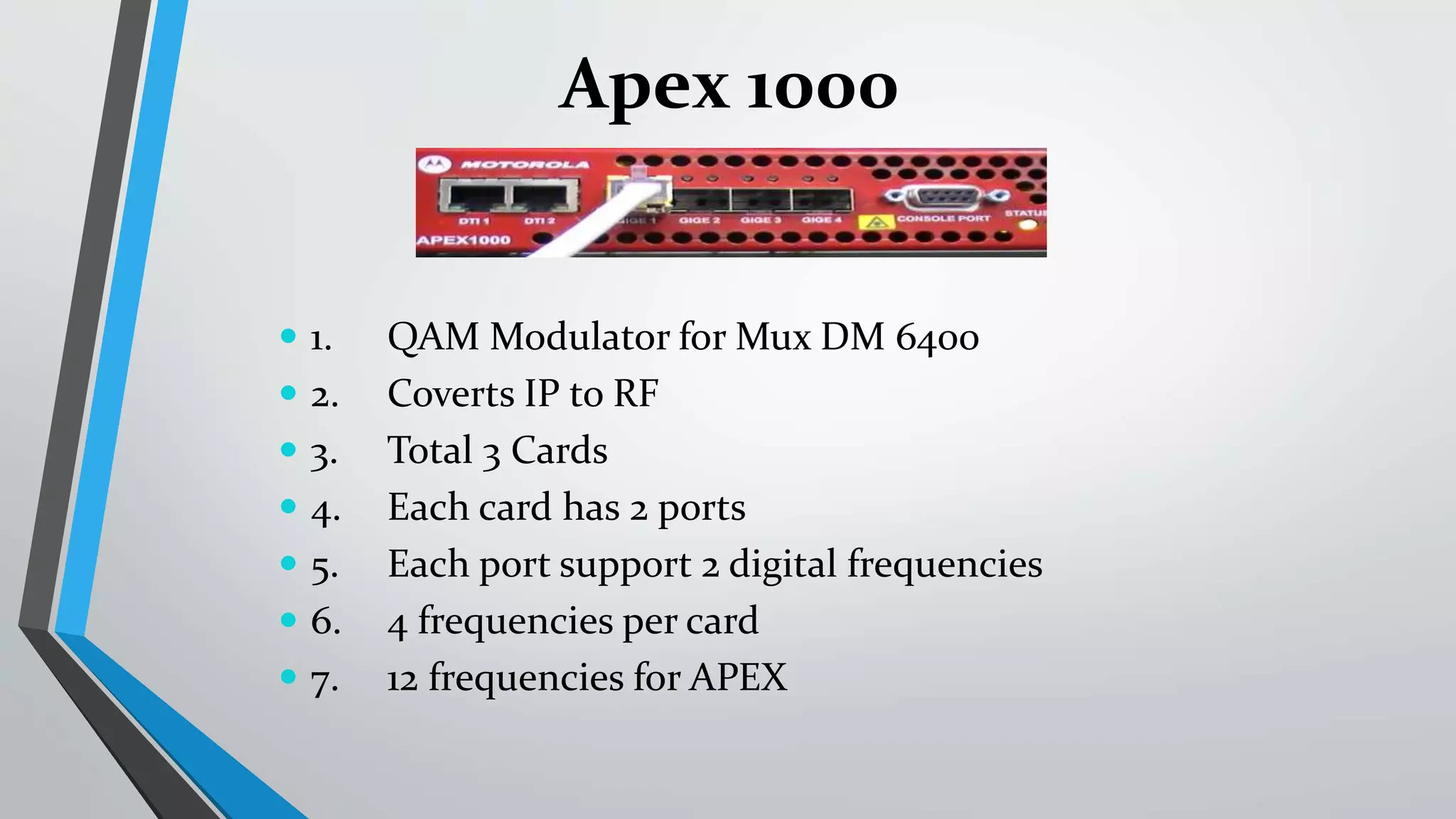
 1. QAM Modulator for Mux DM 6400
 2. Coverts IP to RF
 3. Total 3 Cards
 4. Each card has 2 ports
 5. Each port support 2 digital frequencies
 6. 4 frequencies per card
 7. 12 frequencies for APEX
Apex 1000
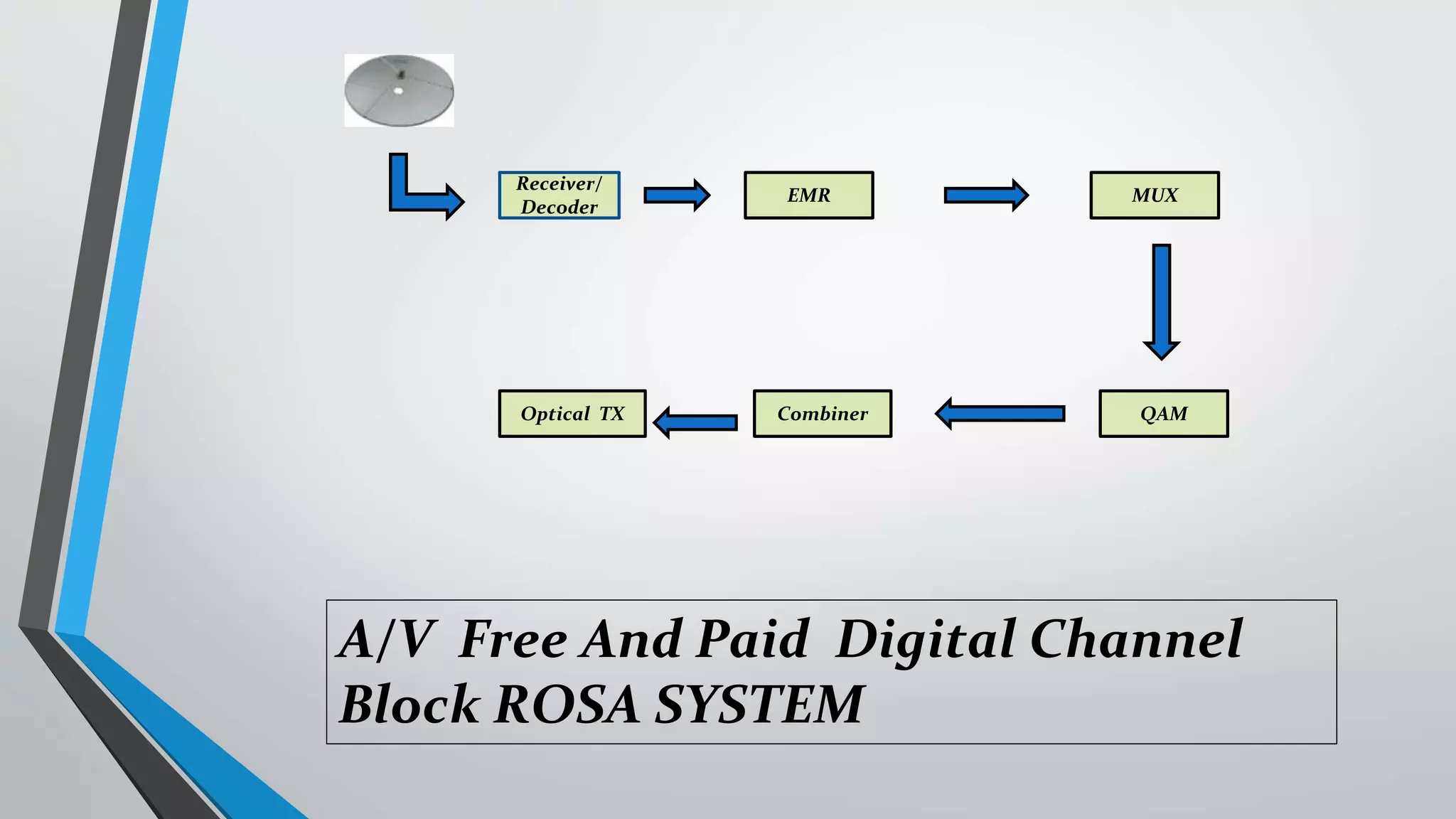
MUX
QAMCombinerOptical TX
EMR
A/V Free And Paid Digital Channel
Block ROSA SYSTEM
Receiver/
Decoder
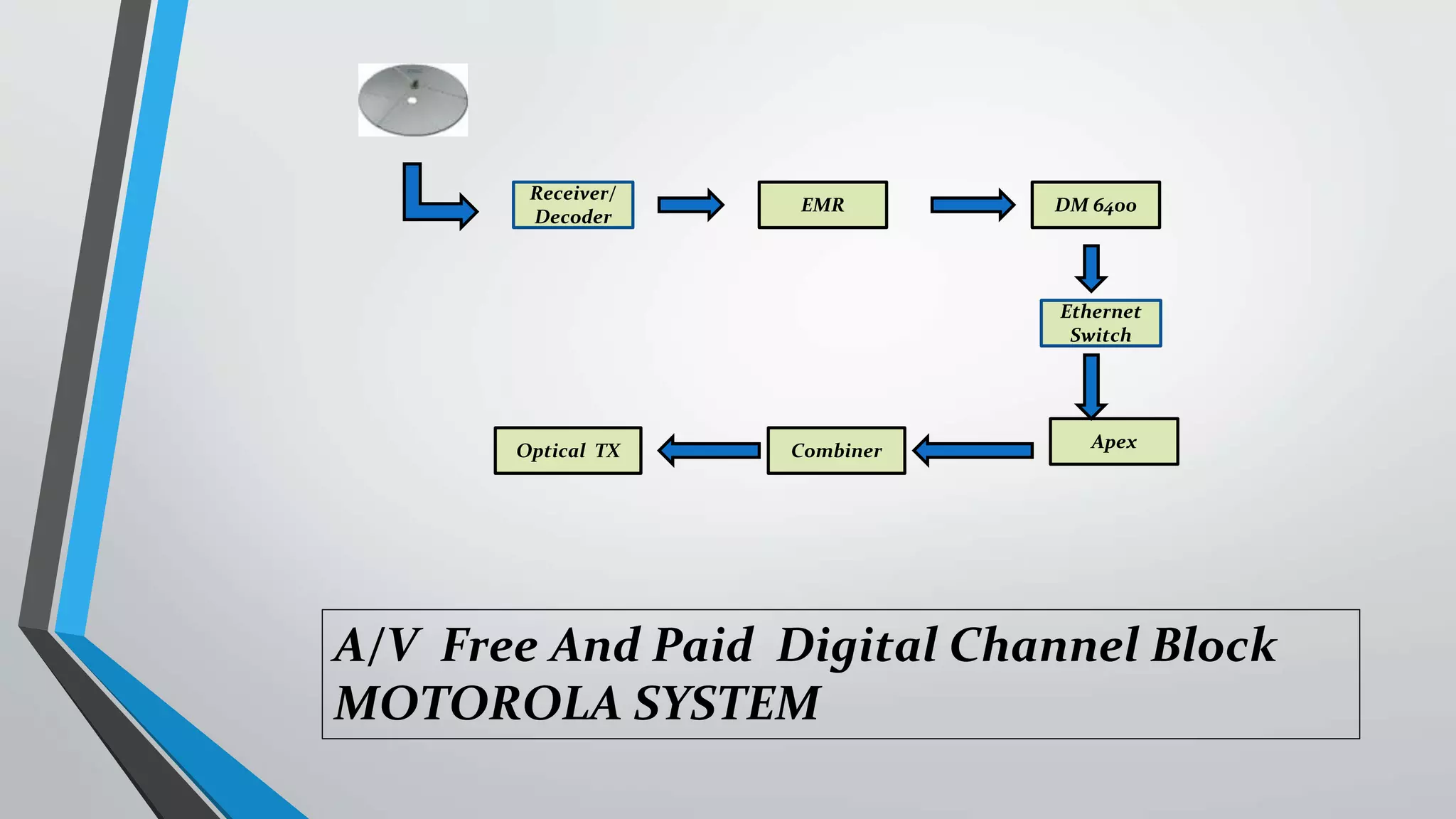
DM 6400
ApexCombinerOptical TX
A/V Free And Paid Digital Channel Block
MOTOROLA SYSTEM
EMR
Receiver/
Decoder
Ethernet
Switch
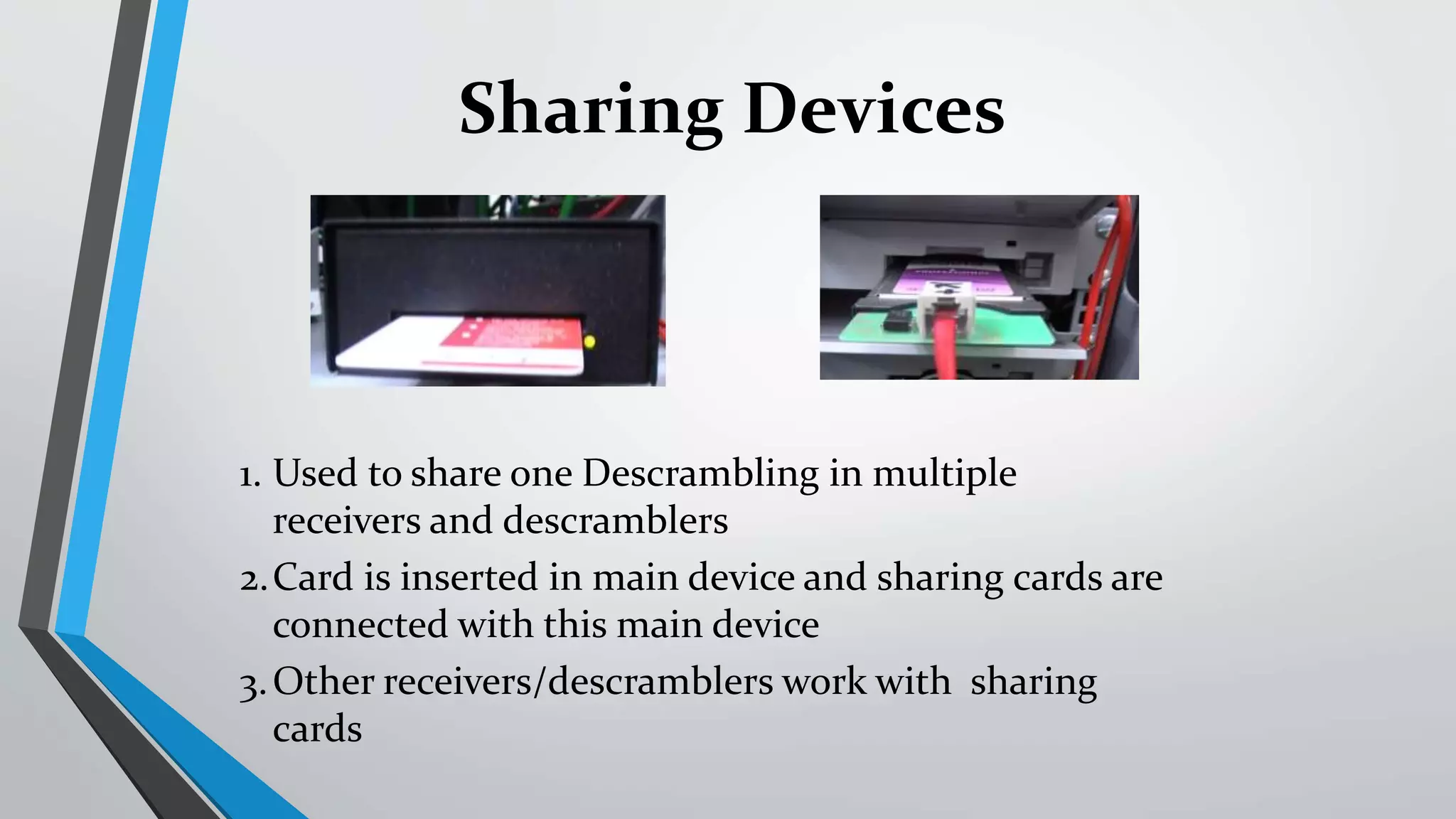
1. Used to share one Descrambling in multiple
receivers and descramblers
2.Card is inserted in main device and sharing cards are
connected with this main device
3.Other receivers/descramblers work with sharing
cards
Sharing Devices
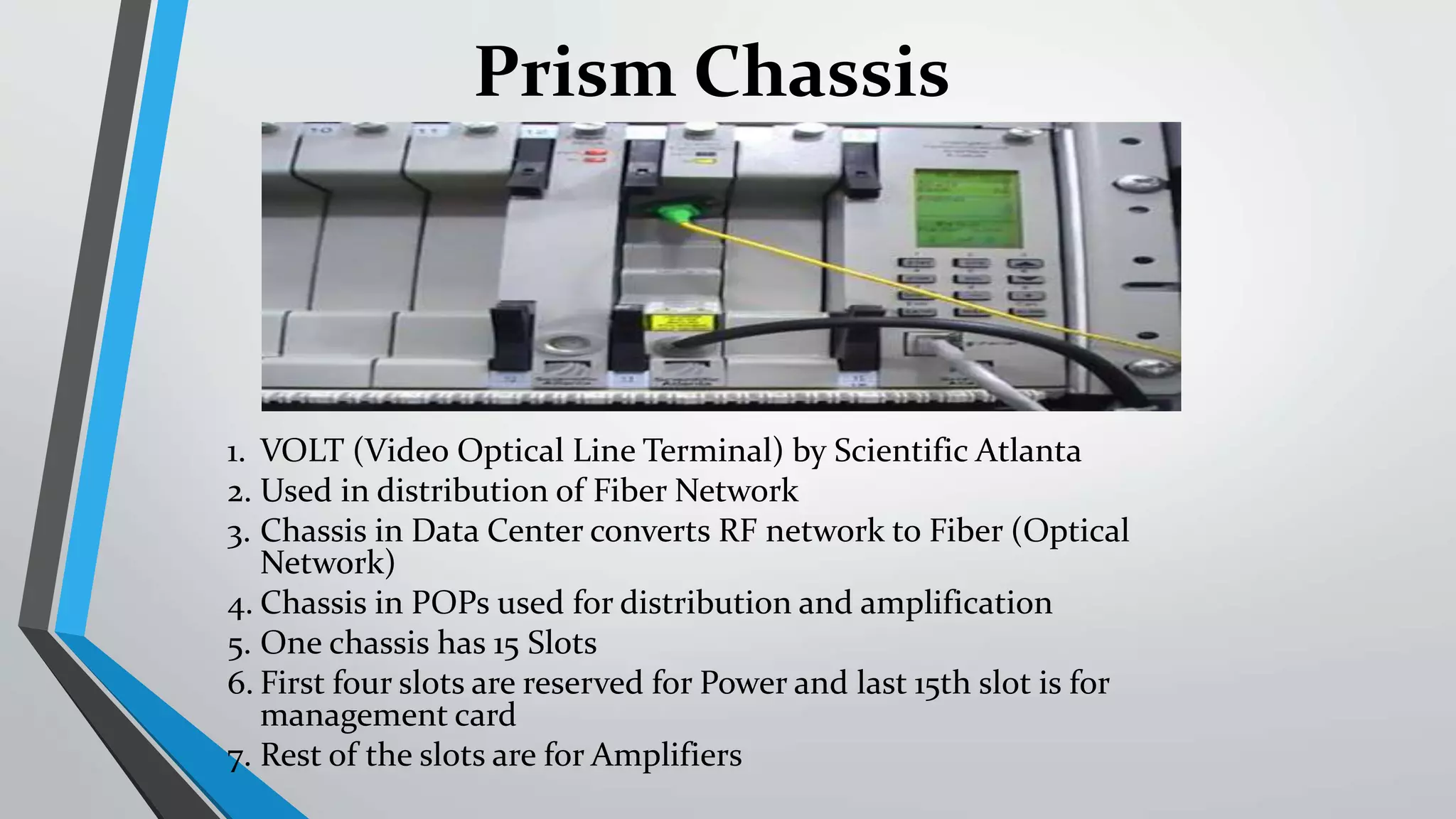
1. VOLT (Video Optical Line Terminal) by Scientific Atlanta
2. Used in distribution of Fiber Network
3. Chassis in Data Center converts RF network to Fiber (Optical
Network)
4. Chassis in POPs used for distribution and amplification
5. One chassis has 15 Slots
6. First four slots are reserved for Power and last 15th slot is for
management card
7. Rest of the slots are for Amplifiers
Prism Chassis
Digital Video Broadcasting (DVB)

Digital Video Broadcasting (DVB)

  • 2.
    IN THIS PRESENTATION •BROADCASTING • DVB • DVB-STANDARDS • FREQUENCY BANDS • BLOCK DIAGRAM OF DIGITAL NETWORK • INTRODUCTION TO DVB-S, C, T • DIFFERENT DEVICES USED IN DIGITAL NETWORK
  • 3.
    Broadcasting: • InTelecommunication, broadcastingrefers to a method of transferring a message to all recipients simultaneously
  • 4.
    DigitalVideo Broadcasting (DVB) •DVB is a set of standards that define digital broadcasting using existing satellite, cable, and terrestrial infrastructures. • The term digital television is sometimes used as a synonym for DVB
  • 5.
    DVB Standards • DVB-S •DVB-C • DVB-T • DVB-S2 • DVB-C2 • DVB-T2
  • 6.
    Satellite Frequency Bands •C-Band(4 to 8GHz) • KU-Band(11 to 17GHz) • KA-Band(20 t0 30GHz)
  • 7.
    Receiver MUX CombinerOptical TX FreeTo Air Digital Channel Block ROSA SYSTEM QAM
  • 8.
    Receiver MUX QAMCombinerOptical TX Descrambler PaidChannel Digital Block Diagram ROSA SYSTEM
  • 9.
    Receiver Multiplexer QAM IFModulator AudioVideo IF out Up Converter ASI OUT ASI OUT ASI =Asynchronous Serial Interface Rf Combiner 1550nm optical TX More than one Channels with single receiver on Digital network Dish Single channel with single receiver on analog network RF RF RF To co-locations QAM=Quadrature amplitude modulation
  • 10.
    DVB-S • DVB-S isan abbreviation for "DigitalVideo Broadcasting — Satellite“. • It is the original DigitalVideo Broadcasting Forward error correction and demodulation standard for Satellite Television. • Dates from 1995, in its first release, while development lasted from 1993 to 1997.
  • 11.
    Frequency in Useby Nayatel • Frequency range being used by Nayatel for receiving channels is 10.3GHz to 12.3GHz. • Note: Communication spectrum for military can use upto 18GHz frequency.
  • 12.
    DVB-S2 DigitalVideo Broadcasting -Satellite - Second Generation • designed as a successor for the popular DVB-S system. • Developed in 2003 • Impact2 and Impact4 Encoding Schemes are used to lessen the Bandwidth • The development of DVB-S2 coincided with the introduction of HDTV and H.264 (MPEG-4 AVC)
  • 13.
    Difference Between DVB-S,DVB-S2 • DVBS is basically SD (NOT HD) and DVBS2 is HD • DVBS sends in MPEG2 (like what you find in DVD`s) and DVBS2 sends in MPEG4 which is a better compression algorithm • DVB-S use QPSK as Modulation Mode while DVB-S2 uses QPSK, 8PSK, 16PSK modulation modes.
  • 14.
    Improvements: • In March2014, DVB-S2X specification has been published by DVB Project
  • 15.
    DVB-C(DigitalVideo Broadcasting –Cable) • DVB European consortium standard for the broadcast transmission of digital television over cable. • first published by the ETSI in 1994 • DVB-C (VHF/UHF) uses QAM: 16-QAM, 32-QAM, 64-QAM, 128-QAM or 256-QAM. • transmits an MPEG-2 or MPEG-4 family digital audio/digital video stream
  • 16.
    DVB-C2 • Development announcedin 2008 • The final DVB-C2 specification was approved by the DVB Steering Board in April 2009. • DVB-C2 allows bitrates up to 83.1 Mbit/s on a 8 MHz channel bandwidth when using 4096-QAM modulation. • Future extensions will allow up to 97 Mbit/s and 110.8 Mbit/s per channel using 16384-QAM and 65536-AQAM modulation • Muliplets Multiple Streams into Single Transport Stream. • Only Lies for UHF
  • 17.
    Being Used inNayatel • Nayatel is using 64QAM with 8MHz gap, using which total of 38.2Mbps of data can be streamed.
  • 18.
    DVB-C DVB-C2 Input Interface SingleTransport Stream(TS) MultipleTransportStream andGeneric Stream Encapsulation(GSE) Modes Constant Coding &Modulati on Variable Coding & Modulation and AdaptiveCoding & Modulation FEC Reed Solomon (RS) LDPC + BCH 1/2, 2/3, 3/4, 4/5, 5/6, 8/9, 9/10[4] Modulation Single Carrier QAM absolute OFDM[5] Modulation Schemes 16- to 256-QAM 16- to 4096-QAM Guard Interval Not Applicable 1/64 or 1/128 Inverse Fast Fourier transform (IFFT) size Not Applicable 4k[6] Interleaving Bit-Interleaving Bit-Time- and Frequency-Interleaving Pilots Not Applicable Scattered andContinual Pilots
  • 19.
    DVB-T • DVB-T offersthree different modulation schemes (QPSK, 16QAM, 64QAM) • A terrestrial (over-the-air) transmission carries 19.39 megabits of data per second
  • 20.
    DVB-H • Sub-standard ofDVB-T, introduced for Hand Held devices like Mobile • Was not successful.
  • 21.
    • Transmission madethrough DVB is not onlyVideo, but Data as well • It contains: • Network InformationTable(NIT) • Transport Stream ID (TS-ID) • Service DescriptionTable (SDT)
  • 22.
    The IRD isthe interface between a receiving satellite dish and a broadcasting facility video/audio infrastructure. Integrated receiver decoder INPUT RF OUTPUT ASI/AV CAPABLE TO DESECRAMBLE PAID CHANNELS IRD
  • 23.
    Advantages: • DVB • -High bandwidth outbound or broadcast • - Designed and built forVideo Broadcast • - Lower Cost of RemoteTerminals
  • 24.
    Disadvantages: • - GenerallyPower-Limited satellite requirement • - Very inefficient when use of transponder capacity • - Not designed forTCP/IP traffic. IP is encapsulated within MPEG • - Very high Hub equipment cost
  • 25.
     1. Usedfor re-multiplexing of digital channels  2. 8 ASI Inputs, 2 ASI Outputs  3. Web Based Management/Server ROSA Management  4. Input stream has multiple channels and we select only which we need  5. We are using 4 Muxes 9600 Multiplexer 9600(SA)
  • 26.
    1. Output ofMux 9600 is given to QAM Modulator 2. Used for QAM (Quadrature Amplitude Modulation) at Digital Frequencies 3. We use 64 QAM (other types are 32, 128, 256) 4. ASI Input, RF Output 5. Limitation of Maximum 38.2 Mbps per QAM 6. One QAM, One Digital Frequency QAM Modulator (SA)
  • 27.
    1. Used toopen complete stream of scrambled channels 2. ASI In, ASI Out 3. Web Based Management 4. Work with Sharing Card Descrambler (SA)
  • 28.
    1. Enhanced MultimediaRouter (EMR) by Sumavision 2.Major Purpose is to add AV channels in Digital 3.6 cards per chassis 4.5 Analog MPEG2 AV Input cards, 2 AV inputs per card 5.1 Output Card, 2 ASI In, 2 ASI Out 6.Total Inputs: 10 AV and 2 ASI 7.Total Outputs: 2 ASI 8.Management through Application ‘Netmanager’ 9.Other cards are ASI Combiners, HDMI Input, Satellite Tuner, IP Output EMR
  • 29.
    1. Multiplexer forDigital and IP TV 2. 16 ASI inputs 3. IP output 4.Supports Multicast, Unicast and all types of QAM streams 5. Management through application ‘Cherrypicker’ 6.Number of RF Muxes depends upon APEX QAM cards Mix DM6400
  • 30.
     1. QAMModulator for Mux DM 6400  2. Coverts IP to RF  3. Total 3 Cards  4. Each card has 2 ports  5. Each port support 2 digital frequencies  6. 4 frequencies per card  7. 12 frequencies for APEX Apex 1000
  • 31.
    MUX QAMCombinerOptical TX EMR A/V FreeAnd Paid Digital Channel Block ROSA SYSTEM Receiver/ Decoder
  • 32.
    DM 6400 ApexCombinerOptical TX A/VFree And Paid Digital Channel Block MOTOROLA SYSTEM EMR Receiver/ Decoder Ethernet Switch
  • 33.
    1. Used toshare one Descrambling in multiple receivers and descramblers 2.Card is inserted in main device and sharing cards are connected with this main device 3.Other receivers/descramblers work with sharing cards Sharing Devices
  • 34.
    1. VOLT (VideoOptical Line Terminal) by Scientific Atlanta 2. Used in distribution of Fiber Network 3. Chassis in Data Center converts RF network to Fiber (Optical Network) 4. Chassis in POPs used for distribution and amplification 5. One chassis has 15 Slots 6. First four slots are reserved for Power and last 15th slot is for management card 7. Rest of the slots are for Amplifiers Prism Chassis

Editor's Notes

  • #13  is a digital television broadcast standard that has been designed as a successor for the popular DVB-S system. It was developed in 2003 by the DVB Project, an international industry consortium, and ratified by ETSI (EN 302307) in March 2005. The standard is based on, and improves upon DVB-S and theelectronic news-gathering (or Digital Satellite News Gathering) system, used by mobile units for sending sounds and images from remote locations world-wide back to their home television stations. DVB-S2 is envisaged for broadcast services including standard and HDTV, interactive services including Internet access, and (professional) data content distribution. The development of DVB-S2 coincided with the introduction of HDTV and H.264 (MPEG-4 AVC) video codecs.
  • #20 This optional table may provide information about the multiplexes and transport streams on a given network
  • #22 MPEG transport stream is a standard format for transmission and storage of audio, video, and Program and System Information Protocol data.  The SDT contains some details about the services that are contained in the data broadcast in a particular network.