
Network
Models
A Presentation
C O N T E N T S
Introduction -- Anjali
1
2
3
4
5
6
7
8
9
10
11
12
13
14
15
How The Internet Works? -- Niraj
Computer Networking Models -- Rohit
OSI Model -- Nasir
Physical Layer -- Manish
Data Link Layer -- Yogita
Network Layer -- Trishala
Transport Layer -- Shadab
Session Layer -- Onkar
Presentation Layer -- Ibrahim
Application Layer -- Kunal
TCP/IP Model -- Arbaz
IPv4 Exhaustion & Requirement of IPv6 -- Aftab
The Conclusion -- Monis
Difference Between OSI & TCP/IP Models -- Avinash
INTRODUCTION
Internetworking is the practice of inter-connecting
multiple computer networks.
The resulting system of inter-connected networks are
called an inter-network, or simply an internet.
The challenge when connecting various systems is to
support communication between disparate
technologies.
1
 The Internet is a global system of interconnected computer
networks.
 When two or more electronic devices (e.g.
computers) are connected so that they can communicate, they
become part of a network.
 Web pages are created using the formatting language HTML; so
anyone can be sure that every device will display the web page in the
same way.
HOW THE INTERNET WORKS?
2
COMPUTER NETWORKING MODELS
3
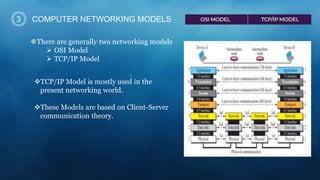
There are generally two networking models
 OSI Model
 TCP/IP Model
TCP/IP Model is mostly used in the
present networking world.
These Models are based on Client-Server
communication theory.
OSI stands for Open System
Interconnection
OSI consists of seven layers, and each
layer performs a particular network
function.
OSI model divides the whole task into
seven smaller layers.
OSI model was developed by the
International Organization for
Standardization (ISO) in 1984.
OSI Model
4
 Physical layer is the lowest layer of the OSI reference model.
 The physical layer defines the transmissioninterface between
devices and transmission medium.
 The sender and receiver are synchronized at bit level.
PHYSICAL LAYER
5
DATA LINK LAYER
6
 Data Link Layer is the second layer of OSI
Layered Model.
 This layer is one of the most complicated
layers.
 Responsible for converting data stream to
signals bit by bit and to end that over the
underlying hardware.
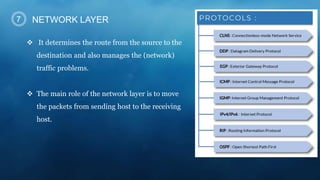
 It determines the route from the source to the
destination and also manages the (network)
traffic problems.
 The main role of the network layer is to move
the packets from sending host to the receiving
host.
NETWORK LAYER
7
 The main role of the transport layer is
to provide the logical communication
between application processes running
on different hosts.
 The transport layer is represented by two protocols: TCP and UDP.
 TCP i.e., Transmission Control Protocol provides full transport layer services
to applications.
 UDP i.e., User Datagram Protocol is used when reliability and security are
less important than speed and size.
TRANSPORT LAYER
8
SESSION LAYER
9
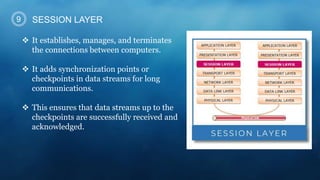
 It establishes, manages, and terminates
the connections between computers.
 It adds synchronization points or
checkpoints in data streams for long
communications.
 This ensures that data streams up to the
checkpoints are successfully received and
acknowledged.
 The Presentation Layer is also called as Translation Layer.
 Responsible for the formatting and delivery of information to the
application layer.
 Functions :
 Encryption/Decryption; data encryption translates the data
into another form or code.
 Compression; reduces the number of bits that need to be
transmitted on the network.
PRESENTATION LAYER
10
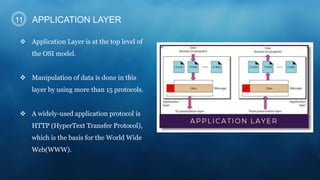
 Application Layer is at the top level of
the OSI model.
 Manipulation of data is done in this
layer by using more than 15 protocols.
 A widely-used application protocol is
HTTP (HyperText Transfer Protocol),
which is the basis for the World Wide
Web(WWW).
APPLICATION LAYER
11
 Developed byDepartment of
Defence's Project Research
Agency( DARPA) to connect remote
machines.
 The overall idea was to allow one
application on one computer to talk
to(send data packets) another
application running on different
computer.
TCP/IP MODEL
12
TCP/IP stands for Transmission
Control Protocol and Internet
Protocol.
DIFFERENCE BETWEEN OSI &
TCP/IP MODELS
13
IPv4 EXHAUSTION & NEED OF IPv6
IPv4 addresses are running out.
The solution is IPv6.
14
 Internetworking is the internet; a network of
networks based on many underlying technologies.
 There are several layers involved in making
internet work as we see it.
 Various kinds of tools, from wires to towers to
display screens, work together to form a net of
communication.
CONCLUSION
15
2.8Million
Social Media
posts 2.5 Million
Website
search queries 27.2Thousand
Review
posts
100
Hours
of Online
videos
201Million
emails
sent
57 Thousand
Pictures
posts 50.7Thousand
Thoughts
posts
EVERY
MINUTE

Networking Models

  • 1.
  • 2.
    C O NT E N T S Introduction -- Anjali 1 2 3 4 5 6 7 8 9 10 11 12 13 14 15 How The Internet Works? -- Niraj Computer Networking Models -- Rohit OSI Model -- Nasir Physical Layer -- Manish Data Link Layer -- Yogita Network Layer -- Trishala Transport Layer -- Shadab Session Layer -- Onkar Presentation Layer -- Ibrahim Application Layer -- Kunal TCP/IP Model -- Arbaz IPv4 Exhaustion & Requirement of IPv6 -- Aftab The Conclusion -- Monis Difference Between OSI & TCP/IP Models -- Avinash
  • 3.
    INTRODUCTION Internetworking is thepractice of inter-connecting multiple computer networks. The resulting system of inter-connected networks are called an inter-network, or simply an internet. The challenge when connecting various systems is to support communication between disparate technologies. 1
  • 4.
     The Internetis a global system of interconnected computer networks.  When two or more electronic devices (e.g. computers) are connected so that they can communicate, they become part of a network.  Web pages are created using the formatting language HTML; so anyone can be sure that every device will display the web page in the same way. HOW THE INTERNET WORKS? 2
  • 5.
    COMPUTER NETWORKING MODELS 3 Thereare generally two networking models  OSI Model  TCP/IP Model TCP/IP Model is mostly used in the present networking world. These Models are based on Client-Server communication theory.
  • 6.
    OSI stands forOpen System Interconnection OSI consists of seven layers, and each layer performs a particular network function. OSI model divides the whole task into seven smaller layers. OSI model was developed by the International Organization for Standardization (ISO) in 1984. OSI Model 4
  • 7.
     Physical layeris the lowest layer of the OSI reference model.  The physical layer defines the transmissioninterface between devices and transmission medium.  The sender and receiver are synchronized at bit level. PHYSICAL LAYER 5
  • 8.
    DATA LINK LAYER 6 Data Link Layer is the second layer of OSI Layered Model.  This layer is one of the most complicated layers.  Responsible for converting data stream to signals bit by bit and to end that over the underlying hardware.
  • 9.
     It determinesthe route from the source to the destination and also manages the (network) traffic problems.  The main role of the network layer is to move the packets from sending host to the receiving host. NETWORK LAYER 7
  • 10.
     The mainrole of the transport layer is to provide the logical communication between application processes running on different hosts.  The transport layer is represented by two protocols: TCP and UDP.  TCP i.e., Transmission Control Protocol provides full transport layer services to applications.  UDP i.e., User Datagram Protocol is used when reliability and security are less important than speed and size. TRANSPORT LAYER 8
  • 11.
    SESSION LAYER 9  Itestablishes, manages, and terminates the connections between computers.  It adds synchronization points or checkpoints in data streams for long communications.  This ensures that data streams up to the checkpoints are successfully received and acknowledged.
  • 12.
     The PresentationLayer is also called as Translation Layer.  Responsible for the formatting and delivery of information to the application layer.  Functions :  Encryption/Decryption; data encryption translates the data into another form or code.  Compression; reduces the number of bits that need to be transmitted on the network. PRESENTATION LAYER 10
  • 13.
     Application Layeris at the top level of the OSI model.  Manipulation of data is done in this layer by using more than 15 protocols.  A widely-used application protocol is HTTP (HyperText Transfer Protocol), which is the basis for the World Wide Web(WWW). APPLICATION LAYER 11
  • 14.
     Developed byDepartmentof Defence's Project Research Agency( DARPA) to connect remote machines.  The overall idea was to allow one application on one computer to talk to(send data packets) another application running on different computer. TCP/IP MODEL 12 TCP/IP stands for Transmission Control Protocol and Internet Protocol.
  • 15.
    DIFFERENCE BETWEEN OSI& TCP/IP MODELS 13
  • 16.
    IPv4 EXHAUSTION &NEED OF IPv6 IPv4 addresses are running out. The solution is IPv6. 14
  • 17.
     Internetworking isthe internet; a network of networks based on many underlying technologies.  There are several layers involved in making internet work as we see it.  Various kinds of tools, from wires to towers to display screens, work together to form a net of communication. CONCLUSION 15
  • 18.
    2.8Million Social Media posts 2.5Million Website search queries 27.2Thousand Review posts 100 Hours of Online videos 201Million emails sent 57 Thousand Pictures posts 50.7Thousand Thoughts posts EVERY MINUTE