Presentation on
MULTICARRIER
MODULATION
OFDM FBMC
Presented by
Vetrivel Chelian T | 1801RL01 | PhD Candidate| PSG Tech
Guided by
Dr.K.Thiyagarajan | Dept.of ECE
Presentation Outline
❏ Multicarrier Modulation
❏ OFDM
❏ Introduction
❏ System model
❏ FBMC
❏ Introduction
❏ System model
❏ Comparison between OFDM vs FBMC
❏ Conclusion & Research Scopes
2
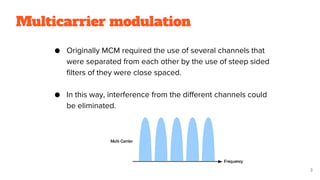
Multicarrier modulation
● Originally MCM required the use of several channels that
were separated from each other by the use of steep sided
filters of they were close spaced.
● In this way, interference from the different channels could
be eliminated.
3
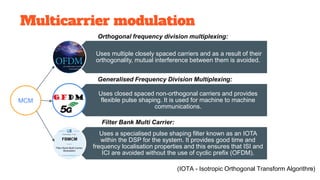
Uses multiple closely spaced carriers and as a result of their
orthogonality, mutual interference between them is avoided.
Uses closed spaced non-orthogonal carriers and provides
flexible pulse shaping. It is used for machine to machine
communications.
Uses a specialised pulse shaping filter known as an IOTA
within the DSP for the system. It provides good time and
frequency localisation properties and this ensures that ISI and
ICI are avoided without the use of cyclic prefix (OFDM).
Multicarrier modulation
Orthogonal frequency division multiplexing:
Generalised Frequency Division Multiplexing:
Filter Bank Multi Carrier:
MCM
(IOTA - Isotropic Orthogonal Transform Algorithm)4
OFDM
Orthogonal frequency-division multiplexing is a method
of encoding digital data on multiple carrier frequencies
which are orthogonal to each other
5
OFDM
● With fast data transmissions, line noise and other interference frequently occurs.
● There will usually be much less interference when data is sent at a slow rate.
● The idea is to send many small pieces of data at the same time, which are later
to be combined into a single unit.
● In the case of OFDM, data is broken into many subcarrier streams (up to 52) and
then multiplexed into one individual data stream.
6
OFDM
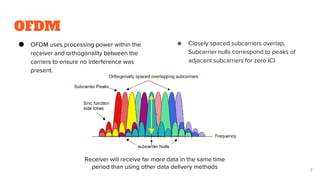
● OFDM uses processing power within the
receiver and orthogonality between the
carriers to ensure no interference was
present.
● Closely spaced subcarriers overlap,
Subcarrier nulls correspond to peaks of
adjacent subcarriers for zero ICI
7
Receiver will receive far more data in the same time
period than using other data delivery methods
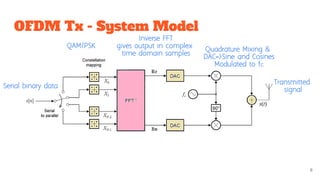
OFDM Tx - System Model
8
Serial binary data
QAM/PSK
Inverse FFT
gives output in complex
time domain samples
Quadrature Mixing &
DAC=>Sine and Cosines
Modulated to fc
Transmitted
signal
OFDM Rx - System Model
9
Rx
signal
Quadrature downmixing &
ADC=>Sine and Cosines
demodulated
LPF
To filter signals
Centred at 2fc
Sampled &
digitised
Forward FFT
Convert to Freq.Domain
Symbol detection
Serial binary data
FBMC
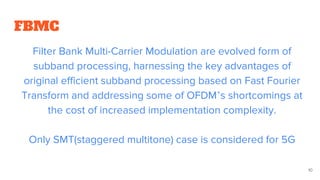
Filter Bank Multi-Carrier Modulation are evolved form of
subband processing, harnessing the key advantages of
original efficient subband processing based on Fast Fourier
Transform and addressing some of OFDM’s shortcomings at
the cost of increased implementation complexity.
Only SMT(staggered multitone) case is considered for 5G
10
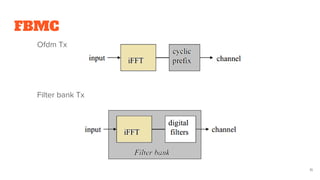
FBMC
Ofdm Tx
Filter bank Tx
11
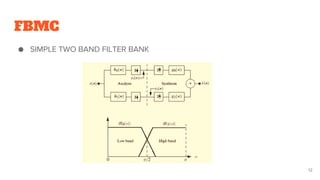
FBMC
● SIMPLE TWO BAND FILTER BANK
12
FBMC Tx
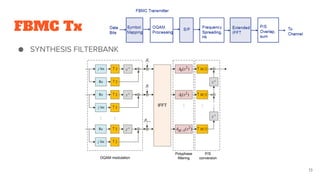
● SYNTHESIS FILTERBANK
13
FBMC Rx
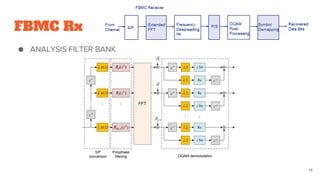
● ANALYSIS FILTER BANK
14
OFDM VS FBMC
15
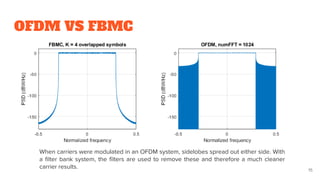
When carriers were modulated in an OFDM system, sidelobes spread out either side. With
a filter bank system, the filters are used to remove these and therefore a much cleaner
carrier results.
OFDM FBMC
Multicarrier system where data is broken
into many orthogonal subcarrier streams
Multicarrier system based on filter banks at
the Tx and Rx. Main Contender for 5G
CP extension required and therefore
reduces Bandwidth (BW) efficiency
Not required and hence conserves BW
Large sidelobes in frequency sprectrum Smaller and sharper sidelobes than ofdm
Multiple access interference (MAI)
cancellation should be performed at the
receiver
MAI is suppressed due to the excellent
frequency localization of the subcarriers in
FBMC
16
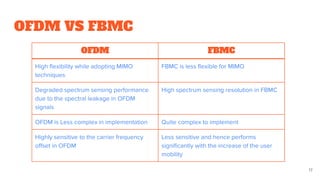
OFDM VS FBMC
OFDM FBMC
High flexibility while adopting MIMO
techniques
FBMC is less flexible for MIMO
Degraded spectrum sensing performance
due to the spectral leakage in OFDM
signals
High spectrum sensing resolution in FBMC
OFDM is Less complex in implementation Quite complex to implement
Highly sensitive to the carrier frequency
offset in OFDM
Less sensitive and hence performs
significantly with the increase of the user
mobility
17
OFDM VS FBMC
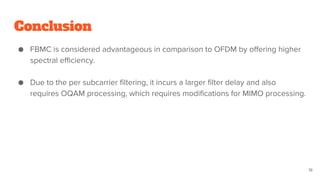
Conclusion
● FBMC is considered advantageous in comparison to OFDM by offering higher
spectral efficiency.
● Due to the per subcarrier filtering, it incurs a larger filter delay and also
requires OQAM processing, which requires modifications for MIMO processing.
18
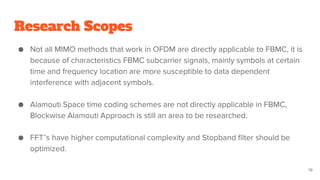
Research Scopes
● Not all MIMO methods that work in OFDM are directly applicable to FBMC, it is
because of characteristics FBMC subcarrier signals, mainly symbols at certain
time and frequency location are more susceptible to data dependent
interference with adjacent symbols.
● Alamouti Space time coding schemes are not directly applicable in FBMC,
Blockwise Alamouti Approach is still an area to be researched.
● FFT’s have higher computational complexity and Stopband filter should be
optimized.
19
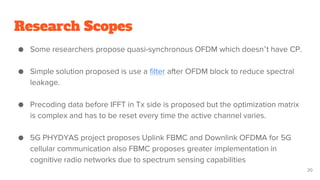
Research Scopes
● Some researchers propose quasi-synchronous OFDM which doesn’t have CP.
● Simple solution proposed is use a filter after OFDM block to reduce spectral
leakage.
● Precoding data before IFFT in Tx side is proposed but the optimization matrix
is complex and has to be reset every time the active channel varies.
● 5G PHYDYAS project proposes Uplink FBMC and Downlink OFDMA for 5G
cellular communication also FBMC proposes greater implementation in
cognitive radio networks due to spectrum sensing capabilities
20
Thank You
21

Multi Carrier Modulation OFDM & FBMC

  • 1.
    Presentation on MULTICARRIER MODULATION OFDM FBMC Presentedby Vetrivel Chelian T | 1801RL01 | PhD Candidate| PSG Tech Guided by Dr.K.Thiyagarajan | Dept.of ECE
  • 2.
    Presentation Outline ❏ MulticarrierModulation ❏ OFDM ❏ Introduction ❏ System model ❏ FBMC ❏ Introduction ❏ System model ❏ Comparison between OFDM vs FBMC ❏ Conclusion & Research Scopes 2
  • 3.
    Multicarrier modulation ● OriginallyMCM required the use of several channels that were separated from each other by the use of steep sided filters of they were close spaced. ● In this way, interference from the different channels could be eliminated. 3
  • 4.
    Uses multiple closelyspaced carriers and as a result of their orthogonality, mutual interference between them is avoided. Uses closed spaced non-orthogonal carriers and provides flexible pulse shaping. It is used for machine to machine communications. Uses a specialised pulse shaping filter known as an IOTA within the DSP for the system. It provides good time and frequency localisation properties and this ensures that ISI and ICI are avoided without the use of cyclic prefix (OFDM). Multicarrier modulation Orthogonal frequency division multiplexing: Generalised Frequency Division Multiplexing: Filter Bank Multi Carrier: MCM (IOTA - Isotropic Orthogonal Transform Algorithm)4
  • 5.
    OFDM Orthogonal frequency-division multiplexingis a method of encoding digital data on multiple carrier frequencies which are orthogonal to each other 5
  • 6.
    OFDM ● With fastdata transmissions, line noise and other interference frequently occurs. ● There will usually be much less interference when data is sent at a slow rate. ● The idea is to send many small pieces of data at the same time, which are later to be combined into a single unit. ● In the case of OFDM, data is broken into many subcarrier streams (up to 52) and then multiplexed into one individual data stream. 6
  • 7.
    OFDM ● OFDM usesprocessing power within the receiver and orthogonality between the carriers to ensure no interference was present. ● Closely spaced subcarriers overlap, Subcarrier nulls correspond to peaks of adjacent subcarriers for zero ICI 7 Receiver will receive far more data in the same time period than using other data delivery methods
  • 8.
    OFDM Tx -System Model 8 Serial binary data QAM/PSK Inverse FFT gives output in complex time domain samples Quadrature Mixing & DAC=>Sine and Cosines Modulated to fc Transmitted signal
  • 9.
    OFDM Rx -System Model 9 Rx signal Quadrature downmixing & ADC=>Sine and Cosines demodulated LPF To filter signals Centred at 2fc Sampled & digitised Forward FFT Convert to Freq.Domain Symbol detection Serial binary data
  • 10.
    FBMC Filter Bank Multi-CarrierModulation are evolved form of subband processing, harnessing the key advantages of original efficient subband processing based on Fast Fourier Transform and addressing some of OFDM’s shortcomings at the cost of increased implementation complexity. Only SMT(staggered multitone) case is considered for 5G 10
  • 11.
  • 12.
    FBMC ● SIMPLE TWOBAND FILTER BANK 12
  • 13.
    FBMC Tx ● SYNTHESISFILTERBANK 13
  • 14.
    FBMC Rx ● ANALYSISFILTER BANK 14
  • 15.
    OFDM VS FBMC 15 Whencarriers were modulated in an OFDM system, sidelobes spread out either side. With a filter bank system, the filters are used to remove these and therefore a much cleaner carrier results.
  • 16.
    OFDM FBMC Multicarrier systemwhere data is broken into many orthogonal subcarrier streams Multicarrier system based on filter banks at the Tx and Rx. Main Contender for 5G CP extension required and therefore reduces Bandwidth (BW) efficiency Not required and hence conserves BW Large sidelobes in frequency sprectrum Smaller and sharper sidelobes than ofdm Multiple access interference (MAI) cancellation should be performed at the receiver MAI is suppressed due to the excellent frequency localization of the subcarriers in FBMC 16 OFDM VS FBMC
  • 17.
    OFDM FBMC High flexibilitywhile adopting MIMO techniques FBMC is less flexible for MIMO Degraded spectrum sensing performance due to the spectral leakage in OFDM signals High spectrum sensing resolution in FBMC OFDM is Less complex in implementation Quite complex to implement Highly sensitive to the carrier frequency offset in OFDM Less sensitive and hence performs significantly with the increase of the user mobility 17 OFDM VS FBMC
  • 18.
    Conclusion ● FBMC isconsidered advantageous in comparison to OFDM by offering higher spectral efficiency. ● Due to the per subcarrier filtering, it incurs a larger filter delay and also requires OQAM processing, which requires modifications for MIMO processing. 18
  • 19.
    Research Scopes ● Notall MIMO methods that work in OFDM are directly applicable to FBMC, it is because of characteristics FBMC subcarrier signals, mainly symbols at certain time and frequency location are more susceptible to data dependent interference with adjacent symbols. ● Alamouti Space time coding schemes are not directly applicable in FBMC, Blockwise Alamouti Approach is still an area to be researched. ● FFT’s have higher computational complexity and Stopband filter should be optimized. 19
  • 20.
    Research Scopes ● Someresearchers propose quasi-synchronous OFDM which doesn’t have CP. ● Simple solution proposed is use a filter after OFDM block to reduce spectral leakage. ● Precoding data before IFFT in Tx side is proposed but the optimization matrix is complex and has to be reset every time the active channel varies. ● 5G PHYDYAS project proposes Uplink FBMC and Downlink OFDMA for 5G cellular communication also FBMC proposes greater implementation in cognitive radio networks due to spectrum sensing capabilities 20
  • 21.