PROF ANNAPURNA SAKHARDANDE
DEPT OF CIVIL ENGG
DON BOSCO COLLEGE OF ENGG
Building Construction
Module I
Foundations
FUNCTIONS OF FOUNDATION
• To distribute weight of the structure over
large area
• To prevent unequal settlement
• To provide level surface for the structure
• Prevent undermining
• Stability against sliding and overturning
• Minimise distress against soil movements
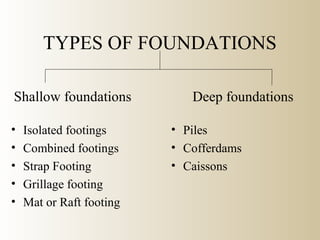
TYPES OF FOUNDATIONS
Shallow foundations Deep foundations
• Isolated footings
• Combined footings
• Strap Footing
• Grillage footing
• Mat or Raft footing
• Piles
• Cofferdams
• Caissons
Shallow foundations
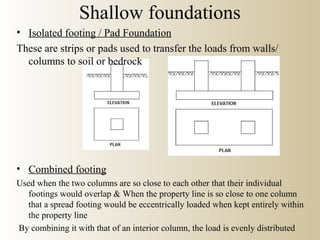
• Isolated footing / Pad Foundation
These are strips or pads used to transfer the loads from walls/
columns to soil or bedrock
• Combined footing
Used when the two columns are so close to each other that their individual
footings would overlap & When the property line is so close to one column
that a spread footing would be eccentrically loaded when kept entirely within
the property line
By combining it with that of an interior column, the load is evenly distributed
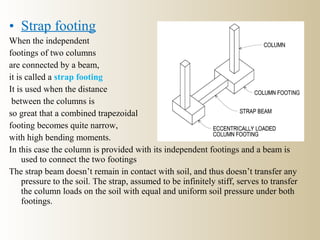
• Strap footing
When the independent
footings of two columns
are connected by a beam,
it is called a strap footing
It is used when the distance
between the columns is
so great that a combined trapezoidal
footing becomes quite narrow,
with high bending moments.
In this case the column is provided with its independent footings and a beam is
used to connect the two footings
The strap beam doesn’t remain in contact with soil, and thus doesn’t transfer any
pressure to the soil. The strap, assumed to be infinitely stiff, serves to transfer
the column loads on the soil with equal and uniform soil pressure under both
footings.
Shallow foundations
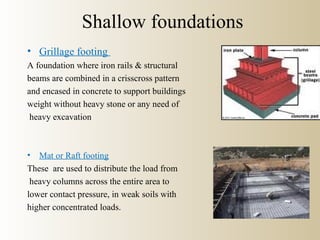
• Grillage footing
A foundation where iron rails & structural
beams are combined in a crisscross pattern
and encased in concrete to support buildings
weight without heavy stone or any need of
heavy excavation
• Mat or Raft footing
These are used to distribute the load from
heavy columns across the entire area to
lower contact pressure, in weak soils with
higher concentrated loads.
Deep foundations
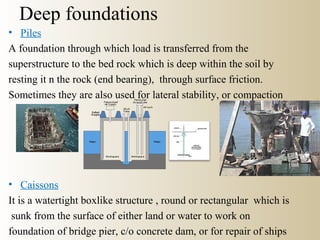
• Piles
A foundation through which load is transferred from the
superstructure to the bed rock which is deep within the soil by
resting it n the rock (end bearing), through surface friction.
Sometimes they are also used for lateral stability, or compaction
etc..
• Caissons
It is a watertight boxlike structure , round or rectangular which is
sunk from the surface of either land or water to work on
foundation of bridge pier, c/o concrete dam, or for repair of ships
Deep foundations
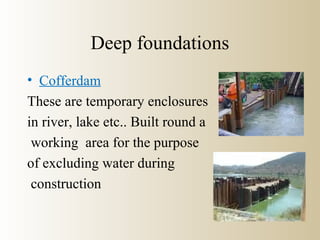
• Cofferdam
These are temporary enclosures
in river, lake etc.. Built round a
working area for the purpose
of excluding water during
construction
Thank you !
Thank you !

TYPES OF Foundation

  • 1.
    PROF ANNAPURNA SAKHARDANDE DEPTOF CIVIL ENGG DON BOSCO COLLEGE OF ENGG Building Construction Module I Foundations
  • 2.
    FUNCTIONS OF FOUNDATION •To distribute weight of the structure over large area • To prevent unequal settlement • To provide level surface for the structure • Prevent undermining • Stability against sliding and overturning • Minimise distress against soil movements
  • 3.
    TYPES OF FOUNDATIONS Shallowfoundations Deep foundations • Isolated footings • Combined footings • Strap Footing • Grillage footing • Mat or Raft footing • Piles • Cofferdams • Caissons
  • 4.
    Shallow foundations • Isolatedfooting / Pad Foundation These are strips or pads used to transfer the loads from walls/ columns to soil or bedrock • Combined footing Used when the two columns are so close to each other that their individual footings would overlap & When the property line is so close to one column that a spread footing would be eccentrically loaded when kept entirely within the property line By combining it with that of an interior column, the load is evenly distributed
  • 5.
    • Strap footing Whenthe independent footings of two columns are connected by a beam, it is called a strap footing It is used when the distance between the columns is so great that a combined trapezoidal footing becomes quite narrow, with high bending moments. In this case the column is provided with its independent footings and a beam is used to connect the two footings The strap beam doesn’t remain in contact with soil, and thus doesn’t transfer any pressure to the soil. The strap, assumed to be infinitely stiff, serves to transfer the column loads on the soil with equal and uniform soil pressure under both footings.
  • 6.
    Shallow foundations • Grillagefooting A foundation where iron rails & structural beams are combined in a crisscross pattern and encased in concrete to support buildings weight without heavy stone or any need of heavy excavation • Mat or Raft footing These are used to distribute the load from heavy columns across the entire area to lower contact pressure, in weak soils with higher concentrated loads.
  • 7.
    Deep foundations • Piles Afoundation through which load is transferred from the superstructure to the bed rock which is deep within the soil by resting it n the rock (end bearing), through surface friction. Sometimes they are also used for lateral stability, or compaction etc.. • Caissons It is a watertight boxlike structure , round or rectangular which is sunk from the surface of either land or water to work on foundation of bridge pier, c/o concrete dam, or for repair of ships
  • 8.
    Deep foundations • Cofferdam Theseare temporary enclosures in river, lake etc.. Built round a working area for the purpose of excluding water during construction
  • 9.
  • 10.

Editor's Notes