ASSIGNMENT - 12
BUILDING CONST. IV
TOPIC : RCC WORK
SUBMITTED BY:SUBMITTED TO:
->PUNEET CHHONKER
->B.ARCH 3rd YR , 5th SEM.
-> Ar. SURJEET SINGH
CONTENT
RCC COLUMN
BEAM
SLAB
STAIRCASE
LINTEL
CHAJJA
CANOPY
COFFER SLAB
PERGOLA
TOPICNO.
1.
2.
3.
4.
5.
6.
7.
8.
9.
RCC COLUMN
• A column is a vertical member which effectively takes load by compression. Basically column is a
compression member as load acts along its longitudinal axis. Bending moment may occur due to wind
earthquake or accidental loads.
• Column transfers the load of the structure of slabs beams above to below, and finally load is
transferred to the soil. Position of the columns should be so that there are no tensile stresses
developed at the cross section of the columns. Columns location should be such that it hides in the
walls partially or fully.
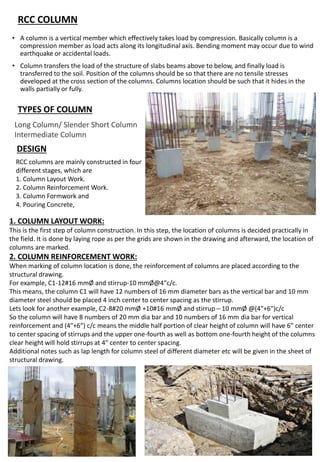
Long Column/ Slender Short Column
Intermediate Column
TYPES OF COLUMN
DESIGN
RCC columns are mainly constructed in four
different stages, which are
1. Column Layout Work.
2. Column Reinforcement Work.
3. Column Formwork and
4. Pouring Concrete,
1. COLUMN LAYOUT WORK:
This is the first step of column construction. In this step, the location of columns is decided practically in
the field. It is done by laying rope as per the grids are shown in the drawing and afterward, the location of
columns are marked.
2. COLUMN REINFORCEMENT WORK:
When marking of column location is done, the reinforcement of columns are placed according to the
structural drawing.
For example, C1-12#16 mmØ and stirrup-10 mmØ@4″c/c.
This means, the column C1 will have 12 numbers of 16 mm diameter bars as the vertical bar and 10 mm
diameter steel should be placed 4 inch center to center spacing as the stirrup.
Lets look for another example, C2-8#20 mmØ +10#16 mmØ and stirrup – 10 mmØ @(4″+6″)c/c
So the column will have 8 numbers of 20 mm dia bar and 10 numbers of 16 mm dia bar for vertical
reinforcement and (4″+6″) c/c means the middle half portion of clear height of column will have 6″ center
to center spacing of stirrups and the upper one-fourth as well as bottom one-fourth height of the columns
clear height will hold stirrups at 4″ center to center spacing.
Additional notes such as lap length for column steel of different diameter etc will be given in the sheet of
structural drawing.
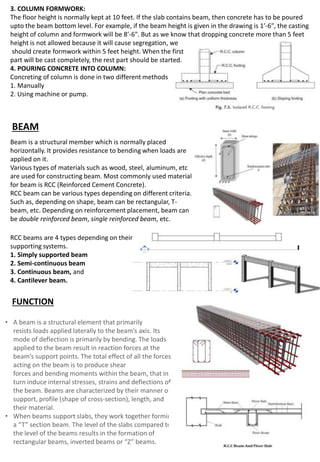
3. COLUMN FORMWORK:
The floor height is normally kept at 10 feet. If the slab contains beam, then concrete has to be poured
upto the beam bottom level. For example, if the beam height is given in the drawing is 1′-6″, the casting
height of column and formwork will be 8′-6″. But as we know that dropping concrete more than 5 feet
height is not allowed because it will cause segregation, we
should create formwork within 5 feet height. When the first
part will be cast completely, the rest part should be started.
4. POURING CONCRETE INTO COLUMN:
Concreting of column is done in two different methods
1. Manually
2. Using machine or pump.
BEAM
Beam is a structural member which is normally placed
horizontally. It provides resistance to bending when loads are
applied on it.
Various types of materials such as wood, steel, aluminum, etc
are used for constructing beam. Most commonly used material
for beam is RCC (Reinforced Cement Concrete).
RCC beam can be various types depending on different criteria.
Such as, depending on shape, beam can be rectangular, T-
beam, etc. Depending on reinforcement placement, beam can
be double reinforced beam, single reinforced beam, etc.
RCC beams are 4 types depending on their
supporting systems.
1. Simply supported beam
2. Semi-continuous beam
3. Continuous beam, and
4. Cantilever beam.
FUNCTION
• A beam is a structural element that primarily
resists loads applied laterally to the beam’s axis. Its
mode of deflection is primarily by bending. The loads
applied to the beam result in reaction forces at the
beam’s support points. The total effect of all the forces
acting on the beam is to produce shear
forces and bending moments within the beam, that in
turn induce internal stresses, strains and deflections of
the beam. Beams are characterized by their manner of
support, profile (shape of cross-section), length, and
their material.
• When beams support slabs, they work together forming
a “T” section beam. The level of the slabs compared to
the level of the beams results in the formation of
rectangular beams, inverted beams or “Z” beams.
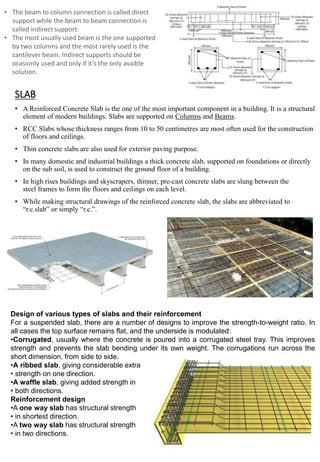
• The beam to column connection is called direct
support while the beam to beam connection is
called indirect support.
• The most usually used beam is the one supported
by two columns and the most rarely used is the
cantilever beam. Indirect supports should be
ocasionly used and only if it’s the only avaible
solution.
SLAB
• A Reinforced Concrete Slab is the one of the most important component in a building. It is a structural
element of modern buildings. Slabs are supported on Columns and Beams.
• RCC Slabs whose thickness ranges from 10 to 50 centimetres are most often used for the construction
of floors and ceilings.
• Thin concrete slabs are also used for exterior paving purpose.
• In many domestic and industrial buildings a thick concrete slab, supported on foundations or directly
on the sub soil, is used to construct the ground floor of a building.
• In high rises buildings and skyscrapers, thinner, pre-cast concrete slabs are slung between the
steel frames to form the floors and ceilings on each level.
• While making structural drawings of the reinforced concrete slab, the slabs are abbreviated to
“r.c.slab” or simply “r.c.”.
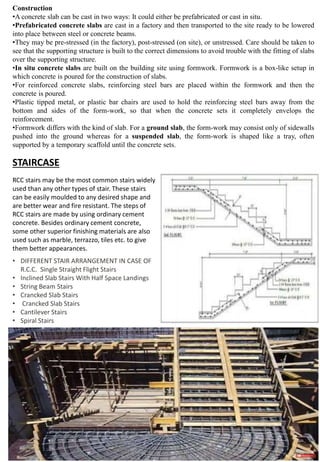
Design of various types of slabs and their reinforcement
For a suspended slab, there are a number of designs to improve the strength-to-weight ratio. In
all cases the top surface remains flat, and the underside is modulated:
•Corrugated, usually where the concrete is poured into a corrugated steel tray. This improves
strength and prevents the slab bending under its own weight. The corrugations run across the
short dimension, from side to side.
•A ribbed slab, giving considerable extra
• strength on one direction.
•A waffle slab, giving added strength in
• both directions.
Reinforcement design
•A one way slab has structural strength
• in shortest direction.
•A two way slab has structural strength
• in two directions.
Construction
•A concrete slab can be cast in two ways: It could either be prefabricated or cast in situ.
•Prefabricated concrete slabs are cast in a factory and then transported to the site ready to be lowered
into place between steel or concrete beams.
•They may be pre-stressed (in the factory), post-stressed (on site), or unstressed. Care should be taken to
see that the supporting structure is built to the correct dimensions to avoid trouble with the fitting of slabs
over the supporting structure.
•In situ concrete slabs are built on the building site using formwork. Formwork is a box-like setup in
which concrete is poured for the construction of slabs.
•For reinforced concrete slabs, reinforcing steel bars are placed within the formwork and then the
concrete is poured.
•Plastic tipped metal, or plastic bar chairs are used to hold the reinforcing steel bars away from the
bottom and sides of the form-work, so that when the concrete sets it completely envelops the
reinforcement.
•Formwork differs with the kind of slab. For a ground slab, the form-work may consist only of sidewalls
pushed into the ground whereas for a suspended slab, the form-work is shaped like a tray, often
supported by a temporary scaffold until the concrete sets.
STAIRCASE
RCC stairs may be the most common stairs widely
used than any other types of stair. These stairs
can be easily moulded to any desired shape and
are better wear and fire resistant. The steps of
RCC stairs are made by using ordinary cement
concrete. Besides ordinary cement concrete,
some other superior finishing materials are also
used such as marble, terrazzo, tiles etc. to give
them better appearances.
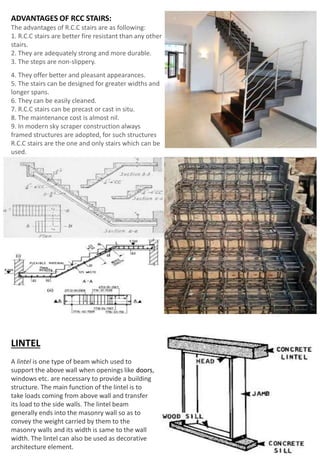
• DIFFERENT STAIR ARRANGEMENT IN CASE OF
R.C.C. Single Straight Flight Stairs
• Inclined Slab Stairs With Half Space Landings
• String Beam Stairs
• Crancked Slab Stairs
• Cantilever Stairs
• Spiral Stairs
ADVANTAGES OF RCC STAIRS:
The advantages of R.C.C stairs are as following:
1. R.C.C stairs are better fire resistant than any other
stairs.
2. They are adequately strong and more durable.
3. The steps are non-slippery.
4. They offer better and pleasant appearances.
5. The stairs can be designed for greater widths and
longer spans.
6. They can be easily cleaned.
7. R.C.C stairs can be precast or cast in situ.
8. The maintenance cost is almost nil.
9. In modern sky scraper construction always
framed structures are adopted, for such structures
R.C.C stairs are the one and only stairs which can be
used.
LINTEL
A lintel is one type of beam which used to
support the above wall when openings like doors,
windows etc. are necessary to provide a building
structure. The main function of the lintel is to
take loads coming from above wall and transfer
its load to the side walls. The lintel beam
generally ends into the masonry wall so as to
convey the weight carried by them to the
masonry walls and its width is same to the wall
width. The lintel can also be used as decorative
architecture element.
Types of Lintel
Lintels are classified into the following types
according to the materials of their construction:
1.Timber lintel
2.Stone lintel
3.Reinforced concrete lintel
4.Brick lintel
5.Reinforced brick lintel
6.Steel lintel
CHAJJA.
Chajja is Hindi word for Eaves, a chhajja is the
projecting or overhanging eaves or cover of a roof
usually called a sunshade supported on large carved
brackets or projected as a cantilever from walls.
An overhang in architecture is a protruding
structure which may provide protection for lower
levels.
Functions of Chajja
1.Protects from external sunlight.
2.Protects from rainwater
3.as aesthetics to a building
4.a recess place to keep utilities like A.C compressor
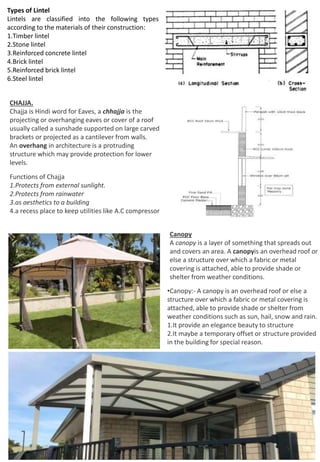
Canopy
A canopy is a layer of something that spreads out
and covers an area. A canopyis an overhead roof or
else a structure over which a fabric or metal
covering is attached, able to provide shade or
shelter from weather conditions.
•Canopy:- A canopy is an overhead roof or else a
structure over which a fabric or metal covering is
attached, able to provide shade or shelter from
weather conditions such as sun, hail, snow and rain.
1.It provide an elegance beauty to structure
2.It maybe a temporary offset or structure provided
in the building for special reason.
COFFER SLAB
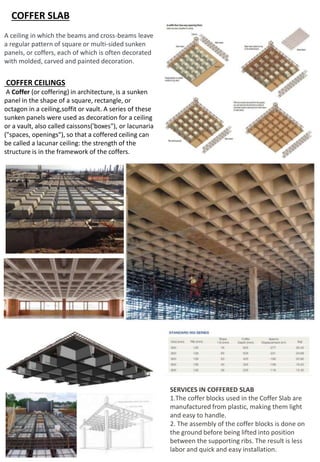
A ceiling in which the beams and cross-beams leave
a regular pattern of square or multi-sided sunken
panels, or coffers, each of which is often decorated
with molded, carved and painted decoration.
COFFER CEILINGS
A Coffer (or coffering) in architecture, is a sunken
panel in the shape of a square, rectangle, or
octagon in a ceiling,soffit or vault. A series of these
sunken panels were used as decoration for a ceiling
or a vault, also called caissons('boxes"), or lacunaria
("spaces, openings"), so that a coffered ceiling can
be called a lacunar ceiling: the strength of the
structure is in the framework of the coffers.
SERVICES IN COFFERED SLAB
1.The coffer blocks used in the Coffer Slab are
manufactured from plastic, making them light
and easy to handle.
2. The assembly of the coffer blocks is done on
the ground before being lifted into position
between the supporting ribs. The result is less
labor and quick and easy installation.
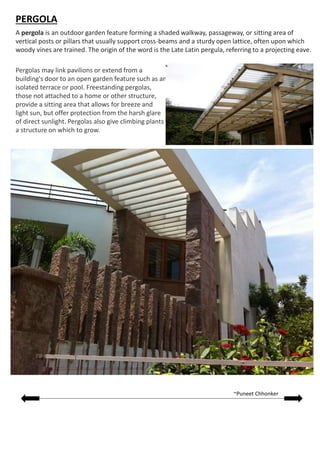
A pergola is an outdoor garden feature forming a shaded walkway, passageway, or sitting area of
vertical posts or pillars that usually support cross-beams and a sturdy open lattice, often upon which
woody vines are trained. The origin of the word is the Late Latin pergula, referring to a projecting eave.
Pergolas may link pavilions or extend from a
building's door to an open garden feature such as an
isolated terrace or pool. Freestanding pergolas,
those not attached to a home or other structure,
provide a sitting area that allows for breeze and
light sun, but offer protection from the harsh glare
of direct sunlight. Pergolas also give climbing plants
a structure on which to grow.
PERGOLA
~Puneet Chhonker

RCC Elements column, beam.

  • 1.
    ASSIGNMENT - 12 BUILDINGCONST. IV TOPIC : RCC WORK SUBMITTED BY:SUBMITTED TO: ->PUNEET CHHONKER ->B.ARCH 3rd YR , 5th SEM. -> Ar. SURJEET SINGH
  • 2.
  • 3.
    RCC COLUMN • Acolumn is a vertical member which effectively takes load by compression. Basically column is a compression member as load acts along its longitudinal axis. Bending moment may occur due to wind earthquake or accidental loads. • Column transfers the load of the structure of slabs beams above to below, and finally load is transferred to the soil. Position of the columns should be so that there are no tensile stresses developed at the cross section of the columns. Columns location should be such that it hides in the walls partially or fully. Long Column/ Slender Short Column Intermediate Column TYPES OF COLUMN DESIGN RCC columns are mainly constructed in four different stages, which are 1. Column Layout Work. 2. Column Reinforcement Work. 3. Column Formwork and 4. Pouring Concrete, 1. COLUMN LAYOUT WORK: This is the first step of column construction. In this step, the location of columns is decided practically in the field. It is done by laying rope as per the grids are shown in the drawing and afterward, the location of columns are marked. 2. COLUMN REINFORCEMENT WORK: When marking of column location is done, the reinforcement of columns are placed according to the structural drawing. For example, C1-12#16 mmØ and stirrup-10 mmØ@4″c/c. This means, the column C1 will have 12 numbers of 16 mm diameter bars as the vertical bar and 10 mm diameter steel should be placed 4 inch center to center spacing as the stirrup. Lets look for another example, C2-8#20 mmØ +10#16 mmØ and stirrup – 10 mmØ @(4″+6″)c/c So the column will have 8 numbers of 20 mm dia bar and 10 numbers of 16 mm dia bar for vertical reinforcement and (4″+6″) c/c means the middle half portion of clear height of column will have 6″ center to center spacing of stirrups and the upper one-fourth as well as bottom one-fourth height of the columns clear height will hold stirrups at 4″ center to center spacing. Additional notes such as lap length for column steel of different diameter etc will be given in the sheet of structural drawing.
  • 4.
    3. COLUMN FORMWORK: Thefloor height is normally kept at 10 feet. If the slab contains beam, then concrete has to be poured upto the beam bottom level. For example, if the beam height is given in the drawing is 1′-6″, the casting height of column and formwork will be 8′-6″. But as we know that dropping concrete more than 5 feet height is not allowed because it will cause segregation, we should create formwork within 5 feet height. When the first part will be cast completely, the rest part should be started. 4. POURING CONCRETE INTO COLUMN: Concreting of column is done in two different methods 1. Manually 2. Using machine or pump. BEAM Beam is a structural member which is normally placed horizontally. It provides resistance to bending when loads are applied on it. Various types of materials such as wood, steel, aluminum, etc are used for constructing beam. Most commonly used material for beam is RCC (Reinforced Cement Concrete). RCC beam can be various types depending on different criteria. Such as, depending on shape, beam can be rectangular, T- beam, etc. Depending on reinforcement placement, beam can be double reinforced beam, single reinforced beam, etc. RCC beams are 4 types depending on their supporting systems. 1. Simply supported beam 2. Semi-continuous beam 3. Continuous beam, and 4. Cantilever beam. FUNCTION • A beam is a structural element that primarily resists loads applied laterally to the beam’s axis. Its mode of deflection is primarily by bending. The loads applied to the beam result in reaction forces at the beam’s support points. The total effect of all the forces acting on the beam is to produce shear forces and bending moments within the beam, that in turn induce internal stresses, strains and deflections of the beam. Beams are characterized by their manner of support, profile (shape of cross-section), length, and their material. • When beams support slabs, they work together forming a “T” section beam. The level of the slabs compared to the level of the beams results in the formation of rectangular beams, inverted beams or “Z” beams.
  • 5.
    • The beamto column connection is called direct support while the beam to beam connection is called indirect support. • The most usually used beam is the one supported by two columns and the most rarely used is the cantilever beam. Indirect supports should be ocasionly used and only if it’s the only avaible solution. SLAB • A Reinforced Concrete Slab is the one of the most important component in a building. It is a structural element of modern buildings. Slabs are supported on Columns and Beams. • RCC Slabs whose thickness ranges from 10 to 50 centimetres are most often used for the construction of floors and ceilings. • Thin concrete slabs are also used for exterior paving purpose. • In many domestic and industrial buildings a thick concrete slab, supported on foundations or directly on the sub soil, is used to construct the ground floor of a building. • In high rises buildings and skyscrapers, thinner, pre-cast concrete slabs are slung between the steel frames to form the floors and ceilings on each level. • While making structural drawings of the reinforced concrete slab, the slabs are abbreviated to “r.c.slab” or simply “r.c.”. Design of various types of slabs and their reinforcement For a suspended slab, there are a number of designs to improve the strength-to-weight ratio. In all cases the top surface remains flat, and the underside is modulated: •Corrugated, usually where the concrete is poured into a corrugated steel tray. This improves strength and prevents the slab bending under its own weight. The corrugations run across the short dimension, from side to side. •A ribbed slab, giving considerable extra • strength on one direction. •A waffle slab, giving added strength in • both directions. Reinforcement design •A one way slab has structural strength • in shortest direction. •A two way slab has structural strength • in two directions.
  • 6.
    Construction •A concrete slabcan be cast in two ways: It could either be prefabricated or cast in situ. •Prefabricated concrete slabs are cast in a factory and then transported to the site ready to be lowered into place between steel or concrete beams. •They may be pre-stressed (in the factory), post-stressed (on site), or unstressed. Care should be taken to see that the supporting structure is built to the correct dimensions to avoid trouble with the fitting of slabs over the supporting structure. •In situ concrete slabs are built on the building site using formwork. Formwork is a box-like setup in which concrete is poured for the construction of slabs. •For reinforced concrete slabs, reinforcing steel bars are placed within the formwork and then the concrete is poured. •Plastic tipped metal, or plastic bar chairs are used to hold the reinforcing steel bars away from the bottom and sides of the form-work, so that when the concrete sets it completely envelops the reinforcement. •Formwork differs with the kind of slab. For a ground slab, the form-work may consist only of sidewalls pushed into the ground whereas for a suspended slab, the form-work is shaped like a tray, often supported by a temporary scaffold until the concrete sets. STAIRCASE RCC stairs may be the most common stairs widely used than any other types of stair. These stairs can be easily moulded to any desired shape and are better wear and fire resistant. The steps of RCC stairs are made by using ordinary cement concrete. Besides ordinary cement concrete, some other superior finishing materials are also used such as marble, terrazzo, tiles etc. to give them better appearances. • DIFFERENT STAIR ARRANGEMENT IN CASE OF R.C.C. Single Straight Flight Stairs • Inclined Slab Stairs With Half Space Landings • String Beam Stairs • Crancked Slab Stairs • Crancked Slab Stairs • Cantilever Stairs • Spiral Stairs
  • 7.
    ADVANTAGES OF RCCSTAIRS: The advantages of R.C.C stairs are as following: 1. R.C.C stairs are better fire resistant than any other stairs. 2. They are adequately strong and more durable. 3. The steps are non-slippery. 4. They offer better and pleasant appearances. 5. The stairs can be designed for greater widths and longer spans. 6. They can be easily cleaned. 7. R.C.C stairs can be precast or cast in situ. 8. The maintenance cost is almost nil. 9. In modern sky scraper construction always framed structures are adopted, for such structures R.C.C stairs are the one and only stairs which can be used. LINTEL A lintel is one type of beam which used to support the above wall when openings like doors, windows etc. are necessary to provide a building structure. The main function of the lintel is to take loads coming from above wall and transfer its load to the side walls. The lintel beam generally ends into the masonry wall so as to convey the weight carried by them to the masonry walls and its width is same to the wall width. The lintel can also be used as decorative architecture element.
  • 8.
    Types of Lintel Lintelsare classified into the following types according to the materials of their construction: 1.Timber lintel 2.Stone lintel 3.Reinforced concrete lintel 4.Brick lintel 5.Reinforced brick lintel 6.Steel lintel CHAJJA. Chajja is Hindi word for Eaves, a chhajja is the projecting or overhanging eaves or cover of a roof usually called a sunshade supported on large carved brackets or projected as a cantilever from walls. An overhang in architecture is a protruding structure which may provide protection for lower levels. Functions of Chajja 1.Protects from external sunlight. 2.Protects from rainwater 3.as aesthetics to a building 4.a recess place to keep utilities like A.C compressor Canopy A canopy is a layer of something that spreads out and covers an area. A canopyis an overhead roof or else a structure over which a fabric or metal covering is attached, able to provide shade or shelter from weather conditions. •Canopy:- A canopy is an overhead roof or else a structure over which a fabric or metal covering is attached, able to provide shade or shelter from weather conditions such as sun, hail, snow and rain. 1.It provide an elegance beauty to structure 2.It maybe a temporary offset or structure provided in the building for special reason.
  • 9.
    COFFER SLAB A ceilingin which the beams and cross-beams leave a regular pattern of square or multi-sided sunken panels, or coffers, each of which is often decorated with molded, carved and painted decoration. COFFER CEILINGS A Coffer (or coffering) in architecture, is a sunken panel in the shape of a square, rectangle, or octagon in a ceiling,soffit or vault. A series of these sunken panels were used as decoration for a ceiling or a vault, also called caissons('boxes"), or lacunaria ("spaces, openings"), so that a coffered ceiling can be called a lacunar ceiling: the strength of the structure is in the framework of the coffers. SERVICES IN COFFERED SLAB 1.The coffer blocks used in the Coffer Slab are manufactured from plastic, making them light and easy to handle. 2. The assembly of the coffer blocks is done on the ground before being lifted into position between the supporting ribs. The result is less labor and quick and easy installation.
  • 10.
    A pergola isan outdoor garden feature forming a shaded walkway, passageway, or sitting area of vertical posts or pillars that usually support cross-beams and a sturdy open lattice, often upon which woody vines are trained. The origin of the word is the Late Latin pergula, referring to a projecting eave. Pergolas may link pavilions or extend from a building's door to an open garden feature such as an isolated terrace or pool. Freestanding pergolas, those not attached to a home or other structure, provide a sitting area that allows for breeze and light sun, but offer protection from the harsh glare of direct sunlight. Pergolas also give climbing plants a structure on which to grow. PERGOLA ~Puneet Chhonker