ARCHES
INTRODUCTION
 An arch is a structure constructed of wedge-
shaped units, jointed together with mortar &
spanning an opening to support the wall above it
with other super-imposed loads.
 Due to wedge-like form, the units support each
other, the load tends to make them compact &
enables them to transmit the pressure
downwards to their supports.
ELEMENTS OF SEGMENTAL
ARCH
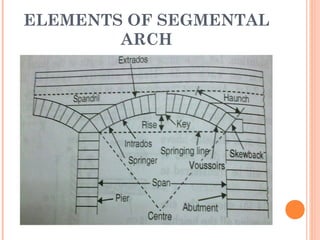
 INTRADOS:- This is the inner curve of an arch.
 SOFFIT:- It is the inner surface of an arch.
Sometimes, intrados & soffit are used synonymously.
 EXTRADOS:- This is the outer curve of an arch.
 VOUSSOIRS:- These are wedge-shaped units of
masonry, forming an arch.
 CROWN:- it is the highest part of extrados.
 KEY:- it is the wedge-shaped unit fixed at crown of
the arch.
 SPANDRIL:- This is the triangular space formed
between the extrados & the horizontal line through
the crown.
ELEMENTS OF SEGMENTAL
ARCH
 ABUTMENT:- This is the end support of an
arch.
 PIER:- This is the intermediate support of an
arcade.
 ARCADE:- It is a row of arches in continuation.
 SKEW BACK:- This is the inclined surface on
the abutment, which is so prepared to receive an
arch.
 SPRINGING LINE:- It is an imaginary line
joining the springing points of either end.
 SPRINGER:- it is the first voussior at springing
level. It is immediately adjacent to the skewback.
 HAUNCH:- It is the lower half of the arch
between the crown and skew back.
ELEMENTS OF SEGMENTAL
ARCH
STABILITY OF AN ARCH
 An arch transmit the super-imposed load to the
side wall through friction between surfaces of
voussior and the cohesion of mortar.
 Every element of arch remains in compression.
 An arch may fail in the following types:-
a) Crushing of the masonry
b) Sliding of voussior
c) Rotation of joints about an edge.
d) Uneven settlement of abutment/pier.
CLASSIFICATION OF ARCH
 According to shape
i) Flat Arch
ii) Segmental Arch
iii)Semicircular Arch
iv)Horse shoe Arch
v) Pointed Arch (Gothic Arch)
vi)Venetian Arch
CLASSIFICATION OF ARCH
 Classification based on number of centers
i) One-Centered Arches
ii) Two-Centered Arches
iii)Three-Centered Arches
iv)Four-Centered Arches
v) Five-Centered Arches
CLASSIFICATION OF ARCH
 Classification based on material of construction
and workmanship
 Stone Arches
a) Rubble Arch
b) Ashlar Arch
 Brick Arches
a) Rough Arch
b) Axed or rough-cut Arch
c) Gauged Arch
d) Purpose made brick Arch
 Concrete Arches
FLAT ARCHES
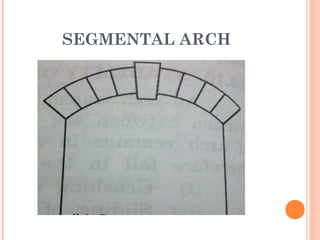
SEGMENTAL ARCH
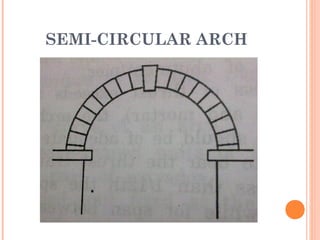
SEMI-CIRCULAR ARCH
HORSE SHOE ARCH
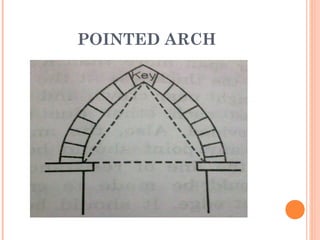
POINTED ARCH
Arches
Arches

Arches

  • 1.
  • 2.
    INTRODUCTION  An archis a structure constructed of wedge- shaped units, jointed together with mortar & spanning an opening to support the wall above it with other super-imposed loads.  Due to wedge-like form, the units support each other, the load tends to make them compact & enables them to transmit the pressure downwards to their supports.
  • 3.
    ELEMENTS OF SEGMENTAL ARCH INTRADOS:- This is the inner curve of an arch.  SOFFIT:- It is the inner surface of an arch. Sometimes, intrados & soffit are used synonymously.  EXTRADOS:- This is the outer curve of an arch.  VOUSSOIRS:- These are wedge-shaped units of masonry, forming an arch.  CROWN:- it is the highest part of extrados.  KEY:- it is the wedge-shaped unit fixed at crown of the arch.  SPANDRIL:- This is the triangular space formed between the extrados & the horizontal line through the crown.
  • 4.
    ELEMENTS OF SEGMENTAL ARCH ABUTMENT:- This is the end support of an arch.  PIER:- This is the intermediate support of an arcade.  ARCADE:- It is a row of arches in continuation.  SKEW BACK:- This is the inclined surface on the abutment, which is so prepared to receive an arch.  SPRINGING LINE:- It is an imaginary line joining the springing points of either end.  SPRINGER:- it is the first voussior at springing level. It is immediately adjacent to the skewback.  HAUNCH:- It is the lower half of the arch between the crown and skew back.
  • 5.
  • 6.
    STABILITY OF ANARCH  An arch transmit the super-imposed load to the side wall through friction between surfaces of voussior and the cohesion of mortar.  Every element of arch remains in compression.  An arch may fail in the following types:- a) Crushing of the masonry b) Sliding of voussior c) Rotation of joints about an edge. d) Uneven settlement of abutment/pier.
  • 7.
    CLASSIFICATION OF ARCH According to shape i) Flat Arch ii) Segmental Arch iii)Semicircular Arch iv)Horse shoe Arch v) Pointed Arch (Gothic Arch) vi)Venetian Arch
  • 8.
    CLASSIFICATION OF ARCH Classification based on number of centers i) One-Centered Arches ii) Two-Centered Arches iii)Three-Centered Arches iv)Four-Centered Arches v) Five-Centered Arches
  • 9.
    CLASSIFICATION OF ARCH Classification based on material of construction and workmanship  Stone Arches a) Rubble Arch b) Ashlar Arch  Brick Arches a) Rough Arch b) Axed or rough-cut Arch c) Gauged Arch d) Purpose made brick Arch  Concrete Arches
  • 10.
  • 11.
  • 12.
  • 13.
  • 14.