FOUNDATION
Module - II
Shanik. A Asst.Prof. MES School Of Architecture
Lets know the module ….
Shanik. A Asst.Prof. MES School Of Architecture
Definition,
functions,
types of foundations,
foundation loads,
selection criteria for foundations based on soil conditions,
bearing capacity of soil,
methods of testing,
method of improving bearing capacity of soil,
settlement of foundations,
precautions against settlement,
shallow and deep foundations,
different types of foundations – wall footing (strip footing), isolated footing, combined
footing, raft foundation, pile foundation etc.
Drawings- wall footing, isolated footing, and combined footing
Introduction
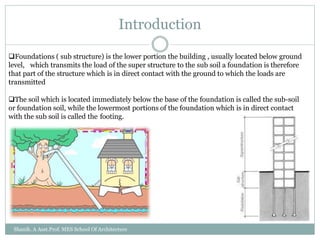
Foundations ( sub structure) is the lower portion the building , usually located below ground
level, which transmits the load of the super structure to the sub soil a foundation is therefore
that part of the structure which is in direct contact with the ground to which the loads are
transmitted
The soil which is located immediately below the base of the foundation is called the sub-soil
or foundation soil, while the lowermost portions of the foundation which is in direct contact
with the sub soil is called the footing.
Shanik. A Asst.Prof. MES School Of Architecture
Functions of foundations
Shanik. A Asst.Prof. MES School Of Architecture
The basic function of a foundation is to transmit the dead loads, super – imposed loads (or live
loads) and wind loads from a building to the soil on which the building rests.
Foundation serves the following purposes:
1. Reduction of load intensity
Foundations distribute the loads of the super structure, to a larger area so that the intensity of the
load at its base does not exceed the safe bearing capacity of the soil.
2. Even distribution of load
Foundations distribute the non – uniform loads of the super structure evenly to the sub-soil
3. Provision of level surface
Foundation provide leveled and hard surface over which the super-structure can be built.
4. Lateral stability
It anchors the super structure to the ground, thus imparting lateral stability to the super
structure.
5. Safety against under mining
It provides the structural safety against undermining due to burrowing animals and food water.
6. Protection against soil movements
Special foundations measures prevents or minimizes the distress (or cracks) in the super-
structure, due to expansion of the sub soil because of moisture movement in same problematic
soils.
Shanik. A Asst.Prof. MES School Of Architecture
Foundation loads
Shanik. A Asst.Prof. MES School Of Architecture
 Dead Load
this is the load of the material used for the various components of a building such as
walls, floors, roofs, etc. all permanent loads are thus included in dead load.
 Live Load
this is the movable load on the floor and hence its variable. Its also sometimes known as
the super imposed load. It includes the load of persons standing on a floor, weight of the
material stored on a floor, weight f snow on a roof, etc.
 Wind Load
In case of tall buildings, the effect due to wind should be considered.
 Structural Member Forces
 Uplift
 Earthquake
Horizontal and vertical forces caused by the motion of the ground relative to the
building.
Types of foundations
Foundations
Shallow – Foundations Deep - Foundations
(Its depth is equal to or less than
its width)
1. Spread footing
2. Combined footing
3. Strap footing
4. Mat (raft) foundation
(Its depth is equal to or
greater than its width)
1. Deep strip footing
2. Pile foundation
3. Pier (drilled
caisson) foundation
4. Well (caissons)
foundation
i. Single footing
ii. Stepped footing
iii. Sloped footing
iv. Wall footing
v. Stepped wall footing
vi. Grillage foundation
i. Rectangular combined footing
ii. Trapezoidal combined footing
iii. Combined column -wall footing
i. Solid slab system
ii. Beam slab system
iii. Cellular system
i. End bearing pile
ii. Friction pile
iii. Combined pile
iv. Compaction pile
i. Masonry or
concrete pier
ii. Drilled caissons
i. Circular
ii. rectangular
Shanik. A Asst.Prof. MES School Of Architecture
Shallow foundations
Spread footings – spread footings are those which spread the super imposed load of wall or
column over a larger area . Spread footings support either a column or wall. Spread footings
may be of the following kinds;
i. Single footing for a column
ii. Stepped footing for a column
iii. Sloped footing for a column
iv. Wall footing without step
v. Stepped footing for wall
vi. Grillage foundation
1. Spread footing
2. Combined footing
3. Strap footing
4. Mat (raft) foundation
Shanik. A Asst.Prof. MES School Of Architecture
Shallow foundations
1. Spread footing
2. Combined footing
3. Strap footing
4. Mat (raft) foundation
Single footing for a column
Shanik. A Asst.Prof. MES School Of Architecture
Stepped footing forwall
Strip footing
Grillage foundation
Shallow foundations
Combined footing – a spread footing which supports two or more columns is termed as
combined footing. The combined footings may be of the following kinds;
i. Rectangular combined footing
ii. Trapezoidal combined footing
iii. Combined column -wall footing
1. Spread footing
2. Combined footing
3. Strap footing
4. Mat (raft) foundation
Shanik. A Asst.Prof. MES School Of Architecture
Shallow foundations
1. Spread footing
2. Combined footing
3. Strap footing
4. Mat (raft) foundation
Shanik. A Asst.Prof. MES School Of Architecture
Shallow foundations
Strap footing – if the independent footings of two columns are connected by a beam, it is
called a strap footing. A strap footings may be used where the distance between the column is
so great that a combined trapezoidal footing becomes quite narrow, with high bending
moment. In that case, each column is provided with its independent footings and a beam is
used to connect the two footings.
1. Spread footing
2. Combined footing
3. Strap footing
4. Mat (raft) foundation
Shanik. A Asst.Prof. MES School Of Architecture
Shallow foundations
1. Spread footing
2. Combined footing
3. Strap footing
4. Mat (raft) foundation
Shanik. A Asst.Prof. MES School Of Architecture
Shallow foundations
Mat foundation ( Raft foundation )– a mat or raft is a combined footing that covers the
entire area beneath a structure and supports all the walls and columns. When the allowable
soil pressure is low, or the building loads are heavy, the use of spread footings would cover
more than one half the area and it may prove more economical to use mat or raft foundation.
Raft may be divided into three types, based on their design and construction;
i. Solid slab system
ii. Beam slab system
iii. Cellular system
1. Spread footing
2. Combined footing
3. Strap footing
4. Mat (raft) foundation
Shanik. A Asst.Prof. MES School Of Architecture
Shallow foundations
i. Solid slab system
ii. Beam slab system
iii. Cellular system
1. Spread footing
2. Combined footing
3. Strap footing
4. Mat (raft) foundation
Shanik. A Asst.Prof. MES School Of Architecture
Deep foundations
Deep strip, rectangular or square footings – the usual strip, rectangular or square
footings come under the category of deep foundations, when the depth of the foundation is
more than the width of the footing.
1. Deep strip footing
2. Pile foundation
3. Pier (drilled caisson) foundation
4. Well (caissons) foundation
Shanik. A Asst.Prof. MES School Of Architecture
Deep foundations
Pile foundation – pile foundation is that type of deep foundation in which the loads are
taken to a low level by means of vertical members which may be of timber, concrete or steel .
Piles used for building foundation may be of four types;
i. End bearing pile
ii. Friction pile
iii. Combined pile
iv. Compaction pile
1. Deep strip footing
2. Pile foundation
3. Pier (drilled caisson) foundation
4. Well (caissons) foundation
Shanik. A Asst.Prof. MES School Of Architecture
Deep foundations
Pier foundation ( drilled caisson foundation)– a pier foundation consist of a
cylindrical column of a large diameter to support and transfer large super imposed loads to the
firm strata below. The difference between pile foundation and pier foundation lies in the
method of constructions. Pier foundation may be of the following types;
i. Masonry or concrete pier
ii. Drilled caissons
1. Deep strip footing
2. Pile foundation
3. Pier (drilled caisson) foundation
4. Well (caissons) foundation
Shanik. A Asst.Prof. MES School Of Architecture
Deep foundations
Well foundation ( or caissons)– well foundations or caissons are box like structure –
circular or rectangular – which are sunk from the surface of either land or water to the desired
depth. They are much large in diameter than the pier foundations or drilled caissons. Well
foundations or caissons are hollow from inside, which may be filled with sand, and are
plugged at the perimeter wall, called steining. This type of foundations are not used for
buildings. Based on shape classified as follows;
i. Circular
ii. rectangular
1. Deep strip footing
2. Pile foundation
3. Pier (drilled caisson) foundation
4. Well (caissons) foundation
Shanik. A Asst.Prof. MES School Of Architecture
Selection criteria for foundations based on soil
conditions,
Shanik. A Asst.Prof. MES School Of Architecture
Selection criteria for foundation for buildings depend on two factors, i.e. factors related to
ground (soil) conditions and factors related to loads from the structure. The
performance of foundation is based on interface between the loadings from the structure and the
supporting ground or strata. The nature and conditions of each of these varies, so, the selection of
appropriate foundation becomes necessary for these variations depending on circumstances.
Selection of Foundation based on Ground Conditions:
The ground or soil condition is necessary for determining the type of suitable foundation. The
soil on which the industrial, commercial or residential building rests may be stable, level and
of uniform composition, but in some situations it may be otherwise.
Following are criteria for selecting suitable foundation based on soil condition:
Where soil close to the surface is capable of supporting
structure loads, shallow foundations can be provided.
Where the ground close to surface is not capable of supporting
structural loads, hard strata is searched for, and in some cases, it
may be very deep, like in case of multi-storey buildings, where
loads are very high. So, deep foundations are suitable for such
cases.
Selection criteria for foundations based on soil
conditions,
Shanik. A Asst.Prof. MES School Of Architecture
Field up ground have low bearing capacity, so deep foundation is required at that place,
whereas uniform stable ground needs relatively shallow foundation.
Level of the ground also affects foundation selection. If the ground is not leveled, and has
gradient then step foundation may be preferred.
Selection of foundation based on Loads from Building:
The loading condition i.e. type and magnitude of loads, depends on the form and type of building
to be constructed.
In case of low rise building with large span, the extent of loading is relatively modest, so
shallow foundation is preferred in this case.
While high-rise building with short span has high loads. Therefore, deep foundation is
required in such cases. Deep foundation is provided because ground at greater depth are highly
compacted.
In case of framed structure multi-storey building, where loads are concentrated at the point of
application, the use of pads and piles are common.
Where, loads of the buildings are uniformly distributed, like from masonry claddings, the piles
are not needed.
Bearing capacity of soil,
Shanik. A Asst.Prof. MES School Of Architecture
A foundation should be designed to satisfy two essential conditions ;
i. It must have some specified safety against ultimate failure .
ii. The settlements under working loads should not exceed the allowable limits for the super
structure.
Bearing capacity is the power of foundation soil to hold the forces from the
superstructure without undergoing shear failure or excessive settlement. used for
the design of foundations (i.e. for determine the dimensions of the foundations ) is determined
on the basis of the above two criteria. In general, the supporting power of a soil or rocks is
referred to as its bearing capacity. The term bearing capacity is defined after attaching certain
qualifying prefixes, as defined below;
1. Gross pressure intensity (q)
2. Net pressure intensity (qn)
3. Ultimate bearing capacity (qf)
4. Net ultimate bearing capacity (qnf)
5. Net safe bearing capacity (qns)
6. Safe bearing capacity (qs)
7. Allowable bearing capacity (qa)
Ultimate Bearing Capacity (qf) : It is the maximum pressure that a foundation soil can
withstand without undergoing shear failure.
Net ultimate Bearing Capacity (qnf) : It is the maximum extra pressure (in addition to
initial overburden pressure) that a foundation soil can withstand without undergoing shear
failure.
qnf = qf –qo
Here, qo represents the overburden pressure at foundation level and is equal to үD for level
ground without surcharge where ү is the unit weight of soil and D is the depth to foundation
bottom from Ground Level.
Safe Bearing Capacity (qs) : It is the safe extra load the foundation soil is subjected to in
addition to initial overburden pressure.
Here. F represents the factor of safety.
Allowable Bearing Pressure (qa) : It is the maximum pressure the foundation soil is
subjected to considering both shear failure and settlement.
Shanik. A Asst.Prof. MES School Of Architecture
Methods of testing bearing capacity of soil
c) Penetration test
a) presumptive bearing capacity values from codes
The bearing capacity of soil can be determined by the following methods;
Rankines’s analysis:
a) Analytical methods involving the use of soil parameter
Terzaghi’s analysis :
Gravity loading platform method
b) Plate load test on the soil Reaction truss method
Shanik. A Asst.Prof. MES School Of Architecture
Foundation
Soil
Sand Bags
Platform for
loading
Dial Gauge
Testing Plate
Foundation Level
It is a field test for the determination of bearing
capacity and settlement characteristics of ground
in field at the foundation level.
The test involves preparing a test pit up to the desired
foundation level.
 A rigid steel plate, round or square in shape, 300 mm to 750 mm in size, 25 mm thick acts
as model footing.
Plate load test on the soil
Shanik. A Asst.Prof. MES School Of Architecture
 Dial gauges, at least 2, of required accuracy (0.002 mm) are placed on plate at corners to
measure the vertical deflection.
 Loading is provided either as gravity loading or as reaction loading. For smaller loads
gravity loading is acceptable where sand bags apply the load.
 In reaction loading, a reaction truss or beam is anchored to
the ground. A hydraulic jack applies the reaction load.
 At every applied load, the plate settles gradually.
The dial gauge readings are recorded after the settlement reduces
to least count of gauge (0.002 mm) & average settlement of
2 or more gauges is recorded.
Load Vs settlement graph is plotted as shown. Load (P) is
plotted on the horizontal scale and settlement (Δ) is plotted on
the vertical scale.
Red curve indicates the general shear failure & the
blue one indicates the local or punching shear failure.
The maximum load at which the shear failure occurs gives the
ultimate bearing capacity of soil.
Shanik. A Asst.Prof. MES School Of Architecture
Plate load test on the soil
Shanik. A Asst.Prof. MES School Of Architecture
Bore Hole
Split Spoon Sampler
Shanik. A Asst.Prof. MES School Of Architecture
65 kg Hammer
Tripod
750
mm
It is a field test to estimate the penetration resistance of soil.
It consists of a split spoon sampler 50.8 mm OD, 35 mm ID, min 600 mm long and 63.5 kg
hammer freely dropped from a height of 750 mm.
Test is performed on a clean hole 50 mm to 150 mm in diameter.
Split spoon sampler is placed vertically in the hole, allowed to freely settle under its own
weight or with blows for first 150 mm which is called seating drive.
Penetration test
The number of blows required for the next 300 mm penetration into the ground is the
standard penetration number N
Apply the desired corrections (such as corrections for overburden pressure, saturated fine silt
and energy)
 N is correlated with most properties of soil such as friction angle, undrained cohesion, density
etc.
Shanik. A Asst.Prof. MES School Of Architecture
Method of improving bearing capacity of soil
Shanik. A Asst.Prof. MES School Of Architecture
Method of improving bearing capacity of soil
Some times, the safe bearing pressure of soil is so low that the dimensions of the footings work
out to be very large and un economical. In such a circumstance, it becomes essential to improve
the safe bearing pressure, which can be done by the following methods;
1. Increasing depth of foundation
2. Compaction of soil
3. Drainage of soil
4. Confining the soil
5. Grouting
6. Chemical treatment
a) Ramming moist soil
b) Rubble compaction into the soil
c) Flooding the soil
d) vibration
e) Vibroflotation
f) Compaction by pre-loading
g) Using sand piles
Shanik. A Asst.Prof. MES School Of Architecture
 Increasing depth of foundation
It has been found that in granular soil, the bearing capacity increases with the depth due to
the confining weight of overlying material. However this is not economical since the cost of
construction increases with the depth.
 Compaction of soil
it has found that compaction of natural soil deposits or man-made fills results in the
improvement of bearing capacity and reduction in the resulting settlement . Compaction of
soil can be achieved by the following means
a) Ramming moist soil
b) Rubble compaction into the soil
c) Flooding the soil
d) vibration
e) Vibroflotation
f) Compaction by pre-loading
g) Using sand piles
 Drainage of soil
it is a well known fact that the presence of water decreases
the bearing power of soil , specially when its saturated.
This is because of low shearing strength of soil in
presence of excess water. Drainage results in decreases
in the voids ratio , and improvement in bearing capacity.
Shanik. A Asst.Prof. MES School Of Architecture
 Confining the soil
some times the safe bearing pressure of the soil is low due to the lateral movement of loose
granular soil. Such a tendency of lateral movement can be checked by confining the soil, out
side the perimeter of foundation area, by driving sheet piles , thus forming an enclosure and
confining the soil
 Grouting
this method is useful in loose gravels and fissured rocky strata. Bores holes in sufficient
numbers are driven in the ground and cement grout is forced through these under pressure.
The cracks, voids and fissures of the strata are thus filled with the grout, resulting increase
in the bearing value.
 Chemical treatment
in this method, certain chemicals are grouted in the place of cement grout. The chemical
should be such that it can solidify and gain early strength.
Shanik. A Asst.Prof. MES School Of Architecture
Settlement of foundations
Shanik. A Asst.Prof. MES School Of Architecture
The vertical downward movement of the base of a structure is called settlement and its effect
upon the structure depends on its magnitude, its informality, the length of the time over which
it takes place, and the nature of the structure itself. Foundation settlements may be caused by
some or a combination of the following reasons;
1. Elastic compression
2. Inelastic (or plastic ) compression
3. Ground water lowering
4. Vibrations
5. Seasonal swelling and shrinkage
6. Ground movement on earth slopes
7. Other causes
Settlement of foundations
Shanik. A Asst.Prof. MES School Of Architecture
1. Elastic compression of the foundation and the underlying soil.
2. Inelastic (or plastic ) compression of the underlying soils, which is much larger than
the elastic compression. The in elastic compression can be predicted by the theory of
consolidation.
3. Ground water lowering repeated lowering and rising of water level in loose granular soil
tends to compact the soil and cause settlement of the ground surface.
4. Vibrations due to pile driving, blasting and oscillating machineries may cause settlement
in deposits of granular soils.
5. Seasonal swelling and shrinkage of expensive clays.
6. Ground movement on earth slopes, such as surface erosion, slow creep or landslide.
7. Other causes such as adjacent excavation, mining subsidence, underground erosion, etc.
Causes of failure of foundation and remedial
measures
Shanik. A Asst.Prof. MES School Of Architecture
1. Unequal settlement of sub soil
2. Unequal settlement of masonry
3. Sub soil moisture movement
4. Lateral pressure on the walls
5. Lateral movement of sub soil
6. Weathering of sub soil due to trees and shrubs
7. Atmospheric action
Causes of failure of foundation and remedial
measures
Shanik. A Asst.Prof. MES School Of Architecture
Site Preparation
•Remove trees and any debris
•Remove top soil
Shanik. A Asst.Prof. MES School Of Architecture
Site Layout
•Ensure lot lines are known & setbacks are
complete
•Layout building perimeter
•Use batter boards
•Establish building corners & building perimeter
Shanik. A Asst.Prof. MES School Of Architecture
Excavation
•Excavate foundation along line created by
batter boards
•Excavate remainder of soil inside perimeter
•If deep foundation, taper edges to prevent
collapse
•If soil unstable, or very deep - use shoring
Shanik. A Asst.Prof. MES School Of Architecture
Thank you
Shanik. A Asst.Prof. MES School Of Architecture

foundations-170117100953.pptx

  • 1.
    FOUNDATION Module - II Shanik.A Asst.Prof. MES School Of Architecture
  • 2.
    Lets know themodule …. Shanik. A Asst.Prof. MES School Of Architecture Definition, functions, types of foundations, foundation loads, selection criteria for foundations based on soil conditions, bearing capacity of soil, methods of testing, method of improving bearing capacity of soil, settlement of foundations, precautions against settlement, shallow and deep foundations, different types of foundations – wall footing (strip footing), isolated footing, combined footing, raft foundation, pile foundation etc. Drawings- wall footing, isolated footing, and combined footing
  • 3.
    Introduction Foundations ( substructure) is the lower portion the building , usually located below ground level, which transmits the load of the super structure to the sub soil a foundation is therefore that part of the structure which is in direct contact with the ground to which the loads are transmitted The soil which is located immediately below the base of the foundation is called the sub-soil or foundation soil, while the lowermost portions of the foundation which is in direct contact with the sub soil is called the footing. Shanik. A Asst.Prof. MES School Of Architecture
  • 4.
    Functions of foundations Shanik.A Asst.Prof. MES School Of Architecture The basic function of a foundation is to transmit the dead loads, super – imposed loads (or live loads) and wind loads from a building to the soil on which the building rests. Foundation serves the following purposes: 1. Reduction of load intensity Foundations distribute the loads of the super structure, to a larger area so that the intensity of the load at its base does not exceed the safe bearing capacity of the soil. 2. Even distribution of load Foundations distribute the non – uniform loads of the super structure evenly to the sub-soil 3. Provision of level surface Foundation provide leveled and hard surface over which the super-structure can be built.
  • 5.
    4. Lateral stability Itanchors the super structure to the ground, thus imparting lateral stability to the super structure. 5. Safety against under mining It provides the structural safety against undermining due to burrowing animals and food water. 6. Protection against soil movements Special foundations measures prevents or minimizes the distress (or cracks) in the super- structure, due to expansion of the sub soil because of moisture movement in same problematic soils. Shanik. A Asst.Prof. MES School Of Architecture
  • 6.
    Foundation loads Shanik. AAsst.Prof. MES School Of Architecture  Dead Load this is the load of the material used for the various components of a building such as walls, floors, roofs, etc. all permanent loads are thus included in dead load.  Live Load this is the movable load on the floor and hence its variable. Its also sometimes known as the super imposed load. It includes the load of persons standing on a floor, weight of the material stored on a floor, weight f snow on a roof, etc.  Wind Load In case of tall buildings, the effect due to wind should be considered.  Structural Member Forces  Uplift  Earthquake Horizontal and vertical forces caused by the motion of the ground relative to the building.
  • 7.
    Types of foundations Foundations Shallow– Foundations Deep - Foundations (Its depth is equal to or less than its width) 1. Spread footing 2. Combined footing 3. Strap footing 4. Mat (raft) foundation (Its depth is equal to or greater than its width) 1. Deep strip footing 2. Pile foundation 3. Pier (drilled caisson) foundation 4. Well (caissons) foundation i. Single footing ii. Stepped footing iii. Sloped footing iv. Wall footing v. Stepped wall footing vi. Grillage foundation i. Rectangular combined footing ii. Trapezoidal combined footing iii. Combined column -wall footing i. Solid slab system ii. Beam slab system iii. Cellular system i. End bearing pile ii. Friction pile iii. Combined pile iv. Compaction pile i. Masonry or concrete pier ii. Drilled caissons i. Circular ii. rectangular Shanik. A Asst.Prof. MES School Of Architecture
  • 8.
    Shallow foundations Spread footings– spread footings are those which spread the super imposed load of wall or column over a larger area . Spread footings support either a column or wall. Spread footings may be of the following kinds; i. Single footing for a column ii. Stepped footing for a column iii. Sloped footing for a column iv. Wall footing without step v. Stepped footing for wall vi. Grillage foundation 1. Spread footing 2. Combined footing 3. Strap footing 4. Mat (raft) foundation Shanik. A Asst.Prof. MES School Of Architecture
  • 9.
    Shallow foundations 1. Spreadfooting 2. Combined footing 3. Strap footing 4. Mat (raft) foundation Single footing for a column Shanik. A Asst.Prof. MES School Of Architecture Stepped footing forwall Strip footing Grillage foundation
  • 10.
    Shallow foundations Combined footing– a spread footing which supports two or more columns is termed as combined footing. The combined footings may be of the following kinds; i. Rectangular combined footing ii. Trapezoidal combined footing iii. Combined column -wall footing 1. Spread footing 2. Combined footing 3. Strap footing 4. Mat (raft) foundation Shanik. A Asst.Prof. MES School Of Architecture
  • 11.
    Shallow foundations 1. Spreadfooting 2. Combined footing 3. Strap footing 4. Mat (raft) foundation Shanik. A Asst.Prof. MES School Of Architecture
  • 12.
    Shallow foundations Strap footing– if the independent footings of two columns are connected by a beam, it is called a strap footing. A strap footings may be used where the distance between the column is so great that a combined trapezoidal footing becomes quite narrow, with high bending moment. In that case, each column is provided with its independent footings and a beam is used to connect the two footings. 1. Spread footing 2. Combined footing 3. Strap footing 4. Mat (raft) foundation Shanik. A Asst.Prof. MES School Of Architecture
  • 13.
    Shallow foundations 1. Spreadfooting 2. Combined footing 3. Strap footing 4. Mat (raft) foundation Shanik. A Asst.Prof. MES School Of Architecture
  • 14.
    Shallow foundations Mat foundation( Raft foundation )– a mat or raft is a combined footing that covers the entire area beneath a structure and supports all the walls and columns. When the allowable soil pressure is low, or the building loads are heavy, the use of spread footings would cover more than one half the area and it may prove more economical to use mat or raft foundation. Raft may be divided into three types, based on their design and construction; i. Solid slab system ii. Beam slab system iii. Cellular system 1. Spread footing 2. Combined footing 3. Strap footing 4. Mat (raft) foundation Shanik. A Asst.Prof. MES School Of Architecture
  • 15.
    Shallow foundations i. Solidslab system ii. Beam slab system iii. Cellular system 1. Spread footing 2. Combined footing 3. Strap footing 4. Mat (raft) foundation Shanik. A Asst.Prof. MES School Of Architecture
  • 16.
    Deep foundations Deep strip,rectangular or square footings – the usual strip, rectangular or square footings come under the category of deep foundations, when the depth of the foundation is more than the width of the footing. 1. Deep strip footing 2. Pile foundation 3. Pier (drilled caisson) foundation 4. Well (caissons) foundation Shanik. A Asst.Prof. MES School Of Architecture
  • 17.
    Deep foundations Pile foundation– pile foundation is that type of deep foundation in which the loads are taken to a low level by means of vertical members which may be of timber, concrete or steel . Piles used for building foundation may be of four types; i. End bearing pile ii. Friction pile iii. Combined pile iv. Compaction pile 1. Deep strip footing 2. Pile foundation 3. Pier (drilled caisson) foundation 4. Well (caissons) foundation Shanik. A Asst.Prof. MES School Of Architecture
  • 18.
    Deep foundations Pier foundation( drilled caisson foundation)– a pier foundation consist of a cylindrical column of a large diameter to support and transfer large super imposed loads to the firm strata below. The difference between pile foundation and pier foundation lies in the method of constructions. Pier foundation may be of the following types; i. Masonry or concrete pier ii. Drilled caissons 1. Deep strip footing 2. Pile foundation 3. Pier (drilled caisson) foundation 4. Well (caissons) foundation Shanik. A Asst.Prof. MES School Of Architecture
  • 19.
    Deep foundations Well foundation( or caissons)– well foundations or caissons are box like structure – circular or rectangular – which are sunk from the surface of either land or water to the desired depth. They are much large in diameter than the pier foundations or drilled caissons. Well foundations or caissons are hollow from inside, which may be filled with sand, and are plugged at the perimeter wall, called steining. This type of foundations are not used for buildings. Based on shape classified as follows; i. Circular ii. rectangular 1. Deep strip footing 2. Pile foundation 3. Pier (drilled caisson) foundation 4. Well (caissons) foundation Shanik. A Asst.Prof. MES School Of Architecture
  • 20.
    Selection criteria forfoundations based on soil conditions, Shanik. A Asst.Prof. MES School Of Architecture Selection criteria for foundation for buildings depend on two factors, i.e. factors related to ground (soil) conditions and factors related to loads from the structure. The performance of foundation is based on interface between the loadings from the structure and the supporting ground or strata. The nature and conditions of each of these varies, so, the selection of appropriate foundation becomes necessary for these variations depending on circumstances. Selection of Foundation based on Ground Conditions: The ground or soil condition is necessary for determining the type of suitable foundation. The soil on which the industrial, commercial or residential building rests may be stable, level and of uniform composition, but in some situations it may be otherwise. Following are criteria for selecting suitable foundation based on soil condition: Where soil close to the surface is capable of supporting structure loads, shallow foundations can be provided. Where the ground close to surface is not capable of supporting structural loads, hard strata is searched for, and in some cases, it may be very deep, like in case of multi-storey buildings, where loads are very high. So, deep foundations are suitable for such cases.
  • 21.
    Selection criteria forfoundations based on soil conditions, Shanik. A Asst.Prof. MES School Of Architecture Field up ground have low bearing capacity, so deep foundation is required at that place, whereas uniform stable ground needs relatively shallow foundation. Level of the ground also affects foundation selection. If the ground is not leveled, and has gradient then step foundation may be preferred. Selection of foundation based on Loads from Building: The loading condition i.e. type and magnitude of loads, depends on the form and type of building to be constructed. In case of low rise building with large span, the extent of loading is relatively modest, so shallow foundation is preferred in this case. While high-rise building with short span has high loads. Therefore, deep foundation is required in such cases. Deep foundation is provided because ground at greater depth are highly compacted. In case of framed structure multi-storey building, where loads are concentrated at the point of application, the use of pads and piles are common. Where, loads of the buildings are uniformly distributed, like from masonry claddings, the piles are not needed.
  • 22.
    Bearing capacity ofsoil, Shanik. A Asst.Prof. MES School Of Architecture A foundation should be designed to satisfy two essential conditions ; i. It must have some specified safety against ultimate failure . ii. The settlements under working loads should not exceed the allowable limits for the super structure. Bearing capacity is the power of foundation soil to hold the forces from the superstructure without undergoing shear failure or excessive settlement. used for the design of foundations (i.e. for determine the dimensions of the foundations ) is determined on the basis of the above two criteria. In general, the supporting power of a soil or rocks is referred to as its bearing capacity. The term bearing capacity is defined after attaching certain qualifying prefixes, as defined below; 1. Gross pressure intensity (q) 2. Net pressure intensity (qn) 3. Ultimate bearing capacity (qf) 4. Net ultimate bearing capacity (qnf) 5. Net safe bearing capacity (qns) 6. Safe bearing capacity (qs) 7. Allowable bearing capacity (qa)
  • 23.
    Ultimate Bearing Capacity(qf) : It is the maximum pressure that a foundation soil can withstand without undergoing shear failure. Net ultimate Bearing Capacity (qnf) : It is the maximum extra pressure (in addition to initial overburden pressure) that a foundation soil can withstand without undergoing shear failure. qnf = qf –qo Here, qo represents the overburden pressure at foundation level and is equal to үD for level ground without surcharge where ү is the unit weight of soil and D is the depth to foundation bottom from Ground Level. Safe Bearing Capacity (qs) : It is the safe extra load the foundation soil is subjected to in addition to initial overburden pressure. Here. F represents the factor of safety. Allowable Bearing Pressure (qa) : It is the maximum pressure the foundation soil is subjected to considering both shear failure and settlement. Shanik. A Asst.Prof. MES School Of Architecture
  • 24.
    Methods of testingbearing capacity of soil c) Penetration test a) presumptive bearing capacity values from codes The bearing capacity of soil can be determined by the following methods; Rankines’s analysis: a) Analytical methods involving the use of soil parameter Terzaghi’s analysis : Gravity loading platform method b) Plate load test on the soil Reaction truss method Shanik. A Asst.Prof. MES School Of Architecture
  • 25.
    Foundation Soil Sand Bags Platform for loading DialGauge Testing Plate Foundation Level It is a field test for the determination of bearing capacity and settlement characteristics of ground in field at the foundation level. The test involves preparing a test pit up to the desired foundation level.  A rigid steel plate, round or square in shape, 300 mm to 750 mm in size, 25 mm thick acts as model footing. Plate load test on the soil Shanik. A Asst.Prof. MES School Of Architecture
  • 26.
     Dial gauges,at least 2, of required accuracy (0.002 mm) are placed on plate at corners to measure the vertical deflection.  Loading is provided either as gravity loading or as reaction loading. For smaller loads gravity loading is acceptable where sand bags apply the load.  In reaction loading, a reaction truss or beam is anchored to the ground. A hydraulic jack applies the reaction load.  At every applied load, the plate settles gradually. The dial gauge readings are recorded after the settlement reduces to least count of gauge (0.002 mm) & average settlement of 2 or more gauges is recorded. Load Vs settlement graph is plotted as shown. Load (P) is plotted on the horizontal scale and settlement (Δ) is plotted on the vertical scale. Red curve indicates the general shear failure & the blue one indicates the local or punching shear failure. The maximum load at which the shear failure occurs gives the ultimate bearing capacity of soil. Shanik. A Asst.Prof. MES School Of Architecture
  • 27.
    Plate load teston the soil Shanik. A Asst.Prof. MES School Of Architecture
  • 28.
    Bore Hole Split SpoonSampler Shanik. A Asst.Prof. MES School Of Architecture 65 kg Hammer Tripod 750 mm It is a field test to estimate the penetration resistance of soil. It consists of a split spoon sampler 50.8 mm OD, 35 mm ID, min 600 mm long and 63.5 kg hammer freely dropped from a height of 750 mm. Test is performed on a clean hole 50 mm to 150 mm in diameter. Split spoon sampler is placed vertically in the hole, allowed to freely settle under its own weight or with blows for first 150 mm which is called seating drive. Penetration test
  • 29.
    The number ofblows required for the next 300 mm penetration into the ground is the standard penetration number N Apply the desired corrections (such as corrections for overburden pressure, saturated fine silt and energy)  N is correlated with most properties of soil such as friction angle, undrained cohesion, density etc. Shanik. A Asst.Prof. MES School Of Architecture
  • 30.
    Method of improvingbearing capacity of soil Shanik. A Asst.Prof. MES School Of Architecture
  • 31.
    Method of improvingbearing capacity of soil Some times, the safe bearing pressure of soil is so low that the dimensions of the footings work out to be very large and un economical. In such a circumstance, it becomes essential to improve the safe bearing pressure, which can be done by the following methods; 1. Increasing depth of foundation 2. Compaction of soil 3. Drainage of soil 4. Confining the soil 5. Grouting 6. Chemical treatment a) Ramming moist soil b) Rubble compaction into the soil c) Flooding the soil d) vibration e) Vibroflotation f) Compaction by pre-loading g) Using sand piles Shanik. A Asst.Prof. MES School Of Architecture
  • 32.
     Increasing depthof foundation It has been found that in granular soil, the bearing capacity increases with the depth due to the confining weight of overlying material. However this is not economical since the cost of construction increases with the depth.  Compaction of soil it has found that compaction of natural soil deposits or man-made fills results in the improvement of bearing capacity and reduction in the resulting settlement . Compaction of soil can be achieved by the following means a) Ramming moist soil b) Rubble compaction into the soil c) Flooding the soil d) vibration e) Vibroflotation f) Compaction by pre-loading g) Using sand piles  Drainage of soil it is a well known fact that the presence of water decreases the bearing power of soil , specially when its saturated. This is because of low shearing strength of soil in presence of excess water. Drainage results in decreases in the voids ratio , and improvement in bearing capacity. Shanik. A Asst.Prof. MES School Of Architecture
  • 33.
     Confining thesoil some times the safe bearing pressure of the soil is low due to the lateral movement of loose granular soil. Such a tendency of lateral movement can be checked by confining the soil, out side the perimeter of foundation area, by driving sheet piles , thus forming an enclosure and confining the soil  Grouting this method is useful in loose gravels and fissured rocky strata. Bores holes in sufficient numbers are driven in the ground and cement grout is forced through these under pressure. The cracks, voids and fissures of the strata are thus filled with the grout, resulting increase in the bearing value.  Chemical treatment in this method, certain chemicals are grouted in the place of cement grout. The chemical should be such that it can solidify and gain early strength. Shanik. A Asst.Prof. MES School Of Architecture
  • 34.
    Settlement of foundations Shanik.A Asst.Prof. MES School Of Architecture The vertical downward movement of the base of a structure is called settlement and its effect upon the structure depends on its magnitude, its informality, the length of the time over which it takes place, and the nature of the structure itself. Foundation settlements may be caused by some or a combination of the following reasons; 1. Elastic compression 2. Inelastic (or plastic ) compression 3. Ground water lowering 4. Vibrations 5. Seasonal swelling and shrinkage 6. Ground movement on earth slopes 7. Other causes
  • 35.
    Settlement of foundations Shanik.A Asst.Prof. MES School Of Architecture 1. Elastic compression of the foundation and the underlying soil. 2. Inelastic (or plastic ) compression of the underlying soils, which is much larger than the elastic compression. The in elastic compression can be predicted by the theory of consolidation. 3. Ground water lowering repeated lowering and rising of water level in loose granular soil tends to compact the soil and cause settlement of the ground surface. 4. Vibrations due to pile driving, blasting and oscillating machineries may cause settlement in deposits of granular soils. 5. Seasonal swelling and shrinkage of expensive clays. 6. Ground movement on earth slopes, such as surface erosion, slow creep or landslide. 7. Other causes such as adjacent excavation, mining subsidence, underground erosion, etc.
  • 36.
    Causes of failureof foundation and remedial measures Shanik. A Asst.Prof. MES School Of Architecture 1. Unequal settlement of sub soil 2. Unequal settlement of masonry 3. Sub soil moisture movement 4. Lateral pressure on the walls 5. Lateral movement of sub soil 6. Weathering of sub soil due to trees and shrubs 7. Atmospheric action
  • 37.
    Causes of failureof foundation and remedial measures Shanik. A Asst.Prof. MES School Of Architecture
  • 38.
    Site Preparation •Remove treesand any debris •Remove top soil Shanik. A Asst.Prof. MES School Of Architecture
  • 39.
    Site Layout •Ensure lotlines are known & setbacks are complete •Layout building perimeter •Use batter boards •Establish building corners & building perimeter Shanik. A Asst.Prof. MES School Of Architecture
  • 40.
    Excavation •Excavate foundation alongline created by batter boards •Excavate remainder of soil inside perimeter •If deep foundation, taper edges to prevent collapse •If soil unstable, or very deep - use shoring Shanik. A Asst.Prof. MES School Of Architecture
  • 41.
    Thank you Shanik. AAsst.Prof. MES School Of Architecture