FOUNDATIONS
Foundations
 “The lowest artificially built part of a structure which
transmits the load of the structure to the soil lying
underneath is called Foundation”.
 The structures such as walls and piers are subjected to loads of
roofs, furniture, wind etc. The load acting on the wall or pier is to
be transmitted to the soil on which it rests. The total load thus
acting on the soil is to be distributed over a large area so as to
bring the intensity of the loading within the safe bearing capacity
of the soil. To meet with such requirements a structure is to
provide with an artificial arrangement in the form of concrete bed
or block, raft piles etc at the base below the ground level which
acts as “foundation” of the structure.
 The foundation of a structure is always constructed below the
ground level so as to increase the lateral stability of the
structure. It includes the portion of the structure below the
ground level. The solid ground on which the foundation rests is
called the foundation bed.
Bearing Capacity
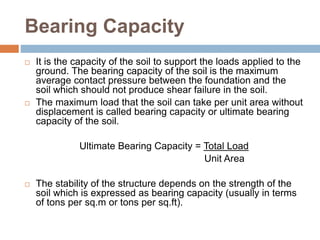
 It is the capacity of the soil to support the loads applied to the
ground. The bearing capacity of the soil is the maximum
average contact pressure between the foundation and the
soil which should not produce shear failure in the soil.
 The maximum load that the soil can take per unit area without
displacement is called bearing capacity or ultimate bearing
capacity of the soil.
Ultimate Bearing Capacity = Total Load
Unit Area
 The stability of the structure depends on the strength of the
soil which is expressed as bearing capacity (usually in terms
of tons per sq.m or tons per sq.ft).
PURPOSE OF FOUNDATION
 To distribute the load of the structure over a large
bearing area so as to bring the intensity of the
loading within the safe bearing capacity of the soil
lying underneath.
 To load the bearing surface at a uniform rate so as
to prevent unequal settlement.
 To secure a level and a firm bed for building
operations.
 To increase the stability of the structure as a
whole.
FACTORS AFFECTING
SELECTION OF A FOUNDATION
 Types and intensity of loading acting on
various parts of the structure which may be
dead load, live load, wind load, snow load etc.
 Nature and the bearing capacity of the soil on
which the structure directly rests.
TYPES OF FOUNDATION
Foundation can be broadly classified into the
following two categories:
 Shallow Foundations
 Deep Foundations
Shallow Foundation:
 The foundations provided immediately
beneath the lowest part of the structure, near
to the ground level, are known as Shallow
foundations. Such foundations are mostly
placed on the first hard and firm strata
available below the ground level. The object of
this type of foundation is to distribute the
structural loads over a considerable base area
at the foundation bed.
Shallow foundations are further
classified into the following types:
Spread Footing:
The Foundation constructed by increasing the area at
the base of structure by means of offsets, is called
spread footing. In such foundation, spread is given
under the base of the wall or a column by providing
offsets. This spread is known as footing and the
foundation itself is called Spread Footing.
The various types of spread footing
foundation are:
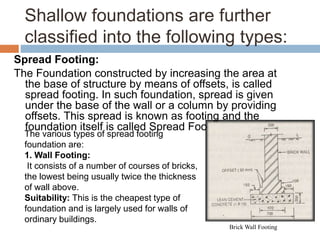
1. Wall Footing:
It consists of a number of courses of bricks,
the lowest being usually twice the thickness
of wall above.
Suitability: This is the cheapest type of
foundation and is largely used for walls of
ordinary buildings.
Brick Wall Footing
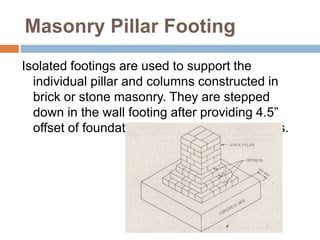
Masonry Pillar Footing
Isolated footings are used to support the
individual pillar and columns constructed in
brick or stone masonry. They are stepped
down in the wall footing after providing 4.5”
offset of foundation concrete on all the sides.
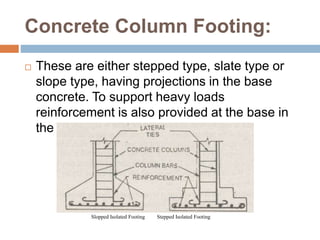
Concrete Column Footing:
 These are either stepped type, slate type or
slope type, having projections in the base
concrete. To support heavy loads
reinforcement is also provided at the base in
the form of steel bars.
Slopped Isolated Footing Stepped Isolated Footing
Concrete Column Footing:
 Concrete column footings may be
either isolated footings or
combined footings.
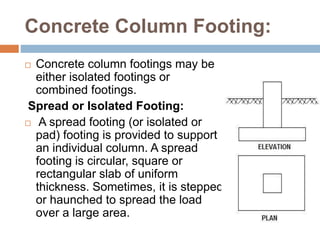
Spread or Isolated Footing:
 A spread footing (or isolated or
pad) footing is provided to support
an individual column. A spread
footing is circular, square or
rectangular slab of uniform
thickness. Sometimes, it is stepped
or haunched to spread the load
over a large area.
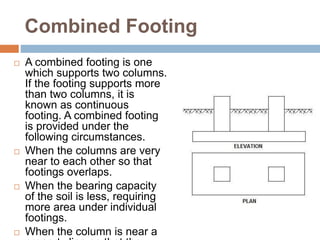
Combined Footing
 A combined footing is one
which supports two columns.
If the footing supports more
than two columns, it is
known as continuous
footing. A combined footing
is provided under the
following circumstances.
 When the columns are very
near to each other so that
footings overlaps.
 When the bearing capacity
of the soil is less, requiring
more area under individual
footings.
 When the column is near a
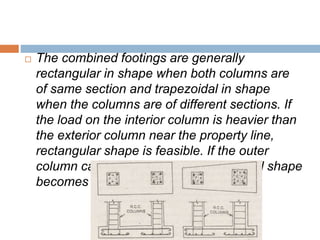
 The combined footings are generally
rectangular in shape when both columns are
of same section and trapezoidal in shape
when the columns are of different sections. If
the load on the interior column is heavier than
the exterior column near the property line,
rectangular shape is feasible. If the outer
column carries heavier load, trapezoidal shape
becomes essential.
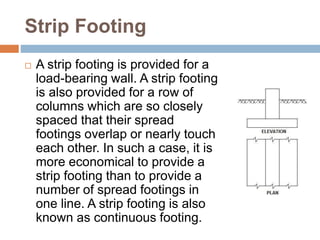
Strip Footing
 A strip footing is provided for a
load-bearing wall. A strip footing
is also provided for a row of
columns which are so closely
spaced that their spread
footings overlap or nearly touch
each other. In such a case, it is
more economical to provide a
strip footing than to provide a
number of spread footings in
one line. A strip footing is also
known as continuous footing.
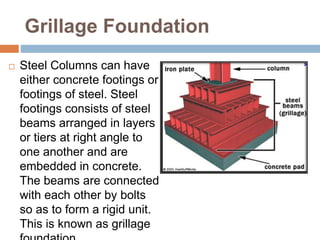
Grillage Foundation
 Steel Columns can have
either concrete footings or
footings of steel. Steel
footings consists of steel
beams arranged in layers
or tiers at right angle to
one another and are
embedded in concrete.
The beams are connected
with each other by bolts
so as to form a rigid unit.
This is known as grillage
Mat or Raft Foundations
 A mat or raft foundation is a large slab supporting
a number of columns and walls under the entire
structure or a large part of the structure. A mat is
required when the allowable soil pressure is low
or where the columns and walls are so close that
individual footings would overlap or nearly touch
each other.
 Mat foundations are useful in reducing the
differential settlements on non-homogeneous soils
or where there is a large variation in the loads on
individual columns.
 Suitability: This type of foundation is useful for
public buildings, office buildings, school buildings
etc, where the ground conditions are very poor
and bearing capacity of the soil is so low that
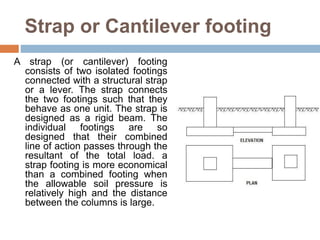
Strap or Cantilever footing
A strap (or cantilever) footing
consists of two isolated footings
connected with a structural strap
or a lever. The strap connects
the two footings such that they
behave as one unit. The strap is
designed as a rigid beam. The
individual footings are so
designed that their combined
line of action passes through the
resultant of the total load. a
strap footing is more economical
than a combined footing when
the allowable soil pressure is
relatively high and the distance
between the columns is large.
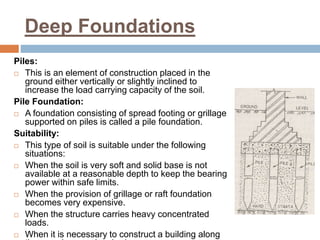
Deep Foundations
Piles:
 This is an element of construction placed in the
ground either vertically or slightly inclined to
increase the load carrying capacity of the soil.
Pile Foundation:
 A foundation consisting of spread footing or grillage
supported on piles is called a pile foundation.
Suitability:
 This type of soil is suitable under the following
situations:
 When the soil is very soft and solid base is not
available at a reasonable depth to keep the bearing
power within safe limits.
 When the provision of grillage or raft foundation
becomes very expensive.
 When the structure carries heavy concentrated
loads.
 When it is necessary to construct a building along
Classification of Piles
 Piles are generally classified into following two categories:
 According to function
 According to Material of construction
Classification of Piles according to their Function:
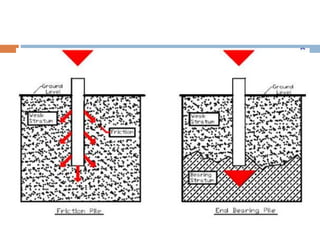
1. Bearing Piles:
 The piles which rests on the hard strata and act as a column to bear the
load of the structure are known as bearing piles. The piles are used to
bear vertical loads. They transfer the load to the hard stratum.
2. Friction Piles:
 The piles which do not rest on the hard strata and bear the load on
account of frictional resistance between their outer surfaces and the soil in
contact are called friction piles.
 These piles are used when the soil is soft and no hard strata is available
upto a considerable depth.
3. Friction cum bearing Piles:
 These piles which rest on a hard strata and resist the structural load partly
by bearing and partly by friction are known as friction cum bearing piles.
Foundations.ppt

Foundations.ppt

  • 1.
  • 2.
    Foundations  “The lowestartificially built part of a structure which transmits the load of the structure to the soil lying underneath is called Foundation”.  The structures such as walls and piers are subjected to loads of roofs, furniture, wind etc. The load acting on the wall or pier is to be transmitted to the soil on which it rests. The total load thus acting on the soil is to be distributed over a large area so as to bring the intensity of the loading within the safe bearing capacity of the soil. To meet with such requirements a structure is to provide with an artificial arrangement in the form of concrete bed or block, raft piles etc at the base below the ground level which acts as “foundation” of the structure.  The foundation of a structure is always constructed below the ground level so as to increase the lateral stability of the structure. It includes the portion of the structure below the ground level. The solid ground on which the foundation rests is called the foundation bed.
  • 3.
    Bearing Capacity  Itis the capacity of the soil to support the loads applied to the ground. The bearing capacity of the soil is the maximum average contact pressure between the foundation and the soil which should not produce shear failure in the soil.  The maximum load that the soil can take per unit area without displacement is called bearing capacity or ultimate bearing capacity of the soil. Ultimate Bearing Capacity = Total Load Unit Area  The stability of the structure depends on the strength of the soil which is expressed as bearing capacity (usually in terms of tons per sq.m or tons per sq.ft).
  • 4.
    PURPOSE OF FOUNDATION To distribute the load of the structure over a large bearing area so as to bring the intensity of the loading within the safe bearing capacity of the soil lying underneath.  To load the bearing surface at a uniform rate so as to prevent unequal settlement.  To secure a level and a firm bed for building operations.  To increase the stability of the structure as a whole.
  • 5.
    FACTORS AFFECTING SELECTION OFA FOUNDATION  Types and intensity of loading acting on various parts of the structure which may be dead load, live load, wind load, snow load etc.  Nature and the bearing capacity of the soil on which the structure directly rests.
  • 6.
    TYPES OF FOUNDATION Foundationcan be broadly classified into the following two categories:  Shallow Foundations  Deep Foundations
  • 7.
    Shallow Foundation:  Thefoundations provided immediately beneath the lowest part of the structure, near to the ground level, are known as Shallow foundations. Such foundations are mostly placed on the first hard and firm strata available below the ground level. The object of this type of foundation is to distribute the structural loads over a considerable base area at the foundation bed.
  • 8.
    Shallow foundations arefurther classified into the following types: Spread Footing: The Foundation constructed by increasing the area at the base of structure by means of offsets, is called spread footing. In such foundation, spread is given under the base of the wall or a column by providing offsets. This spread is known as footing and the foundation itself is called Spread Footing. The various types of spread footing foundation are: 1. Wall Footing: It consists of a number of courses of bricks, the lowest being usually twice the thickness of wall above. Suitability: This is the cheapest type of foundation and is largely used for walls of ordinary buildings. Brick Wall Footing
  • 9.
    Masonry Pillar Footing Isolatedfootings are used to support the individual pillar and columns constructed in brick or stone masonry. They are stepped down in the wall footing after providing 4.5” offset of foundation concrete on all the sides.
  • 10.
    Concrete Column Footing: These are either stepped type, slate type or slope type, having projections in the base concrete. To support heavy loads reinforcement is also provided at the base in the form of steel bars. Slopped Isolated Footing Stepped Isolated Footing
  • 11.
    Concrete Column Footing: Concrete column footings may be either isolated footings or combined footings. Spread or Isolated Footing:  A spread footing (or isolated or pad) footing is provided to support an individual column. A spread footing is circular, square or rectangular slab of uniform thickness. Sometimes, it is stepped or haunched to spread the load over a large area.
  • 12.
    Combined Footing  Acombined footing is one which supports two columns. If the footing supports more than two columns, it is known as continuous footing. A combined footing is provided under the following circumstances.  When the columns are very near to each other so that footings overlaps.  When the bearing capacity of the soil is less, requiring more area under individual footings.  When the column is near a
  • 13.
     The combinedfootings are generally rectangular in shape when both columns are of same section and trapezoidal in shape when the columns are of different sections. If the load on the interior column is heavier than the exterior column near the property line, rectangular shape is feasible. If the outer column carries heavier load, trapezoidal shape becomes essential.
  • 14.
    Strip Footing  Astrip footing is provided for a load-bearing wall. A strip footing is also provided for a row of columns which are so closely spaced that their spread footings overlap or nearly touch each other. In such a case, it is more economical to provide a strip footing than to provide a number of spread footings in one line. A strip footing is also known as continuous footing.
  • 15.
    Grillage Foundation  SteelColumns can have either concrete footings or footings of steel. Steel footings consists of steel beams arranged in layers or tiers at right angle to one another and are embedded in concrete. The beams are connected with each other by bolts so as to form a rigid unit. This is known as grillage
  • 16.
    Mat or RaftFoundations  A mat or raft foundation is a large slab supporting a number of columns and walls under the entire structure or a large part of the structure. A mat is required when the allowable soil pressure is low or where the columns and walls are so close that individual footings would overlap or nearly touch each other.  Mat foundations are useful in reducing the differential settlements on non-homogeneous soils or where there is a large variation in the loads on individual columns.  Suitability: This type of foundation is useful for public buildings, office buildings, school buildings etc, where the ground conditions are very poor and bearing capacity of the soil is so low that
  • 17.
    Strap or Cantileverfooting A strap (or cantilever) footing consists of two isolated footings connected with a structural strap or a lever. The strap connects the two footings such that they behave as one unit. The strap is designed as a rigid beam. The individual footings are so designed that their combined line of action passes through the resultant of the total load. a strap footing is more economical than a combined footing when the allowable soil pressure is relatively high and the distance between the columns is large.
  • 18.
    Deep Foundations Piles:  Thisis an element of construction placed in the ground either vertically or slightly inclined to increase the load carrying capacity of the soil. Pile Foundation:  A foundation consisting of spread footing or grillage supported on piles is called a pile foundation. Suitability:  This type of soil is suitable under the following situations:  When the soil is very soft and solid base is not available at a reasonable depth to keep the bearing power within safe limits.  When the provision of grillage or raft foundation becomes very expensive.  When the structure carries heavy concentrated loads.  When it is necessary to construct a building along
  • 19.
    Classification of Piles Piles are generally classified into following two categories:  According to function  According to Material of construction Classification of Piles according to their Function: 1. Bearing Piles:  The piles which rests on the hard strata and act as a column to bear the load of the structure are known as bearing piles. The piles are used to bear vertical loads. They transfer the load to the hard stratum. 2. Friction Piles:  The piles which do not rest on the hard strata and bear the load on account of frictional resistance between their outer surfaces and the soil in contact are called friction piles.  These piles are used when the soil is soft and no hard strata is available upto a considerable depth. 3. Friction cum bearing Piles:  These piles which rest on a hard strata and resist the structural load partly by bearing and partly by friction are known as friction cum bearing piles.