
SANJIVANI RURAL EDUCATION SOCIETY'S
SANJIVANI COLLEGE OF ENGINEERING, KOPARGAON
-DEPARTMENT OF CIVIL ENGINEERING-
BY
Prof. D. C. Dharwad (Assistant Professor)
Mail ID- danappadharwad@gmail.com
CONTENTS
BASIC BUILDING COMPONENTS
TYPES OF FOUNDATION
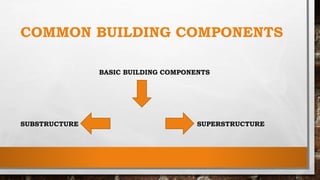
COMMON BUILDING COMPONENTS
BASIC BUILDING COMPONENTS
SUBSTRUCTURE SUPERSTRUCTURE
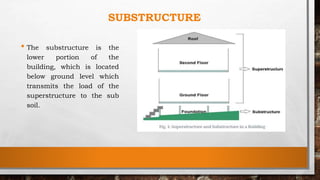
SUBSTRUCTURE
• The substructure is the
lower portion of the
building, which is located
below ground level which
transmits the load of the
superstructure to the sub
soil.
Substructure includes
Foundation-
• The basic function of foundation to transmit the load from building to the
subsoil, in such a way that
1) settlements are within permissible limit. 2) The soil does not fail in shear.
3) Reduce the load intensity. 4) Even distribution of load.
5) Provide level surface.
TYPES OF FOUNDATION
Foundations may be broadly classified as
(A) Shallow foundation
(B) Deep foundation
(A) shallow foundation
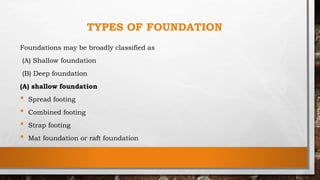
• Spread footing
• Combined footing
• Strap footing
• Mat foundation or raft foundation
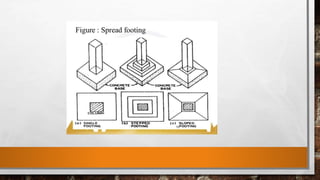
1. SPREAD FOOTING
Spread footings are those which spread the super-imposed load of wall or column
over larger area. Spread footing supports either column or wall
It may of following kinds
• Single footing for column
• Stepped footing for a column
• Sloped footing for a column
• Wall footing without step
• Grillage foundation
COMBINED FOOTING
A spread footing which supports two or more columns is termed as
combined footing.
The combined may be of following kinds
• Rectangular combined footing
• Trapezoidal combined footing
STRAP FOOTING
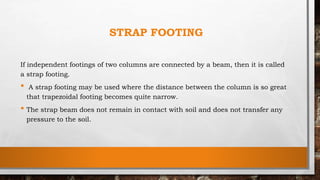
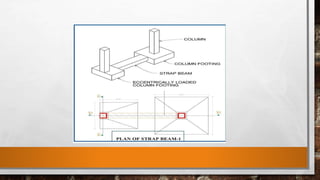
If independent footings of two columns are connected by a beam, then it is called
a strap footing.
• A strap footing may be used where the distance between the column is so great
that trapezoidal footing becomes quite narrow.
• The strap beam does not remain in contact with soil and does not transfer any
pressure to the soil.
MAT/RAFT FOUNDATION
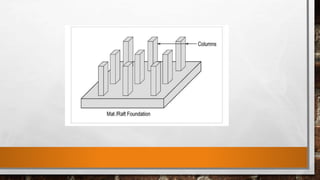
• A mat/raft foundation is a combined footing that covers the entire area beneath
a structure and supports all the walls and columns.
• They are used in areas where the soil masses contains compressible lenses or
the soil is sufficiently erratic so that differential settlement would be difficult to
control
(B) DEEP FOUNDATION
Deep foundation may be of following types
• Pile foundation
• Pier
• Well or caissons
Pile foundation
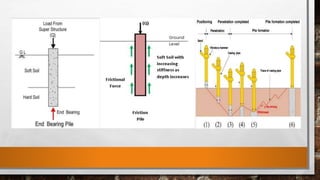
• Pile foundation is that type of foundation in which the loads are taken to a low
level by means of vertical members which may be timber, concrete or steel. Pile
foundation may be adopted when no firm bearing strata is available and the
loading is uneven.
Piles may be of following types
• End bearing piles
• Friction pile
• Compaction pile
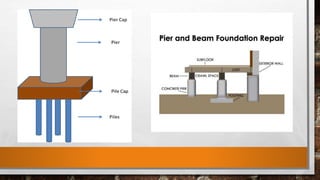
PIER FOUNDATION
• A pier foundation consist of cylindrical column of large diameter to support and
transfer large superimposed load to the firm strata below.
• Generally, pier foundation is shallow in depth than the pile foundation.
Types of pier foundation
• Usually two types of pier foundation are used. These are:
1. Masonry or concrete pier
2. Drilled caissons
THANK YOU

Basic components of a building

  • 1.
    SANJIVANI RURAL EDUCATIONSOCIETY'S SANJIVANI COLLEGE OF ENGINEERING, KOPARGAON -DEPARTMENT OF CIVIL ENGINEERING- BY Prof. D. C. Dharwad (Assistant Professor) Mail ID- danappadharwad@gmail.com
  • 3.
  • 4.
    COMMON BUILDING COMPONENTS BASICBUILDING COMPONENTS SUBSTRUCTURE SUPERSTRUCTURE
  • 5.
    SUBSTRUCTURE • The substructureis the lower portion of the building, which is located below ground level which transmits the load of the superstructure to the sub soil.
  • 6.
    Substructure includes Foundation- • Thebasic function of foundation to transmit the load from building to the subsoil, in such a way that 1) settlements are within permissible limit. 2) The soil does not fail in shear. 3) Reduce the load intensity. 4) Even distribution of load. 5) Provide level surface.
  • 7.
    TYPES OF FOUNDATION Foundationsmay be broadly classified as (A) Shallow foundation (B) Deep foundation (A) shallow foundation • Spread footing • Combined footing • Strap footing • Mat foundation or raft foundation
  • 8.
    1. SPREAD FOOTING Spreadfootings are those which spread the super-imposed load of wall or column over larger area. Spread footing supports either column or wall It may of following kinds • Single footing for column • Stepped footing for a column • Sloped footing for a column • Wall footing without step • Grillage foundation
  • 10.
    COMBINED FOOTING A spreadfooting which supports two or more columns is termed as combined footing. The combined may be of following kinds • Rectangular combined footing • Trapezoidal combined footing
  • 12.
    STRAP FOOTING If independentfootings of two columns are connected by a beam, then it is called a strap footing. • A strap footing may be used where the distance between the column is so great that trapezoidal footing becomes quite narrow. • The strap beam does not remain in contact with soil and does not transfer any pressure to the soil.
  • 14.
    MAT/RAFT FOUNDATION • Amat/raft foundation is a combined footing that covers the entire area beneath a structure and supports all the walls and columns. • They are used in areas where the soil masses contains compressible lenses or the soil is sufficiently erratic so that differential settlement would be difficult to control
  • 16.
    (B) DEEP FOUNDATION Deepfoundation may be of following types • Pile foundation • Pier • Well or caissons
  • 17.
    Pile foundation • Pilefoundation is that type of foundation in which the loads are taken to a low level by means of vertical members which may be timber, concrete or steel. Pile foundation may be adopted when no firm bearing strata is available and the loading is uneven. Piles may be of following types • End bearing piles • Friction pile • Compaction pile
  • 19.
    PIER FOUNDATION • Apier foundation consist of cylindrical column of large diameter to support and transfer large superimposed load to the firm strata below. • Generally, pier foundation is shallow in depth than the pile foundation. Types of pier foundation • Usually two types of pier foundation are used. These are: 1. Masonry or concrete pier 2. Drilled caissons
  • 21.