CHAPTER-2.1
FOUNDATIONS
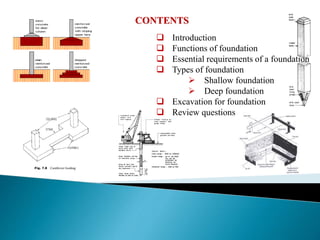
CONTENTS
 Introduction
 Functions of foundation
 Essential requirements of a foundation
 Types of foundation
 Shallow foundation
 Deep foundation
 Excavation for foundation
 Review questions
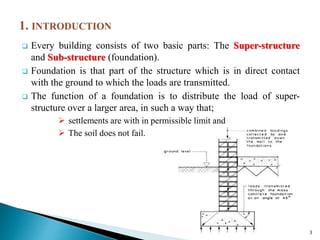
 Every building consists of two basic parts: The Super-structure
and Sub-structure (foundation).
 Foundation is that part of the structure which is in direct contact
with the ground to which the loads are transmitted.
 The function of a foundation is to distribute the load of super-
structure over a larger area, in such a way that;
 settlements are with in permissible limit and
 The soil does not fail.
3
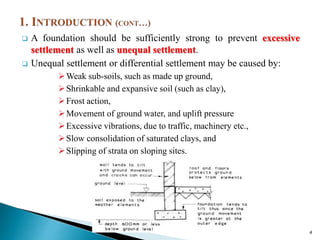
 A foundation should be sufficiently strong to prevent excessive
settlement as well as unequal settlement.
 Unequal settlement or differential settlement may be caused by:
Weak sub-soils, such as made up ground,
Shrinkable and expansive soil (such as clay),
Frost action,
Movement of ground water, and uplift pressure
Excessive vibrations, due to traffic, machinery etc.,
Slow consolidation of saturated clays, and
Slipping of strata on sloping sites.
4
 Foundations serve the following purposes:
1. Reduction of load intensity: Foundation distribute the loads of
superstructure, to a larger area so that the intensity of the load at its
base does not exceed the safe bearing capacity of the sub-soil.
2. Even distribution of load: foundations distribute the non-
uniform load of the superstructure evenly to the sub soil.
3. Provision of level surface: foundations provide levelled and
hard surface over which the superstructure can be built.
4. Lateral stability: it anchors the superstructure to the ground, thus
imparting lateral stability to the superstructure.
5. Safety against undermining: it provides safety against scouring
due to burrowing animal and flood water.
6. Protection against soil movements: minimises the distress on
the superstructure due to expansion or contraction of sub-soil
because of moisture movement in some problematic soil.
5
 Foundations should be constructed to satisfy the following
requirements:
1. The foundations shall be constructed to sustain all loads and
transmit them to the sub soil with out causing settlement which
would impair the stability of the building or adjoining structure.
2. Foundation base should be rigid so that differential settlements are
minimised, specially for the case when super-imposed loads are not
evenly distributed.
3. Foundation should be taken sufficiently deep to guard the building
against damage or distress caused by swelling or shrinkage of sub-soil.
4. Foundations should be ideally located so that its performance may
not be affected due to any unexpected future influence.
6
 Foundations may be broadly classified under two heads:
1. Shallow Foundations
2. Deep Foundations
4.1 SHALLOW FOUNDATIONS
 Shallow foundations are those founded near to the finished ground
surface. generally where the founding depth (Df) is less than the
width of the footing and less than 3m.
Shallows foundations are used when surface soils are
sufficiently strong and stiff to support the imposed loads.
They are generally unsuitable in weak or highly compressible
soils, such as poorly-compacted fill, peat, alluvial deposits, etc.
7
4.2 DEEP FOUNDATIONS
 Deep foundations are those founding too deeply below the finished
ground surface for their base bearing capacity to be affected by
surface conditions,
This is usually at depths >3 m below finished ground level.
Deep foundations can be used to transfer the loading to a
deeper, more competent strata at depth if unsuitable soils are
present near the surface.
8
Shallow foundation
• Spread footings
• Combined footings
• Strap footings
• Mat foundation
Deep foundation
• Pile foundation
• Pier foundation
• Well or caissons
foundation
4.1.1 SPREAD FOOTINGS
 Spread footings are those which spread the super-imposed load of
wall or column over large area.
 Spread footings support either a column or wall.
 They are most widely used foundation types since they do not
require special equipment and skill for construction and are usually
economical.
 Spread footings may be of the following types:
9
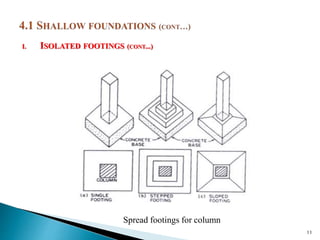
Isolated
footings
Single
footing
Stepped
footing
Slopped
footing
Wall
footings
Without
step
Stepped
footing
Grillage
foundation
Steel
grillage
Timber
grillage
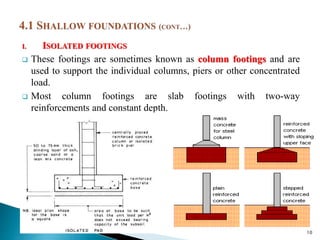
I. ISOLATED FOOTINGS
 These footings are sometimes known as column footings and are
used to support the individual columns, piers or other concentrated
load.
 Most column footings are slab footings with two-way
reinforcements and constant depth.
10
I. ISOLATED FOOTINGS (CONT...)
11
Spread footings for column
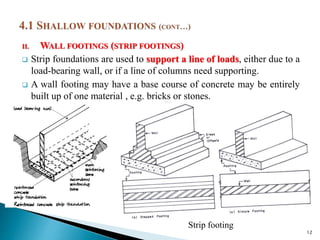
II. WALL FOOTINGS (STRIP FOOTINGS)
 Strip foundations are used to support a line of loads, either due to a
load-bearing wall, or if a line of columns need supporting.
 A wall footing may have a base course of concrete may be entirely
built up of one material , e.g. bricks or stones.
12
Strip footing
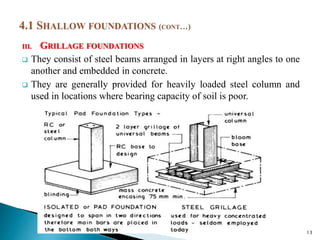
III. GRILLAGE FOUNDATIONS
 They consist of steel beams arranged in layers at right angles to one
another and embedded in concrete.
 They are generally provided for heavily loaded steel column and
used in locations where bearing capacity of soil is poor.
13
4.1.2 COMBINED FOOTINGS
 A spread footing which supports two or more columns is termed as
combined footing.
 Footings of this type are most frequently used to support walls and
columns, which are close to the property line.
 Combined footings are essential whenever:
the projections of columns are not possible on one side due to
limited available space and
 when the spacing of two consecutive columns are close for
isolated footing.
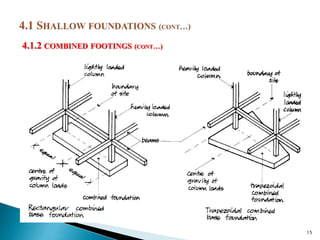
 The combined footing for columns will be rectangular in shape if
they carry equal load or trapezoidal shape for unequal loads.
14
4.1.2 COMBINED FOOTINGS (CONT…)
15
4.1.3 STRAP FOOTINGS (CANTILEVER FOOTING)
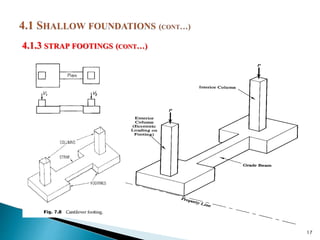
 If the independent footing of two columns are connected by a beam,
it is called a strap footing.
 They serve the same function as combined footings by permitting a
column load to be placed near the edge of the footing.
 It is used where a large spacing between two columns create a
situation where a continuous footing is uneconomical due to the
usage of large quantity of concrete.
 A rigid beam connects the two pads to transmit the unbalanced shear
and moment from the statically unbalanced footing to the second
footing.
16
4.1.3 STRAP FOOTINGS (CONT…)
17
4.1.4 MAT (RAFT) FOUNDATION
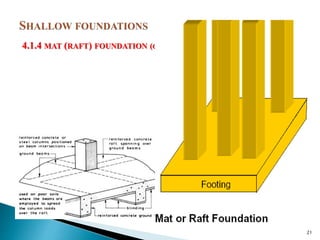
 A raft or mat is a combined footing that covers the entire area
beneath the structure and supports all the walls and columns.
 It is used where:
The allowable soil pressure is low,
The building loads are heavy,
The use of spread footings would cover more than half the area,
The soil mass contains compressible lenses,
The soil is sufficiently erratic so that differential settlement would
be difficult to control.
18
1.3 MAT (RAFT) FOUNDATION (CONT...)
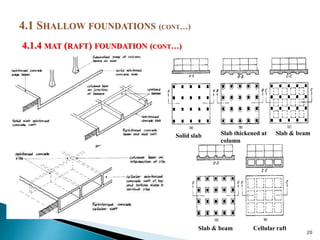
 Rafts may be divided into three types, based on their design and
construction
i. Solid slab system: is a solid reinforced concrete slab generally
uniform thickness.
ii. Beam slab system: consists of up-stand or down-stand beams
that take the loads of the walls or columns and spread them.
iii. Cellular system: consists of top and bottom slab separated by
and reinforced with vertical cross ribs in both direction.
19
4.1.4 MAT (RAFT) FOUNDATION (CONT…)
20
Solid slab Slab thickened at
column
Slab & beam
Cellular raft
Slab & beam
4.1.4 MAT (RAFT) FOUNDATION (CONT…)
21
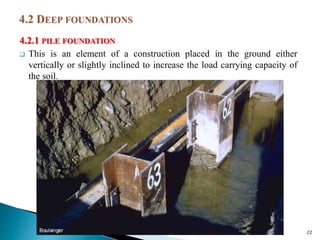
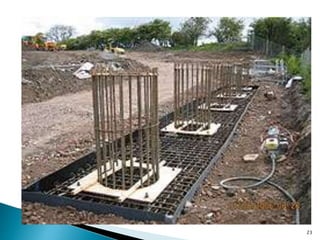
4.2.1 PILE FOUNDATION
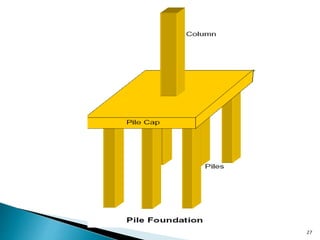
 This is an element of a construction placed in the ground either
vertically or slightly inclined to increase the load carrying capacity of
the soil.
22
23
4.2.1 PILE FOUNDATION
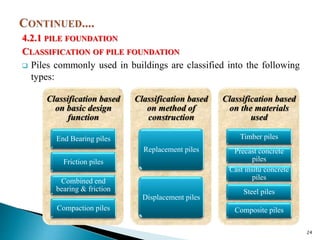
CLASSIFICATION OF PILE FOUNDATION
 Piles commonly used in buildings are classified into the following
types:
24
Classification based
on basic design
function
End Bearing piles
Friction piles
Combined end
bearing & friction
Compaction piles
Classification based
on method of
construction
Replacement piles
Displacement piles
Classification based
on the materials
used
Timber piles
Precast concrete
piles
Cast insitu concrete
piles
Steel piles
Composite piles
4.2.1 PILE FOUNDATION (CONT...)
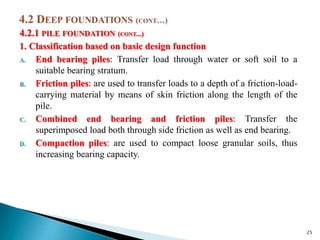
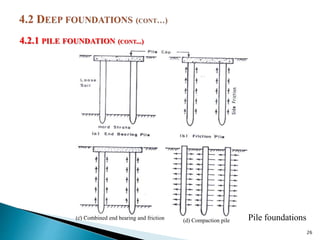
1. Classification based on basic design function
A. End bearing piles: Transfer load through water or soft soil to a
suitable bearing stratum.
B. Friction piles: are used to transfer loads to a depth of a friction-load-
carrying material by means of skin friction along the length of the
pile.
C. Combined end bearing and friction piles: Transfer the
superimposed load both through side friction as well as end bearing.
D. Compaction piles: are used to compact loose granular soils, thus
increasing bearing capacity.
25
4.2.1 PILE FOUNDATION (CONT...)
26
(c) Combined end bearing and friction (d) Compaction pile Pile foundations
27
4.2.1 PILE FOUNDATION (CONT...)
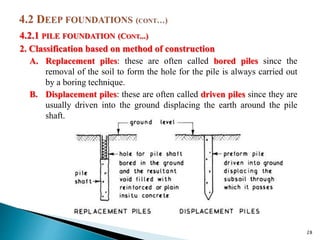
2. Classification based on method of construction
A. Replacement piles: these are often called bored piles since the
removal of the soil to form the hole for the pile is always carried out
by a boring technique.
B. Displacement piles: these are often called driven piles since they are
usually driven into the ground displacing the earth around the pile
shaft.
28
4.2.1 PILE FOUNDATION (CONT...)
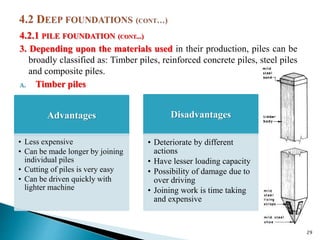
3. Depending upon the materials used in their production, piles can be
broadly classified as: Timber piles, reinforced concrete piles, steel piles
and composite piles.
A. Timber piles
29
Advantages
• Less expensive
• Can be made longer by joining
individual piles
• Cutting of piles is very easy
• Can be driven quickly with
lighter machine
Disadvantages
• Deteriorate by different
actions
• Have lesser loading capacity
• Possibility of damage due to
over driving
• Joining work is time taking
and expensive
4.2.1 PILE FOUNDATION (CONT...)
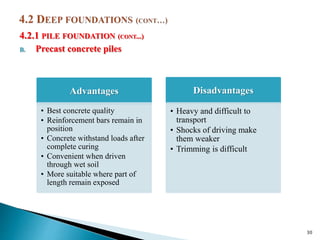
B. Precast concrete piles
30
Advantages
• Best concrete quality
• Reinforcement bars remain in
position
• Concrete withstand loads after
complete curing
• Convenient when driven
through wet soil
• More suitable where part of
length remain exposed
Disadvantages
• Heavy and difficult to
transport
• Shocks of driving make
them weaker
• Trimming is difficult
4.2.1 PILE FOUNDATION (CONT...)
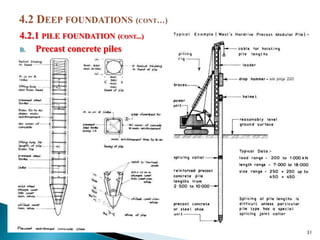
B. Precast concrete piles
31
4.2.1 PILE FOUNDATION (CONT...)
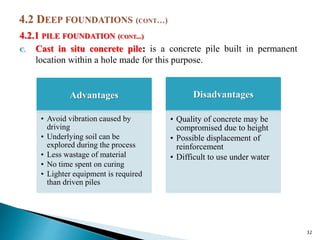
C. Cast in situ concrete pile: is a concrete pile built in permanent
location within a hole made for this purpose.
32
Advantages
• Avoid vibration caused by
driving
• Underlying soil can be
explored during the process
• Less wastage of material
• No time spent on curing
• Lighter equipment is required
than driven piles
Disadvantages
• Quality of concrete may be
compromised due to height
• Possible displacement of
reinforcement
• Difficult to use under water
4.2.1 PILE FOUNDATION (CONT...)
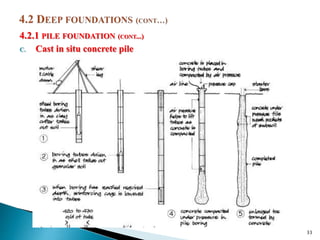
C. Cast in situ concrete pile
33
4.2.1 PILE FOUNDATION (CONT...)
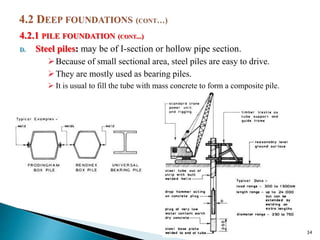
D. Steel piles: may be of I-section or hollow pipe section.
Because of small sectional area, steel piles are easy to drive.
They are mostly used as bearing piles.
 It is usual to fill the tube with mass concrete to form a composite pile.
34
4.2.2 PIER FOUNDATION
 Consists of cylindrical column of large diameter to support and transfer
large super imposed loads to the firm strata below.
 The difference between pile foundation and pier foundation lies in the
method of construction. The major differences are:
i. Pier foundation transfer load only through bearing
ii. Pier foundation are shallower in depth than pile foundation.
iii. Pier foundation is preferred where the top strata consists of
decomposed rock overlaying a strata of hard rock.
iv. Pier foundations are preferred in case of stiff clays, which offer
large resistance to the driving of a bearing pile.
v. In case of piers, the excavation can be carried to the desired depth
easily.
35
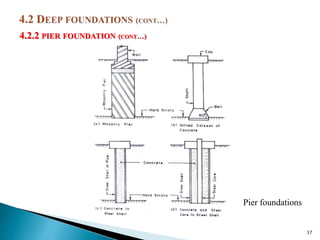
4.2.2 PIER FOUNDATION (CONT…)
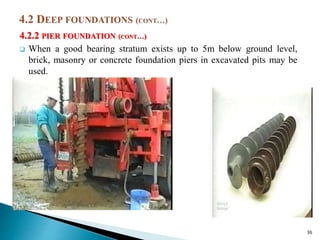
 When a good bearing stratum exists up to 5m below ground level,
brick, masonry or concrete foundation piers in excavated pits may be
used.
36
4.2.2 PIER FOUNDATION (CONT…)
37
Pier foundations
4.2.3 WELL FOUNDATION (CAISSONS)
 They are box like structure- circular or rectangular- which are sunk
from the surface of either land or water to the desired depth.
 They are much large in diameter than the pier foundation or drilled
caissons.
 Well foundations are used for major foundation works, such as for:
Bridge piers and abutments in rivers, lakes etc.
Break waters and other structures for shore protection
Large water front structures such as pump houses.
38
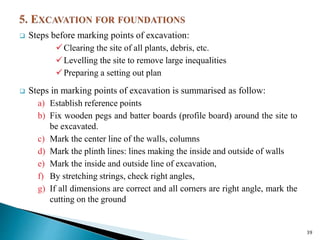
 Steps before marking points of excavation:
Clearing the site of all plants, debris, etc.
Levelling the site to remove large inequalities
Preparing a setting out plan
 Steps in marking points of excavation is summarised as follow:
a) Establish reference points
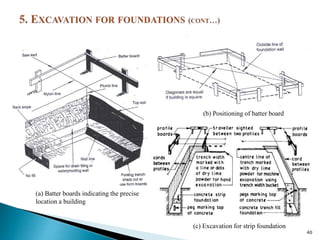
b) Fix wooden pegs and batter boards (profile board) around the site to
be excavated.
c) Mark the center line of the walls, columns
d) Mark the plinth lines: lines making the inside and outside of walls
e) Mark the inside and outside line of excavation,
f) By stretching strings, check right angles,
g) If all dimensions are correct and all corners are right angle, mark the
cutting on the ground
39
40
(a) Batter boards indicating the precise
location a building
(b) Positioning of batter board
(c) Excavation for strip foundation
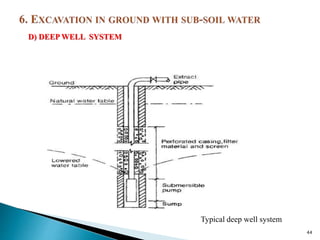
 Excavations of foundation trenches in ground having high water table,
or in water-logged area pose great problems.
 Excavations can be carried out by dewatering the subsoil water.
 Construction sites are dewatered for the following purposes:
To provide suitable working surface at the bottom
To stabilize the banks of excavation, avoiding the hazards of sliding
Prevent disturbance of soil at the bottom (which may reduce the
bearing capacity)
Reduce lateral load on sheeting and bracing.
 Foundation dewatering can be done by the following methods:
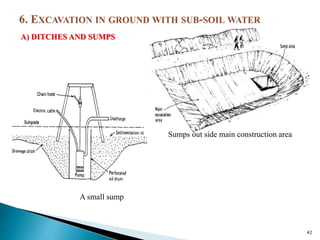
a) Ditches and sumps
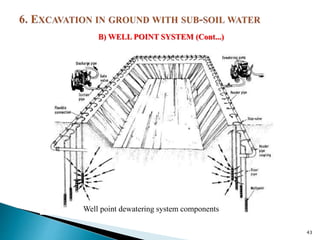
b) Well point system
c) Shallow well system
d) Deep well system
e) Vacuum method
41
42
A) DITCHES AND SUMPS
Sumps out side main construction area
A small sump
43
B) WELL POINT SYSTEM (Cont...)
Well point dewatering system components
44
Typical deep well system
D) DEEP WELL SYSTEM
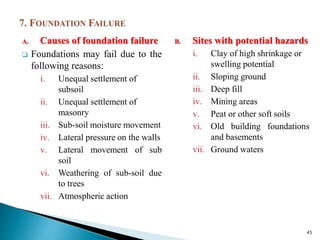
A. Causes of foundation failure
 Foundations may fail due to the
following reasons:
i. Unequal settlement of
subsoil
ii. Unequal settlement of
masonry
iii. Sub-soil moisture movement
iv. Lateral pressure on the walls
v. Lateral movement of sub
soil
vi. Weathering of sub-soil due
to trees
vii. Atmospheric action
45
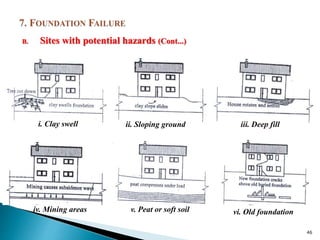
B. Sites with potential hazards
i. Clay of high shrinkage or
swelling potential
ii. Sloping ground
iii. Deep fill
iv. Mining areas
v. Peat or other soft soils
vi. Old building foundations
and basements
vii. Ground waters
B. Sites with potential hazards (Cont...)
46
i. Clay swell ii. Sloping ground iii. Deep fill
iv. Mining areas v. Peat or soft soil vi. Old foundation
THANK YOU!
47

CHAPTER-2.1 FOUNDATIONS.ppt

  • 1.
  • 2.
    CONTENTS  Introduction  Functionsof foundation  Essential requirements of a foundation  Types of foundation  Shallow foundation  Deep foundation  Excavation for foundation  Review questions
  • 3.
     Every buildingconsists of two basic parts: The Super-structure and Sub-structure (foundation).  Foundation is that part of the structure which is in direct contact with the ground to which the loads are transmitted.  The function of a foundation is to distribute the load of super- structure over a larger area, in such a way that;  settlements are with in permissible limit and  The soil does not fail. 3
  • 4.
     A foundationshould be sufficiently strong to prevent excessive settlement as well as unequal settlement.  Unequal settlement or differential settlement may be caused by: Weak sub-soils, such as made up ground, Shrinkable and expansive soil (such as clay), Frost action, Movement of ground water, and uplift pressure Excessive vibrations, due to traffic, machinery etc., Slow consolidation of saturated clays, and Slipping of strata on sloping sites. 4
  • 5.
     Foundations servethe following purposes: 1. Reduction of load intensity: Foundation distribute the loads of superstructure, to a larger area so that the intensity of the load at its base does not exceed the safe bearing capacity of the sub-soil. 2. Even distribution of load: foundations distribute the non- uniform load of the superstructure evenly to the sub soil. 3. Provision of level surface: foundations provide levelled and hard surface over which the superstructure can be built. 4. Lateral stability: it anchors the superstructure to the ground, thus imparting lateral stability to the superstructure. 5. Safety against undermining: it provides safety against scouring due to burrowing animal and flood water. 6. Protection against soil movements: minimises the distress on the superstructure due to expansion or contraction of sub-soil because of moisture movement in some problematic soil. 5
  • 6.
     Foundations shouldbe constructed to satisfy the following requirements: 1. The foundations shall be constructed to sustain all loads and transmit them to the sub soil with out causing settlement which would impair the stability of the building or adjoining structure. 2. Foundation base should be rigid so that differential settlements are minimised, specially for the case when super-imposed loads are not evenly distributed. 3. Foundation should be taken sufficiently deep to guard the building against damage or distress caused by swelling or shrinkage of sub-soil. 4. Foundations should be ideally located so that its performance may not be affected due to any unexpected future influence. 6
  • 7.
     Foundations maybe broadly classified under two heads: 1. Shallow Foundations 2. Deep Foundations 4.1 SHALLOW FOUNDATIONS  Shallow foundations are those founded near to the finished ground surface. generally where the founding depth (Df) is less than the width of the footing and less than 3m. Shallows foundations are used when surface soils are sufficiently strong and stiff to support the imposed loads. They are generally unsuitable in weak or highly compressible soils, such as poorly-compacted fill, peat, alluvial deposits, etc. 7
  • 8.
    4.2 DEEP FOUNDATIONS Deep foundations are those founding too deeply below the finished ground surface for their base bearing capacity to be affected by surface conditions, This is usually at depths >3 m below finished ground level. Deep foundations can be used to transfer the loading to a deeper, more competent strata at depth if unsuitable soils are present near the surface. 8 Shallow foundation • Spread footings • Combined footings • Strap footings • Mat foundation Deep foundation • Pile foundation • Pier foundation • Well or caissons foundation
  • 9.
    4.1.1 SPREAD FOOTINGS Spread footings are those which spread the super-imposed load of wall or column over large area.  Spread footings support either a column or wall.  They are most widely used foundation types since they do not require special equipment and skill for construction and are usually economical.  Spread footings may be of the following types: 9 Isolated footings Single footing Stepped footing Slopped footing Wall footings Without step Stepped footing Grillage foundation Steel grillage Timber grillage
  • 10.
    I. ISOLATED FOOTINGS These footings are sometimes known as column footings and are used to support the individual columns, piers or other concentrated load.  Most column footings are slab footings with two-way reinforcements and constant depth. 10
  • 11.
    I. ISOLATED FOOTINGS(CONT...) 11 Spread footings for column
  • 12.
    II. WALL FOOTINGS(STRIP FOOTINGS)  Strip foundations are used to support a line of loads, either due to a load-bearing wall, or if a line of columns need supporting.  A wall footing may have a base course of concrete may be entirely built up of one material , e.g. bricks or stones. 12 Strip footing
  • 13.
    III. GRILLAGE FOUNDATIONS They consist of steel beams arranged in layers at right angles to one another and embedded in concrete.  They are generally provided for heavily loaded steel column and used in locations where bearing capacity of soil is poor. 13
  • 14.
    4.1.2 COMBINED FOOTINGS A spread footing which supports two or more columns is termed as combined footing.  Footings of this type are most frequently used to support walls and columns, which are close to the property line.  Combined footings are essential whenever: the projections of columns are not possible on one side due to limited available space and  when the spacing of two consecutive columns are close for isolated footing.  The combined footing for columns will be rectangular in shape if they carry equal load or trapezoidal shape for unequal loads. 14
  • 15.
  • 16.
    4.1.3 STRAP FOOTINGS(CANTILEVER FOOTING)  If the independent footing of two columns are connected by a beam, it is called a strap footing.  They serve the same function as combined footings by permitting a column load to be placed near the edge of the footing.  It is used where a large spacing between two columns create a situation where a continuous footing is uneconomical due to the usage of large quantity of concrete.  A rigid beam connects the two pads to transmit the unbalanced shear and moment from the statically unbalanced footing to the second footing. 16
  • 17.
  • 18.
    4.1.4 MAT (RAFT)FOUNDATION  A raft or mat is a combined footing that covers the entire area beneath the structure and supports all the walls and columns.  It is used where: The allowable soil pressure is low, The building loads are heavy, The use of spread footings would cover more than half the area, The soil mass contains compressible lenses, The soil is sufficiently erratic so that differential settlement would be difficult to control. 18
  • 19.
    1.3 MAT (RAFT)FOUNDATION (CONT...)  Rafts may be divided into three types, based on their design and construction i. Solid slab system: is a solid reinforced concrete slab generally uniform thickness. ii. Beam slab system: consists of up-stand or down-stand beams that take the loads of the walls or columns and spread them. iii. Cellular system: consists of top and bottom slab separated by and reinforced with vertical cross ribs in both direction. 19
  • 20.
    4.1.4 MAT (RAFT)FOUNDATION (CONT…) 20 Solid slab Slab thickened at column Slab & beam Cellular raft Slab & beam
  • 21.
    4.1.4 MAT (RAFT)FOUNDATION (CONT…) 21
  • 22.
    4.2.1 PILE FOUNDATION This is an element of a construction placed in the ground either vertically or slightly inclined to increase the load carrying capacity of the soil. 22
  • 23.
  • 24.
    4.2.1 PILE FOUNDATION CLASSIFICATIONOF PILE FOUNDATION  Piles commonly used in buildings are classified into the following types: 24 Classification based on basic design function End Bearing piles Friction piles Combined end bearing & friction Compaction piles Classification based on method of construction Replacement piles Displacement piles Classification based on the materials used Timber piles Precast concrete piles Cast insitu concrete piles Steel piles Composite piles
  • 25.
    4.2.1 PILE FOUNDATION(CONT...) 1. Classification based on basic design function A. End bearing piles: Transfer load through water or soft soil to a suitable bearing stratum. B. Friction piles: are used to transfer loads to a depth of a friction-load- carrying material by means of skin friction along the length of the pile. C. Combined end bearing and friction piles: Transfer the superimposed load both through side friction as well as end bearing. D. Compaction piles: are used to compact loose granular soils, thus increasing bearing capacity. 25
  • 26.
    4.2.1 PILE FOUNDATION(CONT...) 26 (c) Combined end bearing and friction (d) Compaction pile Pile foundations
  • 27.
  • 28.
    4.2.1 PILE FOUNDATION(CONT...) 2. Classification based on method of construction A. Replacement piles: these are often called bored piles since the removal of the soil to form the hole for the pile is always carried out by a boring technique. B. Displacement piles: these are often called driven piles since they are usually driven into the ground displacing the earth around the pile shaft. 28
  • 29.
    4.2.1 PILE FOUNDATION(CONT...) 3. Depending upon the materials used in their production, piles can be broadly classified as: Timber piles, reinforced concrete piles, steel piles and composite piles. A. Timber piles 29 Advantages • Less expensive • Can be made longer by joining individual piles • Cutting of piles is very easy • Can be driven quickly with lighter machine Disadvantages • Deteriorate by different actions • Have lesser loading capacity • Possibility of damage due to over driving • Joining work is time taking and expensive
  • 30.
    4.2.1 PILE FOUNDATION(CONT...) B. Precast concrete piles 30 Advantages • Best concrete quality • Reinforcement bars remain in position • Concrete withstand loads after complete curing • Convenient when driven through wet soil • More suitable where part of length remain exposed Disadvantages • Heavy and difficult to transport • Shocks of driving make them weaker • Trimming is difficult
  • 31.
    4.2.1 PILE FOUNDATION(CONT...) B. Precast concrete piles 31
  • 32.
    4.2.1 PILE FOUNDATION(CONT...) C. Cast in situ concrete pile: is a concrete pile built in permanent location within a hole made for this purpose. 32 Advantages • Avoid vibration caused by driving • Underlying soil can be explored during the process • Less wastage of material • No time spent on curing • Lighter equipment is required than driven piles Disadvantages • Quality of concrete may be compromised due to height • Possible displacement of reinforcement • Difficult to use under water
  • 33.
    4.2.1 PILE FOUNDATION(CONT...) C. Cast in situ concrete pile 33
  • 34.
    4.2.1 PILE FOUNDATION(CONT...) D. Steel piles: may be of I-section or hollow pipe section. Because of small sectional area, steel piles are easy to drive. They are mostly used as bearing piles.  It is usual to fill the tube with mass concrete to form a composite pile. 34
  • 35.
    4.2.2 PIER FOUNDATION Consists of cylindrical column of large diameter to support and transfer large super imposed loads to the firm strata below.  The difference between pile foundation and pier foundation lies in the method of construction. The major differences are: i. Pier foundation transfer load only through bearing ii. Pier foundation are shallower in depth than pile foundation. iii. Pier foundation is preferred where the top strata consists of decomposed rock overlaying a strata of hard rock. iv. Pier foundations are preferred in case of stiff clays, which offer large resistance to the driving of a bearing pile. v. In case of piers, the excavation can be carried to the desired depth easily. 35
  • 36.
    4.2.2 PIER FOUNDATION(CONT…)  When a good bearing stratum exists up to 5m below ground level, brick, masonry or concrete foundation piers in excavated pits may be used. 36
  • 37.
    4.2.2 PIER FOUNDATION(CONT…) 37 Pier foundations
  • 38.
    4.2.3 WELL FOUNDATION(CAISSONS)  They are box like structure- circular or rectangular- which are sunk from the surface of either land or water to the desired depth.  They are much large in diameter than the pier foundation or drilled caissons.  Well foundations are used for major foundation works, such as for: Bridge piers and abutments in rivers, lakes etc. Break waters and other structures for shore protection Large water front structures such as pump houses. 38
  • 39.
     Steps beforemarking points of excavation: Clearing the site of all plants, debris, etc. Levelling the site to remove large inequalities Preparing a setting out plan  Steps in marking points of excavation is summarised as follow: a) Establish reference points b) Fix wooden pegs and batter boards (profile board) around the site to be excavated. c) Mark the center line of the walls, columns d) Mark the plinth lines: lines making the inside and outside of walls e) Mark the inside and outside line of excavation, f) By stretching strings, check right angles, g) If all dimensions are correct and all corners are right angle, mark the cutting on the ground 39
  • 40.
    40 (a) Batter boardsindicating the precise location a building (b) Positioning of batter board (c) Excavation for strip foundation
  • 41.
     Excavations offoundation trenches in ground having high water table, or in water-logged area pose great problems.  Excavations can be carried out by dewatering the subsoil water.  Construction sites are dewatered for the following purposes: To provide suitable working surface at the bottom To stabilize the banks of excavation, avoiding the hazards of sliding Prevent disturbance of soil at the bottom (which may reduce the bearing capacity) Reduce lateral load on sheeting and bracing.  Foundation dewatering can be done by the following methods: a) Ditches and sumps b) Well point system c) Shallow well system d) Deep well system e) Vacuum method 41
  • 42.
    42 A) DITCHES ANDSUMPS Sumps out side main construction area A small sump
  • 43.
    43 B) WELL POINTSYSTEM (Cont...) Well point dewatering system components
  • 44.
    44 Typical deep wellsystem D) DEEP WELL SYSTEM
  • 45.
    A. Causes offoundation failure  Foundations may fail due to the following reasons: i. Unequal settlement of subsoil ii. Unequal settlement of masonry iii. Sub-soil moisture movement iv. Lateral pressure on the walls v. Lateral movement of sub soil vi. Weathering of sub-soil due to trees vii. Atmospheric action 45 B. Sites with potential hazards i. Clay of high shrinkage or swelling potential ii. Sloping ground iii. Deep fill iv. Mining areas v. Peat or other soft soils vi. Old building foundations and basements vii. Ground waters
  • 46.
    B. Sites withpotential hazards (Cont...) 46 i. Clay swell ii. Sloping ground iii. Deep fill iv. Mining areas v. Peat or soft soil vi. Old foundation
  • 47.