
S.S.A.S.I.T, SURAT GTU
CONCRETE HOLLOW
BLOCKS
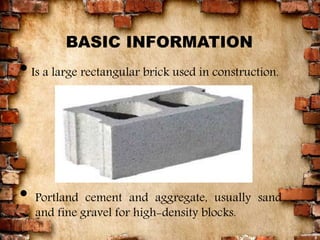
•Is a large rectangular brick used in construction.
• Portland cement and aggregate, usually sand
and fine gravel for high-density blocks.
BASIC INFORMATION
3
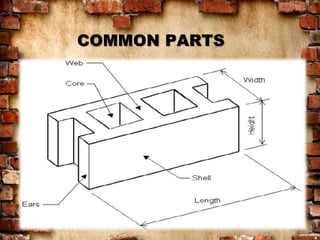
COMMON PARTS
4
CEMENT CONCRETE MASONRY
•Cement concrete is widely used for the
construction purpose due to its various
advantages over the other building materials.
•Hollow concrete units are manufactured
from light weight aggregates. They may be used
for load bearing as well as non load bearing
walls.
5
6
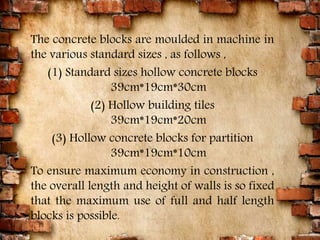
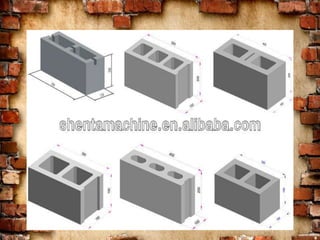
The concrete blocks are moulded in machine in
the various standard sizes , as follows ,
(1) Standard sizes hollow concrete blocks
39cm*19cm*30cm
(2) Hollow building tiles
39cm*19cm*20cm
(3) Hollow concrete blocks for partition
39cm*19cm*10cm
To ensure maximum economy in construction ,
the overall length and height of walls is so fixed
that the maximum use of full and half length
blocks is possible.
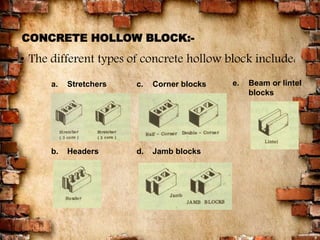
• The different types of concrete hollow block include:
CONCRETE HOLLOW BLOCK:-
a. Stretchers
b. Headers
c. Corner blocks
d. Jamb blocks
e. Beam or lintel
blocks
7
8
9
Manufacturing of Hollow Concrete Blocks:
oThey are manufactured with mix of sand (40%) and coarse
aggregates(60%) of size 6 to 12mm.
oThe concrete mix 1: 6 (C:CA) cement to Combined
aggregate.
oUses hand mould or machine moulding.
oKept for 24 hrs undisturbed.
oCured for minimum 7 days.
oThe minimum strength prescribed is 4 N/mm2.
oThe block should have sharp edges and right angled
corners.
10
MANUFACTURING OF CONCRETE
BLOCKS
•The ratio of cement of aggregate should not be
more than 1:6.
•The blocks should be taken out from the moulds
only when the concrete has set sufficiently.
•In order to obtain better finishing , the machine
casting is more preferred than hand casting.
•The blocks should be used only after 3 to 4 weeks
of taking out from tank.
•The compressive strength of blocks should not be
less than 30 kg/cm*cm. after 28 days curing.
11
12
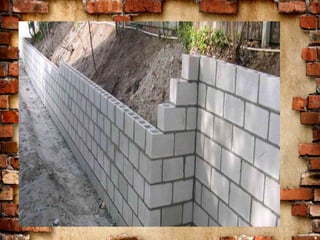
• The construction is started with two corners or
two ends of the wall. First, the construction of few
courses of blocks is done at both the ends and
then the string is stretched between two end
blocks and the blocks are laid in between. Before
laying the blocks the mortar is applied.
WALL CONSTRUCTION WITH
CONCRETE BLOCKS
WALL CONSTRUCTION WITH
CONCRETE BLOCKS
The various point should be followed during the
construction work :
• The concrete blocks used in masonry are dry.
•Blocks of successive courses should be laid in such a
way that the vertical joints are staggered.
• The joints should be uniform and 5 to 10 mm thick.
•Generally cement-lime-sand mortar of mix proportion
is used and it should not stronger than the concrete mix
used for concrete blocks.
•The blocks used for external walls should have
absorption less than 10%. For internal walls the
absorption should be less than 15%.
13
ADVANTAGES OF HOLLOW CONCRETE
BLOCK MASONRY
•The concrete blocks are available in regular
and uniform size and less weight , the masonry
construction done very rapidly.
•As the blocks are light in weight they easy to
handle construction is speedy resulting in less
labour cost.
•It is possible to construct thin wall with
concrete blocks resulting in the increase of floor
area.
•As the blocks are hollow , there is saving of
material. 14
15
•As the size of blocks is large , the number of
joints are less and hence there is saving of
mortar.
•The rough surface of concrete blocks makes
plastering easier.
•The hollow concrete blocks can safely
withstand against atmospheric action, it does not
required any plastering as required in brick
masonry.
16

Chapter 4 (d) hollow concrete block masonry

  • 1.
  • 3.
    CONCRETE HOLLOW BLOCKS •Is alarge rectangular brick used in construction. • Portland cement and aggregate, usually sand and fine gravel for high-density blocks. BASIC INFORMATION 3
  • 4.
  • 5.
    CEMENT CONCRETE MASONRY •Cementconcrete is widely used for the construction purpose due to its various advantages over the other building materials. •Hollow concrete units are manufactured from light weight aggregates. They may be used for load bearing as well as non load bearing walls. 5
  • 6.
    6 The concrete blocksare moulded in machine in the various standard sizes , as follows , (1) Standard sizes hollow concrete blocks 39cm*19cm*30cm (2) Hollow building tiles 39cm*19cm*20cm (3) Hollow concrete blocks for partition 39cm*19cm*10cm To ensure maximum economy in construction , the overall length and height of walls is so fixed that the maximum use of full and half length blocks is possible.
  • 7.
    • The differenttypes of concrete hollow block include: CONCRETE HOLLOW BLOCK:- a. Stretchers b. Headers c. Corner blocks d. Jamb blocks e. Beam or lintel blocks 7
  • 8.
  • 9.
  • 10.
    Manufacturing of HollowConcrete Blocks: oThey are manufactured with mix of sand (40%) and coarse aggregates(60%) of size 6 to 12mm. oThe concrete mix 1: 6 (C:CA) cement to Combined aggregate. oUses hand mould or machine moulding. oKept for 24 hrs undisturbed. oCured for minimum 7 days. oThe minimum strength prescribed is 4 N/mm2. oThe block should have sharp edges and right angled corners. 10
  • 11.
    MANUFACTURING OF CONCRETE BLOCKS •Theratio of cement of aggregate should not be more than 1:6. •The blocks should be taken out from the moulds only when the concrete has set sufficiently. •In order to obtain better finishing , the machine casting is more preferred than hand casting. •The blocks should be used only after 3 to 4 weeks of taking out from tank. •The compressive strength of blocks should not be less than 30 kg/cm*cm. after 28 days curing. 11
  • 12.
    12 • The constructionis started with two corners or two ends of the wall. First, the construction of few courses of blocks is done at both the ends and then the string is stretched between two end blocks and the blocks are laid in between. Before laying the blocks the mortar is applied. WALL CONSTRUCTION WITH CONCRETE BLOCKS
  • 13.
    WALL CONSTRUCTION WITH CONCRETEBLOCKS The various point should be followed during the construction work : • The concrete blocks used in masonry are dry. •Blocks of successive courses should be laid in such a way that the vertical joints are staggered. • The joints should be uniform and 5 to 10 mm thick. •Generally cement-lime-sand mortar of mix proportion is used and it should not stronger than the concrete mix used for concrete blocks. •The blocks used for external walls should have absorption less than 10%. For internal walls the absorption should be less than 15%. 13
  • 14.
    ADVANTAGES OF HOLLOWCONCRETE BLOCK MASONRY •The concrete blocks are available in regular and uniform size and less weight , the masonry construction done very rapidly. •As the blocks are light in weight they easy to handle construction is speedy resulting in less labour cost. •It is possible to construct thin wall with concrete blocks resulting in the increase of floor area. •As the blocks are hollow , there is saving of material. 14
  • 15.
    15 •As the sizeof blocks is large , the number of joints are less and hence there is saving of mortar. •The rough surface of concrete blocks makes plastering easier. •The hollow concrete blocks can safely withstand against atmospheric action, it does not required any plastering as required in brick masonry.
  • 16.