Assignment
                On
            LIGHTINGS
“It is better to light a small candle
   than to curse the darkness."


         Submitted By :
            Yamini Soni
          IInd Year (I. D.)
LIGHTING

Lighting or illumination is the deliberate application of light to achieve some practical or aesthetic
effect. Lighting includes the use of both artificial sources such as lamps and light fixtures, as well as
natural illumination by capturing daylight. Proper lighting can enhance task performance, improve

the appearance of an area, and have positive psychological effects on occupants. Indoor lighting is

usually accomplished using light fixtures, and is a key part of interior.


Light not only illuminates but define one’s path. It can change mood, hide or highlight an object, kill
or liven up a space. Light never stands in isolation, it can only be seen through its impact on the
object it falls on.


Today lighting up a space itself is a major task as nowadays light defines one’s style and
mood. There is nothing better than natural light; one should go for its maximum use. But, because
of its dynamic nature one have to go for artificial lighting which can be used in very playful manner.

Unless one sees and experiences nature and application of light in actual space, it is difficult to deal

with it. Lighting can be classified into various different methods of lighting. It can be broadly
classified as:


             1. Direct Lighting

             2. Indirect Lighting

             3. Concealed lighting

             4. Semi-concealed lighting


For any built mass, both indoor and outdoor spaces get affected by natural as well as artificial light.
It is important to play in combination of natural and artificial light. It determines functionality of both

space and style and decor of environment it creates. In homes, a thoughtful selection of lighting

schemes enhances the aesthetics of interiors as well as garden spaces.
Purpose Of Light
We use light in buildings for the following reasons:

       •   To carry out tasks or work- reading, writing, operating equipment.

       •   To create an area of comfort or an amenity – this is general lighting to live with either by
           daylight or artificial light and direct sunlight.

       •   To create effects for aesthetics – displays, artworks, shadows definition.

       •   To ensure safety – ensuring appropriate lighting levels for all those using the facility.


How to plan lighting in your homes?

At first, there is a need of choosing a particular style and mood of whole interior scheme going up

with one’s living style and then define a schematic design to all spaces of the house so as to avoid
clutter of different spatial environments that lighting creates. Initially, one should go for planned
position of lighting points demarcated by a professional. Later on, one should go for selection of
lighting types providing a specific effect to the designated space while enhancing the functional

aspects.


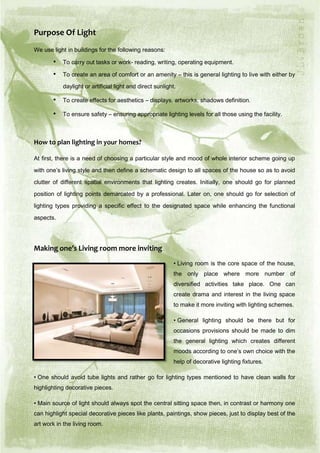
Making one’s Living room more inviting
                                                           • Living room is the core space of the house,
                                                           the only place where more number of
                                                           diversified activities take place. One can
                                                           create drama and interest in the living space
                                                           to make it more inviting with lighting schemes.

                                                           • General lighting should be there but for
                                                           occasions provisions should be made to dim
                                                           the general lighting which creates different
                                                           moods according to one’s own choice with the
                                                           help of decorative lighting fixtures.

• One should avoid tube lights and rather go for lighting types mentioned to have clean walls for
highlighting decorative pieces.

• Main source of light should always spot the central sitting space then, in contrast or harmony one
can highlight special decorative pieces like plants, paintings, show pieces, just to display best of the
art work in the living room.
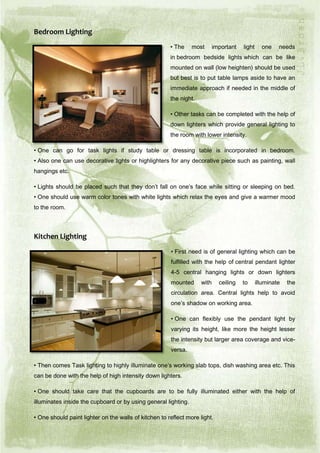
Bedroom Lighting
                                                       • The    most       important   light     one    needs
                                                       in bedroom bedside lights which can be like
                                                       mounted on wall (low heighten) should be used
                                                       but best is to put table lamps aside to have an
                                                       immediate approach if needed in the middle of
                                                       the night.

                                                       • Other tasks can be completed with the help of
                                                       down lighters which provide general lighting to
                                                       the room with lower intensity.

• One can go for task lights if study table or dressing table is incorporated in bedroom.
• Also one can use decorative lights or highlighters for any decorative piece such as painting, wall
hangings etc.

• Lights should be placed such that they don’t fall on one’s face while sitting or sleeping on bed.
• One should use warm color tones with white lights which relax the eyes and give a warmer mood
to the room.


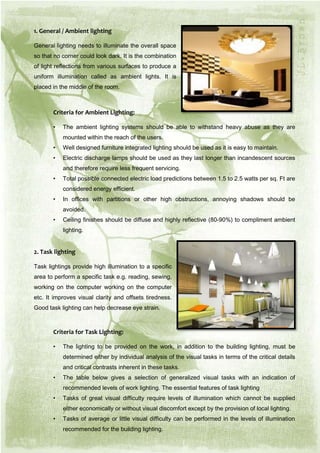
Kitchen Lighting
                                                       • First need is of general lighting which can be
                                                       fulfilled with the help of central pendant lighter
                                                       4-5 central hanging lights or down lighters
                                                       mounted      with     ceiling   to      illuminate   the
                                                       circulation area. Central lights help to avoid
                                                       one’s shadow on working area.

                                                       • One can flexibly use the pendant light by
                                                       varying its height, like more the height lesser
                                                       the intensity but larger area coverage and vice-
                                                       versa.

• Then comes Task lighting to highly illuminate one’s working slab tops, dish washing area etc. This
can be done with the help of high intensity down lighters.

• One should take care that the cupboards are to be fully illuminated either with the help of
illuminates inside the cupboard or by using general lighting.

• One should paint lighter on the walls of kitchen to reflect more light.
Bathroom lighting
                                                       • One should avoid window or any lighting
                                                       source in front of mirror of wash basin and
                                                       dressing table to avoid darkness on the face
                                                       while looking in the mirror.

                                                       • Use frosted glass in widow panels to make it
                                                       comfortable for the user and get sufficient
                                                       natural lights in day time.

                                                       • For general lighting one can use down lighters
                                                       if the space is big and wall mounted decorative
                                                       lights can also easily solve the purpose.

• One should use dimmers or diffused lights to avoid reflection in the mirror. Also, one doesn’t need
direct light in bathrooms.

• One should go for side lights in case of mirror so that lights could illuminate ones image without
casting any shadow on to the face.


Lighting for dining area
                                                         When choosing dining room lighting, start
                                                       with a chandelier in the middle of the room,
                                                       then work out with accent lights.
                                                         One should use task lighting in terms of
                                                       hanging lights, pendants which can illuminate
                                                       the table from top not from sides to avoid
                                                       casting shadows on plates.
                                                         Use dimmers for general lighting to highlight
                                                       the dining area.
                                                         A Crystal Chandelier over the center of the
                                                       dining table can help to balance chi in the room


Types of lighting:
Lighting is classified by intended use as General, Decorative, or Task lighting, depending largely on
the distribution of the light produced by the fixture. It is an integral part of design. It determines the
utilitarian and the aesthetic environment provided by a designer, thus calling for the most careful
planning and highest skills.
1. General / Ambient lighting

General lighting needs to illuminate the overall space
so that no corner could look dark. It is the combination
of light reflections from various surfaces to produce a
uniform illumination called as ambient lights. It is
placed in the middle of the room.


       Criteria for Ambient Lighting:

       •   The ambient lighting systems should be able to withstand heavy abuse as they are
           mounted within the reach of the users.
       •   Well designed furniture integrated lighting should be used as it is easy to maintain.
       •   Electric discharge lamps should be used as they last longer than incandescent sources
           and therefore require less frequent servicing.
       •   Total possible connected electric load predictions between 1.5 to 2.5 watts per sq. Ft are
           considered energy efficient.
       •   In offices with partitions or other high obstructions, annoying shadows should be
           avoided.
       •   Ceiling finishes should be diffuse and highly reflective (80-90%) to compliment ambient
           lighting.


2. Task lighting

Task lightings provide high illumination to a specific
area to perform a specific task e.g. reading, sewing,
working on the computer working on the computer
etc. It improves visual clarity and offsets tiredness.
Good task lighting can help decrease eye strain.


       Criteria for Task Lighting:

       •   The lighting to be provided on the work, in addition to the building lighting, must be
           determined either by individual analysis of the visual tasks in terms of the critical details
           and critical contrasts inherent in these tasks.
       •   The table below gives a selection of generalized visual tasks with an indication of
           recommended levels of work lighting. The essential features of task lighting
       •   Tasks of great visual difficulty require levels of illumination which cannot be supplied
           either economically or without visual discomfort except by the provision of local lighting.
       •   Tasks of average or little visual difficulty can be performed in the levels of illumination
           recommended for the building lighting.
3. Decorative lighting

These lighting themselves can act as focal points for a
room. Combination of glass, color and light can
change whole mood of the environment. Decorative
lighting can refer to any lighting used in the space that
adds aesthetic appeal to the home as well as
functional lighting.

                       Shadow         play:   Occurs   where
                       pattern of light is the background,
                       or negative space, and shape of
                       shadow carries the message.


                       Beam play: Opposite of shadow
                       play where light beam becomes
                       the   visual     feature.   Sometimes
                       achieved with gobos.


                       Sparkle:       Occurs when bits of
                       small brightness appear on a dark
                       background.       Requires very high
                       contrast to be effective.


                       Colored light: Use of colored light
                       sources to create special visual
                       effects.


Criteria For Decorative Lighting:

       •   The luminaries should be capable of 358 degree of rotation.

       •   It should have minimum tilt of 35 degree.

       •   An accent light should accommodate color filters and spread lenses and be able to hold
           both the filter and the lens at the same time.
•   It should have adequate baffling to prevent direct sight of the lamp from normal viewing
          angles when the lamp is tilted.

      •   The luminaries’ working components should be easily accessible from either below or
          above the ceiling line in order to adjust direction, change lamps, change color filters and
          lenses, or change the orientation of light pattern produced by the lamp.

      •   It should be possible to lock all adjustable features in place once they have been focused
          so that the light scheme is not altered.

      •   An accent light should accommodate a variety of lamp wattages and beam distributions
          without the need for external adaptors.

      •   Any accent light should be efficient, some direct most of their light inside the lamp
          housing when tilted more than 10 degrees.


Accent lightings
Accent lighting is one of the four types of light, along with ambient or background or general
lighting, task and decorative lighting. Used to illuminate architectural or interior elements. General
rule, if you add too much accent lighting the effect will be lost. Common techniques include:

       Grazing: Used to emphasize textural qualities of vertical
       surfaces and to define a space by featuring one wall over
       another.     Achieved by directing light parallel to featured
       surface, appx 6-12” from surface.


       Wall washing: These are ceiling mounted lightings which
       illuminate vertical surfaces like a column or a wall; provides
       soft, ambient reflected light; attracts attention to wall; and
       unifies diverse objects on wall, unifies a wall with sheet of
       uniform brightness.

       Backlighting: A light source placed on the opposite side of
       the “subject” (model, actor) from a viewer’s (camera,
       audience) point of view.       Rear lighting technique that
       diffuses light through translucent materials.

       Highlighting: Emphasizes featured object by creating 5 to
       10 times the amount of brightness on the object than in the
       background. When light hits a surface, it naturally catches
       on the most prominent areas. High contrast attracts
       attention.
Silhouetting: Sandwiches an object between viewer and
sheet of light. Object is outlined by the light the brightness
of which serves as negative space. Details on face of object
are obliterated. It involves placing the light source at the
back of any object that needs to be lit.

Down lighting: These lights in downward direc tion and
can be fully or half- inscribed in ceiling. Mainly down lighters
are used for general lighting of a space but, it can also be
used under cabinets of kitchen to illuminate the slab area.


Up lighting: These lights upwards and are mainly used for
the steps of staircase in homes. Good ambient lighting
technique or accent for interesting surfaces that are “up”;
important that surfaces have high value, matte finish to
reflect light.

Lights

  • 1.
    Assignment On LIGHTINGS “It is better to light a small candle than to curse the darkness." Submitted By : Yamini Soni IInd Year (I. D.)
  • 2.
    LIGHTING Lighting or illuminationis the deliberate application of light to achieve some practical or aesthetic effect. Lighting includes the use of both artificial sources such as lamps and light fixtures, as well as natural illumination by capturing daylight. Proper lighting can enhance task performance, improve the appearance of an area, and have positive psychological effects on occupants. Indoor lighting is usually accomplished using light fixtures, and is a key part of interior. Light not only illuminates but define one’s path. It can change mood, hide or highlight an object, kill or liven up a space. Light never stands in isolation, it can only be seen through its impact on the object it falls on. Today lighting up a space itself is a major task as nowadays light defines one’s style and mood. There is nothing better than natural light; one should go for its maximum use. But, because of its dynamic nature one have to go for artificial lighting which can be used in very playful manner. Unless one sees and experiences nature and application of light in actual space, it is difficult to deal with it. Lighting can be classified into various different methods of lighting. It can be broadly classified as: 1. Direct Lighting 2. Indirect Lighting 3. Concealed lighting 4. Semi-concealed lighting For any built mass, both indoor and outdoor spaces get affected by natural as well as artificial light. It is important to play in combination of natural and artificial light. It determines functionality of both space and style and decor of environment it creates. In homes, a thoughtful selection of lighting schemes enhances the aesthetics of interiors as well as garden spaces.
  • 3.
    Purpose Of Light Weuse light in buildings for the following reasons: • To carry out tasks or work- reading, writing, operating equipment. • To create an area of comfort or an amenity – this is general lighting to live with either by daylight or artificial light and direct sunlight. • To create effects for aesthetics – displays, artworks, shadows definition. • To ensure safety – ensuring appropriate lighting levels for all those using the facility. How to plan lighting in your homes? At first, there is a need of choosing a particular style and mood of whole interior scheme going up with one’s living style and then define a schematic design to all spaces of the house so as to avoid clutter of different spatial environments that lighting creates. Initially, one should go for planned position of lighting points demarcated by a professional. Later on, one should go for selection of lighting types providing a specific effect to the designated space while enhancing the functional aspects. Making one’s Living room more inviting • Living room is the core space of the house, the only place where more number of diversified activities take place. One can create drama and interest in the living space to make it more inviting with lighting schemes. • General lighting should be there but for occasions provisions should be made to dim the general lighting which creates different moods according to one’s own choice with the help of decorative lighting fixtures. • One should avoid tube lights and rather go for lighting types mentioned to have clean walls for highlighting decorative pieces. • Main source of light should always spot the central sitting space then, in contrast or harmony one can highlight special decorative pieces like plants, paintings, show pieces, just to display best of the art work in the living room.
  • 4.
    Bedroom Lighting • The most important light one needs in bedroom bedside lights which can be like mounted on wall (low heighten) should be used but best is to put table lamps aside to have an immediate approach if needed in the middle of the night. • Other tasks can be completed with the help of down lighters which provide general lighting to the room with lower intensity. • One can go for task lights if study table or dressing table is incorporated in bedroom. • Also one can use decorative lights or highlighters for any decorative piece such as painting, wall hangings etc. • Lights should be placed such that they don’t fall on one’s face while sitting or sleeping on bed. • One should use warm color tones with white lights which relax the eyes and give a warmer mood to the room. Kitchen Lighting • First need is of general lighting which can be fulfilled with the help of central pendant lighter 4-5 central hanging lights or down lighters mounted with ceiling to illuminate the circulation area. Central lights help to avoid one’s shadow on working area. • One can flexibly use the pendant light by varying its height, like more the height lesser the intensity but larger area coverage and vice- versa. • Then comes Task lighting to highly illuminate one’s working slab tops, dish washing area etc. This can be done with the help of high intensity down lighters. • One should take care that the cupboards are to be fully illuminated either with the help of illuminates inside the cupboard or by using general lighting. • One should paint lighter on the walls of kitchen to reflect more light.
  • 5.
    Bathroom lighting • One should avoid window or any lighting source in front of mirror of wash basin and dressing table to avoid darkness on the face while looking in the mirror. • Use frosted glass in widow panels to make it comfortable for the user and get sufficient natural lights in day time. • For general lighting one can use down lighters if the space is big and wall mounted decorative lights can also easily solve the purpose. • One should use dimmers or diffused lights to avoid reflection in the mirror. Also, one doesn’t need direct light in bathrooms. • One should go for side lights in case of mirror so that lights could illuminate ones image without casting any shadow on to the face. Lighting for dining area When choosing dining room lighting, start with a chandelier in the middle of the room, then work out with accent lights. One should use task lighting in terms of hanging lights, pendants which can illuminate the table from top not from sides to avoid casting shadows on plates. Use dimmers for general lighting to highlight the dining area. A Crystal Chandelier over the center of the dining table can help to balance chi in the room Types of lighting: Lighting is classified by intended use as General, Decorative, or Task lighting, depending largely on the distribution of the light produced by the fixture. It is an integral part of design. It determines the utilitarian and the aesthetic environment provided by a designer, thus calling for the most careful planning and highest skills.
  • 6.
    1. General /Ambient lighting General lighting needs to illuminate the overall space so that no corner could look dark. It is the combination of light reflections from various surfaces to produce a uniform illumination called as ambient lights. It is placed in the middle of the room. Criteria for Ambient Lighting: • The ambient lighting systems should be able to withstand heavy abuse as they are mounted within the reach of the users. • Well designed furniture integrated lighting should be used as it is easy to maintain. • Electric discharge lamps should be used as they last longer than incandescent sources and therefore require less frequent servicing. • Total possible connected electric load predictions between 1.5 to 2.5 watts per sq. Ft are considered energy efficient. • In offices with partitions or other high obstructions, annoying shadows should be avoided. • Ceiling finishes should be diffuse and highly reflective (80-90%) to compliment ambient lighting. 2. Task lighting Task lightings provide high illumination to a specific area to perform a specific task e.g. reading, sewing, working on the computer working on the computer etc. It improves visual clarity and offsets tiredness. Good task lighting can help decrease eye strain. Criteria for Task Lighting: • The lighting to be provided on the work, in addition to the building lighting, must be determined either by individual analysis of the visual tasks in terms of the critical details and critical contrasts inherent in these tasks. • The table below gives a selection of generalized visual tasks with an indication of recommended levels of work lighting. The essential features of task lighting • Tasks of great visual difficulty require levels of illumination which cannot be supplied either economically or without visual discomfort except by the provision of local lighting. • Tasks of average or little visual difficulty can be performed in the levels of illumination recommended for the building lighting.
  • 7.
    3. Decorative lighting Theselighting themselves can act as focal points for a room. Combination of glass, color and light can change whole mood of the environment. Decorative lighting can refer to any lighting used in the space that adds aesthetic appeal to the home as well as functional lighting. Shadow play: Occurs where pattern of light is the background, or negative space, and shape of shadow carries the message. Beam play: Opposite of shadow play where light beam becomes the visual feature. Sometimes achieved with gobos. Sparkle: Occurs when bits of small brightness appear on a dark background. Requires very high contrast to be effective. Colored light: Use of colored light sources to create special visual effects. Criteria For Decorative Lighting: • The luminaries should be capable of 358 degree of rotation. • It should have minimum tilt of 35 degree. • An accent light should accommodate color filters and spread lenses and be able to hold both the filter and the lens at the same time.
  • 8.
    It should have adequate baffling to prevent direct sight of the lamp from normal viewing angles when the lamp is tilted. • The luminaries’ working components should be easily accessible from either below or above the ceiling line in order to adjust direction, change lamps, change color filters and lenses, or change the orientation of light pattern produced by the lamp. • It should be possible to lock all adjustable features in place once they have been focused so that the light scheme is not altered. • An accent light should accommodate a variety of lamp wattages and beam distributions without the need for external adaptors. • Any accent light should be efficient, some direct most of their light inside the lamp housing when tilted more than 10 degrees. Accent lightings Accent lighting is one of the four types of light, along with ambient or background or general lighting, task and decorative lighting. Used to illuminate architectural or interior elements. General rule, if you add too much accent lighting the effect will be lost. Common techniques include: Grazing: Used to emphasize textural qualities of vertical surfaces and to define a space by featuring one wall over another. Achieved by directing light parallel to featured surface, appx 6-12” from surface. Wall washing: These are ceiling mounted lightings which illuminate vertical surfaces like a column or a wall; provides soft, ambient reflected light; attracts attention to wall; and unifies diverse objects on wall, unifies a wall with sheet of uniform brightness. Backlighting: A light source placed on the opposite side of the “subject” (model, actor) from a viewer’s (camera, audience) point of view. Rear lighting technique that diffuses light through translucent materials. Highlighting: Emphasizes featured object by creating 5 to 10 times the amount of brightness on the object than in the background. When light hits a surface, it naturally catches on the most prominent areas. High contrast attracts attention.
  • 9.
    Silhouetting: Sandwiches anobject between viewer and sheet of light. Object is outlined by the light the brightness of which serves as negative space. Details on face of object are obliterated. It involves placing the light source at the back of any object that needs to be lit. Down lighting: These lights in downward direc tion and can be fully or half- inscribed in ceiling. Mainly down lighters are used for general lighting of a space but, it can also be used under cabinets of kitchen to illuminate the slab area. Up lighting: These lights upwards and are mainly used for the steps of staircase in homes. Good ambient lighting technique or accent for interesting surfaces that are “up”; important that surfaces have high value, matte finish to reflect light.