Cavity Walls
What is a Cavity Wall?
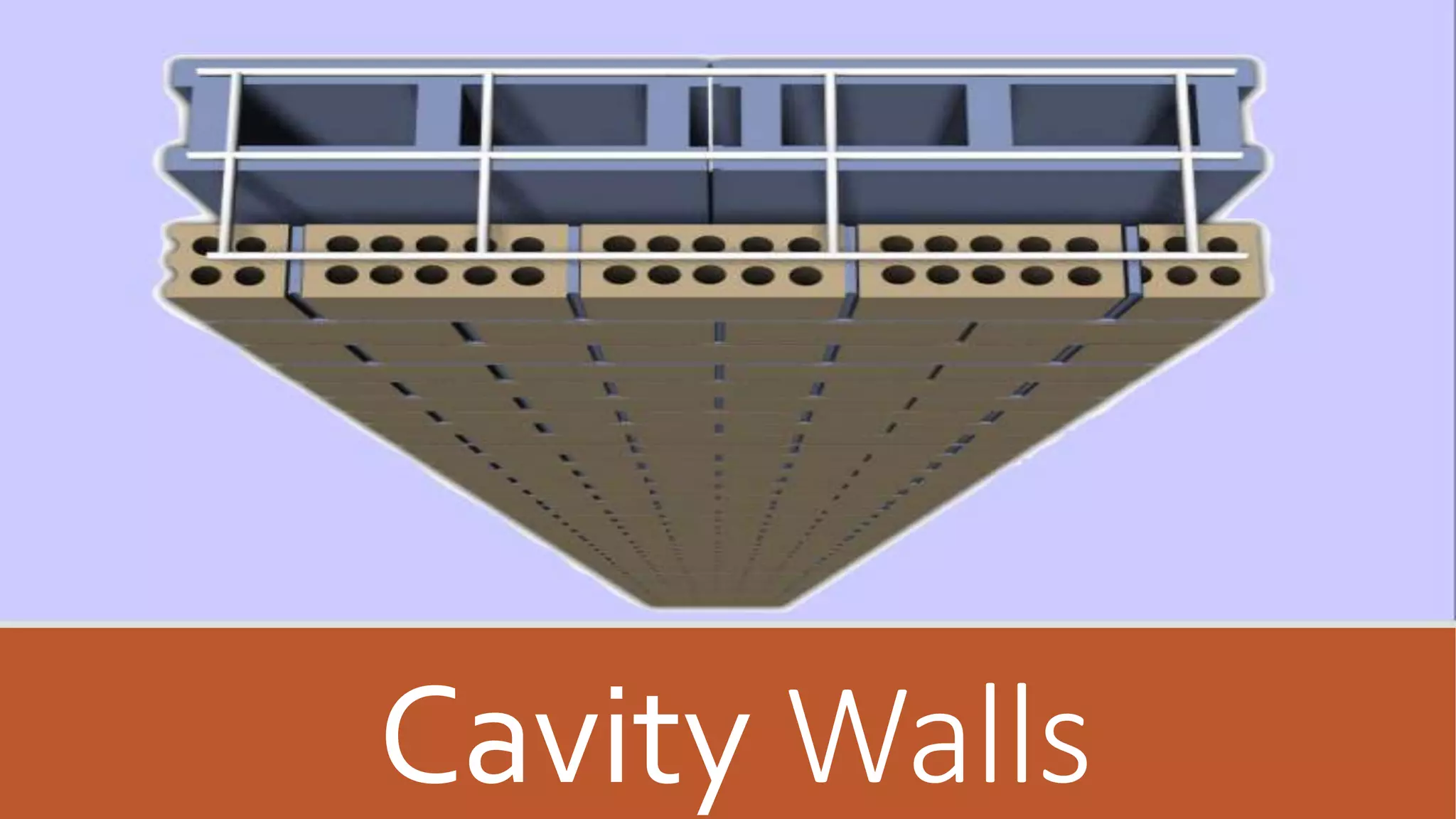
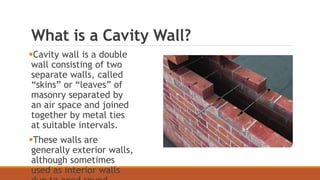
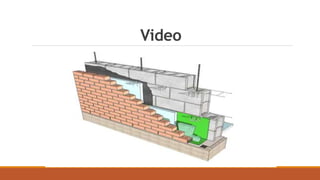
Cavity wall is a double
wall consisting of two
separate walls, called
“skins” or “leaves” of
masonry separated by
an air space and joined
together by metal ties
at suitable intervals.
These walls are
generally exterior walls,
although sometimes
used as interior walls
Construction Details
General features:
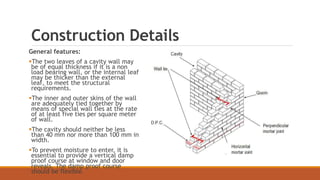
The two leaves of a cavity wall may
be of equal thickness if it is a non
load bearing wall, or the internal leaf
may be thicker than the external
leaf, to meet the structural
requirements.
The inner and outer skins of the wall
are adequately tied together by
means of special wall ties at the rate
of at least five ties per square meter
of wall.
The cavity should neither be less
than 40 mm nor more than 100 mm in
width.
To prevent moisture to enter, it is
essential to provide a vertical damp
proof course at window and door
reveals. The damp proof course
should be flexible.
Video
Early Cavity Walls
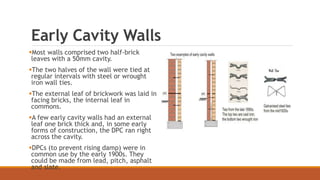
Most walls comprised two half-brick
leaves with a 50mm cavity.
The two halves of the wall were tied at
regular intervals with steel or wrought
iron wall ties.
The external leaf of brickwork was laid in
facing bricks, the internal leaf in
commons.
A few early cavity walls had an external
leaf one brick thick and, in some early
forms of construction, the DPC ran right
across the cavity.
DPCs (to prevent rising damp) were in
common use by the early 1900s. They
could be made from lead, pitch, asphalt
and slate.
Building Regulations
According to building codes the double wall is generally 265mm or 275mm thick,
consisting of 102.5mm inner and outer skins and a 60-70 mm cavity (adequate for 2
storied domestic building) .
The inner leaf is increased to 215 mm or more in thickness when heavier load or floors
have to be supported
For stone faced buildings, the outer leaf is 103-206mm and inner leaf is 102.5mm. The
width of cavity in between varies from 50-75mm.
Position of Cavity at Foundations:
Cavity Extending up to Concrete
Bed
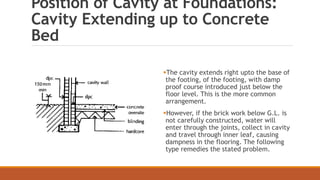
The cavity extends right upto the base of
the footing, of the footing, with damp
proof course introduced just below the
floor level. This is the more common
arrangement.
However, if the brick work below G.L. is
not carefully constructed, water will
enter through the joints, collect in cavity
and travel through inner leaf, causing
dampness in the flooring. The following
type remedies the stated problem.
Position of Cavity at Foundations
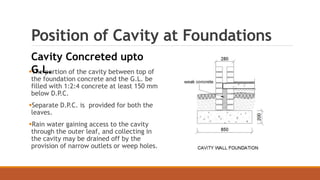
The portion of the cavity between top of
the foundation concrete and the G.L. be
filled with 1:2:4 concrete at least 150 mm
below D.P.C.
Separate D.P.C. is provided for both the
leaves.
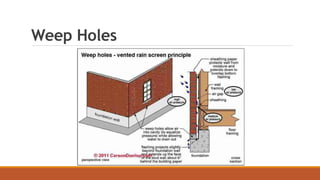
Rain water gaining access to the cavity
through the outer leaf, and collecting in
the cavity may be drained off by the
provision of narrow outlets or weep holes.
Cavity Concreted upto
G.L.
Position of Cavity at Parapet Level
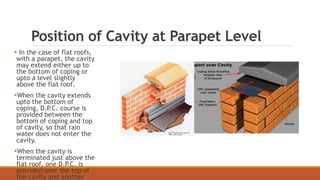
 In the case of flat roofs,
with a parapet, the cavity
may extend either up to
the bottom of coping or
upto a level slightly
above the flat roof.
When the cavity extends
upto the bottom of
coping, D.P.C. course is
provided between the
bottom of coping and top
of cavity, so that rain
water does not enter the
cavity.
When the cavity is
terminated just above the
flat roof, one D.P.C. is
provided over the top of
the cavity and another
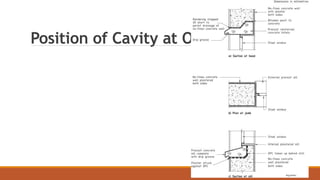
Position of Cavity at Openings
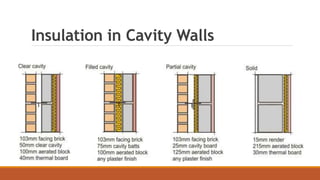
Insulation in Cavity Walls
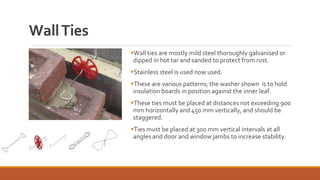
Wall ties are mostly mild steel thoroughly galvanised or
dipped in hot tar and sanded to protect from rust.
Stainless steel is used now used.
These are various patterns; the washer shown is to hold
insulation boards in position against the inner leaf.
These ties must be placed at distances not exceeding 900
mm horizontally and 450 mm vertically, and should be
staggered.
Ties must be placed at 300 mm vertical intervals at all
angles and door and window jambs to increase stability.
WallTies
Weep Holes
Example
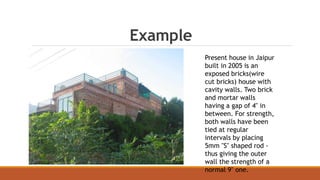
Present house in Jaipur
built in 2005 is an
exposed bricks(wire
cut bricks) house with
cavity walls. Two brick
and mortar walls
having a gap of 4" in
between. For strength,
both walls have been
tied at regular
intervals by placing
5mm "S" shaped rod -
thus giving the outer
wall the strength of a
normal 9" one.
Advantages of cavity walls.
Advantages of cavity walls:
There is no possibility of the moisture travelling from
the outer wall to the inner wall.
 The layer of air in the cavity being non-conductor of
heat, and reduces the transmission of heat from the
external face to internal one.
 This acts as damp barrier, reduces the cooling cost of
the building.
 Economy- A 275 mm cavity wall costs less to construct
than a 328 mm solid wall
 Cheaper than exterior or interior wall insulation.
 Maintains existing wall thickness.
Minimal disruption to install
Can reduce condensation
Disadvantages
 Cavity walls were first built, in exposed coastal areas, in order to keep out wind-driven
rain. Filling the cavity with insulation will always hold the risk that moisture will be able to
find its way across to the inside, whatever the insulation material.
There is also the possibility that the installation will leave unfilled air pockets –causing
‘cold spots’ on the inside walls which attract condensation.
 Another problem concerns wall-tie corrosion; cavity insulation makes the outer brick leaf
colder, and therefore wetter, which can accelerate rusting of the wall ties. And if the ties
then have to be replaced, there is no satisfactory way of refilling the holes in the
insulation, whatever the material.
 Thermal bridging problems.
 Thickness of insulation is restricted by width of cavity.
 Significant parts of the UK are unsuitable due to their exposure.
 There are significant number of buildings with mortar droppings on ties within the cavity
which result in penetrating dampness.
 Settlement and saturation of cavity-fill leading to cold bridging
Precautions
 Damp proof course should be laid separately for two walls.
 The cavity should be properly drained and ventilated by providing weep holes.
 Cavity should be kept clear of dropping of mortar or brick, rubbish etc during
construction.
 Vermin's or mosquitoes should not be there in the cavity wall.
Bibliography
1. https://www.google.co.in/search?biw=1366&bih=623&noj=1&tbm=isch&q=cavity+w
all+ties&revid=424010215&sa=X&ved=0CCcQ1QJqFQoTCM6X8bOA8sgCFYyiiAodk_8D
qw#imgrc=muaot58ecH_cMM%3A
2. http://inspectapedia.com/structure/1763s.jpg
3. http://fet.uwe.ac.uk/conweb/house_ages/elements/print.htm
4. https://www.google.co.in/url?sa=i&rct=j&q=&esrc=s&source=images&cd=&cad=rja
&uact=8&ved=0CAYQjB1qFQoTCJn2nMDD8sgCFUHYpgodkJkInA&url=https%3A%2F%2Fl
aw.resource.org%2Fpub%2Fza%2Fibr%2Fza.sans.10400.l.2011.html&psig=AFQjCNHnc
nH7H8sCWm9IrlQA5BNJxZvVrQ&ust=1446580363191096
5. https://en.wikipedia.org/wiki/Cavity_wall
6. http://www.indiamike.com
7. Building Construction, W.B. Mckay
8. Building Construction, BC Punmia
ThankYou!

Cavity walls

  • 1.
  • 2.
    What is aCavity Wall? Cavity wall is a double wall consisting of two separate walls, called “skins” or “leaves” of masonry separated by an air space and joined together by metal ties at suitable intervals. These walls are generally exterior walls, although sometimes used as interior walls
  • 3.
    Construction Details General features: Thetwo leaves of a cavity wall may be of equal thickness if it is a non load bearing wall, or the internal leaf may be thicker than the external leaf, to meet the structural requirements. The inner and outer skins of the wall are adequately tied together by means of special wall ties at the rate of at least five ties per square meter of wall. The cavity should neither be less than 40 mm nor more than 100 mm in width. To prevent moisture to enter, it is essential to provide a vertical damp proof course at window and door reveals. The damp proof course should be flexible.
  • 4.
  • 5.
    Early Cavity Walls Mostwalls comprised two half-brick leaves with a 50mm cavity. The two halves of the wall were tied at regular intervals with steel or wrought iron wall ties. The external leaf of brickwork was laid in facing bricks, the internal leaf in commons. A few early cavity walls had an external leaf one brick thick and, in some early forms of construction, the DPC ran right across the cavity. DPCs (to prevent rising damp) were in common use by the early 1900s. They could be made from lead, pitch, asphalt and slate.
  • 6.
    Building Regulations According tobuilding codes the double wall is generally 265mm or 275mm thick, consisting of 102.5mm inner and outer skins and a 60-70 mm cavity (adequate for 2 storied domestic building) . The inner leaf is increased to 215 mm or more in thickness when heavier load or floors have to be supported For stone faced buildings, the outer leaf is 103-206mm and inner leaf is 102.5mm. The width of cavity in between varies from 50-75mm.
  • 7.
    Position of Cavityat Foundations: Cavity Extending up to Concrete Bed The cavity extends right upto the base of the footing, of the footing, with damp proof course introduced just below the floor level. This is the more common arrangement. However, if the brick work below G.L. is not carefully constructed, water will enter through the joints, collect in cavity and travel through inner leaf, causing dampness in the flooring. The following type remedies the stated problem.
  • 8.
    Position of Cavityat Foundations The portion of the cavity between top of the foundation concrete and the G.L. be filled with 1:2:4 concrete at least 150 mm below D.P.C. Separate D.P.C. is provided for both the leaves. Rain water gaining access to the cavity through the outer leaf, and collecting in the cavity may be drained off by the provision of narrow outlets or weep holes. Cavity Concreted upto G.L.
  • 9.
    Position of Cavityat Parapet Level  In the case of flat roofs, with a parapet, the cavity may extend either up to the bottom of coping or upto a level slightly above the flat roof. When the cavity extends upto the bottom of coping, D.P.C. course is provided between the bottom of coping and top of cavity, so that rain water does not enter the cavity. When the cavity is terminated just above the flat roof, one D.P.C. is provided over the top of the cavity and another
  • 10.
    Position of Cavityat Openings
  • 11.
  • 12.
    Wall ties aremostly mild steel thoroughly galvanised or dipped in hot tar and sanded to protect from rust. Stainless steel is used now used. These are various patterns; the washer shown is to hold insulation boards in position against the inner leaf. These ties must be placed at distances not exceeding 900 mm horizontally and 450 mm vertically, and should be staggered. Ties must be placed at 300 mm vertical intervals at all angles and door and window jambs to increase stability. WallTies
  • 13.
  • 14.
    Example Present house inJaipur built in 2005 is an exposed bricks(wire cut bricks) house with cavity walls. Two brick and mortar walls having a gap of 4" in between. For strength, both walls have been tied at regular intervals by placing 5mm "S" shaped rod - thus giving the outer wall the strength of a normal 9" one.
  • 15.
    Advantages of cavitywalls. Advantages of cavity walls: There is no possibility of the moisture travelling from the outer wall to the inner wall.  The layer of air in the cavity being non-conductor of heat, and reduces the transmission of heat from the external face to internal one.  This acts as damp barrier, reduces the cooling cost of the building.  Economy- A 275 mm cavity wall costs less to construct than a 328 mm solid wall  Cheaper than exterior or interior wall insulation.  Maintains existing wall thickness. Minimal disruption to install Can reduce condensation
  • 16.
    Disadvantages  Cavity wallswere first built, in exposed coastal areas, in order to keep out wind-driven rain. Filling the cavity with insulation will always hold the risk that moisture will be able to find its way across to the inside, whatever the insulation material. There is also the possibility that the installation will leave unfilled air pockets –causing ‘cold spots’ on the inside walls which attract condensation.  Another problem concerns wall-tie corrosion; cavity insulation makes the outer brick leaf colder, and therefore wetter, which can accelerate rusting of the wall ties. And if the ties then have to be replaced, there is no satisfactory way of refilling the holes in the insulation, whatever the material.  Thermal bridging problems.  Thickness of insulation is restricted by width of cavity.  Significant parts of the UK are unsuitable due to their exposure.  There are significant number of buildings with mortar droppings on ties within the cavity which result in penetrating dampness.  Settlement and saturation of cavity-fill leading to cold bridging
  • 17.
    Precautions  Damp proofcourse should be laid separately for two walls.  The cavity should be properly drained and ventilated by providing weep holes.  Cavity should be kept clear of dropping of mortar or brick, rubbish etc during construction.  Vermin's or mosquitoes should not be there in the cavity wall.
  • 18.
    Bibliography 1. https://www.google.co.in/search?biw=1366&bih=623&noj=1&tbm=isch&q=cavity+w all+ties&revid=424010215&sa=X&ved=0CCcQ1QJqFQoTCM6X8bOA8sgCFYyiiAodk_8D qw#imgrc=muaot58ecH_cMM%3A 2. http://inspectapedia.com/structure/1763s.jpg 3.http://fet.uwe.ac.uk/conweb/house_ages/elements/print.htm 4. https://www.google.co.in/url?sa=i&rct=j&q=&esrc=s&source=images&cd=&cad=rja &uact=8&ved=0CAYQjB1qFQoTCJn2nMDD8sgCFUHYpgodkJkInA&url=https%3A%2F%2Fl aw.resource.org%2Fpub%2Fza%2Fibr%2Fza.sans.10400.l.2011.html&psig=AFQjCNHnc nH7H8sCWm9IrlQA5BNJxZvVrQ&ust=1446580363191096 5. https://en.wikipedia.org/wiki/Cavity_wall 6. http://www.indiamike.com 7. Building Construction, W.B. Mckay 8. Building Construction, BC Punmia
  • 19.