JIS College of Engineering
Civil Engineering Department
Prepared by:-
BISHAL SARKAR
ROLL NO:-140308128
REG NO:-141230120044
DEPEARTMENT:-CIVIL ENGINEERING (3RD YEAR)
6th Semester 2016/2017
Foundation is the
lowest part of a
super‐structure and
transmit the loads
(live load, wind
load) on the
structure including
the dead weight of
the structure
transmit to the soil
below.
 Types of Foundation:
 Foundation can be broadly classified into two
types :
1. Deep Foundations
2. Shallow Foundations
 Foundation is placed immediately lowest part of the
super structure, is termed as Shallow foundation:
 Why we use shallow foundation?
 To distribute the structural loads over a wide horizontal
area at a shallow depth below the ground level.
TYPES OF SHALLOW FOUNDATIONS
 The various types of shallow foundations are :
 Spread footing
 Combined footing
 Mat or Raft foundation.
 Grillage footing
 Eccentrically loaded footing
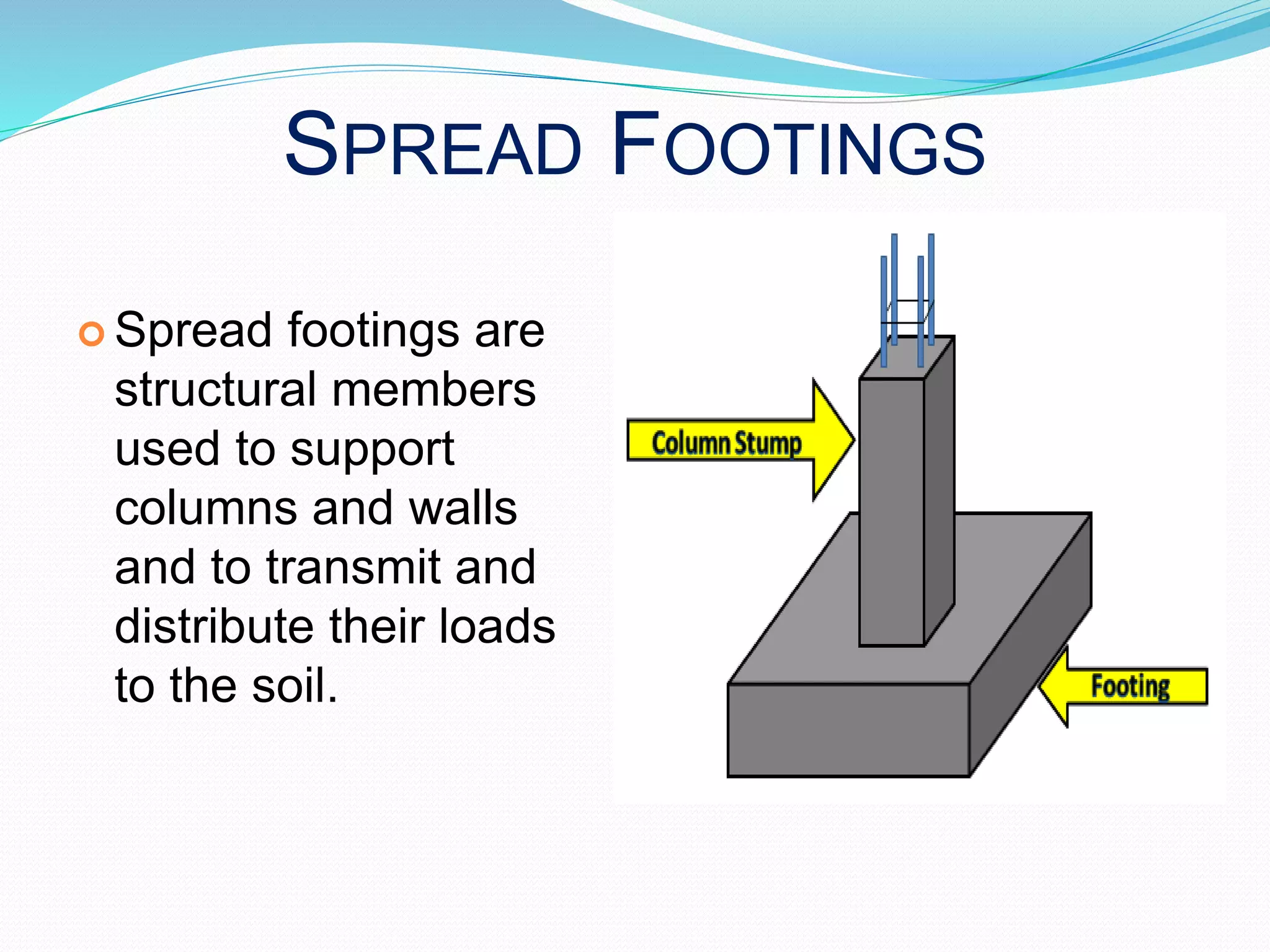
SPREAD FOOTINGS
 Spread footings are
structural members
used to support
columns and walls
and to transmit and
distribute their loads
to the soil.
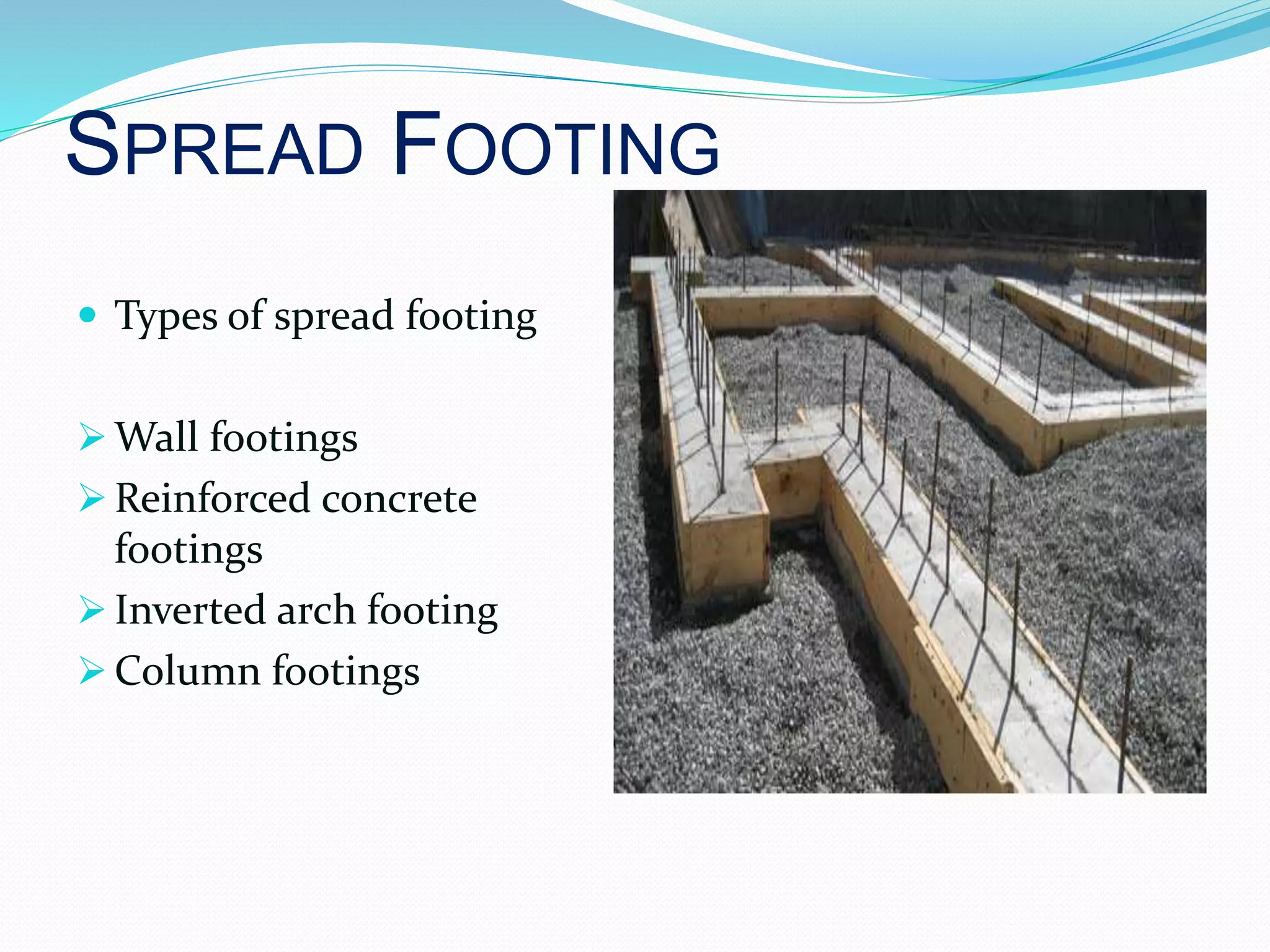
SPREAD FOOTING
 Types of spread footing
 Wall footings
 Reinforced concrete
footings
 Inverted arch footing
 Column footings
WALL FOOTING
 Why Wall Footing?
 Support walls that may be
either bearing or
nonbearing walls.
 Commonly required to
support direct concentric
loads.
WALL FOOTING
Why Wall Footing?
Footings carry relatively light
loads on well drained cohesive
soil.
A wall footing under
concentric load behaves
similarly to a cantilever beam.
Used in low rise buildings.
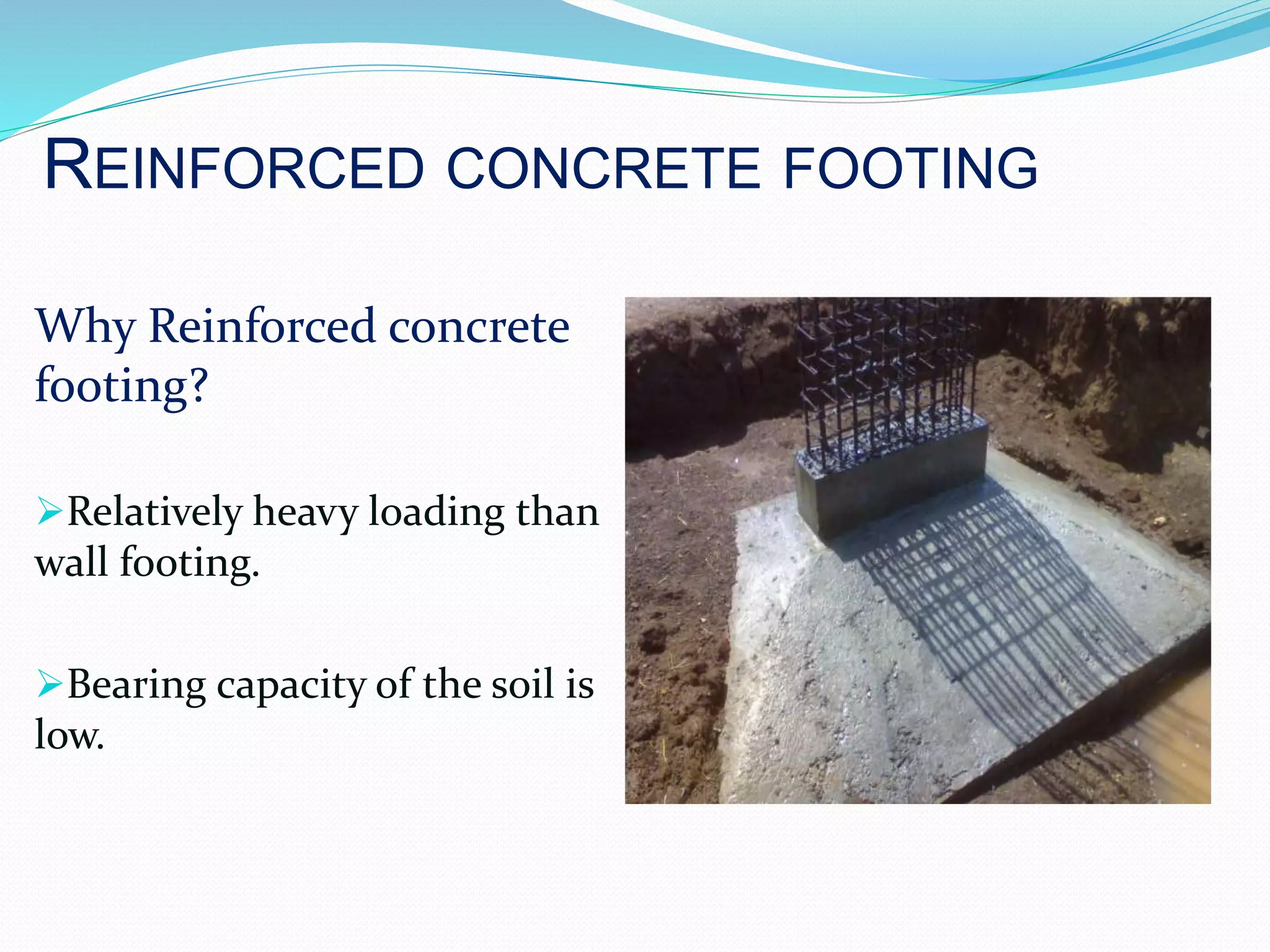
REINFORCED CONCRETE FOOTING
Why Reinforced concrete
footing?
Relatively heavy loading than
wall footing.
Bearing capacity of the soil is
low.
REINFORCED CONCRETE FOOTING
 In a reinforced concrete wall
footing, the behavior is
identical to that of wall
footing.
 Reinforcing steel is placed in
the bottom of the footing in a
direction perpendicular to
the wall like a reinforced
concrete beam or slab.
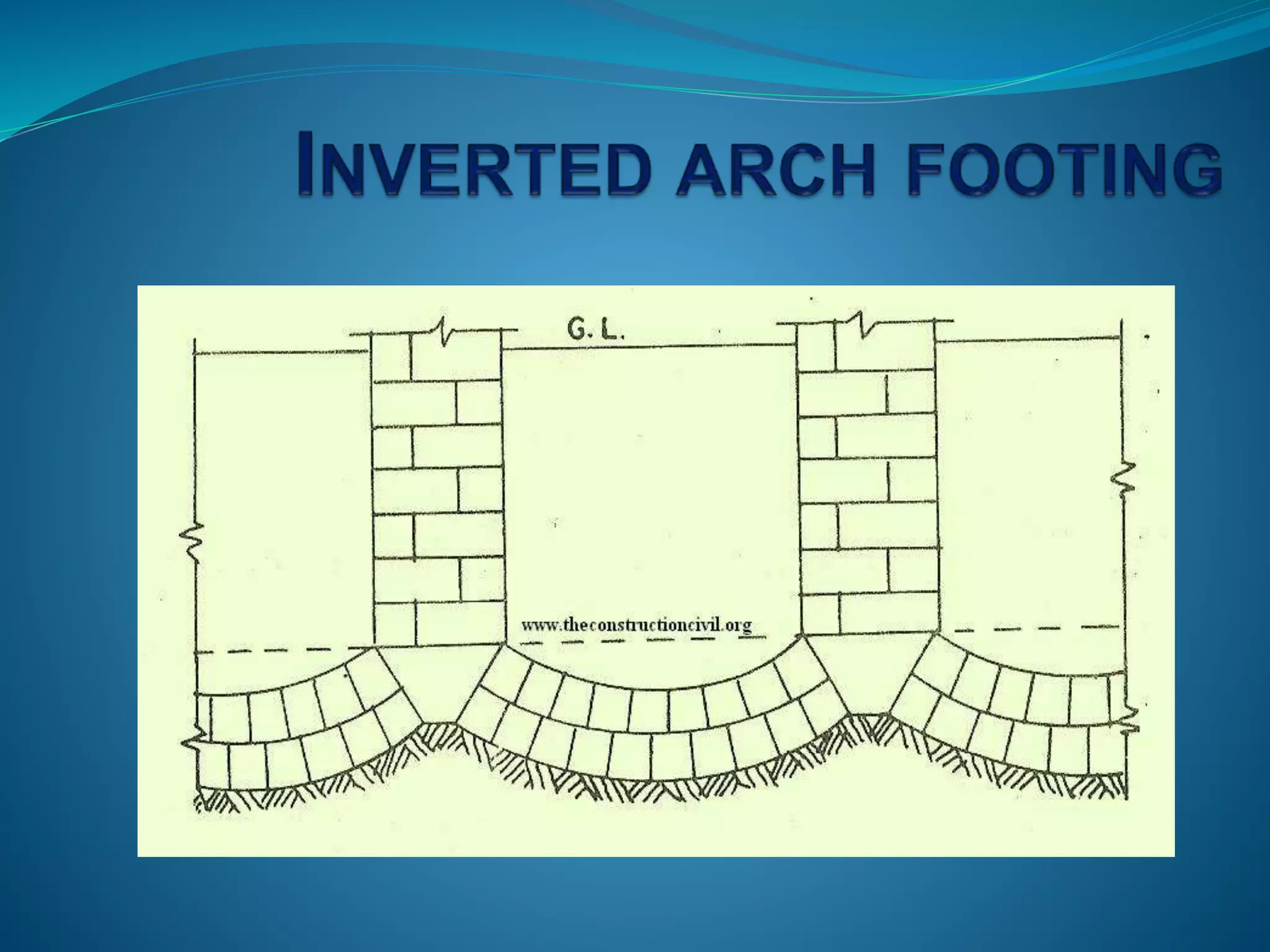
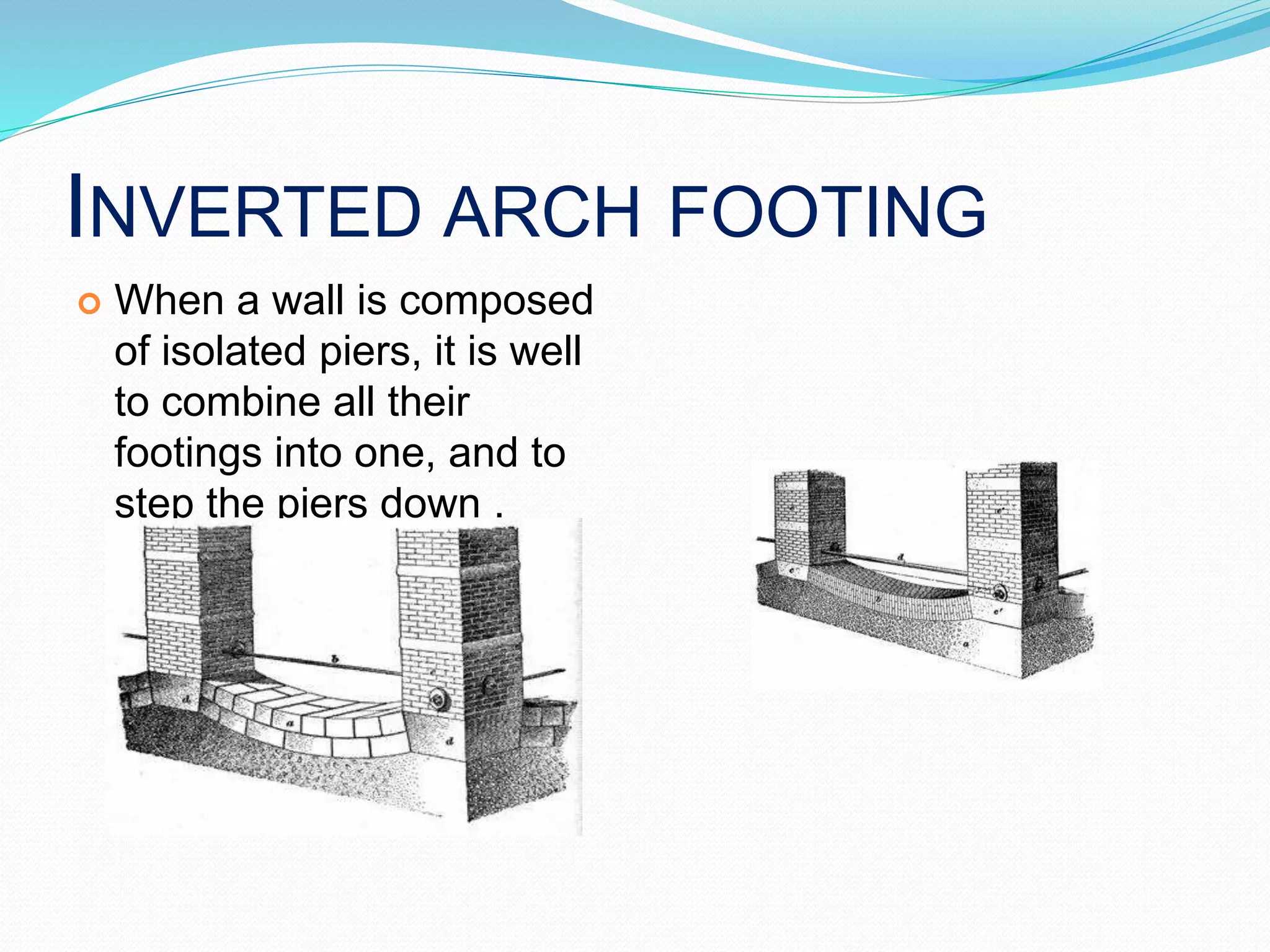
INVERTED ARCH FOOTING
 When a wall is composed
of isolated piers, it is well
to combine all their
footings into one, and to
step the piers down .
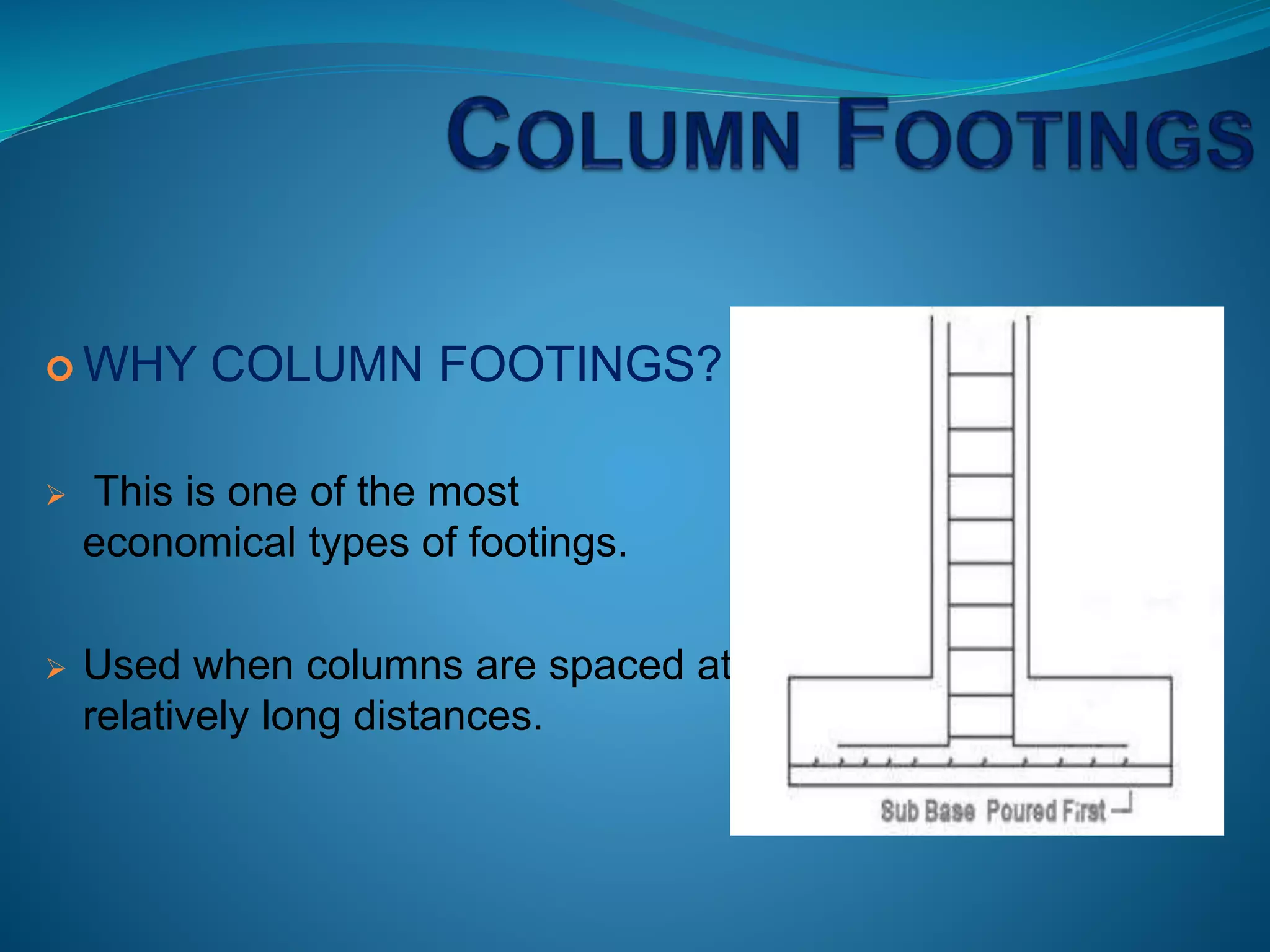
 WHY COLUMN FOOTINGS?
 This is one of the most
economical types of footings.
 Used when columns are spaced at
relatively long distances.
COLUMN FOOTINGS
 WHY COLUMN FOOTINGS?
 Low bending strength.
 When bearing capacity of soil is good.
 Carry heavy loads.
 Used to support single columns.
 To distribute the load uniformly.
COLUMN FOOTINGS
 CHARACTERISTICS OF COLUMN
FOOTINGS
 Constructed with brick, stone or plane
concrete.
 Circular, rectangular or square in plan.
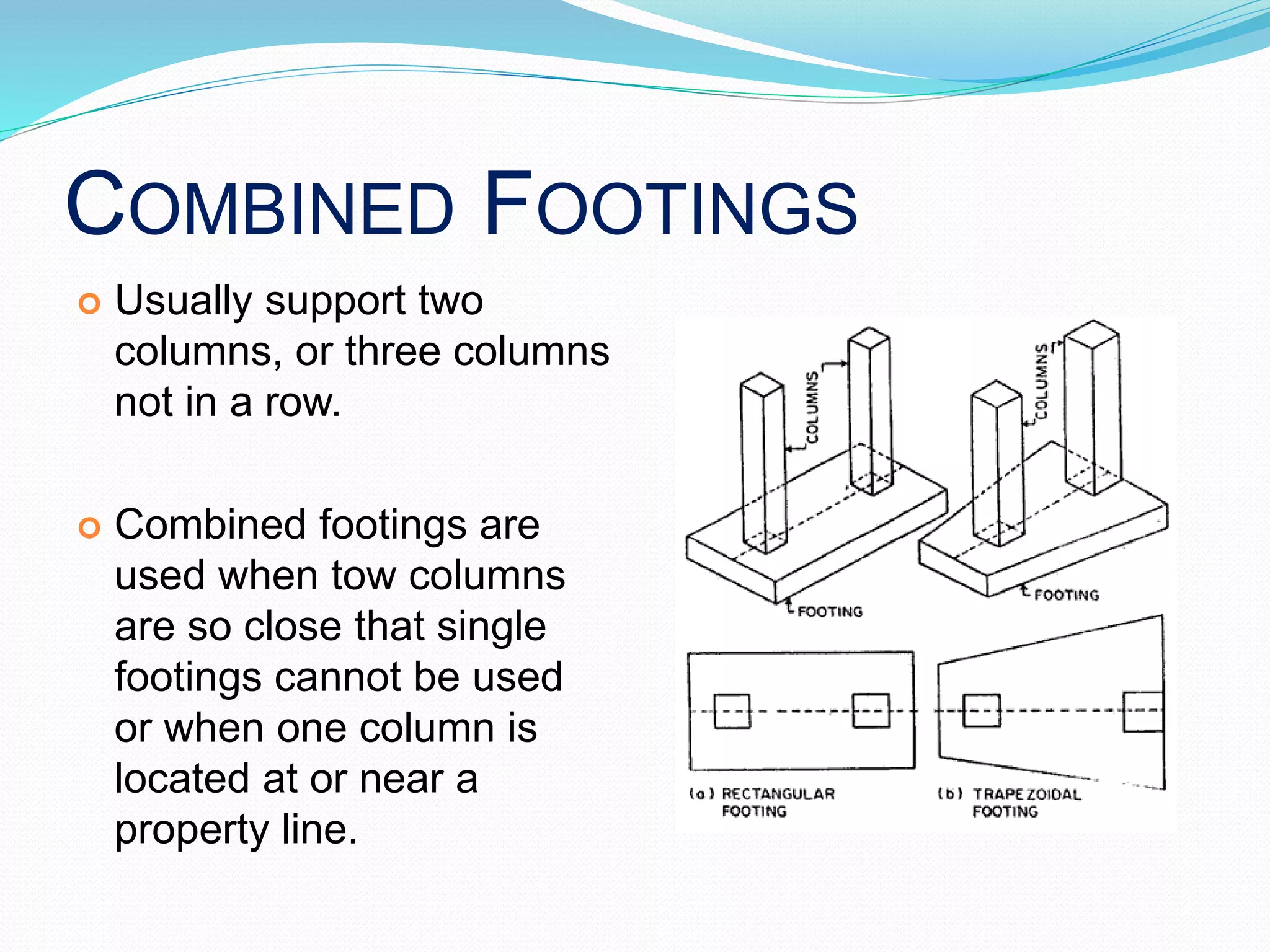
COMBINED FOOTINGS
 Usually support two
columns, or three columns
not in a row.
 Combined footings are
used when tow columns
are so close that single
footings cannot be used
or when one column is
located at or near a
property line.
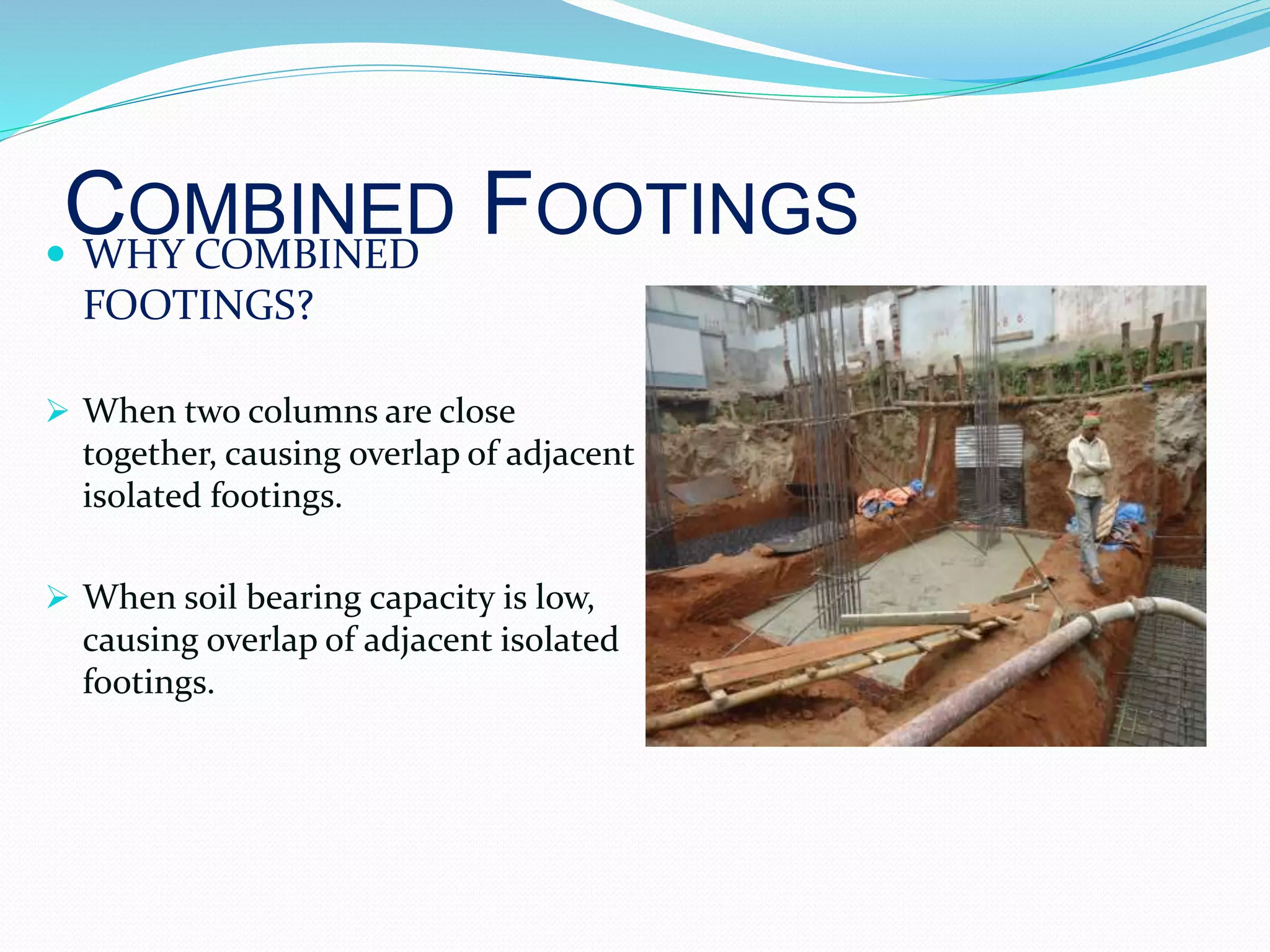
COMBINED FOOTINGS WHY COMBINED
FOOTINGS?
 When two columns are close
together, causing overlap of adjacent
isolated footings.
 When soil bearing capacity is low,
causing overlap of adjacent isolated
footings.
GRILLAGE FOUNDATIONS
 Grillage foundations consist of a number of
layers of beams usually laid at right angles to
each other and used to disperse heavy point
loads from the superstructure to an
acceptable ground bearing pressure.
RAFT FOUNDATION
 Foundation which consists of thick reinforced
concrete slab covering the entire area of the bottom
of the structure like a floor. This foundation was
invented by John Root at Chicago in 19th century.
 Why Raft Foundation?
 Base soil has low bearing
capacity or the column loads are
so large that more than 50% of
the area is covered by
conventional spread footings.
 Resist unequal settlement due to
earthquake.
 Quickness of the construction
work
RAFT FOUNDATION
LIMITATIONS OF SHALLOW FOUNDATION
 A huge amount of earthwork is to be done in Mat
foundation.
 If the shoring system can not resist the pressure of outside
land, then the structure surrounding the area may be
damaged by deflection of soil.
 Ground water may come out when the earthwork is done.
 Limited to dealing with point loads. foundation
ADVANTAGES OF SHALLOW FOUNDATION
 It is a quick process compared to others in the
construction work.
 This type of foundation is also economically
cheaper than any other foundations.
 Though there are some limitations in mat
foundation still it is economical in some cases.
ADVANTAGES OF SHALLOW FOUNDATION
 It can resist ground water absorption.
 The damage due to earthquake is lesser than any other type
of foundation.
 It consists of a reinforced concrete slab which is more
thicker than footing foundation.
 It prevents unequal settlements.
DIFFERENT TYPE OF SHALLOW FOUNDATION

DIFFERENT TYPE OF SHALLOW FOUNDATION

  • 1.
    JIS College ofEngineering Civil Engineering Department Prepared by:- BISHAL SARKAR ROLL NO:-140308128 REG NO:-141230120044 DEPEARTMENT:-CIVIL ENGINEERING (3RD YEAR) 6th Semester 2016/2017
  • 2.
    Foundation is the lowestpart of a super‐structure and transmit the loads (live load, wind load) on the structure including the dead weight of the structure transmit to the soil below.
  • 3.
     Types ofFoundation:  Foundation can be broadly classified into two types : 1. Deep Foundations 2. Shallow Foundations
  • 4.
     Foundation isplaced immediately lowest part of the super structure, is termed as Shallow foundation:  Why we use shallow foundation?  To distribute the structural loads over a wide horizontal area at a shallow depth below the ground level.
  • 5.
    TYPES OF SHALLOWFOUNDATIONS  The various types of shallow foundations are :  Spread footing  Combined footing  Mat or Raft foundation.  Grillage footing  Eccentrically loaded footing
  • 6.
    SPREAD FOOTINGS  Spreadfootings are structural members used to support columns and walls and to transmit and distribute their loads to the soil.
  • 7.
    SPREAD FOOTING  Typesof spread footing  Wall footings  Reinforced concrete footings  Inverted arch footing  Column footings
  • 8.
    WALL FOOTING  WhyWall Footing?  Support walls that may be either bearing or nonbearing walls.  Commonly required to support direct concentric loads.
  • 9.
    WALL FOOTING Why WallFooting? Footings carry relatively light loads on well drained cohesive soil. A wall footing under concentric load behaves similarly to a cantilever beam. Used in low rise buildings.
  • 10.
  • 11.
    REINFORCED CONCRETE FOOTING WhyReinforced concrete footing? Relatively heavy loading than wall footing. Bearing capacity of the soil is low.
  • 12.
    REINFORCED CONCRETE FOOTING In a reinforced concrete wall footing, the behavior is identical to that of wall footing.  Reinforcing steel is placed in the bottom of the footing in a direction perpendicular to the wall like a reinforced concrete beam or slab.
  • 14.
    INVERTED ARCH FOOTING When a wall is composed of isolated piers, it is well to combine all their footings into one, and to step the piers down .
  • 16.
     WHY COLUMNFOOTINGS?  This is one of the most economical types of footings.  Used when columns are spaced at relatively long distances.
  • 17.
    COLUMN FOOTINGS  WHYCOLUMN FOOTINGS?  Low bending strength.  When bearing capacity of soil is good.  Carry heavy loads.  Used to support single columns.  To distribute the load uniformly.
  • 18.
    COLUMN FOOTINGS  CHARACTERISTICSOF COLUMN FOOTINGS  Constructed with brick, stone or plane concrete.  Circular, rectangular or square in plan.
  • 19.
    COMBINED FOOTINGS  Usuallysupport two columns, or three columns not in a row.  Combined footings are used when tow columns are so close that single footings cannot be used or when one column is located at or near a property line.
  • 20.
    COMBINED FOOTINGS WHYCOMBINED FOOTINGS?  When two columns are close together, causing overlap of adjacent isolated footings.  When soil bearing capacity is low, causing overlap of adjacent isolated footings.
  • 21.
    GRILLAGE FOUNDATIONS  Grillagefoundations consist of a number of layers of beams usually laid at right angles to each other and used to disperse heavy point loads from the superstructure to an acceptable ground bearing pressure.
  • 22.
    RAFT FOUNDATION  Foundationwhich consists of thick reinforced concrete slab covering the entire area of the bottom of the structure like a floor. This foundation was invented by John Root at Chicago in 19th century.
  • 23.
     Why RaftFoundation?  Base soil has low bearing capacity or the column loads are so large that more than 50% of the area is covered by conventional spread footings.  Resist unequal settlement due to earthquake.  Quickness of the construction work RAFT FOUNDATION
  • 24.
    LIMITATIONS OF SHALLOWFOUNDATION  A huge amount of earthwork is to be done in Mat foundation.  If the shoring system can not resist the pressure of outside land, then the structure surrounding the area may be damaged by deflection of soil.  Ground water may come out when the earthwork is done.  Limited to dealing with point loads. foundation
  • 25.
    ADVANTAGES OF SHALLOWFOUNDATION  It is a quick process compared to others in the construction work.  This type of foundation is also economically cheaper than any other foundations.  Though there are some limitations in mat foundation still it is economical in some cases.
  • 26.
    ADVANTAGES OF SHALLOWFOUNDATION  It can resist ground water absorption.  The damage due to earthquake is lesser than any other type of foundation.  It consists of a reinforced concrete slab which is more thicker than footing foundation.  It prevents unequal settlements.