SHALLOW FOUNDATION
Foundation is shallow if its depth is equal to or less than its width.
Types of shallow foundation
1. Spread footings
2. Combined footings
3. Strap or cantilever footings
4. Mat or raft foundation
1. Spread footings
Spreads the super-imposed load of a wall or a column over a larger
area.
Used where the loads are light or there are strong shallow soils.
Spread footing may be of the following types –
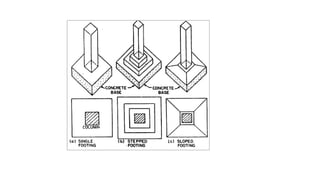
1) Single column footing
2) Stepped column footing Pad footing
3) Slopped column footing
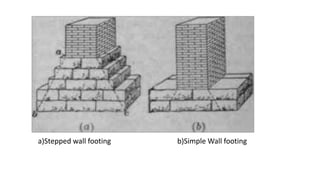
4) Simple Wall footing strip footing
5) Stepped wall footing
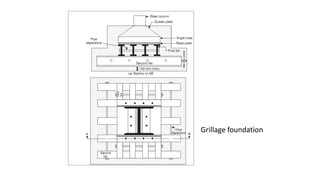
6) Grillage foundation
a)Stepped wall footing b)Simple Wall footing
Grillage foundation
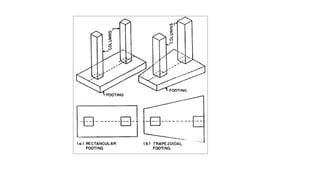
2. Combined footings
• Are preferred when 2 individual column are close to each other.
• It is economical.
• Provided when bearing capacity of soil is less, requiring more area
under individual footing.
• Combined footing may be rectangular, Trapezoidal or column-wall.
• If the columns carry equal loads, the footing is of rectangular shape,
otherwise its trapezoidal shape.
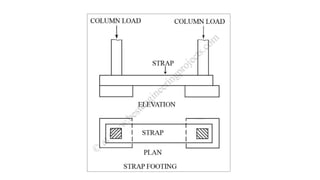
3. Strap or cantilever footings
• Independent footings of two columns are connected by a beam.
• The strap beam does not remain in contact with soil, and thus does
not transfer any pressure to the soil.
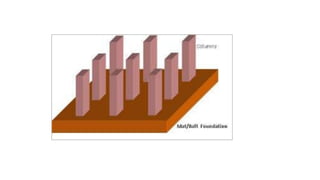
4. Mat or raft foundation
• It is a combined footing that covers the entire area beneath a
structure and supports all the walls and columns.
• Used on soft or loose soils with low bearing capacity as they can
spread loads over larger area.
Shallow foundation

Shallow foundation

  • 1.
    SHALLOW FOUNDATION Foundation isshallow if its depth is equal to or less than its width. Types of shallow foundation 1. Spread footings 2. Combined footings 3. Strap or cantilever footings 4. Mat or raft foundation
  • 2.
    1. Spread footings Spreadsthe super-imposed load of a wall or a column over a larger area. Used where the loads are light or there are strong shallow soils. Spread footing may be of the following types – 1) Single column footing 2) Stepped column footing Pad footing 3) Slopped column footing 4) Simple Wall footing strip footing 5) Stepped wall footing 6) Grillage foundation
  • 4.
    a)Stepped wall footingb)Simple Wall footing
  • 5.
  • 6.
    2. Combined footings •Are preferred when 2 individual column are close to each other. • It is economical. • Provided when bearing capacity of soil is less, requiring more area under individual footing. • Combined footing may be rectangular, Trapezoidal or column-wall. • If the columns carry equal loads, the footing is of rectangular shape, otherwise its trapezoidal shape.
  • 8.
    3. Strap orcantilever footings • Independent footings of two columns are connected by a beam. • The strap beam does not remain in contact with soil, and thus does not transfer any pressure to the soil.
  • 10.
    4. Mat orraft foundation • It is a combined footing that covers the entire area beneath a structure and supports all the walls and columns. • Used on soft or loose soils with low bearing capacity as they can spread loads over larger area.