LIGHTING
Lighting is a form of energy without which
there can be no vision. When light strikes an
object, It may be reflected, absorbed or
allowed to pass through.
TYPES OF LIGHT
SOURCE BASED CLASSIFICATION
NATURAL LIGHT
The bright radiant
energy of the sun,
daylight, is a major
determining factor
in the design of
hotel guestrooms
and homes,
especially where
large wall areas
have been
decorated with
glass.
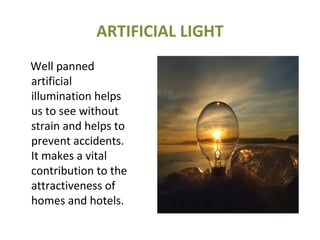
ARTIFICIAL LIGHT
Well panned
artificial
illumination helps
us to see without
strain and helps to
prevent accidents.
It makes a vital
contribution to the
attractiveness of
homes and hotels.
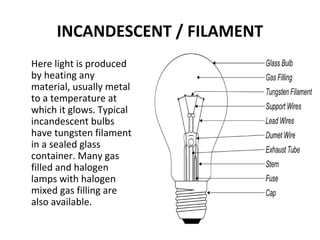
INCANDESCENT / FILAMENT
Here light is produced
by heating any
material, usually metal
to a temperature at
which it glows. Typical
incandescent bulbs
have tungsten filament
in a sealed glass
container. Many gas
filled and halogen
lamps with halogen
mixed gas filling are
also available.
INCANDESCENT / FILAMENT
GAS FILLED (GENEAL LIGHTING SERVICE) HALOGEN LAMPS
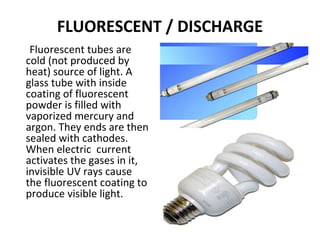
FLUORESCENT / DISCHARGE
Fluorescent tubes are
cold (not produced by
heat) source of light. A
glass tube with inside
coating of fluorescent
powder is filled with
vaporized mercury and
argon. They ends are then
sealed with cathodes.
When electric current
activates the gases in it,
invisible UV rays cause
the fluorescent coating to
produce visible light.
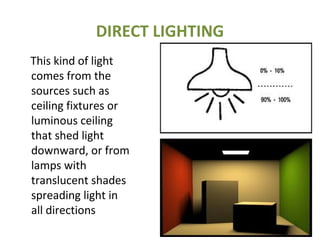
DIRECT LIGHTING
This kind of light
comes from the
sources such as
ceiling fixtures or
luminous ceiling
that shed light
downward, or from
lamps with
translucent shades
spreading light in
all directions
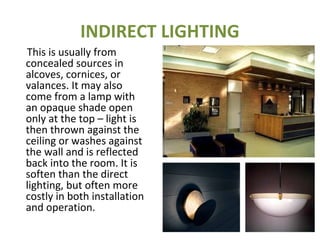
INDIRECT LIGHTING
This is usually from
concealed sources in
alcoves, cornices, or
valances. It may also
come from a lamp with
an opaque shade open
only at the top – light is
then thrown against the
ceiling or washes against
the wall and is reflected
back into the room. It is
soften than the direct
lighting, but often more
costly in both installation
and operation.
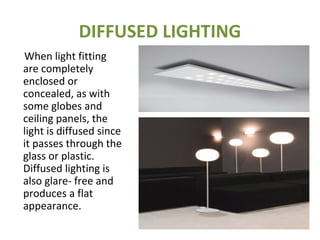
DIFFUSED LIGHTING
When light fitting
are completely
enclosed or
concealed, as with
some globes and
ceiling panels, the
light is diffused since
it passes through the
glass or plastic.
Diffused lighting is
also glare- free and
produces a flat
appearance.
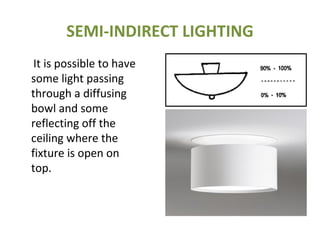
SEMI-INDIRECT LIGHTING
It is possible to have
some light passing
through a diffusing
bowl and some
reflecting off the
ceiling where the
fixture is open on
top.
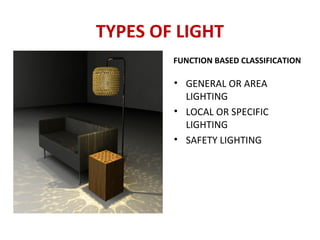
TYPES OF LIGHT
FUNCTION BASED CLASSIFICATION
• GENERAL OR AREA
LIGHTING
• LOCAL OR SPECIFIC
LIGHTING
• SAFETY LIGHTING
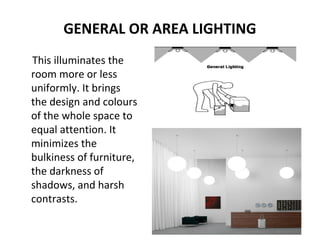
GENERAL OR AREA LIGHTING
This illuminates the
room more or less
uniformly. It brings
the design and colours
of the whole space to
equal attention. It
minimizes the
bulkiness of furniture,
the darkness of
shadows, and harsh
contrasts.
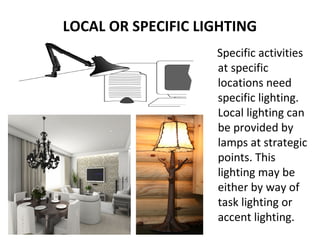
LOCAL OR SPECIFIC LIGHTING
Specific activities
at specific
locations need
specific lighting.
Local lighting can
be provided by
lamps at strategic
points. This
lighting may be
either by way of
task lighting or
accent lighting.
SAFETY LIGHTING
As the name
suggests this
type of bright
lighting is used
for safety
reasons in areas
such as
stairways, along
corridors
swimming pools
and by way of
emergency
lighting
METHODS OF LIGHTING
ARCHITECTURAL AND BUILT-IN LIGHTING
• Valance Lighting
• Cornice Lighting
• Cove Lighting
• Track Lighting
• Soffit Lighting
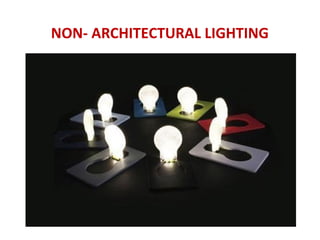
NON-ARCHITECTURAL LIGHTING
• Ceiling Fixtures
• Wall Fixtures
• Portable Lamps
ARCHITECTURAL AND BUILT-IN LIGHTING
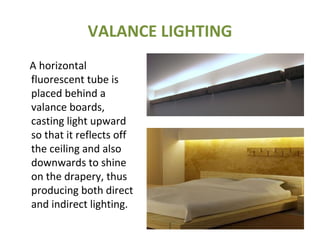
VALANCE LIGHTING
A horizontal
fluorescent tube is
placed behind a
valance boards,
casting light upward
so that it reflects off
the ceiling and also
downwards to shine
on the drapery, thus
producing both direct
and indirect lighting.
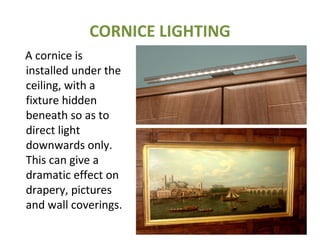
CORNICE LIGHTING
A cornice is
installed under the
ceiling, with a
fixture hidden
beneath so as to
direct light
downwards only.
This can give a
dramatic effect on
drapery, pictures
and wall coverings.
COVE LIGHTING
This consists of
placing continuous
series of fluorescent
tubes in a groove
along one or more
walls of a room,
about 12 inches from
the ceiling. The light
reflects off the ceiling
and bathes the room
in indirect light.
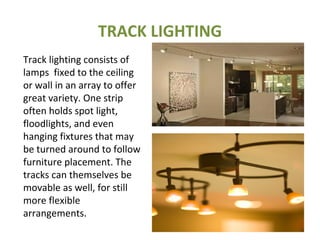
TRACK LIGHTING
Track lighting consists of
lamps fixed to the ceiling
or wall in an array to offer
great variety. One strip
often holds spot light,
floodlights, and even
hanging fixtures that may
be turned around to follow
furniture placement. The
tracks can themselves be
movable as well, for still
more flexible
arrangements.
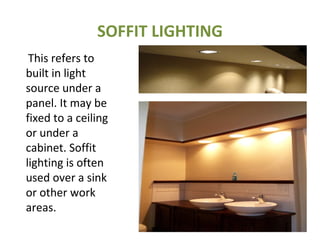
SOFFIT LIGHTING
This refers to
built in light
source under a
panel. It may be
fixed to a ceiling
or under a
cabinet. Soffit
lighting is often
used over a sink
or other work
areas.
NON- ARCHITECTURAL LIGHTING
CEILING FIXTURE
These are recessed
into the ceiling or
set flush with it.
They may soften
light of diffuse.
Some may be in
form of soft
luminous panels
that illuminates
large areas evenly.
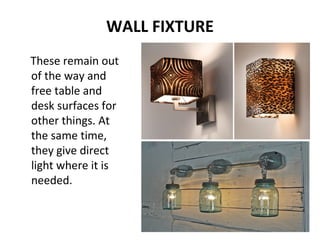
WALL FIXTURE
These remain out
of the way and
free table and
desk surfaces for
other things. At
the same time,
they give direct
light where it is
needed.
PORTABLE LAMPS
Floor and table
lamps can be
moved when
and where
needed. They
also act as
decorative
accessories.
CONSIDERATIONS FOR GOOD LIGHTING
• Utilize potential day light
when available
• Energy efficient
• Good design and
durability
• Ease of replacement of
fixture and bulb
• Easy to maintain
• Proportionate area-light
ratio
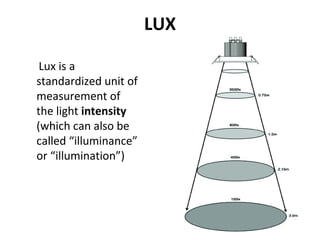
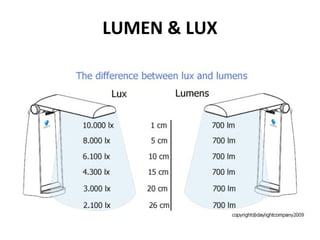
LUX
Lux is a
standardized unit of
measurement of
the light intensity
(which can also be
called “illuminance”
or “illumination”)
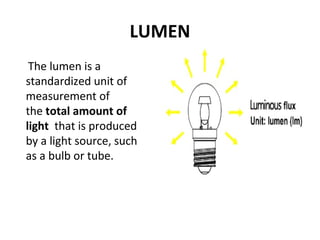
LUMEN
The lumen is a
standardized unit of
measurement of
the total amount of
light that is produced
by a light source, such
as a bulb or tube.
LUMEN & LUX
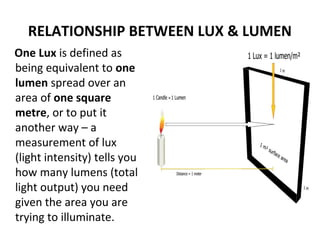
RELATIONSHIP BETWEEN LUX & LUMEN
One Lux is defined as
being equivalent to one
lumen spread over an
area of one square
metre, or to put it
another way – a
measurement of lux
(light intensity) tells you
how many lumens (total
light output) you need
given the area you are
trying to illuminate.
ASSIGNMENT 
LIGHTING PLAN
• Entrance Areas and Lobbies
• Restaurants and Public
Areas
• Guest Room and Corridors

Lighting

  • 1.
    LIGHTING Lighting is aform of energy without which there can be no vision. When light strikes an object, It may be reflected, absorbed or allowed to pass through.
  • 2.
    TYPES OF LIGHT SOURCEBASED CLASSIFICATION
  • 3.
    NATURAL LIGHT The brightradiant energy of the sun, daylight, is a major determining factor in the design of hotel guestrooms and homes, especially where large wall areas have been decorated with glass.
  • 4.
    ARTIFICIAL LIGHT Well panned artificial illuminationhelps us to see without strain and helps to prevent accidents. It makes a vital contribution to the attractiveness of homes and hotels.
  • 5.
    INCANDESCENT / FILAMENT Herelight is produced by heating any material, usually metal to a temperature at which it glows. Typical incandescent bulbs have tungsten filament in a sealed glass container. Many gas filled and halogen lamps with halogen mixed gas filling are also available.
  • 6.
    INCANDESCENT / FILAMENT GASFILLED (GENEAL LIGHTING SERVICE) HALOGEN LAMPS
  • 7.
    FLUORESCENT / DISCHARGE Fluorescenttubes are cold (not produced by heat) source of light. A glass tube with inside coating of fluorescent powder is filled with vaporized mercury and argon. They ends are then sealed with cathodes. When electric current activates the gases in it, invisible UV rays cause the fluorescent coating to produce visible light.
  • 8.
    DIRECT LIGHTING This kindof light comes from the sources such as ceiling fixtures or luminous ceiling that shed light downward, or from lamps with translucent shades spreading light in all directions
  • 9.
    INDIRECT LIGHTING This isusually from concealed sources in alcoves, cornices, or valances. It may also come from a lamp with an opaque shade open only at the top – light is then thrown against the ceiling or washes against the wall and is reflected back into the room. It is soften than the direct lighting, but often more costly in both installation and operation.
  • 10.
    DIFFUSED LIGHTING When lightfitting are completely enclosed or concealed, as with some globes and ceiling panels, the light is diffused since it passes through the glass or plastic. Diffused lighting is also glare- free and produces a flat appearance.
  • 11.
    SEMI-INDIRECT LIGHTING It ispossible to have some light passing through a diffusing bowl and some reflecting off the ceiling where the fixture is open on top.
  • 12.
    TYPES OF LIGHT FUNCTIONBASED CLASSIFICATION • GENERAL OR AREA LIGHTING • LOCAL OR SPECIFIC LIGHTING • SAFETY LIGHTING
  • 13.
    GENERAL OR AREALIGHTING This illuminates the room more or less uniformly. It brings the design and colours of the whole space to equal attention. It minimizes the bulkiness of furniture, the darkness of shadows, and harsh contrasts.
  • 14.
    LOCAL OR SPECIFICLIGHTING Specific activities at specific locations need specific lighting. Local lighting can be provided by lamps at strategic points. This lighting may be either by way of task lighting or accent lighting.
  • 15.
    SAFETY LIGHTING As thename suggests this type of bright lighting is used for safety reasons in areas such as stairways, along corridors swimming pools and by way of emergency lighting
  • 16.
    METHODS OF LIGHTING ARCHITECTURALAND BUILT-IN LIGHTING • Valance Lighting • Cornice Lighting • Cove Lighting • Track Lighting • Soffit Lighting NON-ARCHITECTURAL LIGHTING • Ceiling Fixtures • Wall Fixtures • Portable Lamps
  • 17.
  • 18.
    VALANCE LIGHTING A horizontal fluorescenttube is placed behind a valance boards, casting light upward so that it reflects off the ceiling and also downwards to shine on the drapery, thus producing both direct and indirect lighting.
  • 19.
    CORNICE LIGHTING A corniceis installed under the ceiling, with a fixture hidden beneath so as to direct light downwards only. This can give a dramatic effect on drapery, pictures and wall coverings.
  • 20.
    COVE LIGHTING This consistsof placing continuous series of fluorescent tubes in a groove along one or more walls of a room, about 12 inches from the ceiling. The light reflects off the ceiling and bathes the room in indirect light.
  • 21.
    TRACK LIGHTING Track lightingconsists of lamps fixed to the ceiling or wall in an array to offer great variety. One strip often holds spot light, floodlights, and even hanging fixtures that may be turned around to follow furniture placement. The tracks can themselves be movable as well, for still more flexible arrangements.
  • 22.
    SOFFIT LIGHTING This refersto built in light source under a panel. It may be fixed to a ceiling or under a cabinet. Soffit lighting is often used over a sink or other work areas.
  • 23.
  • 24.
    CEILING FIXTURE These arerecessed into the ceiling or set flush with it. They may soften light of diffuse. Some may be in form of soft luminous panels that illuminates large areas evenly.
  • 25.
    WALL FIXTURE These remainout of the way and free table and desk surfaces for other things. At the same time, they give direct light where it is needed.
  • 26.
    PORTABLE LAMPS Floor andtable lamps can be moved when and where needed. They also act as decorative accessories.
  • 27.
    CONSIDERATIONS FOR GOODLIGHTING • Utilize potential day light when available • Energy efficient • Good design and durability • Ease of replacement of fixture and bulb • Easy to maintain • Proportionate area-light ratio
  • 28.
    LUX Lux is a standardizedunit of measurement of the light intensity (which can also be called “illuminance” or “illumination”)
  • 29.
    LUMEN The lumen isa standardized unit of measurement of the total amount of light that is produced by a light source, such as a bulb or tube.
  • 30.
  • 31.
    RELATIONSHIP BETWEEN LUX& LUMEN One Lux is defined as being equivalent to one lumen spread over an area of one square metre, or to put it another way – a measurement of lux (light intensity) tells you how many lumens (total light output) you need given the area you are trying to illuminate.
  • 32.
    ASSIGNMENT  LIGHTING PLAN •Entrance Areas and Lobbies • Restaurants and Public Areas • Guest Room and Corridors