1
CONTENT
 Introduction
 Types of Retaining Wall
 Gravity Retaining Wall
 Cantilever Retaining Wall
 Design of counterfort Retaining Wall
 Drainage of the Backfill
 Sheet Pile Wall
 Diaphragm Wall
2
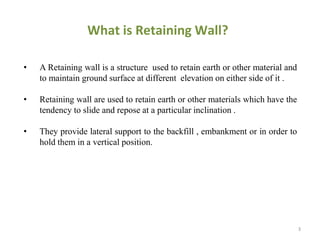
• A Retaining wall is a structure used to retain earth or other material and
to maintain ground surface at different elevation on either side of it .
• Retaining wall are used to retain earth or other materials which have the
tendency to slide and repose at a particular inclination .
• They provide lateral support to the backfill , embankment or in order to
hold them in a vertical position.
What is Retaining Wall?
3
Retaining Wall
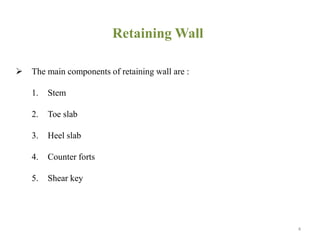
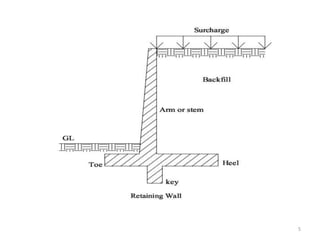
 The main components of retaining wall are :
1. Stem
2. Toe slab
3. Heel slab
4. Counter forts
5. Shear key
4
5
1. Construction of basement below ground level in buildings.
2. Wing wall and abutment in bridge work are designed as retaining wall.
3. To retain slopes in hilly terrain roads.
4. As side walls of bridge approach roads.
5. To provide lateral support to embankment.
Application of Retaining wall
6
Types of Retaining Wall
The different types of retaining wall are as follows :
1. Gravity retaining wall
2. Cantilever retaining wall
3. Counterfort retaining wall
4. Buttress wall
5. Bridge Abutment
6. Box Culvert
7
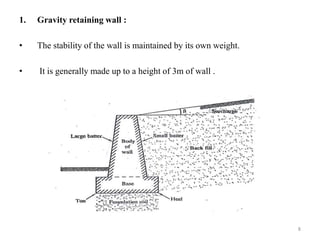
1. Gravity retaining wall :
• The stability of the wall is maintained by its own weight.
• It is generally made up to a height of 3m of wall .
8
2. Cantilever retaining wall :
• It consists of a vertical wall, heel slab and toe slab which act as cantilever
beams .
• It is generally used when the height of wall is up to 6m .
• The cantilever retaining wall are of three types :
1. T-shaped
2. L-shaped
3. T-shaped with shear key
9
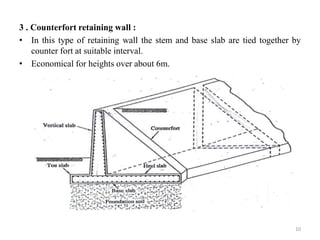
3 . Counterfort retaining wall :
• In this type of retaining wall the stem and base slab are tied together by
counter fort at suitable interval.
• Economical for heights over about 6m.
10
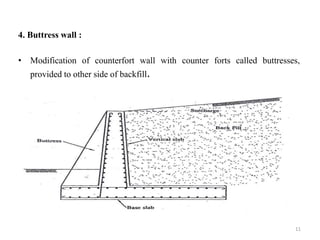
4. Buttress wall :
• Modification of counterfort wall with counter forts called buttresses,
provided to other side of backfill.
11
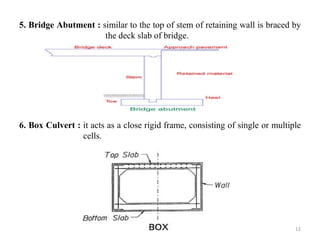
5. Bridge Abutment : similar to the top of stem of retaining wall is braced by
the deck slab of bridge.
6. Box Culvert : it acts as a close rigid frame, consisting of single or multiple
cells.
12
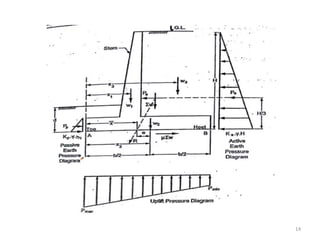
Forces Acting on Retaining wall
The various forces acting on retaining wall are :
1. Lateral earth pressure
2. Self weight of retaining wall
3. Weight of soil above the base slab
4. Surcharge
5. Soil reactions below base slab
6. Frictional force at the bottom of base slab .
13
14
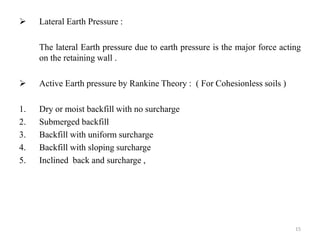
 Lateral Earth Pressure :
The lateral Earth pressure due to earth pressure is the major force acting
on the retaining wall .
 Active Earth pressure by Rankine Theory : ( For Cohesionless soils )
1. Dry or moist backfill with no surcharge
2. Submerged backfill
3. Backfill with uniform surcharge
4. Backfill with sloping surcharge
5. Inclined back and surcharge ,
15
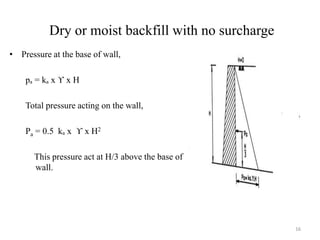
Dry or moist backfill with no surcharge
• Pressure at the base of wall,
pₐ = kₐ x ϒ x H
Total pressure acting on the wall,
Pa = 0.5 kₐ x ϒ x H2
This pressure act at H/3 above the base of
wall.
16
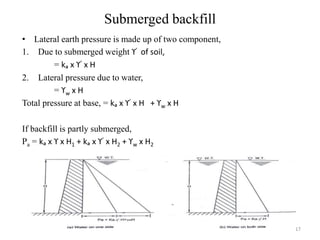
Submerged backfill
• Lateral earth pressure is made up of two component,
1. Due to submerged weight ϒ’ of soil,
= kₐ x ϒ’ x H
2. Lateral pressure due to water,
= ϒw x H
Total pressure at base, = kₐ x ϒ’ x H + ϒw x H
If backfill is partly submerged,
Pa = kₐ x ϒ x H1 + kₐ x ϒ’ x H2 + ϒw x H2
17
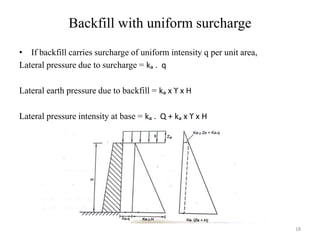
Backfill with uniform surcharge
• If backfill carries surcharge of uniform intensity q per unit area,
Lateral pressure due to surcharge = kₐ . q
Lateral earth pressure due to backfill = kₐ x ϒ x H
Lateral pressure intensity at base = kₐ . Q + kₐ x ϒ x H
18
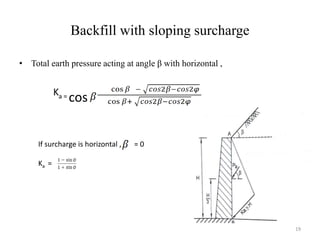
Backfill with sloping surcharge
• Total earth pressure acting at angle β with horizontal ,
Ka = cos
If surcharge is horizontal , = 0
Ka =
19
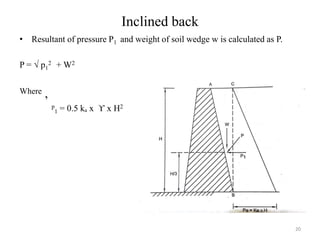
Inclined back
• Resultant of pressure P1 and weight of soil wedge w is calculated as P.
P = √ p1
2 + W2
Where ,
p
1 = 0.5 kₐ x ϒ x H2
20
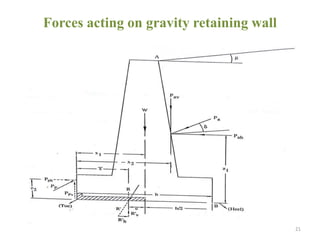
Forces acting on gravity retaining wall
21
Design criteria
 The criteria for the design of a gravity retaining wall are:-
• The base width (b) of the wall must be such that the maximum pressure
exerted on the foundation soil does not exceed the SBC of the soil.
• No tension should be developed anywhere in the wall.
• The wall must be safe against sliding.
• The wall must be safe against overturning.
22
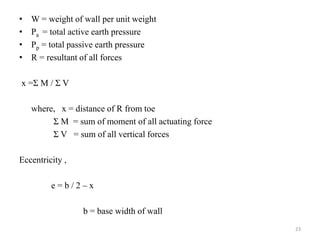
• W = weight of wall per unit weight
• Pa = total active earth pressure
• Pp = total passive earth pressure
• R = resultant of all forces
x =Σ M / Σ V
where, x = distance of R from toe
Σ M = sum of moment of all actuating force
Σ V = sum of all vertical forces
Eccentricity ,
e = b / 2 – x
b = base width of wall
23
Stability checks
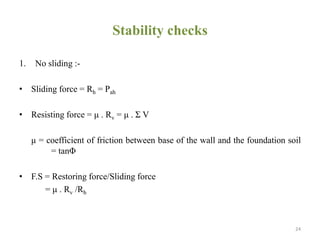
1. No sliding :-
• Sliding force = Rh = Pah
• Resisting force = μ . Rv = μ . Σ V
μ = coefficient of friction between base of the wall and the foundation soil
= tanΦ
• F.S = Restoring force/Sliding force
= μ . Rv /Rh
24
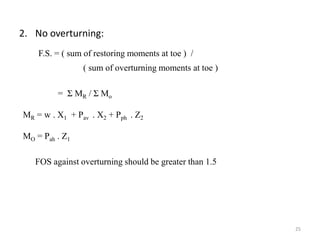
2. No overturning:
F.S. = ( sum of restoring moments at toe ) /
( sum of overturning moments at toe )
= Σ MR / Σ Mo
MR = w . X1 + Pav . X2 + Pph . Z2
MO = Pah . Z1
FOS against overturning should be greater than 1.5
25
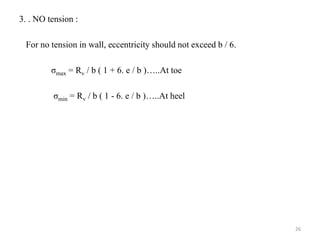
3. . NO tension :
For no tension in wall, eccentricity should not exceed b / 6.
σmax = Rv / b ( 1 + 6. e / b )…..At toe
σmin = Rv / b ( 1 - 6. e / b )…..At heel
26
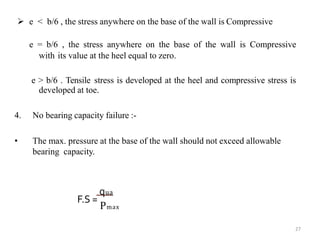
 e < b/6 , the stress anywhere on the base of the wall is Compressive
e = b/6 , the stress anywhere on the base of the wall is Compressive
with its value at the heel equal to zero.
e > b/6 . Tensile stress is developed at the heel and compressive stress is
developed at toe.
4. No bearing capacity failure :-
• The max. pressure at the base of the wall should not exceed allowable
bearing capacity.
27
qua
F.S =
Pmax
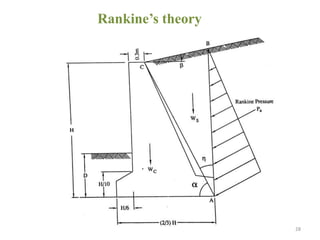
Rankine’s theory
28
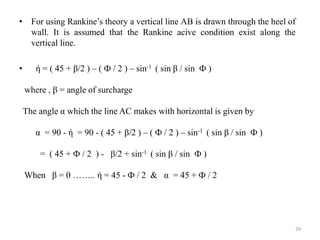
• For using Rankine’s theory a vertical line AB is drawn through the heel of
wall. It is assumed that the Rankine acive condition exist along the
vertical line.
• ή = ( 45 + β/2 ) – ( Ф / 2 ) – sin-1 ( sin β / sin Ф )
where , β = angle of surcharge
The angle α which the line AC makes with horizontal is given by
α = 90 - ή = 90 - ( 45 + β/2 ) – ( Ф / 2 ) – sin-1 ( sin β / sin Ф )
= ( 45 + Ф / 2 ) - β/2 + sin-1 ( sin β / sin Ф )
When β = 0 …….. ή = 45 - Ф / 2 & α = 45 + Ф / 2
29
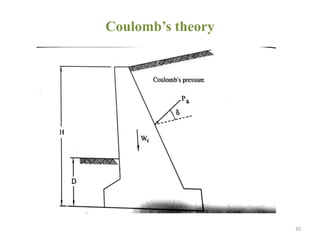
Coulomb’s theory
30
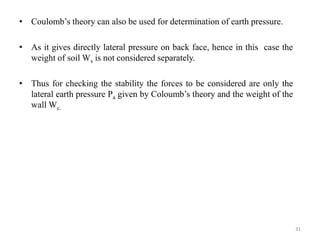
• Coulomb’s theory can also be used for determination of earth pressure.
• As it gives directly lateral pressure on back face, hence in this case the
weight of soil Ws is not considered separately.
• Thus for checking the stability the forces to be considered are only the
lateral earth pressure Pa given by Coloumb’s theory and the weight of the
wall Wc.
31
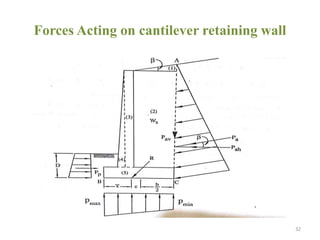
Forces Acting on cantilever retaining wall
32
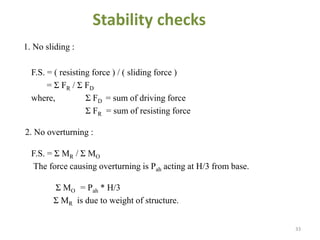
Stability checks
1. No sliding :
F.S. = ( resisting force ) / ( sliding force )
= Σ FR / Σ FD
where, Σ FD = sum of driving force
Σ FR = sum of resisting force
2. No overturning :
F.S. = Σ MR / Σ MO
The force causing overturning is Pah acting at H/3 from base.
Σ MO = Pah * H/3
Σ MR is due to weight of structure.
33
3. No tension :
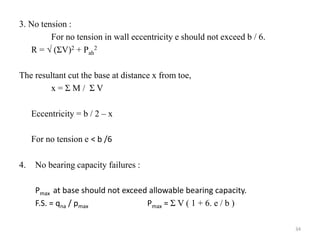
For no tension in wall eccentricity e should not exceed b / 6.
R =  (ΣV)2 + Pah
2
The resultant cut the base at distance x from toe,
x = Σ M / Σ V
Eccentricity = b / 2 – x
For no tension e ˂ b /6
4. No bearing capacity failures :
Pmax at base should not exceed allowable bearing capacity.
F.S. = qna / pmax Pmax = Σ V ( 1 + 6. e / b )
34
Drainage of backfill
35
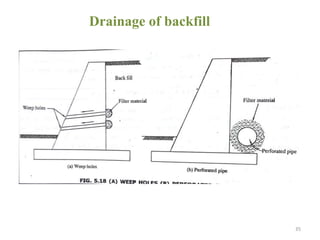
• When the backfill becomes wet due to rainfall or any other reason , its
unit weight increases. It increase the pressure on retaining wall and create
unstable conditions.
• If the water table rises the pore water pressure develops and it cause
excessive hydrostatic pressure on retaining wall.
• To reduce the excessive lateral pressure on retaining wall, adequate
drainage must be provided.
• For the drainage of backfill weep holes are generally provided. The weep
holes are of 0.1 m dia. And their spacing varies from 1.5 m to 3.0 m. in
horizontal direction.
• Perforated pipes may also be used as drainage of backfill. They are
placed at the base of the wall. The filler materials is placed around the
pipes to avoid washing of backfill material in perforated pipe.
36
Sheet Pile Walls
• Sheet pile walls are a type of earth retaining structures in which a
continuous wall is constructed by joining sheet piles.
• They are made of timber, steel or reinforced concrete and consists of
special shapes which have interlocking arrangements.
• They are embedded in ground to develop passive resistance in front to keep
wall in equilibrium.
• A bulkhead is a sheet pile retaining wall of water front, backed up by
ground.
37
Uses of Sheet Pile Walls
• Waterfront structures
• Canal locks
• Cofferdams
• River protection , etc.
38
Types of Sheet Pile Walls
 By material,
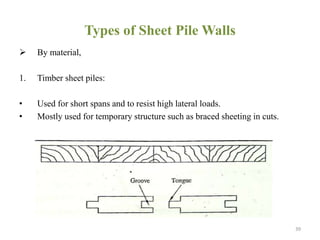
1. Timber sheet piles:
• Used for short spans and to resist high lateral loads.
• Mostly used for temporary structure such as braced sheeting in cuts.
39
2. Reinforced concrete sheet pile:
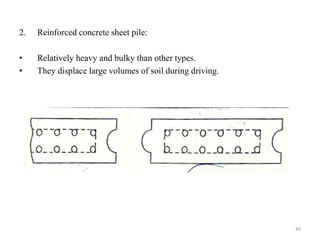
• Relatively heavy and bulky than other types.
• They displace large volumes of soil during driving.
40
3. Steel sheet pile:
• Most commonly used type of sheet pile.
• Lighter in section and resistant to high driving stresses in hard or rocky
material.
• Pile length can be increased by welding or bolting.
41
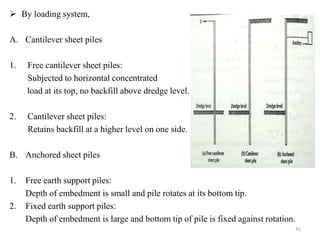
 By loading system,
A. Cantilever sheet piles
1. Free cantilever sheet piles:
Subjected to horizontal concentrated
load at its top, no backfill above dredge level.
2. Cantilever sheet piles:
Retains backfill at a higher level on one side.
B. Anchored sheet piles
1. Free earth support piles:
Depth of embedment is small and pile rotates at its bottom tip.
2. Fixed earth support piles:
Depth of embedment is large and bottom tip of pile is fixed against rotation.
42
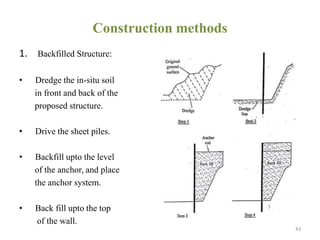
Construction methods
1. Backfilled Structure:
• Dredge the in-situ soil
in front and back of the
proposed structure.
• Drive the sheet piles.
• Backfill upto the level
of the anchor, and place
the anchor system.
• Back fill upto the top
of the wall.
43
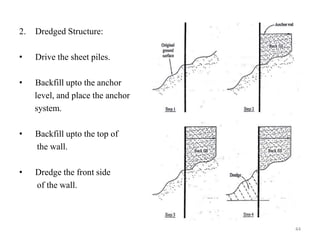
2. Dredged Structure:
• Drive the sheet piles.
• Backfill upto the anchor
level, and place the anchor
system.
• Backfill upto the top of
the wall.
• Dredge the front side
of the wall.
44
Factors affecting sheet pile wall
• Active earth pressure tries to push wall away from the backfill.
• Lateral pressure due to surcharge load.
• Unbalanced water pressure and seepage pressure.
• Mooring pull ,ship impact.
• Earthquake forces.
45
Diaphragm Wall
• A wall constructed in situ by special trenching methods to act as cut off
wall or serve as a structural member.
• The standard widths are 100-200mm for cut off wall and 450-1200mm for
structural member.
• The wall is usually designed to reach very great depth, up to 50m.
 It is constructed to facilitate certain construction activities, such as:
• As a retaining wall
• As a cut-off wall.
• As the final wall for basement.
46
Materials
• Cement: OPC or RHC
• Aggregate: Course aggregate of size 20mm
• Sand: Well graded sand consisting of 50% coarse sand
• Water: Clean water free from impurities
• Admixtures: If required chemical admixtures shall be used as per IS
456:1978
• Reinforcement: Mild Steel bars/Deformed bars/ Cold worked bars
• Bentonite: Sodium based bentonite shall be used in preparing bentonite
slurry.
• Concrete Mix: Water cement ratio shall not be greater than 0.6.
47
Stages of construction
1. Successive panels method:
• In this method panel shall be cast in continuation of previously completed
panel.
• Excavation of each trench panel shall be done with help of suitable
machinery.
• Trench panel shall be kept filled with bentonite slurry of suitable
consistency during excavation period.
• End tube of 1 m diameter and 30 m long is inserted at the end of panel to
support concrete and to form a suitable joint with next panel.
• Reinforcement cage shall then be lowered in the trench panel and suitably
supported. the concrete cover for the reinforcement shall be maintained
by use of spacers.
48
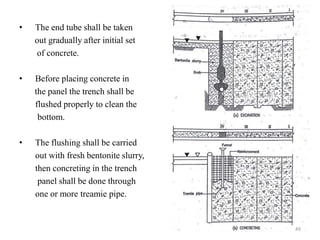
• The end tube shall be taken
out gradually after initial set
of concrete.
• Before placing concrete in
the panel the trench shall be
flushed properly to clean the
bottom.
• The flushing shall be carried
out with fresh bentonite slurry,
then concreting in the trench
panel shall be done through
one or more treamie pipe.
49
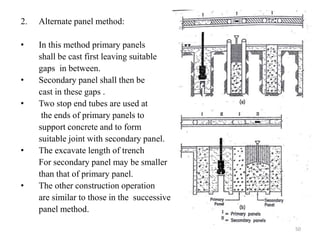
2. Alternate panel method:
• In this method primary panels
shall be cast first leaving suitable
gaps in between.
• Secondary panel shall then be
cast in these gaps .
• Two stop end tubes are used at
the ends of primary panels to
support concrete and to form
suitable joint with secondary panel.
• The excavate length of trench
For secondary panel may be smaller
than that of primary panel.
• The other construction operation
are similar to those in the successive
panel method.
50
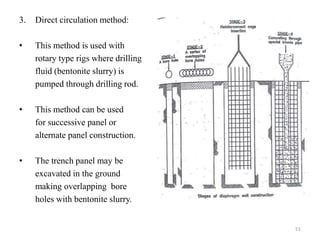
3. Direct circulation method:
• This method is used with
rotary type rigs where drilling
fluid (bentonite slurry) is
pumped through drilling rod.
• This method can be used
for successive panel or
alternate panel construction.
• The trench panel may be
excavated in the ground
making overlapping bore
holes with bentonite slurry.
51
Wall of precast RCC panel
• Trench panel shall be kept filled up with self setting bentonite slurry.
• The self setting bentonite slurry shall be slow setting and should develop
adequate strength and impermeability.
• The quality of concrete in precast RCC panel is better than the achieved by
tremie concrete method.
• GROUT CUT OFF WALL :
When the structural strength is not required the self setting bentonite slurry
may be used to provide an impermeable cut off wall.
Sand bentonite cement mix may be used for diaphragm walls which are
primarily meant as impermeable cut offs.
52
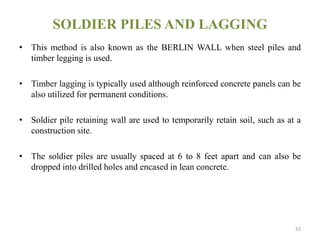
SOLDIER PILES AND LAGGING
• This method is also known as the BERLIN WALL when steel piles and
timber legging is used.
• Timber lagging is typically used although reinforced concrete panels can be
also utilized for permanent conditions.
• Soldier pile retaining wall are used to temporarily retain soil, such as at a
construction site.
• The soldier piles are usually spaced at 6 to 8 feet apart and can also be
dropped into drilled holes and encased in lean concrete.
53
54
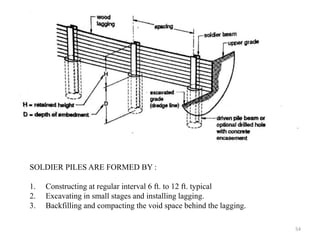
SOLDIER PILES ARE FORMED BY :
1. Constructing at regular interval 6 ft. to 12 ft. typical
2. Excavating in small stages and installing lagging.
3. Backfilling and compacting the void space behind the lagging.
• Advantages :
1. Are fast to construct
2. Comparatively cheaper than other system
3. Installation is versatile.
• Disadvantage :
1. Limited to temporary construction.
2. Cannot be used in high water table conditions
3. They are not as stiff as other system.
55
THANK YOU
56

Retaining wall

  • 1.
  • 2.
    CONTENT  Introduction  Typesof Retaining Wall  Gravity Retaining Wall  Cantilever Retaining Wall  Design of counterfort Retaining Wall  Drainage of the Backfill  Sheet Pile Wall  Diaphragm Wall 2
  • 3.
    • A Retainingwall is a structure used to retain earth or other material and to maintain ground surface at different elevation on either side of it . • Retaining wall are used to retain earth or other materials which have the tendency to slide and repose at a particular inclination . • They provide lateral support to the backfill , embankment or in order to hold them in a vertical position. What is Retaining Wall? 3
  • 4.
    Retaining Wall  Themain components of retaining wall are : 1. Stem 2. Toe slab 3. Heel slab 4. Counter forts 5. Shear key 4
  • 5.
  • 6.
    1. Construction ofbasement below ground level in buildings. 2. Wing wall and abutment in bridge work are designed as retaining wall. 3. To retain slopes in hilly terrain roads. 4. As side walls of bridge approach roads. 5. To provide lateral support to embankment. Application of Retaining wall 6
  • 7.
    Types of RetainingWall The different types of retaining wall are as follows : 1. Gravity retaining wall 2. Cantilever retaining wall 3. Counterfort retaining wall 4. Buttress wall 5. Bridge Abutment 6. Box Culvert 7
  • 8.
    1. Gravity retainingwall : • The stability of the wall is maintained by its own weight. • It is generally made up to a height of 3m of wall . 8
  • 9.
    2. Cantilever retainingwall : • It consists of a vertical wall, heel slab and toe slab which act as cantilever beams . • It is generally used when the height of wall is up to 6m . • The cantilever retaining wall are of three types : 1. T-shaped 2. L-shaped 3. T-shaped with shear key 9
  • 10.
    3 . Counterfortretaining wall : • In this type of retaining wall the stem and base slab are tied together by counter fort at suitable interval. • Economical for heights over about 6m. 10
  • 11.
    4. Buttress wall: • Modification of counterfort wall with counter forts called buttresses, provided to other side of backfill. 11
  • 12.
    5. Bridge Abutment: similar to the top of stem of retaining wall is braced by the deck slab of bridge. 6. Box Culvert : it acts as a close rigid frame, consisting of single or multiple cells. 12
  • 13.
    Forces Acting onRetaining wall The various forces acting on retaining wall are : 1. Lateral earth pressure 2. Self weight of retaining wall 3. Weight of soil above the base slab 4. Surcharge 5. Soil reactions below base slab 6. Frictional force at the bottom of base slab . 13
  • 14.
  • 15.
     Lateral EarthPressure : The lateral Earth pressure due to earth pressure is the major force acting on the retaining wall .  Active Earth pressure by Rankine Theory : ( For Cohesionless soils ) 1. Dry or moist backfill with no surcharge 2. Submerged backfill 3. Backfill with uniform surcharge 4. Backfill with sloping surcharge 5. Inclined back and surcharge , 15
  • 16.
    Dry or moistbackfill with no surcharge • Pressure at the base of wall, pₐ = kₐ x ϒ x H Total pressure acting on the wall, Pa = 0.5 kₐ x ϒ x H2 This pressure act at H/3 above the base of wall. 16
  • 17.
    Submerged backfill • Lateralearth pressure is made up of two component, 1. Due to submerged weight ϒ’ of soil, = kₐ x ϒ’ x H 2. Lateral pressure due to water, = ϒw x H Total pressure at base, = kₐ x ϒ’ x H + ϒw x H If backfill is partly submerged, Pa = kₐ x ϒ x H1 + kₐ x ϒ’ x H2 + ϒw x H2 17
  • 18.
    Backfill with uniformsurcharge • If backfill carries surcharge of uniform intensity q per unit area, Lateral pressure due to surcharge = kₐ . q Lateral earth pressure due to backfill = kₐ x ϒ x H Lateral pressure intensity at base = kₐ . Q + kₐ x ϒ x H 18
  • 19.
    Backfill with slopingsurcharge • Total earth pressure acting at angle β with horizontal , Ka = cos If surcharge is horizontal , = 0 Ka = 19
  • 20.
    Inclined back • Resultantof pressure P1 and weight of soil wedge w is calculated as P. P = √ p1 2 + W2 Where , p 1 = 0.5 kₐ x ϒ x H2 20
  • 21.
    Forces acting ongravity retaining wall 21
  • 22.
    Design criteria  Thecriteria for the design of a gravity retaining wall are:- • The base width (b) of the wall must be such that the maximum pressure exerted on the foundation soil does not exceed the SBC of the soil. • No tension should be developed anywhere in the wall. • The wall must be safe against sliding. • The wall must be safe against overturning. 22
  • 23.
    • W =weight of wall per unit weight • Pa = total active earth pressure • Pp = total passive earth pressure • R = resultant of all forces x =Σ M / Σ V where, x = distance of R from toe Σ M = sum of moment of all actuating force Σ V = sum of all vertical forces Eccentricity , e = b / 2 – x b = base width of wall 23
  • 24.
    Stability checks 1. Nosliding :- • Sliding force = Rh = Pah • Resisting force = μ . Rv = μ . Σ V μ = coefficient of friction between base of the wall and the foundation soil = tanΦ • F.S = Restoring force/Sliding force = μ . Rv /Rh 24
  • 25.
    2. No overturning: F.S.= ( sum of restoring moments at toe ) / ( sum of overturning moments at toe ) = Σ MR / Σ Mo MR = w . X1 + Pav . X2 + Pph . Z2 MO = Pah . Z1 FOS against overturning should be greater than 1.5 25
  • 26.
    3. . NOtension : For no tension in wall, eccentricity should not exceed b / 6. σmax = Rv / b ( 1 + 6. e / b )…..At toe σmin = Rv / b ( 1 - 6. e / b )…..At heel 26
  • 27.
     e <b/6 , the stress anywhere on the base of the wall is Compressive e = b/6 , the stress anywhere on the base of the wall is Compressive with its value at the heel equal to zero. e > b/6 . Tensile stress is developed at the heel and compressive stress is developed at toe. 4. No bearing capacity failure :- • The max. pressure at the base of the wall should not exceed allowable bearing capacity. 27 qua F.S = Pmax
  • 28.
  • 29.
    • For usingRankine’s theory a vertical line AB is drawn through the heel of wall. It is assumed that the Rankine acive condition exist along the vertical line. • ή = ( 45 + β/2 ) – ( Ф / 2 ) – sin-1 ( sin β / sin Ф ) where , β = angle of surcharge The angle α which the line AC makes with horizontal is given by α = 90 - ή = 90 - ( 45 + β/2 ) – ( Ф / 2 ) – sin-1 ( sin β / sin Ф ) = ( 45 + Ф / 2 ) - β/2 + sin-1 ( sin β / sin Ф ) When β = 0 …….. ή = 45 - Ф / 2 & α = 45 + Ф / 2 29
  • 30.
  • 31.
    • Coulomb’s theorycan also be used for determination of earth pressure. • As it gives directly lateral pressure on back face, hence in this case the weight of soil Ws is not considered separately. • Thus for checking the stability the forces to be considered are only the lateral earth pressure Pa given by Coloumb’s theory and the weight of the wall Wc. 31
  • 32.
    Forces Acting oncantilever retaining wall 32
  • 33.
    Stability checks 1. Nosliding : F.S. = ( resisting force ) / ( sliding force ) = Σ FR / Σ FD where, Σ FD = sum of driving force Σ FR = sum of resisting force 2. No overturning : F.S. = Σ MR / Σ MO The force causing overturning is Pah acting at H/3 from base. Σ MO = Pah * H/3 Σ MR is due to weight of structure. 33
  • 34.
    3. No tension: For no tension in wall eccentricity e should not exceed b / 6. R =  (ΣV)2 + Pah 2 The resultant cut the base at distance x from toe, x = Σ M / Σ V Eccentricity = b / 2 – x For no tension e ˂ b /6 4. No bearing capacity failures : Pmax at base should not exceed allowable bearing capacity. F.S. = qna / pmax Pmax = Σ V ( 1 + 6. e / b ) 34
  • 35.
  • 36.
    • When thebackfill becomes wet due to rainfall or any other reason , its unit weight increases. It increase the pressure on retaining wall and create unstable conditions. • If the water table rises the pore water pressure develops and it cause excessive hydrostatic pressure on retaining wall. • To reduce the excessive lateral pressure on retaining wall, adequate drainage must be provided. • For the drainage of backfill weep holes are generally provided. The weep holes are of 0.1 m dia. And their spacing varies from 1.5 m to 3.0 m. in horizontal direction. • Perforated pipes may also be used as drainage of backfill. They are placed at the base of the wall. The filler materials is placed around the pipes to avoid washing of backfill material in perforated pipe. 36
  • 37.
    Sheet Pile Walls •Sheet pile walls are a type of earth retaining structures in which a continuous wall is constructed by joining sheet piles. • They are made of timber, steel or reinforced concrete and consists of special shapes which have interlocking arrangements. • They are embedded in ground to develop passive resistance in front to keep wall in equilibrium. • A bulkhead is a sheet pile retaining wall of water front, backed up by ground. 37
  • 38.
    Uses of SheetPile Walls • Waterfront structures • Canal locks • Cofferdams • River protection , etc. 38
  • 39.
    Types of SheetPile Walls  By material, 1. Timber sheet piles: • Used for short spans and to resist high lateral loads. • Mostly used for temporary structure such as braced sheeting in cuts. 39
  • 40.
    2. Reinforced concretesheet pile: • Relatively heavy and bulky than other types. • They displace large volumes of soil during driving. 40
  • 41.
    3. Steel sheetpile: • Most commonly used type of sheet pile. • Lighter in section and resistant to high driving stresses in hard or rocky material. • Pile length can be increased by welding or bolting. 41
  • 42.
     By loadingsystem, A. Cantilever sheet piles 1. Free cantilever sheet piles: Subjected to horizontal concentrated load at its top, no backfill above dredge level. 2. Cantilever sheet piles: Retains backfill at a higher level on one side. B. Anchored sheet piles 1. Free earth support piles: Depth of embedment is small and pile rotates at its bottom tip. 2. Fixed earth support piles: Depth of embedment is large and bottom tip of pile is fixed against rotation. 42
  • 43.
    Construction methods 1. BackfilledStructure: • Dredge the in-situ soil in front and back of the proposed structure. • Drive the sheet piles. • Backfill upto the level of the anchor, and place the anchor system. • Back fill upto the top of the wall. 43
  • 44.
    2. Dredged Structure: •Drive the sheet piles. • Backfill upto the anchor level, and place the anchor system. • Backfill upto the top of the wall. • Dredge the front side of the wall. 44
  • 45.
    Factors affecting sheetpile wall • Active earth pressure tries to push wall away from the backfill. • Lateral pressure due to surcharge load. • Unbalanced water pressure and seepage pressure. • Mooring pull ,ship impact. • Earthquake forces. 45
  • 46.
    Diaphragm Wall • Awall constructed in situ by special trenching methods to act as cut off wall or serve as a structural member. • The standard widths are 100-200mm for cut off wall and 450-1200mm for structural member. • The wall is usually designed to reach very great depth, up to 50m.  It is constructed to facilitate certain construction activities, such as: • As a retaining wall • As a cut-off wall. • As the final wall for basement. 46
  • 47.
    Materials • Cement: OPCor RHC • Aggregate: Course aggregate of size 20mm • Sand: Well graded sand consisting of 50% coarse sand • Water: Clean water free from impurities • Admixtures: If required chemical admixtures shall be used as per IS 456:1978 • Reinforcement: Mild Steel bars/Deformed bars/ Cold worked bars • Bentonite: Sodium based bentonite shall be used in preparing bentonite slurry. • Concrete Mix: Water cement ratio shall not be greater than 0.6. 47
  • 48.
    Stages of construction 1.Successive panels method: • In this method panel shall be cast in continuation of previously completed panel. • Excavation of each trench panel shall be done with help of suitable machinery. • Trench panel shall be kept filled with bentonite slurry of suitable consistency during excavation period. • End tube of 1 m diameter and 30 m long is inserted at the end of panel to support concrete and to form a suitable joint with next panel. • Reinforcement cage shall then be lowered in the trench panel and suitably supported. the concrete cover for the reinforcement shall be maintained by use of spacers. 48
  • 49.
    • The endtube shall be taken out gradually after initial set of concrete. • Before placing concrete in the panel the trench shall be flushed properly to clean the bottom. • The flushing shall be carried out with fresh bentonite slurry, then concreting in the trench panel shall be done through one or more treamie pipe. 49
  • 50.
    2. Alternate panelmethod: • In this method primary panels shall be cast first leaving suitable gaps in between. • Secondary panel shall then be cast in these gaps . • Two stop end tubes are used at the ends of primary panels to support concrete and to form suitable joint with secondary panel. • The excavate length of trench For secondary panel may be smaller than that of primary panel. • The other construction operation are similar to those in the successive panel method. 50
  • 51.
    3. Direct circulationmethod: • This method is used with rotary type rigs where drilling fluid (bentonite slurry) is pumped through drilling rod. • This method can be used for successive panel or alternate panel construction. • The trench panel may be excavated in the ground making overlapping bore holes with bentonite slurry. 51
  • 52.
    Wall of precastRCC panel • Trench panel shall be kept filled up with self setting bentonite slurry. • The self setting bentonite slurry shall be slow setting and should develop adequate strength and impermeability. • The quality of concrete in precast RCC panel is better than the achieved by tremie concrete method. • GROUT CUT OFF WALL : When the structural strength is not required the self setting bentonite slurry may be used to provide an impermeable cut off wall. Sand bentonite cement mix may be used for diaphragm walls which are primarily meant as impermeable cut offs. 52
  • 53.
    SOLDIER PILES ANDLAGGING • This method is also known as the BERLIN WALL when steel piles and timber legging is used. • Timber lagging is typically used although reinforced concrete panels can be also utilized for permanent conditions. • Soldier pile retaining wall are used to temporarily retain soil, such as at a construction site. • The soldier piles are usually spaced at 6 to 8 feet apart and can also be dropped into drilled holes and encased in lean concrete. 53
  • 54.
    54 SOLDIER PILES AREFORMED BY : 1. Constructing at regular interval 6 ft. to 12 ft. typical 2. Excavating in small stages and installing lagging. 3. Backfilling and compacting the void space behind the lagging.
  • 55.
    • Advantages : 1.Are fast to construct 2. Comparatively cheaper than other system 3. Installation is versatile. • Disadvantage : 1. Limited to temporary construction. 2. Cannot be used in high water table conditions 3. They are not as stiff as other system. 55
  • 56.