Pox (small, chicken)
Dr. S. A. Rizwan M.D.,
Assistant Professor,
Dept. of Community Medicine,
VMCHRI, Madurai.
Learning objectives
• At the end of this lecture you sh be able to
– Describe the epidemiological triad and the
prevention aspects of these infections
– Understand the factors that contribute to
epidemics
– Enumerate the factors that led to eradication of
small pox
– Enumerate the differences between the two
SMALL POX
பெரியம்மை
Introduction
• Smallpox is a serious, contagious and sometimes fatal
disease
• At its height, 10-15 million cases a year, with 2 million
deaths
• There is no specific treatment for smallpox, and the only
prevention is vaccination.
• The name smallpox is derived from the Latin word
“spotted” and refers to the raised bumps that appear on
the face and body of an infected person.
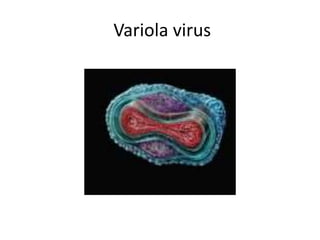
• It is caused by variola virus, Orthopoxvirus genus
History
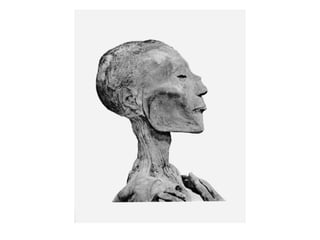
• Mummified remains of Ramses. (1157 B.C.)
• Smallpox was likely carried from Egyptian
traders to India
• By 1967 it became a major killer in not less
than 33 countries
• Those who survive became immune
• As a result, physicians intentionally infected
healthy persons with smallpox organisms
Variolation
• It is the act of taking samples (pus from
pustules or ground scabs) from patients
whose disease had been benign, and
introducing it into others through the nose or
skin
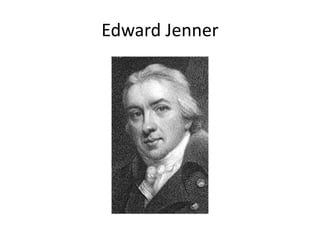
Edward Jenner
Jenner’s contribution
• He found that, the cowpox would protect the patient
from smallpox
• He proposed it in 1798
• In England vaccination with cowpox became
compulsory in 1853
• Jenner was honored for his technique, and ‘Vaccine’
became the universally used term to indicate
introducing material under the skin to produce a
protection against disease
Variola virus
Transmission
• Humans are the only natural host of smallpox
(no animal reservoir)
• Transmission generally occurs from direct and
fairly prolonged face-to-face contact
• Infected aerosols and air droplets spread in
face-to-face contact
Pathogenesis
• Portal of entry: respiratory tract or inoculation on skin
• Source of infection: Excretions from the mouth and
nose, rather than scabs
• During incubation the virus proceeds through infection,
replication, and liberation (usually accompanied by cell
necrosis) first at the site of inoculation and then to the
regional lymph nodes, then deeper lymph nodes and
bloodstream
Pathogenesis
• 4 orthopoxviruses are known to infect humans:
variola, vaccinia, cowpox, and monkeypox
• Variola major is severe and the most common form
with more extensive rash and higher fever with a
death rate of 30%
• Variola minor has less common presentation and
much less severe with death rate of 1%
Pathogenesis
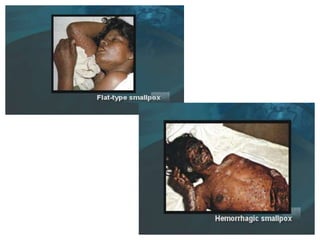
• Variola Major has 3 clinical presentations based
on the nature and evolution of the lesions:
– Ordinary: most frequent, corresponds to classical
description
– Modified: milder and may occur in previously
vaccinated people; rarely fatal
– Flat and Hemorrhagic: very severe but uncommon
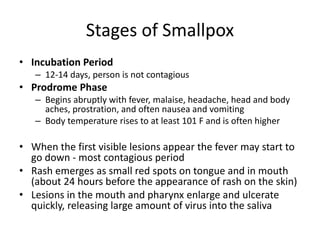
Stages of Smallpox
• Incubation Period
– 12-14 days, person is not contagious
• Prodrome Phase
– Begins abruptly with fever, malaise, headache, head and body
aches, prostration, and often nausea and vomiting
– Body temperature rises to at least 101 F and is often higher
• When the first visible lesions appear the fever may start to
go down - most contagious period
• Rash emerges as small red spots on tongue and in mouth
(about 24 hours before the appearance of rash on the skin)
• Lesions in the mouth and pharynx enlarge and ulcerate
quickly, releasing large amount of virus into the saliva
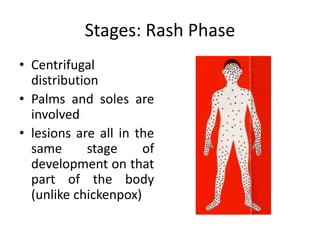
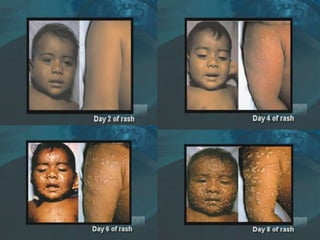
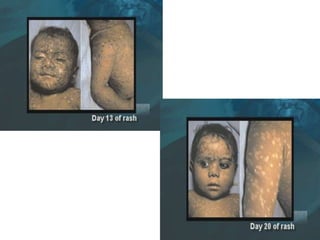
Stages: Rash Phase
• Centrifugal
distribution
• Palms and soles are
involved
• lesions are all in the
same stage of
development on that
part of the body
(unlike chickenpox)
Outcomes of infection
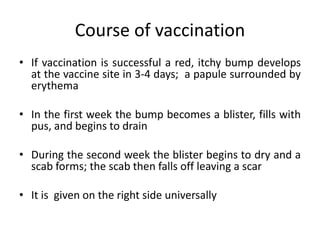
• Those who survive usually have scars
• In eye involvement, blindness could occur
• Recovery results in long lasting immunity
• No evidence of chronic or recurrent infection
Vaccination
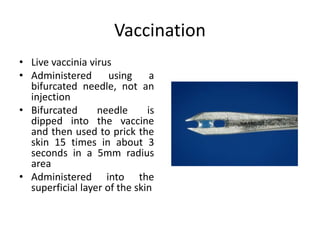
• Live vaccinia virus
• Administered using a
bifurcated needle, not an
injection
• Bifurcated needle is
dipped into the vaccine
and then used to prick the
skin 15 times in about 3
seconds in a 5mm radius
area
• Administered into the
superficial layer of the skin
Course of vaccination
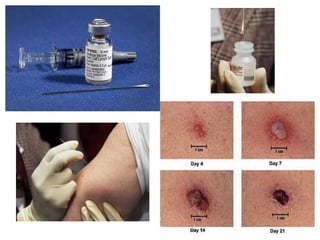
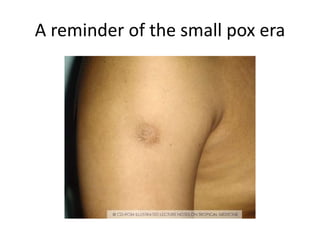
• If vaccination is successful a red, itchy bump develops
at the vaccine site in 3-4 days; a papule surrounded by
erythema
• In the first week the bump becomes a blister, fills with
pus, and begins to drain
• During the second week the blister begins to dry and a
scab forms; the scab then falls off leaving a scar
• It is given on the right side universally
A reminder of the small pox era
Control
• Only after WWI most of Europe become
smallpox free, and only after WWII
transmission stopped throughout Europe and
North America
• In developing countries smallpox continued
largely unabated until middle of 20th century
Control
• 1958: Soviet Union proposed to the WHO that a
global smallpox eradication program be
undertaken
• The campaign was based on a two fold strategy
– 1. Mass vaccination campaigns in each country using
a vaccine of ensured potency and stability that would
reach at least 80% of the population
– 2. Surveillance-Containment - isolation of patients
and the vaccination of family members and other
contacts in the immediate vicinity
Control
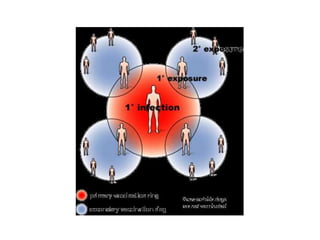
• Ring vaccination:
• Incorporated into the current CDC Smallpox Plan
• The strategy involves the following steps:
– Rapid identification and isolation of all smallpox cases
– Identification and vaccination of contacts of smallpox
cases
– Monitoring contacts for development of fever and
isolating them if fever occurs
– Vaccination of household members of contacts if no
contraindications to vaccination exist
Management of an outbreak
• Surveillance is easier because of the distinctive rash
• Containment involves efficient detection of cases and
identification and vaccination of contacts
• Patients diagnosed with smallpox should be physically
isolated
• All specimen collectors, care givers and attendants
coming into close contact with patients should be
vaccinated
• Medical care givers, attendants, and mortuary workers
should wear gloves, caps, gowns, and surgical masks
Management of an outbreak
• Contaminated clothing and bedding, if not
incinerated, should be autoclaved or washed
in hot water containing bleach
• Fumigation of premises with formaldehyde
• Airborne and Contact Precautions in addition
to Standard Precautions should be
implemented for patients with suspected
smallpox
Eradication
• In India
• Last case reported on 17th May 1975 in Bihar
• On 24th May 1975, imported from Bangladesh
• In April 1977 declared free from smallpox
Eradication
• 26th October 1977 the last naturally occurring
case of smallpox was recorded in Somalia
• In 1978 two cases were reported. These were
both from people working in labs with smallpox
in England
• 8th May 1980, WHO declared that smallpox has
been eradicated
Factors that led to eradication
• Epidemiological factors:
– No known animal reservoir
– No long-term carrier of the virus
– Life-long immunity after recovery from the disease
– Detection of cases, the rash was so characteristic
– Sub-clinical infection did not transmit the disease
– Vaccine highly effective
– International co-operation
CHICKEN POX
சின்னம்மை
Introduction
• Acute, highly infectious disease caused by Varicella-
Zoster (V–Z) virus
• Chicken pecked skin appearance, chickpea
appearance
• World-wide in distribution and occurs in endemic
and epidemic forms
• Chickenpox and Herpes zoster as different host
responses to the same etiological agent
• In India, approx. 28,000 cases per year
Epidemiological determinants
• Agent: Human (alpha) herpes virus
– Primary infection causes chicken pox
– Recovery followed by latent infection
– Reactivation results in zoster- a painful, vesicular,
pustular eruption in distribution of one or more
sensory nerve roots
– Can be grown in tissue culture
• Incubation period: 14-16 days (7-21 days)
Source of infection
• Usually a case of chicken pox
• Virus present in oropharyngeal secretions and
lesions of skin and mucosa
• Rarely may be a patient with herpes zoster
• It can be isolated from the vesicular fluid
during the first 3 days of illness
Infectivity
• Period of communicability: 1-2 days before
the appearance of rash, and 4-5 days
thereafter
• It tends to die out before the pustular stage
• Patient ceases to be infectious once the lesion
have crusted
• Secondary attack rate: About 90% in
household contacts
Host factors
• Age
– Children under 10 years of age
– Few escape until adulthood but can be severe in
adults
• Immunity
– One attack give durable immunity
– Maternal antibody protects the infant for few months
– No age is exempt in the absence of immunity
– IgG antibodies persist for life and correlate with
protection
– Cell mediated immunity is important in recovery
• Pregnancy: Risk for fetus and neonate
Environmental factors
• It shows a seasonal trend, occurring mostly
during the first six months of the year
• Overcrowding
• In temperate climates, there is little evidence
of seasonal trend
Transmission
• Droplet infection and droplet nuclei
• ‘Face to face’ (personal) contact
• Portal of entry: respiratory tract
• Virus is extremely labile, so fomites unlikely to
transmit
• Contact infection plays a significant role when an
individual with herpes is an index case
• Congenital varicella - it crosses the placental
barrier and infects the foetus
Clinical features
• Clinical spectrum
– Mild illness with few scattered lesions
– Severe febrile illness with widespread rash
• Pre-eruptive stage
– Sudden onset with mild to moderate fever
– Pain in the back, shivering and malaise
– Duration about 24 hours
– In adults, prodromal illness is usually more severe
and may last for 2-3 days before the rash
Clinical features
• Eruptive stage: in children the rash comes on day the
fever starts and first sign
• The distinctive features of rash are
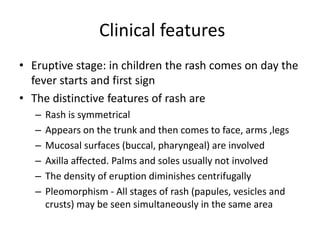
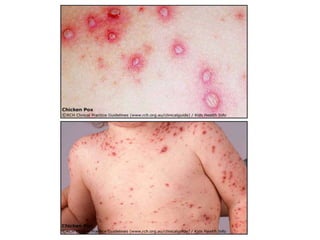
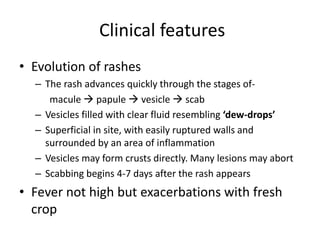
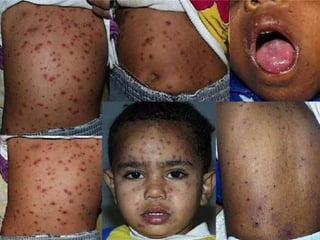
– Rash is symmetrical
– Appears on the trunk and then comes to face, arms ,legs
– Mucosal surfaces (buccal, pharyngeal) are involved
– Axilla affected. Palms and soles usually not involved
– The density of eruption diminishes centrifugally
– Pleomorphism - All stages of rash (papules, vesicles and
crusts) may be seen simultaneously in the same area
Clinical features
• Evolution of rashes
– The rash advances quickly through the stages of-
macule  papule  vesicle  scab
– Vesicles filled with clear fluid resembling ‘dew-drops’
– Superficial in site, with easily ruptured walls and
surrounded by an area of inflammation
– Vesicles may form crusts directly. Many lesions may abort
– Scabbing begins 4-7 days after the rash appears
• Fever not high but exacerbations with fresh
crop
Complications
• It’s a mild, self-limiting disease
• Patients at risk of complications are
– Immunosuppressive patients
– Cancer patients
– Recipients of organ transplants
– Chemo, radio, steroid therapy recipients
– HIV infected
– Children with leukemia
Complications
• Haemorrhages (varicella haemorrhagica)
• Pneumonia
• Encephalitis
• Acute cerebellar ataxia
• Reye’s syndrome
• Maternal varicella may cause foetal wastage & birth defects
• Acute retinal necrosis
• Secondary bacterial infections (Cellulitis, erysipelas,
epiglottitis, osteomyelitis, scarlet fever and meningitis)
• Pitted scars
Congenital defects in babies
• Damage to brain: encephalitis, microcephaly, hydrocephaly,
aplasia of brain
• Damage to the eye: microphthalmia, cataracts, chorioretinitis,
optic atrophy
• Other neurological disorder: damage to cervical and
lumbosacral spinal cord, motor/sensory deficits, absent deep
tendon reflexes, anisocoria/Horner's syndrome
• Damage to body: hypoplasia of upper/lower extremities, anal
and bladder sphincter dysfunction
• Skin disorders: (cicatricial) skin lesions, hypo pigmentation
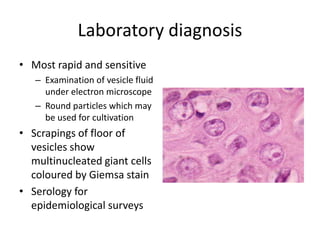
Laboratory diagnosis
• Most rapid and sensitive
– Examination of vesicle fluid
under electron microscope
– Round particles which may
be used for cultivation
• Scrapings of floor of
vesicles show
multinucleated giant cells
coloured by Giemsa stain
• Serology for
epidemiological surveys
Control
• No specific treatment for chicken pox
• Notification
• Isolation of cases for about 6 days after onset
of rash
• Disinfection of articles soiled by nose and
throat discharges
• Antiviral drugs provide effective therapy for
varicella (acyclovir, valaciclovir, famiciclovir
and foscarnet)
Prevention
• Varicella zoster immunoglobulin (VZIG)
• VZIG given within 72 hours of exposure has
been recommended for prevention
– Dosage: 1.25-5ml intramuscularly
– Used for immunosuppressed contacts of acute
cases or newborn contacts
– Provide improvement in high risk children with
varicella
Vaccine
• Live attenuated vaccine (Japan)
• Mild local reaction at inoculation site is 1%
• A general reaction mainly rash or mild
varicella may occur
• Seroconversion in healthy seronegative
children is over 90%
• Age shift of peak incidence due to
vaccinations is a major concern
Vaccine
• Monovalent vaccine
• One or two dose schedule (0.5 ml subcutaneous
injection)
• For children between 12-18 months
• Two dose schedule for persons aged >13 years
• Minimum interval between doses 6 weeks
• Combination vaccines (MMRV) for children 9
months to 12 years
• Duration of immunity probably 10 years
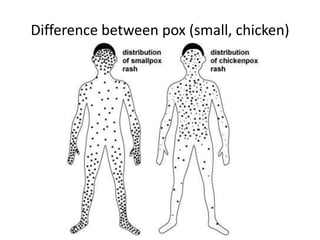
Difference between pox (small, chicken)
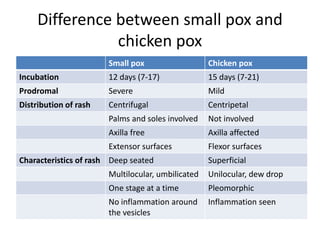
Difference between small pox and
chicken pox
Small pox Chicken pox
Incubation 12 days (7-17) 15 days (7-21)
Prodromal Severe Mild
Distribution of rash Centrifugal Centripetal
Palms and soles involved Not involved
Axilla free Axilla affected
Extensor surfaces Flexor surfaces
Characteristics of rash Deep seated Superficial
Multilocular, umbilicated Unilocular, dew drop
One stage at a time Pleomorphic
No inflammation around
the vesicles
Inflammation seen
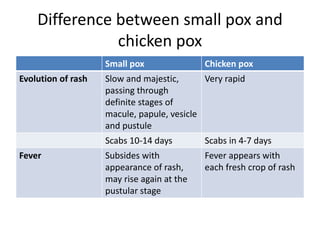
Difference between small pox and
chicken pox
Small pox Chicken pox
Evolution of rash Slow and majestic,
passing through
definite stages of
macule, papule, vesicle
and pustule
Very rapid
Scabs 10-14 days Scabs in 4-7 days
Fever Subsides with
appearance of rash,
may rise again at the
pustular stage
Fever appears with
each fresh crop of rash
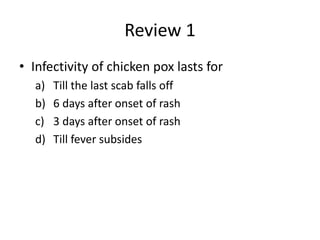
Review 1
• Infectivity of chicken pox lasts for
a) Till the last scab falls off
b) 6 days after onset of rash
c) 3 days after onset of rash
d) Till fever subsides
Review 2
• Chicken pox is characterized by all except
a) Scabs are infective
b) Pleomorphic stages
c) Rashes symmetrical centripetal dew drop like
d) Palms and soles not affected by rash
Review 3
• Small pox eradication was successful due to all
of the following reasons except
a) Subclinical cases did not transmit the disease
b) A highly effective vaccine was available
c) Infection provided lifelong immunity
d) Cross resistance existed with animal pox
Review 4
• All of the following are true about varicella
virus except
a) 10-30% chance of recurrence
b) All stages of rash seen at the same time
c) Secondary attack rate is 90%
d) Rash commonly seen in flexor area
Review 5
• All of the following are true about varicella
virus except
a) Lesions appear in crops
b) Centripetal distribution of rashes
c) Rashes shows rapid progression from macule to
vesicle
d) Crusts contain live virus
Review 6
• What is the difference between vaccination
and variolation?
Review 7
• When was the last case of small pox in India
identified and when was it declared small pox
free?
Review 8
• When was the world declared free of small
pox?
Review 9
• Why is small pox called class blind?
Review 10
• Can small pox infection occur in the world
today?
• If yes, what will be the consequences?
THANK YOU

Small pox and chicken pox

  • 1.
    Pox (small, chicken) Dr.S. A. Rizwan M.D., Assistant Professor, Dept. of Community Medicine, VMCHRI, Madurai.
  • 2.
    Learning objectives • Atthe end of this lecture you sh be able to – Describe the epidemiological triad and the prevention aspects of these infections – Understand the factors that contribute to epidemics – Enumerate the factors that led to eradication of small pox – Enumerate the differences between the two
  • 3.
  • 12.
    Introduction • Smallpox isa serious, contagious and sometimes fatal disease • At its height, 10-15 million cases a year, with 2 million deaths • There is no specific treatment for smallpox, and the only prevention is vaccination. • The name smallpox is derived from the Latin word “spotted” and refers to the raised bumps that appear on the face and body of an infected person. • It is caused by variola virus, Orthopoxvirus genus
  • 13.
    History • Mummified remainsof Ramses. (1157 B.C.) • Smallpox was likely carried from Egyptian traders to India • By 1967 it became a major killer in not less than 33 countries • Those who survive became immune • As a result, physicians intentionally infected healthy persons with smallpox organisms
  • 14.
    Variolation • It isthe act of taking samples (pus from pustules or ground scabs) from patients whose disease had been benign, and introducing it into others through the nose or skin
  • 15.
  • 16.
    Jenner’s contribution • Hefound that, the cowpox would protect the patient from smallpox • He proposed it in 1798 • In England vaccination with cowpox became compulsory in 1853 • Jenner was honored for his technique, and ‘Vaccine’ became the universally used term to indicate introducing material under the skin to produce a protection against disease
  • 17.
  • 18.
    Transmission • Humans arethe only natural host of smallpox (no animal reservoir) • Transmission generally occurs from direct and fairly prolonged face-to-face contact • Infected aerosols and air droplets spread in face-to-face contact
  • 19.
    Pathogenesis • Portal ofentry: respiratory tract or inoculation on skin • Source of infection: Excretions from the mouth and nose, rather than scabs • During incubation the virus proceeds through infection, replication, and liberation (usually accompanied by cell necrosis) first at the site of inoculation and then to the regional lymph nodes, then deeper lymph nodes and bloodstream
  • 20.
    Pathogenesis • 4 orthopoxvirusesare known to infect humans: variola, vaccinia, cowpox, and monkeypox • Variola major is severe and the most common form with more extensive rash and higher fever with a death rate of 30% • Variola minor has less common presentation and much less severe with death rate of 1%
  • 21.
    Pathogenesis • Variola Majorhas 3 clinical presentations based on the nature and evolution of the lesions: – Ordinary: most frequent, corresponds to classical description – Modified: milder and may occur in previously vaccinated people; rarely fatal – Flat and Hemorrhagic: very severe but uncommon
  • 23.
    Stages of Smallpox •Incubation Period – 12-14 days, person is not contagious • Prodrome Phase – Begins abruptly with fever, malaise, headache, head and body aches, prostration, and often nausea and vomiting – Body temperature rises to at least 101 F and is often higher • When the first visible lesions appear the fever may start to go down - most contagious period • Rash emerges as small red spots on tongue and in mouth (about 24 hours before the appearance of rash on the skin) • Lesions in the mouth and pharynx enlarge and ulcerate quickly, releasing large amount of virus into the saliva
  • 24.
    Stages: Rash Phase •Centrifugal distribution • Palms and soles are involved • lesions are all in the same stage of development on that part of the body (unlike chickenpox)
  • 27.
    Outcomes of infection •Those who survive usually have scars • In eye involvement, blindness could occur • Recovery results in long lasting immunity • No evidence of chronic or recurrent infection
  • 28.
    Vaccination • Live vacciniavirus • Administered using a bifurcated needle, not an injection • Bifurcated needle is dipped into the vaccine and then used to prick the skin 15 times in about 3 seconds in a 5mm radius area • Administered into the superficial layer of the skin
  • 30.
    Course of vaccination •If vaccination is successful a red, itchy bump develops at the vaccine site in 3-4 days; a papule surrounded by erythema • In the first week the bump becomes a blister, fills with pus, and begins to drain • During the second week the blister begins to dry and a scab forms; the scab then falls off leaving a scar • It is given on the right side universally
  • 31.
    A reminder ofthe small pox era
  • 32.
    Control • Only afterWWI most of Europe become smallpox free, and only after WWII transmission stopped throughout Europe and North America • In developing countries smallpox continued largely unabated until middle of 20th century
  • 33.
    Control • 1958: SovietUnion proposed to the WHO that a global smallpox eradication program be undertaken • The campaign was based on a two fold strategy – 1. Mass vaccination campaigns in each country using a vaccine of ensured potency and stability that would reach at least 80% of the population – 2. Surveillance-Containment - isolation of patients and the vaccination of family members and other contacts in the immediate vicinity
  • 34.
    Control • Ring vaccination: •Incorporated into the current CDC Smallpox Plan • The strategy involves the following steps: – Rapid identification and isolation of all smallpox cases – Identification and vaccination of contacts of smallpox cases – Monitoring contacts for development of fever and isolating them if fever occurs – Vaccination of household members of contacts if no contraindications to vaccination exist
  • 36.
    Management of anoutbreak • Surveillance is easier because of the distinctive rash • Containment involves efficient detection of cases and identification and vaccination of contacts • Patients diagnosed with smallpox should be physically isolated • All specimen collectors, care givers and attendants coming into close contact with patients should be vaccinated • Medical care givers, attendants, and mortuary workers should wear gloves, caps, gowns, and surgical masks
  • 37.
    Management of anoutbreak • Contaminated clothing and bedding, if not incinerated, should be autoclaved or washed in hot water containing bleach • Fumigation of premises with formaldehyde • Airborne and Contact Precautions in addition to Standard Precautions should be implemented for patients with suspected smallpox
  • 38.
    Eradication • In India •Last case reported on 17th May 1975 in Bihar • On 24th May 1975, imported from Bangladesh • In April 1977 declared free from smallpox
  • 39.
    Eradication • 26th October1977 the last naturally occurring case of smallpox was recorded in Somalia • In 1978 two cases were reported. These were both from people working in labs with smallpox in England • 8th May 1980, WHO declared that smallpox has been eradicated
  • 40.
    Factors that ledto eradication • Epidemiological factors: – No known animal reservoir – No long-term carrier of the virus – Life-long immunity after recovery from the disease – Detection of cases, the rash was so characteristic – Sub-clinical infection did not transmit the disease – Vaccine highly effective – International co-operation
  • 41.
  • 42.
    Introduction • Acute, highlyinfectious disease caused by Varicella- Zoster (V–Z) virus • Chicken pecked skin appearance, chickpea appearance • World-wide in distribution and occurs in endemic and epidemic forms • Chickenpox and Herpes zoster as different host responses to the same etiological agent • In India, approx. 28,000 cases per year
  • 43.
    Epidemiological determinants • Agent:Human (alpha) herpes virus – Primary infection causes chicken pox – Recovery followed by latent infection – Reactivation results in zoster- a painful, vesicular, pustular eruption in distribution of one or more sensory nerve roots – Can be grown in tissue culture • Incubation period: 14-16 days (7-21 days)
  • 44.
    Source of infection •Usually a case of chicken pox • Virus present in oropharyngeal secretions and lesions of skin and mucosa • Rarely may be a patient with herpes zoster • It can be isolated from the vesicular fluid during the first 3 days of illness
  • 45.
    Infectivity • Period ofcommunicability: 1-2 days before the appearance of rash, and 4-5 days thereafter • It tends to die out before the pustular stage • Patient ceases to be infectious once the lesion have crusted • Secondary attack rate: About 90% in household contacts
  • 46.
    Host factors • Age –Children under 10 years of age – Few escape until adulthood but can be severe in adults • Immunity – One attack give durable immunity – Maternal antibody protects the infant for few months – No age is exempt in the absence of immunity – IgG antibodies persist for life and correlate with protection – Cell mediated immunity is important in recovery • Pregnancy: Risk for fetus and neonate
  • 47.
    Environmental factors • Itshows a seasonal trend, occurring mostly during the first six months of the year • Overcrowding • In temperate climates, there is little evidence of seasonal trend
  • 48.
    Transmission • Droplet infectionand droplet nuclei • ‘Face to face’ (personal) contact • Portal of entry: respiratory tract • Virus is extremely labile, so fomites unlikely to transmit • Contact infection plays a significant role when an individual with herpes is an index case • Congenital varicella - it crosses the placental barrier and infects the foetus
  • 49.
    Clinical features • Clinicalspectrum – Mild illness with few scattered lesions – Severe febrile illness with widespread rash • Pre-eruptive stage – Sudden onset with mild to moderate fever – Pain in the back, shivering and malaise – Duration about 24 hours – In adults, prodromal illness is usually more severe and may last for 2-3 days before the rash
  • 50.
    Clinical features • Eruptivestage: in children the rash comes on day the fever starts and first sign • The distinctive features of rash are – Rash is symmetrical – Appears on the trunk and then comes to face, arms ,legs – Mucosal surfaces (buccal, pharyngeal) are involved – Axilla affected. Palms and soles usually not involved – The density of eruption diminishes centrifugally – Pleomorphism - All stages of rash (papules, vesicles and crusts) may be seen simultaneously in the same area
  • 52.
    Clinical features • Evolutionof rashes – The rash advances quickly through the stages of- macule  papule  vesicle  scab – Vesicles filled with clear fluid resembling ‘dew-drops’ – Superficial in site, with easily ruptured walls and surrounded by an area of inflammation – Vesicles may form crusts directly. Many lesions may abort – Scabbing begins 4-7 days after the rash appears • Fever not high but exacerbations with fresh crop
  • 54.
    Complications • It’s amild, self-limiting disease • Patients at risk of complications are – Immunosuppressive patients – Cancer patients – Recipients of organ transplants – Chemo, radio, steroid therapy recipients – HIV infected – Children with leukemia
  • 55.
    Complications • Haemorrhages (varicellahaemorrhagica) • Pneumonia • Encephalitis • Acute cerebellar ataxia • Reye’s syndrome • Maternal varicella may cause foetal wastage & birth defects • Acute retinal necrosis • Secondary bacterial infections (Cellulitis, erysipelas, epiglottitis, osteomyelitis, scarlet fever and meningitis) • Pitted scars
  • 56.
    Congenital defects inbabies • Damage to brain: encephalitis, microcephaly, hydrocephaly, aplasia of brain • Damage to the eye: microphthalmia, cataracts, chorioretinitis, optic atrophy • Other neurological disorder: damage to cervical and lumbosacral spinal cord, motor/sensory deficits, absent deep tendon reflexes, anisocoria/Horner's syndrome • Damage to body: hypoplasia of upper/lower extremities, anal and bladder sphincter dysfunction • Skin disorders: (cicatricial) skin lesions, hypo pigmentation
  • 57.
    Laboratory diagnosis • Mostrapid and sensitive – Examination of vesicle fluid under electron microscope – Round particles which may be used for cultivation • Scrapings of floor of vesicles show multinucleated giant cells coloured by Giemsa stain • Serology for epidemiological surveys
  • 58.
    Control • No specifictreatment for chicken pox • Notification • Isolation of cases for about 6 days after onset of rash • Disinfection of articles soiled by nose and throat discharges • Antiviral drugs provide effective therapy for varicella (acyclovir, valaciclovir, famiciclovir and foscarnet)
  • 59.
    Prevention • Varicella zosterimmunoglobulin (VZIG) • VZIG given within 72 hours of exposure has been recommended for prevention – Dosage: 1.25-5ml intramuscularly – Used for immunosuppressed contacts of acute cases or newborn contacts – Provide improvement in high risk children with varicella
  • 60.
    Vaccine • Live attenuatedvaccine (Japan) • Mild local reaction at inoculation site is 1% • A general reaction mainly rash or mild varicella may occur • Seroconversion in healthy seronegative children is over 90% • Age shift of peak incidence due to vaccinations is a major concern
  • 61.
    Vaccine • Monovalent vaccine •One or two dose schedule (0.5 ml subcutaneous injection) • For children between 12-18 months • Two dose schedule for persons aged >13 years • Minimum interval between doses 6 weeks • Combination vaccines (MMRV) for children 9 months to 12 years • Duration of immunity probably 10 years
  • 62.
    Difference between pox(small, chicken)
  • 63.
    Difference between smallpox and chicken pox Small pox Chicken pox Incubation 12 days (7-17) 15 days (7-21) Prodromal Severe Mild Distribution of rash Centrifugal Centripetal Palms and soles involved Not involved Axilla free Axilla affected Extensor surfaces Flexor surfaces Characteristics of rash Deep seated Superficial Multilocular, umbilicated Unilocular, dew drop One stage at a time Pleomorphic No inflammation around the vesicles Inflammation seen
  • 64.
    Difference between smallpox and chicken pox Small pox Chicken pox Evolution of rash Slow and majestic, passing through definite stages of macule, papule, vesicle and pustule Very rapid Scabs 10-14 days Scabs in 4-7 days Fever Subsides with appearance of rash, may rise again at the pustular stage Fever appears with each fresh crop of rash
  • 65.
    Review 1 • Infectivityof chicken pox lasts for a) Till the last scab falls off b) 6 days after onset of rash c) 3 days after onset of rash d) Till fever subsides
  • 66.
    Review 2 • Chickenpox is characterized by all except a) Scabs are infective b) Pleomorphic stages c) Rashes symmetrical centripetal dew drop like d) Palms and soles not affected by rash
  • 67.
    Review 3 • Smallpox eradication was successful due to all of the following reasons except a) Subclinical cases did not transmit the disease b) A highly effective vaccine was available c) Infection provided lifelong immunity d) Cross resistance existed with animal pox
  • 68.
    Review 4 • Allof the following are true about varicella virus except a) 10-30% chance of recurrence b) All stages of rash seen at the same time c) Secondary attack rate is 90% d) Rash commonly seen in flexor area
  • 69.
    Review 5 • Allof the following are true about varicella virus except a) Lesions appear in crops b) Centripetal distribution of rashes c) Rashes shows rapid progression from macule to vesicle d) Crusts contain live virus
  • 70.
    Review 6 • Whatis the difference between vaccination and variolation?
  • 71.
    Review 7 • Whenwas the last case of small pox in India identified and when was it declared small pox free?
  • 72.
    Review 8 • Whenwas the world declared free of small pox?
  • 73.
    Review 9 • Whyis small pox called class blind?
  • 74.
    Review 10 • Cansmall pox infection occur in the world today? • If yes, what will be the consequences?
  • 75.