Immunologia	
  TB/HIV	
  
Andrea	
  Gori	
  
UO	
  Mala/e	
  Infe23ve	
  
AO	
  San	
  Gerardo,	
  Monza	
  	
  
Università	
  Milano-­‐Bicocca	
  
andrea.gori@unimib.it	


Milano,	
  21-­‐22	
  Marzo	
  2014	


!
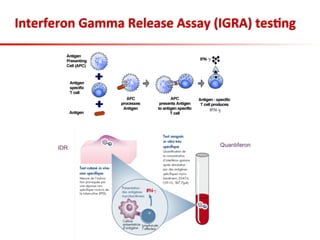
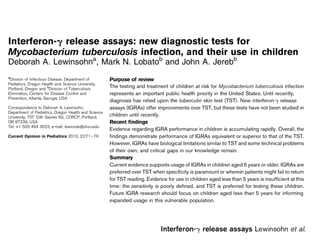
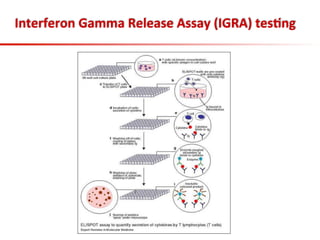
Interferon	
  Gamma	
  Release	
  Assay	
  (IGRA)	
  tes;ng	
  
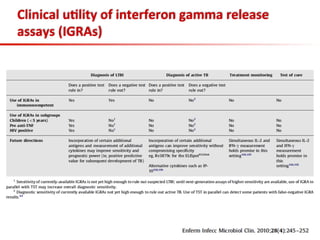
Clinical	
  u;lity	
  of	
  interferon	
  gamma	
  release	
  
assays	
  (IGRAs)	
  
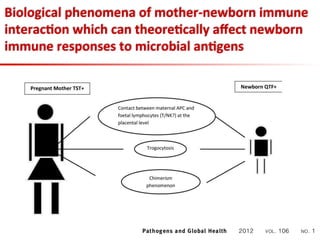
Biological	
  phenomena	
  of	
  mother-­‐newborn	
  immune	
  
interac;on	
  which	
  can	
  theore;cally	
  affect	
  newborn	
  
immune	
  responses	
  to	
  microbial	
  an;gens	


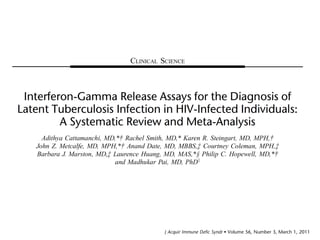
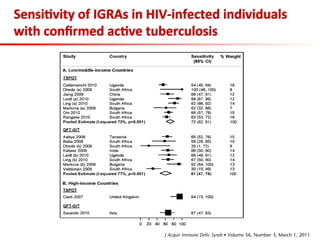
Sensi;vity	
  of	
  IGRAs	
  in	
  HIV-­‐infected	
  individuals	
  
with	
  confirmed	
  ac;ve	
  tuberculosis	
  
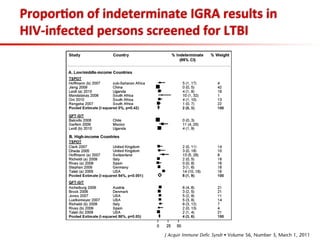
Propor;on	
  of	
  indeterminate	
  IGRA	
  results	
  in	
  
HIV-­‐infected	
  persons	
  screened	
  for	
  LTBI	
  
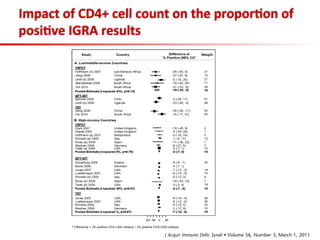
Impact	
  of	
  CD4+	
  cell	
  count	
  on	
  the	
  propor;on	
  of	
  
posi;ve	
  IGRA	
  results	
  
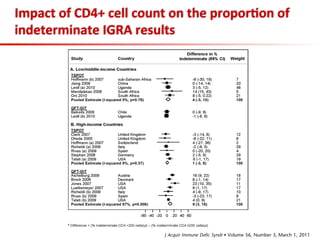
Impact	
  of	
  CD4+	
  cell	
  count	
  on	
  the	
  propor;on	
  of	
  
indeterminate	
  IGRA	
  results	
  
IGRA	
  test	
  for	
  the	
  Diagnosis	
  of	
  LTBI	
  in	
  HIV-­‐
Infected	
  Individuals	
  
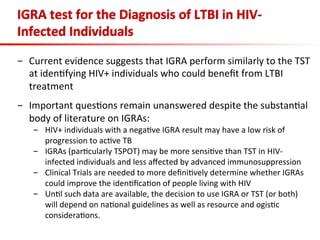
-  Current	
  evidence	
  suggests	
  that	
  IGRA	
  perform	
  similarly	
  to	
  the	
  TST	
  
at	
  iden3fying	
  HIV+	
  individuals	
  who	
  could	
  benefit	
  from	
  LTBI	
  
treatment	
  	
  
-  Important	
  ques3ons	
  remain	
  unanswered	
  despite	
  the	
  substan3al	
  
body	
  of	
  literature	
  on	
  IGRAs:	
  
-  HIV+	
  individuals	
  with	
  a	
  nega3ve	
  IGRA	
  result	
  may	
  have	
  a	
  low	
  risk	
  of	
  
progression	
  to	
  ac3ve	
  TB	
  
-  IGRAs	
  (par3cularly	
  TSPOT)	
  may	
  be	
  more	
  sensi3ve	
  than	
  TST	
  in	
  HIV-­‐
infected	
  individuals	
  and	
  less	
  affected	
  by	
  advanced	
  immunosuppression	
  	
  
-  Clinical	
  Trials	
  are	
  needed	
  to	
  more	
  defini3vely	
  determine	
  whether	
  IGRAs	
  
could	
  improve	
  the	
  iden3fica3on	
  of	
  people	
  living	
  with	
  HIV	
  
-  Un3l	
  such	
  data	
  are	
  available,	
  the	
  decision	
  to	
  use	
  IGRA	
  or	
  TST	
  (or	
  both)	
  
will	
  depend	
  on	
  na3onal	
  guidelines	
  as	
  well	
  as	
  resource	
  and	
  ogis3c	
  
considera3ons.	
  
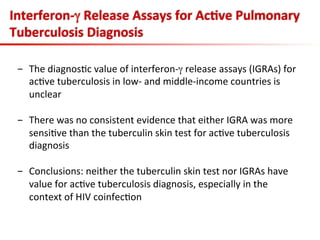
-  The	
  diagnos3c	
  value	
  of	
  interferon-­‐γ	
  release	
  assays	
  (IGRAs)	
  for	
  
ac3ve	
  tuberculosis	
  in	
  low-­‐	
  and	
  middle-­‐income	
  countries	
  is	
  
unclear	
  
-  There	
  was	
  no	
  consistent	
  evidence	
  that	
  either	
  IGRA	
  was	
  more	
  
sensi3ve	
  than	
  the	
  tuberculin	
  skin	
  test	
  for	
  ac3ve	
  tuberculosis	
  
diagnosis	
  
-  Conclusions:	
  neither	
  the	
  tuberculin	
  skin	
  test	
  nor	
  IGRAs	
  have	
  
value	
  for	
  ac3ve	
  tuberculosis	
  diagnosis,	
  especially	
  in	
  the	
  
context	
  of	
  HIV	
  coinfec3on	
  
Interferon-­‐γ	
  Release	
  Assays	
  for	
  Ac;ve	
  Pulmonary	
  
Tuberculosis	
  Diagnosis	
  
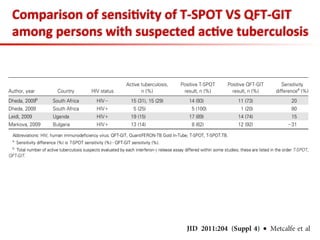
Comparison	
  of	
  sensi;vity	
  of	
  T-­‐SPOT	
  VS	
  QFT-­‐GIT	
  
among	
  persons	
  with	
  suspected	
  ac;ve	
  tuberculosis	
  
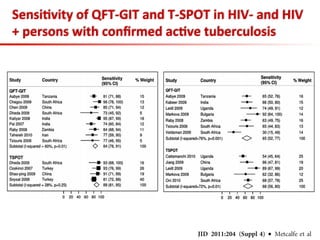
Sensi;vity	
  of	
  QFT-­‐GIT	
  and	
  T-­‐SPOT	
  in	
  HIV-­‐	
  and	
  HIV
+	
  persons	
  with	
  confirmed	
  ac;ve	
  tuberculosis	
  
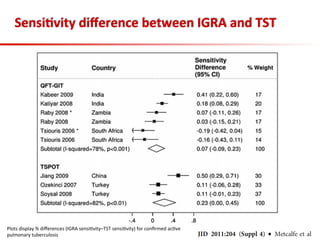
Sensi;vity	
  difference	
  between	
  IGRA	
  and	
  TST
Plots	
  display	
  %	
  differences	
  (IGRA	
  sensi3vity–TST	
  sensi3vity)	
  for	
  confirmed	
  ac3ve	
  
pulmonary	
  tuberculosis	
  
Interferon-­‐γ	
  Release	
  Assays	
  for	
  Ac;ve	
  
Pulmonary	
  Tuberculosis	
  Diagnosis	


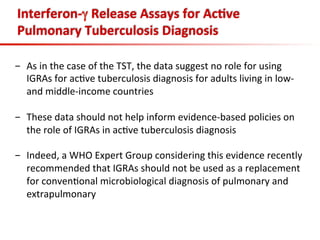
-  As	
  in	
  the	
  case	
  of	
  the	
  TST,	
  the	
  data	
  suggest	
  no	
  role	
  for	
  using	
  
IGRAs	
  for	
  ac3ve	
  tuberculosis	
  diagnosis	
  for	
  adults	
  living	
  in	
  low-­‐	
  
and	
  middle-­‐income	
  countries	
  
-  These	
  data	
  should	
  not	
  help	
  inform	
  evidence-­‐based	
  policies	
  on	
  
the	
  role	
  of	
  IGRAs	
  in	
  ac3ve	
  tuberculosis	
  diagnosis	
  	
  
-  Indeed,	
  a	
  WHO	
  Expert	
  Group	
  considering	
  this	
  evidence	
  recently	
  
recommended	
  that	
  IGRAs	
  should	
  not	
  be	
  used	
  as	
  a	
  replacement	
  
for	
  conven3onal	
  microbiological	
  diagnosis	
  of	
  pulmonary	
  and	
  
extrapulmonary	
  
-  Tuberculosis	
  is	
  unique	
  among	
  the	
  major	
  infec3ous	
  diseases	
  in	
  
that	
  it	
  lacks	
  accurate	
  rapid	
  point-­‐of-­‐care	
  diagnos3c	
  tests	
  
-  Failure	
  to	
  control	
  the	
  spread	
  of	
  tuberculosis	
  is	
  largely	
  due	
  to	
  our	
  
inability	
  to	
  detect	
  and	
  treat	
  all	
  infec3ous	
  cases	
  of	
  pulmonary	
  
tuberculosis	
  in	
  a	
  3mely	
  fashion,	
  allowing	
  con3nued	
  
Mycobacterium	
  tuberculosis	
  transmission	
  within	
  communi3es	
  
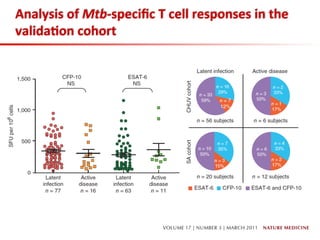
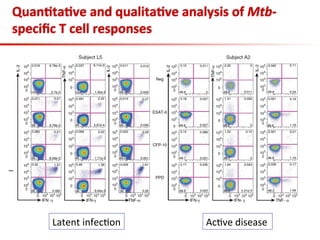
Analysis	
  of	
  Mtb-­‐specific	
  T	
  cell	
  responses	
  in	
  the	
  
valida;on	
  cohort	
  	
  
Quan;ta;ve	
  and	
  qualita;ve	
  analysis	
  of	
  Mtb-­‐
specific	
  T	
  cell	
  responses	
  
Latent	
  infec3on	
   Ac3ve	
  disease	
  
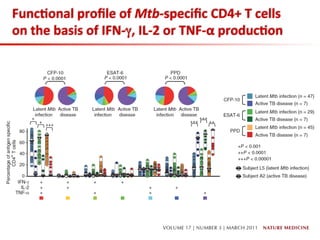
Func;onal	
  profile	
  of	
  Mtb-­‐specific	
  CD4+	
  T	
  cells	
  
on	
  the	
  basis	
  of	
  IFN-­‐γ,	
  IL-­‐2	
  or	
  TNF-­‐α	
  produc;on	
  	
  
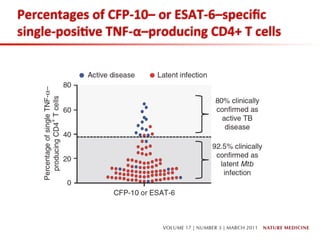
Percentages	
  of	
  CFP-­‐10–	
  or	
  ESAT-­‐6–specific	
  
single-­‐posi;ve	
  TNF-­‐α–producing	
  CD4+	
  T	
  cells	
  	
  
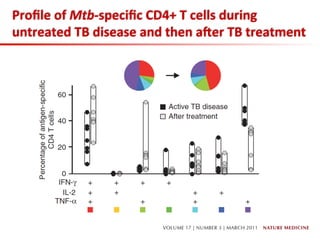
Profile	
  of	
  Mtb-­‐specific	
  CD4+	
  T	
  cells	
  during	
  
untreated	
  TB	
  disease	
  and	
  then	
  aZer	
  TB	
  treatment	
  
 
M.	
  tuberculosis–specific	
  CD4+	
  T	
  cell	
  responses	
  
and	
  latent	
  infec;on	
  or	
  ac;ve	
  disease	
  
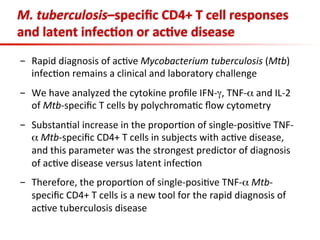
-  Rapid	
  diagnosis	
  of	
  ac3ve	
  Mycobacterium	
  tuberculosis	
  (Mtb)	
  
infec3on	
  remains	
  a	
  clinical	
  and	
  laboratory	
  challenge	


-  We	
  have	
  analyzed	
  the	
  cytokine	
  profile	
  IFN-­‐γ,	
  TNF-­‐α	
  and	
  IL-­‐2	
  
of	
  Mtb-­‐specific	
  T	
  cells	
  by	
  polychroma3c	
  flow	
  cytometry	
  
-  Substan3al	
  increase	
  in	
  the	
  propor3on	
  of	
  single-­‐posi3ve	
  TNF-­‐
α	
  Mtb-­‐specific	
  CD4+	
  T	
  cells	
  in	
  subjects	
  with	
  ac3ve	
  disease,	
  
and	
  this	
  parameter	
  was	
  the	
  strongest	
  predictor	
  of	
  diagnosis	
  
of	
  ac3ve	
  disease	
  versus	
  latent	
  infec3on	
  
-  Therefore,	
  the	
  propor3on	
  of	
  single-­‐posi3ve	
  TNF-­‐α	
  Mtb-­‐
specific	
  CD4+	
  T	
  cells	
  is	
  a	
  new	
  tool	
  for	
  the	
  rapid	
  diagnosis	
  of	
  
ac3ve	
  tuberculosis	
  disease	
  
Division	
  of	
  Onco-­‐Haemathology,	
  “San	
  Gerardo”	
  
Hospital,	
  University	
  Milano-­‐Bicocca	
  
Monza,	
  Italy	
  
Luisa	
  Verga	
  
Fausto	
  Rossini	
  
Pietro	
  Pioltelli	
  
Enrico	
  Pogliani	


Division	
  of	
  Division	
  of	
  Pathology,	
  “San	
  Gerardo”	
  
Hospital,	
  	
  
University	
  Milan-­‐Bicocca	
  
Monza,	
  Italy	
  
Ambrogio	
  Brenna	
  
Serena	
  Cu`n	
  
Giorgio	
  Catore`	


Division	
  of	
  Microbiology	
  and	
  Virology	
  Laboratories,	
  
“San	
  Gerardo”	
  Hospital,	
  Monza,	
  Italy	
  
Sergio	
  Malandrin	
  
Annalisa	
  Cavallero	


Haemathology	
  and	
  Transfusion	
  Center,	
  “San	
  
Gerardo”	
  Hospital,	
  Monza,	
  Italy	
  
Paolo	
  Perseghin	
  
Arianna	
  Incontri	


Chair	
  of	
  Immunology,	
  
University	
  of	
  Milan,	
  Milan,	
  Italy	
  
Daria	
  Trabaaoni	
  
Marina	
  Saresella	
  
Mara	
  Biasin	
  
Mario	
  (Mago)	
  Clerici	
  
Department	
  of	
  Infec;ous	
  Diseases,	
  	
  
“L.	
  Sacco”	
  Hospital,	
  University	
  of	
  Milan	
  
Milan,	
  Italy,	
  	
  
Fabio	
  Franze`	
  
Fabio	
  Zanini	
  
Stefano	
  Rusconi	
  
Stefania	
  Piconi	
  
Giuliano	
  Rizzardini	


Clinic	
  of	
  Infec;ous	
  Diseases,	
  “San	
  Paolo”	
  Hospital,	
  
University	
  of	
  Milan	
  
Milan,	
  Italy	
  
Giulia	
  Marche`	
  	
  
Camilla	
  Tinca;	
  
Antonella	
  d’Arminio	
  Monforte	


Divisione	
  di	
  Mala`e	
  Infe`ve	
  
A.O.	
  “San	
  Gerardo”	
  
Monza	
  
Giuseppe	
  Lapadula	
  
Silvia	
  Costarelli	
  
Alessandra	
  Bandera	
  
Marianna	
  Rossi	
  
Nicola	
  Squillace	
  
Alessandro	
  Soria	
  
Antonio	
  Muscatello	
  
Sebas;ano	
  Leone	
  
Guglielmo	
  Migliorino	
  
BACK	
  UP	
  SLIDES	
  
Interferon	
  Gamma	
  Release	
  Assay	
  (IGRA)	
  tes;ng	
  
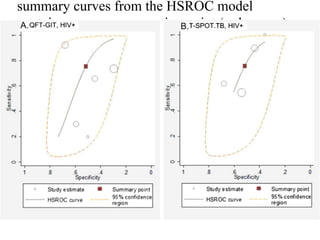
summary curves from the HSROC model
contain a summary operating point (red square)
representing
summarized sensitivity and specificity point
estimates for individual study estimates (open
circles). The 95% confidence region is
delineated by the area
in the orange dashed line.	
  

PPT Gori "Immunologia TB/HIV"

  • 1.
    Immunologia  TB/HIV   Andrea  Gori   UO  Mala/e  Infe23ve   AO  San  Gerardo,  Monza     Università  Milano-­‐Bicocca   andrea.gori@unimib.it     Milano,  21-­‐22  Marzo  2014     !
  • 2.
    Interferon  Gamma  Release  Assay  (IGRA)  tes;ng  
  • 4.
    Clinical  u;lity  of  interferon  gamma  release   assays  (IGRAs)  
  • 7.
    Biological  phenomena  of  mother-­‐newborn  immune   interac;on  which  can  theore;cally  affect  newborn   immune  responses  to  microbial  an;gens    
  • 9.
    Sensi;vity  of  IGRAs  in  HIV-­‐infected  individuals   with  confirmed  ac;ve  tuberculosis  
  • 10.
    Propor;on  of  indeterminate  IGRA  results  in   HIV-­‐infected  persons  screened  for  LTBI  
  • 11.
    Impact  of  CD4+  cell  count  on  the  propor;on  of   posi;ve  IGRA  results  
  • 12.
    Impact  of  CD4+  cell  count  on  the  propor;on  of   indeterminate  IGRA  results  
  • 13.
    IGRA  test  for  the  Diagnosis  of  LTBI  in  HIV-­‐ Infected  Individuals   -  Current  evidence  suggests  that  IGRA  perform  similarly  to  the  TST   at  iden3fying  HIV+  individuals  who  could  benefit  from  LTBI   treatment     -  Important  ques3ons  remain  unanswered  despite  the  substan3al   body  of  literature  on  IGRAs:   -  HIV+  individuals  with  a  nega3ve  IGRA  result  may  have  a  low  risk  of   progression  to  ac3ve  TB   -  IGRAs  (par3cularly  TSPOT)  may  be  more  sensi3ve  than  TST  in  HIV-­‐ infected  individuals  and  less  affected  by  advanced  immunosuppression     -  Clinical  Trials  are  needed  to  more  defini3vely  determine  whether  IGRAs   could  improve  the  iden3fica3on  of  people  living  with  HIV   -  Un3l  such  data  are  available,  the  decision  to  use  IGRA  or  TST  (or  both)   will  depend  on  na3onal  guidelines  as  well  as  resource  and  ogis3c   considera3ons.  
  • 15.
    -  The  diagnos3c  value  of  interferon-­‐γ  release  assays  (IGRAs)  for   ac3ve  tuberculosis  in  low-­‐  and  middle-­‐income  countries  is   unclear   -  There  was  no  consistent  evidence  that  either  IGRA  was  more   sensi3ve  than  the  tuberculin  skin  test  for  ac3ve  tuberculosis   diagnosis   -  Conclusions:  neither  the  tuberculin  skin  test  nor  IGRAs  have   value  for  ac3ve  tuberculosis  diagnosis,  especially  in  the   context  of  HIV  coinfec3on   Interferon-­‐γ  Release  Assays  for  Ac;ve  Pulmonary   Tuberculosis  Diagnosis  
  • 16.
    Comparison  of  sensi;vity  of  T-­‐SPOT  VS  QFT-­‐GIT   among  persons  with  suspected  ac;ve  tuberculosis  
  • 17.
    Sensi;vity  of  QFT-­‐GIT  and  T-­‐SPOT  in  HIV-­‐  and  HIV +  persons  with  confirmed  ac;ve  tuberculosis  
  • 18.
    Sensi;vity  difference  between  IGRA  and  TST Plots  display  %  differences  (IGRA  sensi3vity–TST  sensi3vity)  for  confirmed  ac3ve   pulmonary  tuberculosis  
  • 19.
    Interferon-­‐γ  Release  Assays  for  Ac;ve   Pulmonary  Tuberculosis  Diagnosis     -  As  in  the  case  of  the  TST,  the  data  suggest  no  role  for  using   IGRAs  for  ac3ve  tuberculosis  diagnosis  for  adults  living  in  low-­‐   and  middle-­‐income  countries   -  These  data  should  not  help  inform  evidence-­‐based  policies  on   the  role  of  IGRAs  in  ac3ve  tuberculosis  diagnosis     -  Indeed,  a  WHO  Expert  Group  considering  this  evidence  recently   recommended  that  IGRAs  should  not  be  used  as  a  replacement   for  conven3onal  microbiological  diagnosis  of  pulmonary  and   extrapulmonary  
  • 20.
    -  Tuberculosis  is  unique  among  the  major  infec3ous  diseases  in   that  it  lacks  accurate  rapid  point-­‐of-­‐care  diagnos3c  tests   -  Failure  to  control  the  spread  of  tuberculosis  is  largely  due  to  our   inability  to  detect  and  treat  all  infec3ous  cases  of  pulmonary   tuberculosis  in  a  3mely  fashion,  allowing  con3nued   Mycobacterium  tuberculosis  transmission  within  communi3es  
  • 22.
    Analysis  of  Mtb-­‐specific  T  cell  responses  in  the   valida;on  cohort    
  • 23.
    Quan;ta;ve  and  qualita;ve  analysis  of  Mtb-­‐ specific  T  cell  responses   Latent  infec3on   Ac3ve  disease  
  • 24.
    Func;onal  profile  of  Mtb-­‐specific  CD4+  T  cells   on  the  basis  of  IFN-­‐γ,  IL-­‐2  or  TNF-­‐α  produc;on    
  • 25.
    Percentages  of  CFP-­‐10–  or  ESAT-­‐6–specific   single-­‐posi;ve  TNF-­‐α–producing  CD4+  T  cells    
  • 26.
    Profile  of  Mtb-­‐specific  CD4+  T  cells  during   untreated  TB  disease  and  then  aZer  TB  treatment  
  • 27.
      M.  tuberculosis–specific  CD4+  T  cell  responses   and  latent  infec;on  or  ac;ve  disease   -  Rapid  diagnosis  of  ac3ve  Mycobacterium  tuberculosis  (Mtb)   infec3on  remains  a  clinical  and  laboratory  challenge     -  We  have  analyzed  the  cytokine  profile  IFN-­‐γ,  TNF-­‐α  and  IL-­‐2   of  Mtb-­‐specific  T  cells  by  polychroma3c  flow  cytometry   -  Substan3al  increase  in  the  propor3on  of  single-­‐posi3ve  TNF-­‐ α  Mtb-­‐specific  CD4+  T  cells  in  subjects  with  ac3ve  disease,   and  this  parameter  was  the  strongest  predictor  of  diagnosis   of  ac3ve  disease  versus  latent  infec3on   -  Therefore,  the  propor3on  of  single-­‐posi3ve  TNF-­‐α  Mtb-­‐ specific  CD4+  T  cells  is  a  new  tool  for  the  rapid  diagnosis  of   ac3ve  tuberculosis  disease  
  • 28.
    Division  of  Onco-­‐Haemathology,  “San  Gerardo”   Hospital,  University  Milano-­‐Bicocca   Monza,  Italy   Luisa  Verga   Fausto  Rossini   Pietro  Pioltelli   Enrico  Pogliani       Division  of  Division  of  Pathology,  “San  Gerardo”   Hospital,     University  Milan-­‐Bicocca   Monza,  Italy   Ambrogio  Brenna   Serena  Cu`n   Giorgio  Catore`       Division  of  Microbiology  and  Virology  Laboratories,   “San  Gerardo”  Hospital,  Monza,  Italy   Sergio  Malandrin   Annalisa  Cavallero       Haemathology  and  Transfusion  Center,  “San   Gerardo”  Hospital,  Monza,  Italy   Paolo  Perseghin   Arianna  Incontri     Chair  of  Immunology,   University  of  Milan,  Milan,  Italy   Daria  Trabaaoni   Marina  Saresella   Mara  Biasin   Mario  (Mago)  Clerici   Department  of  Infec;ous  Diseases,     “L.  Sacco”  Hospital,  University  of  Milan   Milan,  Italy,     Fabio  Franze`   Fabio  Zanini   Stefano  Rusconi   Stefania  Piconi   Giuliano  Rizzardini       Clinic  of  Infec;ous  Diseases,  “San  Paolo”  Hospital,   University  of  Milan   Milan,  Italy   Giulia  Marche`     Camilla  Tinca;   Antonella  d’Arminio  Monforte     Divisione  di  Mala`e  Infe`ve   A.O.  “San  Gerardo”   Monza   Giuseppe  Lapadula   Silvia  Costarelli   Alessandra  Bandera   Marianna  Rossi   Nicola  Squillace   Alessandro  Soria   Antonio  Muscatello   Sebas;ano  Leone   Guglielmo  Migliorino  
  • 29.
  • 31.
    Interferon  Gamma  Release  Assay  (IGRA)  tes;ng  
  • 32.
    summary curves fromthe HSROC model contain a summary operating point (red square) representing summarized sensitivity and specificity point estimates for individual study estimates (open circles). The 95% confidence region is delineated by the area in the orange dashed line.