1
INTRODUCTION
•Tuberculosis is an infectious bacterial disease caused
by Mycobacterium tuberculosis.
•The lungs are the most common site of primary infection
by tuberculosis and are a major source of spread of the
disease and of individual morbidity and mortality.
Neo-latin word : -
•Tubercle” - Round nodule/Swelling
•“Osis” - Condition
2
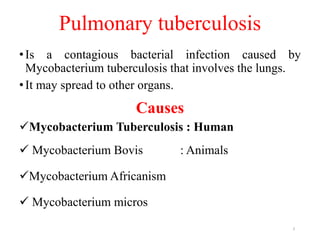
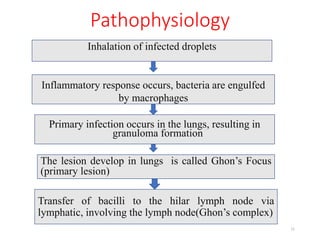
Pulmonary tuberculosis
•Is a contagious bacterial infection caused by
Mycobacterium tuberculosis that involves the lungs.
•It may spread to other organs.
Causes
Mycobacterium Tuberculosis : Human
 Mycobacterium Bovis : Animals
Mycobacterium Africanism
 Mycobacterium micros
3
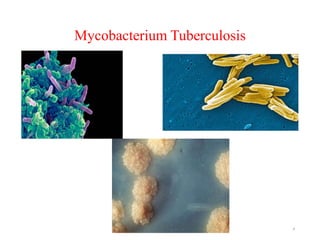
Mycobacterium Tuberculosis
4
Tuberculosis is either latent or active
Latent TB
• Person carries the TB bacteria within their
body, but the bacteria are present in very small
numbers and are kept under control by the
body’s immune system.
• People with latent TB don't have any
symptoms of TB and can't spread the disease to
others.
5
Contn…
Active TB
•Occurs when the TB bacteria have started to multiply
and they become numerous enough to overcome the
body’s immune system.
• It causes a person to feel ill and able to spread the
disease to others.
Incubation period:
•Varies between 4-12 weeks.
6
Risk factors
•Close contacts of patients with smear-positive
pulmonary tuberculosis
•Overcrowding
•Poor environment and malnutrition
•Primary infection < 1 year previously
•IV drugs abusers, alcoholic, smokers, homeless
people and health workers
•Immigrants from high-prevalence countries
7
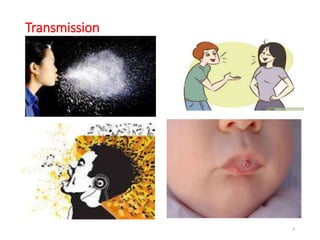
Transmission
8
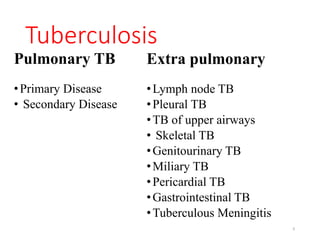
Tuberculosis
Pulmonary TB
•Primary Disease
• Secondary Disease
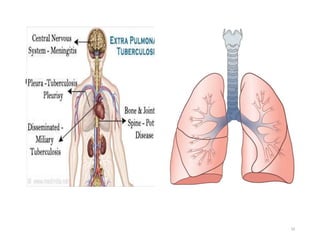
Extra pulmonary
•Lymph node TB
•Pleural TB
•TB of upper airways
• Skeletal TB
•Genitourinary TB
•Miliary TB
•Pericardial TB
•Gastrointestinal TB
•Tuberculous Meningitis
9
Extra pulmonary Pulmonary
10
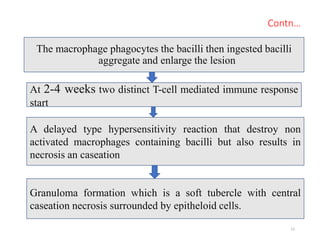
Pathophysiology
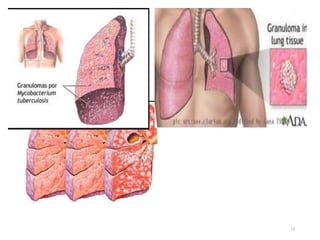
Primary infection occurs in the lungs, resulting in
granuloma formation
11
Inhalation of infected droplets
Inflammatory response occurs, bacteria are engulfed
by macrophages
The lesion develop in lungs is called Ghon’s Focus
(primary lesion)
Transfer of bacilli to the hilar lymph node via
lymphatic, involving the lymph node(Ghon’s complex)
Contn…
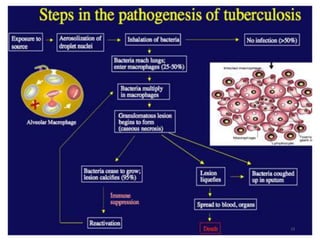
The macrophage phagocytes the bacilli then ingested bacilli
aggregate and enlarge the lesion
12
At 2-4 weeks two distinct T-cell mediated immune response
start
A delayed type hypersensitivity reaction that destroy non
activated macrophages containing bacilli but also results in
necrosis an caseation
Granuloma formation which is a soft tubercle with central
caseation necrosis surrounded by epitheloid cells.
13
14
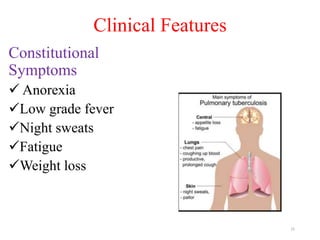
Clinical Features
Constitutional
Symptoms
 Anorexia
Low grade fever
Night sweats
Fatigue
Weight loss
15
Pulmonary Symptoms
Dyspnea
Non resolving bronchopneumonia
Chest tightness
Non productive cough
Mucopurulent sputum with hemoptpysis
Chest pain
16
Diagnosis
History taking
Physical examination
Clubbing of the fingers or toes
Swollen or tender lymph nodes in the neck or
other areas
Fluid around a lung
Unusual breath sounds
18
Diagnostic tests
Laboratory Diagnosis
•Tuberculin test
•Sputum smears and culture
•Gene Xpert
•Quanti FERON-TB (QFT)
•HIV test
19
Diagnostic tests…
Imaging tests
•Chest X-ray
• Chest CT Scan
•Bronchoscopy
Others
•Thoracocentesis
•Biopsy of the affected tissue (done rarely)
20
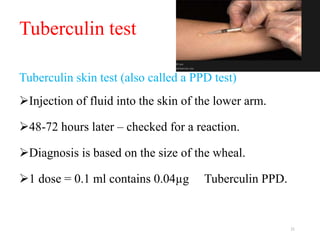
Tuberculin test
Tuberculin skin test (also called a PPD test)
Injection of fluid into the skin of the lower arm.
48-72 hours later – checked for a reaction.
Diagnosis is based on the size of the wheal.
1 dose = 0.1 ml contains 0.04µg Tuberculin PPD.
21
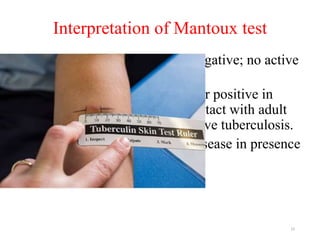
Interpretation of Mantoux test
Size of induration <5 mm : Negative; no active
disease
5-10 mm : Borderline; consider positive in
immunocompromised host; contact with adult
patient with sputum AFB positive tuberculosis.
≥10 mm :Positive; suggests disease in presence
of clinical features.
22
Drug resistent tuberculosis
Multidrug-resistant tuberculosis (MDR-TB):
•Tuberculosis caused by organisms that are
resistant to isoniazid and rifampicin, two first-
line anti -TB drugs is defined as MDR TB.
Extensively drug-resistant TB (XDR-TB):
•Defined as MDR-TB that is resistant as well to
any one of the fluoroquinolones and to at least
one of three injectable second-line drugs
(amikacin, capreomycin or kanamycin),
23
Complications
•Pleural effusion
•TB pneumonia
•Serious reactions to drug therapy: hepatitis, skin
rashes, GI upset, deafness or neuritis
•Multidrug resistance TB
•Spread of TB infection( miliary TB)
24
Treatment
First line drugs
•Isoniazid (H)
•Rifampicin (R)
•Pyrazinamide (Z)
•Ethambutol (E)
•Streptomycin (S)
25
Second line drugs
• Kanamycin
• Capreomycin
• Amikacin
• Ethionamide
• Para Aminosalicylic acid
(PAS)
• Cycloserine
• Ciprofloxacin
Relative activity of first line drugs
•INH: potent bactericidal (Synergistic
effect)
•Rifampicin (R): potent bactericidal
(Synergistic effect)
•Pyrazinamide (Z) : weak bactericidal
•Ethambutol (E): bacteriostatic
•Streptomycin (S) : bactericidal
26
Medicines are available in fixed dose
combination (FDC)
HRZE
• Isoniazide [75 mg]
• Rifampicin [150 mg]
• Pyrazinamide [400mg}
• Ethambutol [275mg]
HR
•Isoniazide (150mg)
•Rifampicin (150mg)
HRE
• Isoniazide [75 mg]
• Rifampicin [150 mg]
27
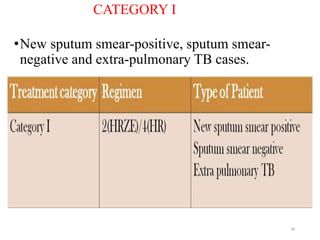
CATEGORY I
•New sputum smear-positive, sputum smear-
negative and extra-pulmonary TB cases.
28
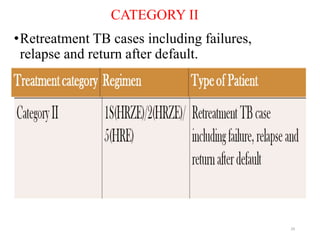
CATEGORY II
•Retreatment TB cases including failures,
relapse and return after default.
29
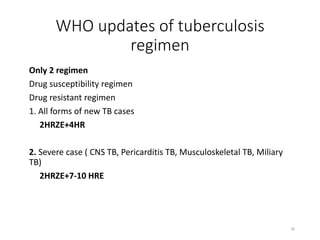
WHO updates of tuberculosis
regimen
Only 2 regimen
Drug susceptibility regimen
Drug resistant regimen
1. All forms of new TB cases
2HRZE+4HR
2. Severe case ( CNS TB, Pericarditis TB, Musculoskeletal TB, Miliary
TB)
2HRZE+7-10 HRE
30
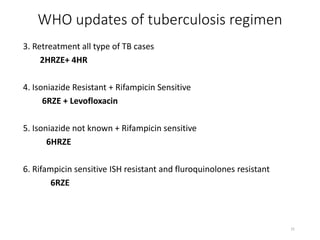
WHO updates of tuberculosis regimen
3. Retreatment all type of TB cases
2HRZE+ 4HR
4. Isoniazide Resistant + Rifampicin Sensitive
6RZE + Levofloxacin
5. Isoniazide not known + Rifampicin sensitive
6HRZE
6. Rifampicin sensitive ISH resistant and fluroquinolones resistant
6RZE
31
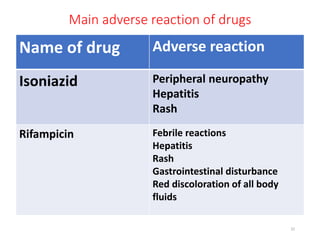
Main adverse reaction of drugs
Name of drug Adverse reaction
Isoniazid Peripheral neuropathy
Hepatitis
Rash
Rifampicin Febrile reactions
Hepatitis
Rash
Gastrointestinal disturbance
Red discoloration of all body
fluids
32
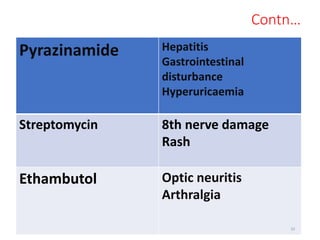
Contn…
Pyrazinamide Hepatitis
Gastrointestinal
disturbance
Hyperuricaemia
Streptomycin 8th nerve damage
Rash
Ethambutol Optic neuritis
Arthralgia
33
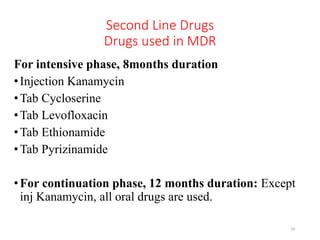
Second Line Drugs
Drugs used in MDR
For intensive phase, 8months duration
•Injection Kanamycin
•Tab Cycloserine
•Tab Levofloxacin
•Tab Ethionamide
•Tab Pyrizinamide
•For continuation phase, 12 months duration: Except
inj Kanamycin, all oral drugs are used.
34
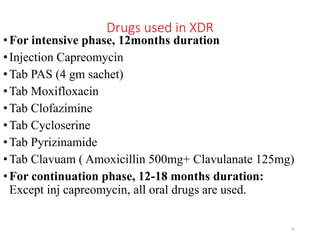
Drugs used in XDR
•For intensive phase, 12months duration
•Injection Capreomycin
•Tab PAS (4 gm sachet)
•Tab Moxifloxacin
•Tab Clofazimine
•Tab Cycloserine
•Tab Pyrizinamide
•Tab Clavuam ( Amoxicillin 500mg+ Clavulanate 125mg)
•For continuation phase, 12-18 months duration:
Except inj capreomycin, all oral drugs are used.
35
Supportive management
•Vitamin supplementation (esp. Vit B6)
•Rest and sleep
•Nutrition – High protein diet
•Oxygen therapy (if required)
Prognosis
•Symptoms often improve in 2 to 3 weeks after starting
treatment.
•A chest x-ray will not show this improvement until
weeks or months later
36
THANK-YOU
37

Tuberculosis presentation with introduction of its bacteria

  • 1.
  • 2.
    INTRODUCTION •Tuberculosis is aninfectious bacterial disease caused by Mycobacterium tuberculosis. •The lungs are the most common site of primary infection by tuberculosis and are a major source of spread of the disease and of individual morbidity and mortality. Neo-latin word : - •Tubercle” - Round nodule/Swelling •“Osis” - Condition 2
  • 3.
    Pulmonary tuberculosis •Is acontagious bacterial infection caused by Mycobacterium tuberculosis that involves the lungs. •It may spread to other organs. Causes Mycobacterium Tuberculosis : Human  Mycobacterium Bovis : Animals Mycobacterium Africanism  Mycobacterium micros 3
  • 4.
  • 5.
    Tuberculosis is eitherlatent or active Latent TB • Person carries the TB bacteria within their body, but the bacteria are present in very small numbers and are kept under control by the body’s immune system. • People with latent TB don't have any symptoms of TB and can't spread the disease to others. 5
  • 6.
    Contn… Active TB •Occurs whenthe TB bacteria have started to multiply and they become numerous enough to overcome the body’s immune system. • It causes a person to feel ill and able to spread the disease to others. Incubation period: •Varies between 4-12 weeks. 6
  • 7.
    Risk factors •Close contactsof patients with smear-positive pulmonary tuberculosis •Overcrowding •Poor environment and malnutrition •Primary infection < 1 year previously •IV drugs abusers, alcoholic, smokers, homeless people and health workers •Immigrants from high-prevalence countries 7
  • 8.
  • 9.
    Tuberculosis Pulmonary TB •Primary Disease •Secondary Disease Extra pulmonary •Lymph node TB •Pleural TB •TB of upper airways • Skeletal TB •Genitourinary TB •Miliary TB •Pericardial TB •Gastrointestinal TB •Tuberculous Meningitis 9
  • 10.
  • 11.
    Pathophysiology Primary infection occursin the lungs, resulting in granuloma formation 11 Inhalation of infected droplets Inflammatory response occurs, bacteria are engulfed by macrophages The lesion develop in lungs is called Ghon’s Focus (primary lesion) Transfer of bacilli to the hilar lymph node via lymphatic, involving the lymph node(Ghon’s complex)
  • 12.
    Contn… The macrophage phagocytesthe bacilli then ingested bacilli aggregate and enlarge the lesion 12 At 2-4 weeks two distinct T-cell mediated immune response start A delayed type hypersensitivity reaction that destroy non activated macrophages containing bacilli but also results in necrosis an caseation Granuloma formation which is a soft tubercle with central caseation necrosis surrounded by epitheloid cells.
  • 13.
  • 14.
  • 15.
    Clinical Features Constitutional Symptoms  Anorexia Lowgrade fever Night sweats Fatigue Weight loss 15
  • 16.
    Pulmonary Symptoms Dyspnea Non resolvingbronchopneumonia Chest tightness Non productive cough Mucopurulent sputum with hemoptpysis Chest pain 16
  • 17.
    Diagnosis History taking Physical examination Clubbingof the fingers or toes Swollen or tender lymph nodes in the neck or other areas Fluid around a lung Unusual breath sounds 18
  • 18.
    Diagnostic tests Laboratory Diagnosis •Tuberculintest •Sputum smears and culture •Gene Xpert •Quanti FERON-TB (QFT) •HIV test 19
  • 19.
    Diagnostic tests… Imaging tests •ChestX-ray • Chest CT Scan •Bronchoscopy Others •Thoracocentesis •Biopsy of the affected tissue (done rarely) 20
  • 20.
    Tuberculin test Tuberculin skintest (also called a PPD test) Injection of fluid into the skin of the lower arm. 48-72 hours later – checked for a reaction. Diagnosis is based on the size of the wheal. 1 dose = 0.1 ml contains 0.04µg Tuberculin PPD. 21
  • 21.
    Interpretation of Mantouxtest Size of induration <5 mm : Negative; no active disease 5-10 mm : Borderline; consider positive in immunocompromised host; contact with adult patient with sputum AFB positive tuberculosis. ≥10 mm :Positive; suggests disease in presence of clinical features. 22
  • 22.
    Drug resistent tuberculosis Multidrug-resistanttuberculosis (MDR-TB): •Tuberculosis caused by organisms that are resistant to isoniazid and rifampicin, two first- line anti -TB drugs is defined as MDR TB. Extensively drug-resistant TB (XDR-TB): •Defined as MDR-TB that is resistant as well to any one of the fluoroquinolones and to at least one of three injectable second-line drugs (amikacin, capreomycin or kanamycin), 23
  • 23.
    Complications •Pleural effusion •TB pneumonia •Seriousreactions to drug therapy: hepatitis, skin rashes, GI upset, deafness or neuritis •Multidrug resistance TB •Spread of TB infection( miliary TB) 24
  • 24.
    Treatment First line drugs •Isoniazid(H) •Rifampicin (R) •Pyrazinamide (Z) •Ethambutol (E) •Streptomycin (S) 25 Second line drugs • Kanamycin • Capreomycin • Amikacin • Ethionamide • Para Aminosalicylic acid (PAS) • Cycloserine • Ciprofloxacin
  • 25.
    Relative activity offirst line drugs •INH: potent bactericidal (Synergistic effect) •Rifampicin (R): potent bactericidal (Synergistic effect) •Pyrazinamide (Z) : weak bactericidal •Ethambutol (E): bacteriostatic •Streptomycin (S) : bactericidal 26
  • 26.
    Medicines are availablein fixed dose combination (FDC) HRZE • Isoniazide [75 mg] • Rifampicin [150 mg] • Pyrazinamide [400mg} • Ethambutol [275mg] HR •Isoniazide (150mg) •Rifampicin (150mg) HRE • Isoniazide [75 mg] • Rifampicin [150 mg] 27
  • 27.
    CATEGORY I •New sputumsmear-positive, sputum smear- negative and extra-pulmonary TB cases. 28
  • 28.
    CATEGORY II •Retreatment TBcases including failures, relapse and return after default. 29
  • 29.
    WHO updates oftuberculosis regimen Only 2 regimen Drug susceptibility regimen Drug resistant regimen 1. All forms of new TB cases 2HRZE+4HR 2. Severe case ( CNS TB, Pericarditis TB, Musculoskeletal TB, Miliary TB) 2HRZE+7-10 HRE 30
  • 30.
    WHO updates oftuberculosis regimen 3. Retreatment all type of TB cases 2HRZE+ 4HR 4. Isoniazide Resistant + Rifampicin Sensitive 6RZE + Levofloxacin 5. Isoniazide not known + Rifampicin sensitive 6HRZE 6. Rifampicin sensitive ISH resistant and fluroquinolones resistant 6RZE 31
  • 31.
    Main adverse reactionof drugs Name of drug Adverse reaction Isoniazid Peripheral neuropathy Hepatitis Rash Rifampicin Febrile reactions Hepatitis Rash Gastrointestinal disturbance Red discoloration of all body fluids 32
  • 32.
  • 33.
    Second Line Drugs Drugsused in MDR For intensive phase, 8months duration •Injection Kanamycin •Tab Cycloserine •Tab Levofloxacin •Tab Ethionamide •Tab Pyrizinamide •For continuation phase, 12 months duration: Except inj Kanamycin, all oral drugs are used. 34
  • 34.
    Drugs used inXDR •For intensive phase, 12months duration •Injection Capreomycin •Tab PAS (4 gm sachet) •Tab Moxifloxacin •Tab Clofazimine •Tab Cycloserine •Tab Pyrizinamide •Tab Clavuam ( Amoxicillin 500mg+ Clavulanate 125mg) •For continuation phase, 12-18 months duration: Except inj capreomycin, all oral drugs are used. 35
  • 35.
    Supportive management •Vitamin supplementation(esp. Vit B6) •Rest and sleep •Nutrition – High protein diet •Oxygen therapy (if required) Prognosis •Symptoms often improve in 2 to 3 weeks after starting treatment. •A chest x-ray will not show this improvement until weeks or months later 36
  • 36.