
ABHINAV SAWHNEY
M.PHARMACY
(PHARMACOLOGY)
AMITY INSITUTE OF PHARMACY,
AMITY UNIVERSITY
NOIDA
Review Different Methods of Contraception
Review the advantages and disadvantages
of each method
Choose appropriate contraception based
on different clinical situations
Review how to prescribe contraceptives
 Hormonal Contraceptives:
• oral, transdermal, intravaginal, IM, implanted
 Barrier Devices
• Diaphragm
• Condoms: male and female
• Cervical Caps
Surgical:
• Tubal Ligation, Vasectomy
Intrauterine Devices:
• IUDs: copper or progesterone
releasing
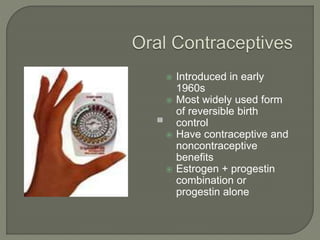
 Introduced in early
1960s
 Most widely used form
of reversible birth
control
 Have contraceptive and
noncontraceptive
benefits
 Estrogen + progestin
combination or
progestin alone
Synthetic estrogens
• Ethinyl estradiol
• Mestranol
Synthetic progestins
• Many different progestins available
 Ethinyl estradiol doses range from 20 -150 mcg
• Doses > 50mcg no longer available in US
• Low dose estrogen (35 mcg or less) recommended as initial
treatment
 Higher doses increase incidence of VTE
 Lower doses may result in significant breakthrough bleeding or spotting
 20 mcg dose helpful in premenopausal women or those with significant
estrogen side effects
• 50mcg dose needed in women on certain anticonvulsants
 Ex: Genora 1/50; Nelova 1/50, Ortho-Novum 1/50, Demulen 1/50
Progestin doses range from 0.05mg – 1mg
Differ in their androgenic, estrogenic, and
progestational activity
Norethindrone – ex: ortho-novum, necon
Norethindrone acetate – ex: junel,
estrostep, loestrin
Ethynodiol diacetate – ex: zovia
Medium androgenic potency
 High progestational and androgenic activity
 Levonorgestrel
 Most widely prescribed progestin
 Ex: Levlen, Alesse, Tri-Leven, Triphasil
 Approved for emergency contraception
 Approved for extended cycle use –ex: seasonal
 Norgestrel
• Ex: cryselle, lo-ovral
Norgestimate ( ortho-cyclen or tri-cyclen)
 FDA approved to treat acne
desogestrel (desogen, ortho-cept)
Gestodene – not available in US
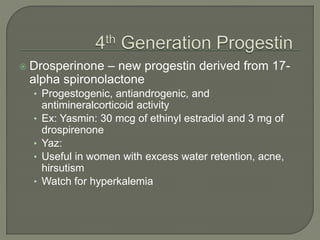
 Drosperinone – new progestin derived from 17-
alpha spironolactone
• Progestogenic, antiandrogenic, and
antimineralcorticoid activity
• Ex: Yasmin: 30 mcg of ethinyl estradiol and 3 mg of
drospirenone
• Yaz:
• Useful in women with excess water retention, acne,
hirsutism
• Watch for hyperkalemia
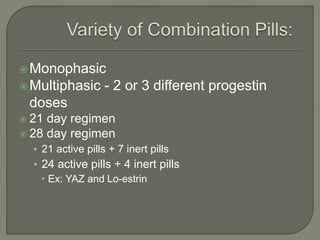
Monophasic
Multiphasic - 2 or 3 different progestin
doses
 21 day regimen
 28 day regimen
• 21 active pills + 7 inert pills
• 24 active pills + 4 inert pills
 Ex: YAZ and Lo-estrin
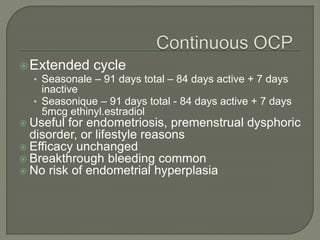
Extended cycle
• Seasonale – 91 days total – 84 days active + 7 days
inactive
• Seasonique – 91 days total - 84 days active + 7 days
5mcg ethinyl.estradiol
 Useful for endometriosis, premenstrual dysphoric
disorder, or lifestyle reasons
 Efficacy unchanged
 Breakthrough bleeding common
 No risk of endometrial hyperplasia
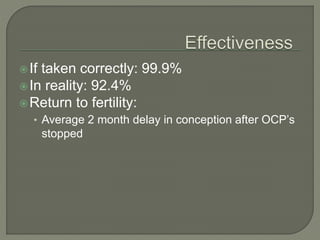
If taken correctly: 99.9%
In reality: 92.4%
Return to fertility:
• Average 2 month delay in conception after OCP’s
stopped
Suppress ovulation
Suppress follicular development
Alter cervical mucous making sperm
penetration more difficult
Alters endometrium making implantation
less likely
Definite
 Decreases dysmenorrhea
 Decreased risk of ovarian cancer
 Decreased risk of endometrial cancer by 50%
 Decreased risk of pregnancy
 Treatment of Acne
 Stroke
• Ischemic: increased risk by 2 ½ times
 Increased risk with age, HTN, Migraine headaches
 Myocardial Infarction:
• 80% of cases of MI among OC users are in smokers
• OC are contraindicated if age>=35 and smoke >15
cig/day
Hepatic vein thrombosis
Portal vein thrombosis
Splenic artery thrombosis
Mesenteric artery thrombosis
Mesenteric vein thrombosis
 Pregnant or breastfeeding
 History of DVT, MI, Stroke, Hypercoagulable
state
 Liver disease
 Smoker >15 cig/day age> 35
 Complicated Migraine Headaches or migraines
in women > age 35
 Estrogen dependent tumor –breast,
endometrium
 Uncontrolled HTN, unexplained vaginal bleeding
 Side effects:
• Breakthrough bleeding – most common reason for
discontinuation
• Nausea
• Weight gain
• Mood swings
• Breast tenderness
• Headaches
• Acne, facial hair growth
Most common in low dose combination
pills
Most frequent in the first three months as
endometrium adjusts to lower hormone
levels
Increased rate if miss a pill
Increased rates in extended use cycles
 Treatment options
• Increase estrogen dose
 Bleeding early in cycle or no withdrawal bleeding
 Ex: ortho tri cyclen lo (25 mcg) to orth-tri cyclen ( 35 mcg)
• Increase progestin dose
 Bleeding after day 14 in cycle
• Change to more androgenic progestin
 Decreases bleeding at any time during cycle
 Ex: levlen ( LNG progesterone)
• Switch from extended cycle to 28 day cycle regimen
Related to estrogen dose
Usually most severe in first 1 – 3 cycles of
OC use
Management:
• Take with food or bedtime
• Change to OC with lower estrogen dose
 Related to high estrogen content
 Usually concentrated in pill-free days and first
days of cycle
 Ischemic stroke risk increased in patients with hx
of migraines
• Do not give to women with aura or focal symptoms
• Do not give to women with migraine over age 35
• Do not give if frequent or severe migraine hx
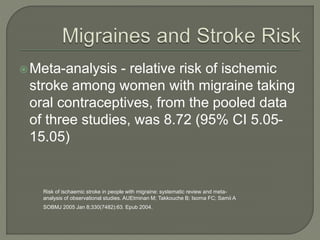
Meta-analysis - relative risk of ischemic
stroke among women with migraine taking
oral contraceptives, from the pooled data
of three studies, was 8.72 (95% CI 5.05-
15.05)
Risk of ischaemic stroke in people with migraine: systematic review and meta-
analysis of observational studies. AUEtminan M; Takkouche B; Isorna FC; Samii A
SOBMJ 2005 Jan 8;330(7482):63. Epub 2004.
 Decreased:
• Direct action on brain from progestin
• Increase in sex hormone-binding gonadotropin
induced by estrogen
 Treatment:
• OCP with less estrogenic or progestational properties
• Higher androgenic properties
 Progesteron component: levonorgestrel,dl-norgestrel,
desogestrel
 Ex: alesse, lo-ovral, levlen
The estrogen component of OC pills raises
serum concentrations of thyroxine-binding
globulin (TBG)
• Increased levels of total thyroxine & total
triiodothyronine
• No change in levels of free thyroxine and free
triiodothyronine
• T3 resin uptake will be low
 Hepatic adenoma
 Correlates with dose and duration of OCP use
 Incidence 30-40 / 1 million in OCP users
• 1 / 1 million women in non users
 Increased number, size, and risk of bleeding in
OCP users
 s/s: abdominal pain, incidental, rupture / abd
bleeding
IM injection of 150 mg every 12 weeks
99.7% success rate
medroxyprogesterone:
• Thickens cervical mucous-less penetrable to
sperm
• Suppresses ovulation
First dose given within 5 days of LMP
If given >=7th day of LMP, another form of
contraceptive should be used for 7 days
Efficacy is up to 14 weeks
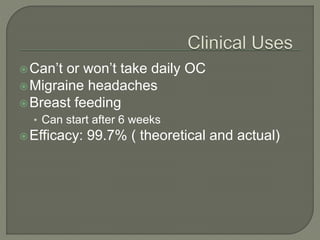
Can’t or won’t take daily OC
Migraine headaches
Breast feeding
• Can start after 6 weeks
Efficacy: 99.7% ( theoretical and actual)
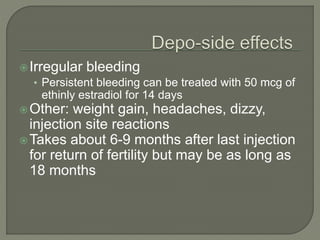
Irregular bleeding
• Persistent bleeding can be treated with 50 mcg of
ethinly estradiol for 14 days
Other: weight gain, headaches, dizzy,
injection site reactions
Takes about 6-9 months after last injection
for return of fertility but may be as long as
18 months
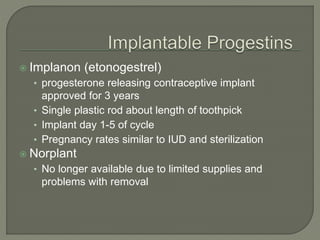
 Implanon (etonogestrel)
• progesterone releasing contraceptive implant
approved for 3 years
• Single plastic rod about length of toothpick
• Implant day 1-5 of cycle
• Pregnancy rates similar to IUD and sterilization
 Norplant
• No longer available due to limited supplies and
problems with removal
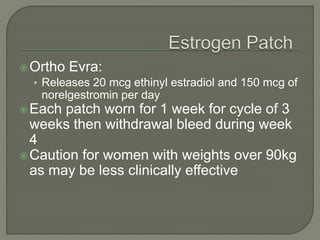
Ortho Evra:
• Releases 20 mcg ethinyl estradiol and 150 mcg of
norelgestromin per day
Each patch worn for 1 week for cycle of 3
weeks then withdrawal bleed during week
4
Caution for women with weights over 90kg
as may be less clinically effective
DVT risk:
• Steady state levels of estrogen much higher with
patch users then OCP users
• One study showed 2.4 OR increased risk of VTE
for patch users compared to OCP users
DVT: Deep Vein Thrombosis
VTE: Vascular thromboembolosis
Breast tenderness
Headache
Application site irritation
Nausea
Breakthrough bleeding
< 1 pregnancy / 100 users
Higher compliance rates than OCP users
and higher “perfect use” rates
 Delivers 15 mcg of
ethinly estradiol and
120 mcg of
etonogestrel per day
 Intravaginal for three
weeks
 Insert on or before
day 5 of LMP-use
backup for 7 days
Vaginitis
Leukorrhea
Weight gain
Nausea
Headache
Breakthrough bleeding
Similar to OCP use
Slightly higher rates of discontinuation due
to local side effects
Administer within 72 hours of unprotected
intercourse
• most effective if taken within 12 hours
Mechanism of action
• Inhibits ovulation, prevents implantation, or may
cause regression of corpus luteum
Yuzpe Regimen:
• 100mcg of ethinyl estradiol and 0.5 mg of
levonorgestrel. E.g. Ovral, Preven
(50mcg/0.25mg)
 Take 2 pills within 72 hours and 2 pills 12 hours later
• Has a 75-80% efficacy rate
• Usually requires antimetic
Levonorgestrel: Progesterone only, Plan B
• 0.75 mg Q 12 hrs for total of two doses
• Prevents 85%
• Less nausea and vomiting
Copper IUD inserted within 5 days is also
effective
 Male condom; efficacy 14/100
 Diaphragm: 20/100
 Cervical Cap:
• Never pregnant: 20/100
• Ever Pregnant: 40/100
 Today Sponge: barrier plus spermicide. Effective for 24
hours. Estimated efficacy of 89-91%
• No special fitting required
Levonorgestrel (Lng IUC)
• Mirena = trademark
• Progesterone secreting
• Can be left in place for 5 years
• First yr pregnancy rate 0.1-0.2%
• Irregular bleeding common early followed by
development of amenorrhea in 20%
Copper T (Tcu380A IUD)
• Paragard = trademark
• Copper releasing
• Approved to remain in place for 10 years
• First yr pregnancy rate 0.6-0.8%
• Heavy menses and dysmenorrhea common
• Highly effective
• Convenient
• High patient satisfaction
• Inexpensive over time
• No effect on fertility after removal
• Decreases risk of ectopic pregnancy compared to no
contraception
• LNg IUD can decrease risk of PID from newly acquired
STD’s once IUD in place
• Progestin thickens cervical mucous which acts as barrier to
ascending infection
 High initial cost
 No protection against STD’s
 Small increase risk of PID in first 20 days after
placement
• Related to contamination during insertion process and
presence of pre-existent STD’s
 If pregnancy occurs while IUD in place then
more likely to be ectopic
Lactation:
• Most useful in first three months
• Effective if woman is breast feeding full time and is
amenorrheic
Tubal Ligation
Vasectomy
Contraceptions

Contraceptions

  • 1.
  • 2.
    Review Different Methodsof Contraception Review the advantages and disadvantages of each method Choose appropriate contraception based on different clinical situations Review how to prescribe contraceptives
  • 3.
     Hormonal Contraceptives: •oral, transdermal, intravaginal, IM, implanted  Barrier Devices • Diaphragm • Condoms: male and female • Cervical Caps
  • 4.
    Surgical: • Tubal Ligation,Vasectomy Intrauterine Devices: • IUDs: copper or progesterone releasing
  • 5.
     Introduced inearly 1960s  Most widely used form of reversible birth control  Have contraceptive and noncontraceptive benefits  Estrogen + progestin combination or progestin alone
  • 6.
    Synthetic estrogens • Ethinylestradiol • Mestranol Synthetic progestins • Many different progestins available
  • 7.
     Ethinyl estradioldoses range from 20 -150 mcg • Doses > 50mcg no longer available in US • Low dose estrogen (35 mcg or less) recommended as initial treatment  Higher doses increase incidence of VTE  Lower doses may result in significant breakthrough bleeding or spotting  20 mcg dose helpful in premenopausal women or those with significant estrogen side effects • 50mcg dose needed in women on certain anticonvulsants  Ex: Genora 1/50; Nelova 1/50, Ortho-Novum 1/50, Demulen 1/50
  • 8.
    Progestin doses rangefrom 0.05mg – 1mg Differ in their androgenic, estrogenic, and progestational activity
  • 9.
    Norethindrone – ex:ortho-novum, necon Norethindrone acetate – ex: junel, estrostep, loestrin Ethynodiol diacetate – ex: zovia Medium androgenic potency
  • 10.
     High progestationaland androgenic activity  Levonorgestrel  Most widely prescribed progestin  Ex: Levlen, Alesse, Tri-Leven, Triphasil  Approved for emergency contraception  Approved for extended cycle use –ex: seasonal  Norgestrel • Ex: cryselle, lo-ovral
  • 11.
    Norgestimate ( ortho-cyclenor tri-cyclen)  FDA approved to treat acne desogestrel (desogen, ortho-cept) Gestodene – not available in US
  • 12.
     Drosperinone –new progestin derived from 17- alpha spironolactone • Progestogenic, antiandrogenic, and antimineralcorticoid activity • Ex: Yasmin: 30 mcg of ethinyl estradiol and 3 mg of drospirenone • Yaz: • Useful in women with excess water retention, acne, hirsutism • Watch for hyperkalemia
  • 13.
    Monophasic Multiphasic - 2or 3 different progestin doses  21 day regimen  28 day regimen • 21 active pills + 7 inert pills • 24 active pills + 4 inert pills  Ex: YAZ and Lo-estrin
  • 14.
    Extended cycle • Seasonale– 91 days total – 84 days active + 7 days inactive • Seasonique – 91 days total - 84 days active + 7 days 5mcg ethinyl.estradiol  Useful for endometriosis, premenstrual dysphoric disorder, or lifestyle reasons  Efficacy unchanged  Breakthrough bleeding common  No risk of endometrial hyperplasia
  • 15.
    If taken correctly:99.9% In reality: 92.4% Return to fertility: • Average 2 month delay in conception after OCP’s stopped
  • 16.
    Suppress ovulation Suppress folliculardevelopment Alter cervical mucous making sperm penetration more difficult Alters endometrium making implantation less likely
  • 17.
    Definite  Decreases dysmenorrhea Decreased risk of ovarian cancer  Decreased risk of endometrial cancer by 50%  Decreased risk of pregnancy  Treatment of Acne
  • 18.
     Stroke • Ischemic:increased risk by 2 ½ times  Increased risk with age, HTN, Migraine headaches  Myocardial Infarction: • 80% of cases of MI among OC users are in smokers • OC are contraindicated if age>=35 and smoke >15 cig/day
  • 19.
    Hepatic vein thrombosis Portalvein thrombosis Splenic artery thrombosis Mesenteric artery thrombosis Mesenteric vein thrombosis
  • 20.
     Pregnant orbreastfeeding  History of DVT, MI, Stroke, Hypercoagulable state  Liver disease  Smoker >15 cig/day age> 35  Complicated Migraine Headaches or migraines in women > age 35  Estrogen dependent tumor –breast, endometrium  Uncontrolled HTN, unexplained vaginal bleeding
  • 21.
     Side effects: •Breakthrough bleeding – most common reason for discontinuation • Nausea • Weight gain • Mood swings • Breast tenderness • Headaches • Acne, facial hair growth
  • 22.
    Most common inlow dose combination pills Most frequent in the first three months as endometrium adjusts to lower hormone levels Increased rate if miss a pill Increased rates in extended use cycles
  • 23.
     Treatment options •Increase estrogen dose  Bleeding early in cycle or no withdrawal bleeding  Ex: ortho tri cyclen lo (25 mcg) to orth-tri cyclen ( 35 mcg) • Increase progestin dose  Bleeding after day 14 in cycle • Change to more androgenic progestin  Decreases bleeding at any time during cycle  Ex: levlen ( LNG progesterone) • Switch from extended cycle to 28 day cycle regimen
  • 24.
    Related to estrogendose Usually most severe in first 1 – 3 cycles of OC use Management: • Take with food or bedtime • Change to OC with lower estrogen dose
  • 25.
     Related tohigh estrogen content  Usually concentrated in pill-free days and first days of cycle  Ischemic stroke risk increased in patients with hx of migraines • Do not give to women with aura or focal symptoms • Do not give to women with migraine over age 35 • Do not give if frequent or severe migraine hx
  • 26.
    Meta-analysis - relativerisk of ischemic stroke among women with migraine taking oral contraceptives, from the pooled data of three studies, was 8.72 (95% CI 5.05- 15.05) Risk of ischaemic stroke in people with migraine: systematic review and meta- analysis of observational studies. AUEtminan M; Takkouche B; Isorna FC; Samii A SOBMJ 2005 Jan 8;330(7482):63. Epub 2004.
  • 27.
     Decreased: • Directaction on brain from progestin • Increase in sex hormone-binding gonadotropin induced by estrogen  Treatment: • OCP with less estrogenic or progestational properties • Higher androgenic properties  Progesteron component: levonorgestrel,dl-norgestrel, desogestrel  Ex: alesse, lo-ovral, levlen
  • 28.
    The estrogen componentof OC pills raises serum concentrations of thyroxine-binding globulin (TBG) • Increased levels of total thyroxine & total triiodothyronine • No change in levels of free thyroxine and free triiodothyronine • T3 resin uptake will be low
  • 29.
     Hepatic adenoma Correlates with dose and duration of OCP use  Incidence 30-40 / 1 million in OCP users • 1 / 1 million women in non users  Increased number, size, and risk of bleeding in OCP users  s/s: abdominal pain, incidental, rupture / abd bleeding
  • 30.
    IM injection of150 mg every 12 weeks 99.7% success rate medroxyprogesterone: • Thickens cervical mucous-less penetrable to sperm • Suppresses ovulation
  • 31.
    First dose givenwithin 5 days of LMP If given >=7th day of LMP, another form of contraceptive should be used for 7 days Efficacy is up to 14 weeks
  • 32.
    Can’t or won’ttake daily OC Migraine headaches Breast feeding • Can start after 6 weeks Efficacy: 99.7% ( theoretical and actual)
  • 33.
    Irregular bleeding • Persistentbleeding can be treated with 50 mcg of ethinly estradiol for 14 days Other: weight gain, headaches, dizzy, injection site reactions Takes about 6-9 months after last injection for return of fertility but may be as long as 18 months
  • 34.
     Implanon (etonogestrel) •progesterone releasing contraceptive implant approved for 3 years • Single plastic rod about length of toothpick • Implant day 1-5 of cycle • Pregnancy rates similar to IUD and sterilization  Norplant • No longer available due to limited supplies and problems with removal
  • 35.
    Ortho Evra: • Releases20 mcg ethinyl estradiol and 150 mcg of norelgestromin per day Each patch worn for 1 week for cycle of 3 weeks then withdrawal bleed during week 4 Caution for women with weights over 90kg as may be less clinically effective
  • 36.
    DVT risk: • Steadystate levels of estrogen much higher with patch users then OCP users • One study showed 2.4 OR increased risk of VTE for patch users compared to OCP users DVT: Deep Vein Thrombosis VTE: Vascular thromboembolosis
  • 37.
    Breast tenderness Headache Application siteirritation Nausea Breakthrough bleeding
  • 38.
    < 1 pregnancy/ 100 users Higher compliance rates than OCP users and higher “perfect use” rates
  • 39.
     Delivers 15mcg of ethinly estradiol and 120 mcg of etonogestrel per day  Intravaginal for three weeks  Insert on or before day 5 of LMP-use backup for 7 days
  • 40.
  • 41.
    Similar to OCPuse Slightly higher rates of discontinuation due to local side effects
  • 42.
    Administer within 72hours of unprotected intercourse • most effective if taken within 12 hours Mechanism of action • Inhibits ovulation, prevents implantation, or may cause regression of corpus luteum
  • 43.
    Yuzpe Regimen: • 100mcgof ethinyl estradiol and 0.5 mg of levonorgestrel. E.g. Ovral, Preven (50mcg/0.25mg)  Take 2 pills within 72 hours and 2 pills 12 hours later • Has a 75-80% efficacy rate • Usually requires antimetic
  • 44.
    Levonorgestrel: Progesterone only,Plan B • 0.75 mg Q 12 hrs for total of two doses • Prevents 85% • Less nausea and vomiting Copper IUD inserted within 5 days is also effective
  • 45.
     Male condom;efficacy 14/100  Diaphragm: 20/100  Cervical Cap: • Never pregnant: 20/100 • Ever Pregnant: 40/100  Today Sponge: barrier plus spermicide. Effective for 24 hours. Estimated efficacy of 89-91% • No special fitting required
  • 46.
    Levonorgestrel (Lng IUC) •Mirena = trademark • Progesterone secreting • Can be left in place for 5 years • First yr pregnancy rate 0.1-0.2% • Irregular bleeding common early followed by development of amenorrhea in 20%
  • 47.
    Copper T (Tcu380AIUD) • Paragard = trademark • Copper releasing • Approved to remain in place for 10 years • First yr pregnancy rate 0.6-0.8% • Heavy menses and dysmenorrhea common
  • 48.
    • Highly effective •Convenient • High patient satisfaction • Inexpensive over time • No effect on fertility after removal • Decreases risk of ectopic pregnancy compared to no contraception • LNg IUD can decrease risk of PID from newly acquired STD’s once IUD in place • Progestin thickens cervical mucous which acts as barrier to ascending infection
  • 49.
     High initialcost  No protection against STD’s  Small increase risk of PID in first 20 days after placement • Related to contamination during insertion process and presence of pre-existent STD’s  If pregnancy occurs while IUD in place then more likely to be ectopic
  • 50.
    Lactation: • Most usefulin first three months • Effective if woman is breast feeding full time and is amenorrheic Tubal Ligation Vasectomy