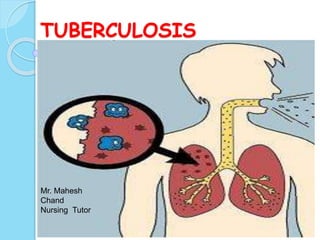
TUBERCULOSIS
Mr. Mahesh
Chand
Nursing Tutor
INTRODUCTION
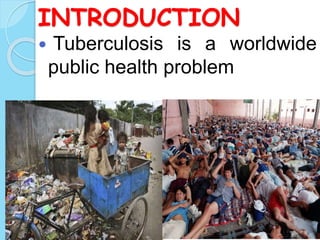
 Tuberculosis is a worldwide
public health problem
Cont.. INTRODUCTION
Cont.. INTRODUCTION
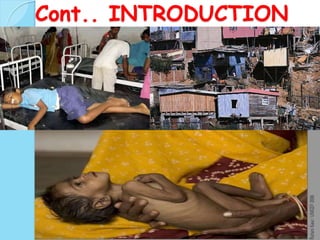
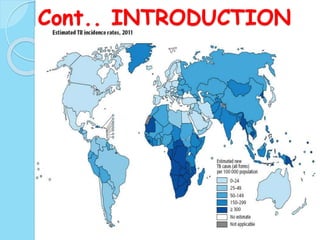
An estimated 8- 9 million
cases per year and
approximately 2 million die
annually.
Everyday 5000 people
develop the disease. India is
the highest TB burden country
in the world.
Cont.. INTRODUCTION
MEANING
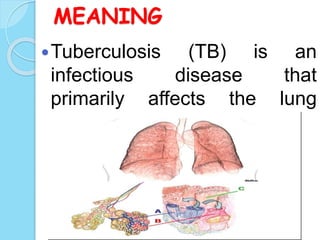
Tuberculosis (TB) is an
infectious disease that
primarily affects the lung
parenchyma .
Cont.. MEANING
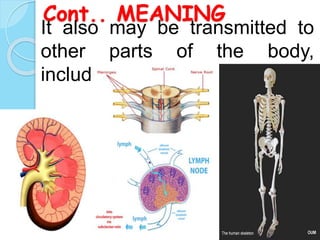
It also may be transmitted to
other parts of the body,
including the
Cont.. MEANING
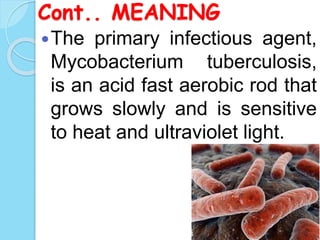
The primary infectious agent,
Mycobacterium tuberculosis,
is an acid fast aerobic rod that
grows slowly and is sensitive
to heat and ultraviolet light.
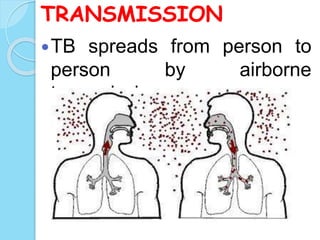
TRANSMISSION
TB spreads from person to
person by airborne
transmission
Cony..
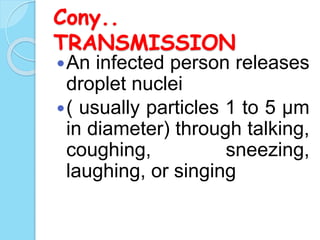
TRANSMISSION
An infected person releases
droplet nuclei
( usually particles 1 to 5 μm
in diameter) through talking,
coughing, sneezing,
laughing, or singing
RISK FACTORS
Close contact with
someone who has active
TB
Immunocompromised
status
Cont.. RISK FATCORS
Substance abuse
Any person without
adequate health care
Cont.. RISK FACTORS
Preexisting medical conditions
or special treatment
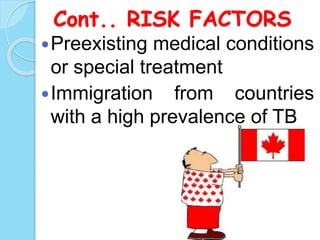
Immigration from countries
with a high prevalence of TB
Cont.. RISK FACTORS
Institutionalization
Living in overcrowded,
substandard housing
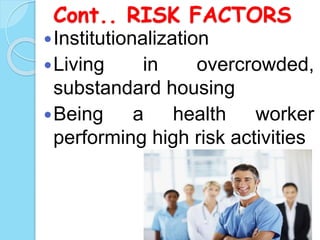
Being a health worker
performing high risk activities
PATHOPHYSIOLOGY
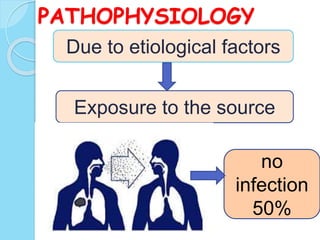
Due to etiological factors
Exposure to the source
no
infection
50%
Cont..
PATHOTHYSIOLOGY
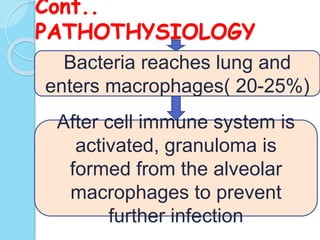
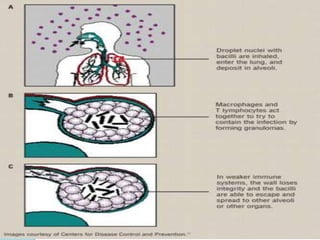
Bacteria reaches lung and
enters macrophages( 20-25%)
After cell immune system is
activated, granuloma is
formed from the alveolar
macrophages to prevent
further infection
Cont..
PATHOPHYSIOLOGY
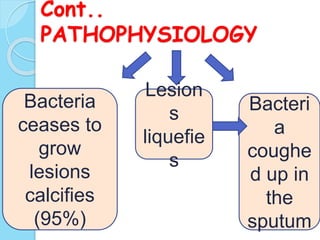
Bacteria
ceases to
grow
lesions
calcifies
(95%)
Lesion
s
liquefie
s
Bacteri
a
coughe
d up in
the
sputum
Cont..
PATHOPHYSIOLOGY
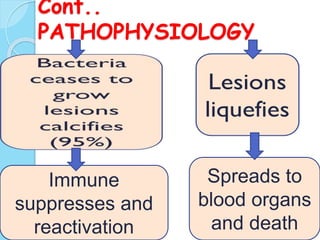
Immune
suppresses and
reactivation
Spreads to
blood organs
and death
STAGES OF
TUBERCULOSIS
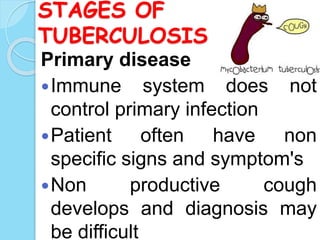
Primary disease
Immune system does not
control primary infection
Patient often have non
specific signs and symptom's
Non productive cough
develops and diagnosis may
be difficult
Cont.. STAGES
Primary progressive disease
Cough becomes productive
More signs and symptoms
appears
Diagnosis shows TB on chest
x rays and sputum culture
Cont.. STAGES
Latent disease
 Mycobacterium persist in the
body
No sign and symptoms occur
Patient are susceptible for
reactivation of disease
Granuloma lesion becomes
calcify and fibrotic and
appears on chest x rays
CLINICAL
MANIFESTATION
Low grade fever
Cough( may be productive or
nonproductive)
Night sweat
Cont.. CLINICAL
MANIFESTATION
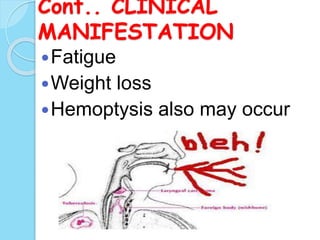
Fatigue
Weight loss
Hemoptysis also may occur
Cont.. CLINICAL
MANIFESTATION
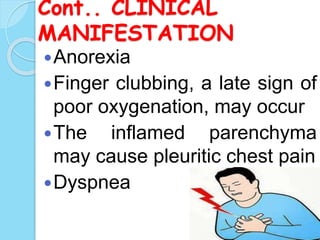
Anorexia
Finger clubbing, a late sign of
poor oxygenation, may occur
The inflamed parenchyma
may cause pleuritic chest pain
Dyspnea
DIAGNOSIS
History and physical
examination
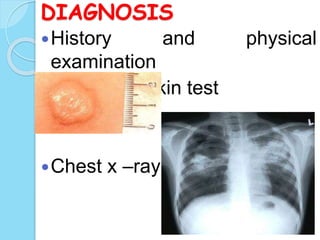
Tuberculin skin test
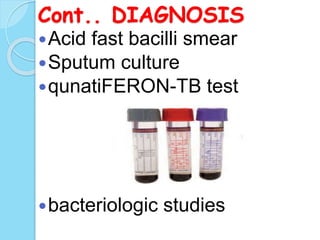
Chest x –ray
Cont.. DIAGNOSIS
Acid fast bacilli smear
Sputum culture
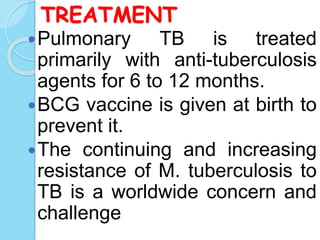
qunatiFERON-TB test
bacteriologic studies
TREATMENT
Pulmonary TB is treated
primarily with anti-tuberculosis
agents for 6 to 12 months.
BCG vaccine is given at birth to
prevent it.
The continuing and increasing
resistance of M. tuberculosis to
TB is a worldwide concern and
challenge
Cont.. TREATMENT
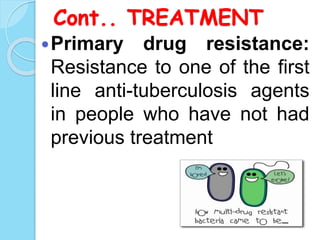
Primary drug resistance:
Resistance to one of the first
line anti-tuberculosis agents
in people who have not had
previous treatment
Cont.. TREATMENT
Secondary drug
resistance: Drug resistance
to one or more anti-
tuberculosis agents in
patients undergoing therapy
Cont.. TREATMENT
Multi drug resistance(MDR):
Resistance to two agents,
Isoniazid and rifampin
JOURNAL STUDY
Development of a
new tuberculosis vaccine: is
there value in the mucosal
approach
Effective prophylactic
vaccination remains the key
long-term strategy for
combating TB.
Cont.. JOURNAL
 It is also based on the
assumption, that the failure of
recent human vaccine trials
could have been due to a
suboptimal vaccine design and
delivery, and focuses on the
most recent advances in the
field of mucosal TB vaccine
development, with a specific
emphasis on subunit TB
Cont.. TREATMENT
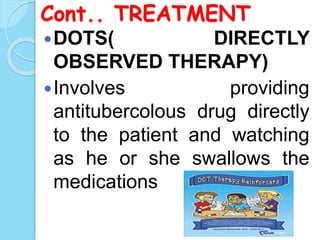
DOTS( DIRECTLY
OBSERVED THERAPY)
Involves providing
antitubercolous drug directly
to the patient and watching
as he or she swallows the
medications
Cont.. TREATMENT
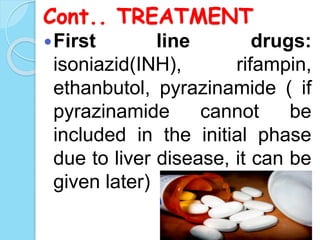
First line drugs:
isoniazid(INH), rifampin,
ethanbutol, pyrazinamide ( if
pyrazinamide cannot be
included in the initial phase
due to liver disease, it can be
given later)
Cont.. TREATMENT
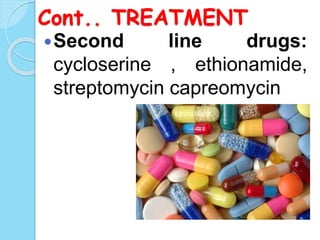
Second line drugs:
cycloserine , ethionamide,
streptomycin capreomycin
Cont.. TREATMENT
DRUG THERAPY REGIMEN
Initial phase : 4 drugs consist
of INH, rifampin,
pyrazinamide, ethanbutol for 4
months
Continuation phase: INH,
rifampin for 2 months
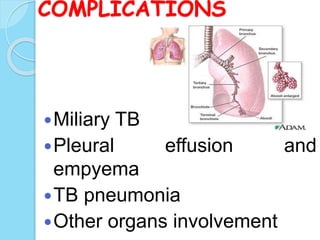
COMPLICATIONS
Miliary TB
Pleural effusion and
empyema
TB pneumonia
Other organs involvement
NURSING
MANAGEMENET
Promoting airway clearance
Advocating adherence to
treatment regimen
Promoting activity and
adequate nutrition
Preventing spreading of
tuberculosis infection
SUMMARY
QUESTION
Define tuberculosis
List major risk factors of
tuberculosis
Classify the stages of
tuberculosis
What is the treatment of
tuberculosis?
MCQ
1. BCG vaccine is used to
prevent
a. Cholera
b. Tetanus
c. Typhoid
d. Tuberculosis
Cont.. MCQ
2. Mode of transmission of
tuberculosis is
a. Direct contact
b. Inhalation
c. Ingestion
d. Sexual contact
ASSIGNMENT
A client came with the history
of fever, cough since 1 week,
weakness, anorexia,
dyspnea, weight loss; he was
diagnosed with active
tuberculosis. Write 5 care
plans for this client according
to the priority.
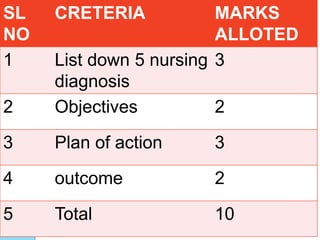
SL
NO
CRETERIA MARKS
ALLOTED
1 List down 5 nursing
diagnosis
3
2 Objectives 2
3 Plan of action 3
4 outcome 2
5 Total 10
REFERENCE
JOURNAL
GR Diogo, R. R. (2014(
september)). Development of
new tuberculosis vaccine:is
there value in the mucosal
approach. Journal of
Immunotherapy.
Cont.. REFERENCE
BOOKS
Chintamani. (2011). Medical
Surgical Nursing. Elsevier.
 3. S Suzanne, B. B.
(2011). Textbook of Medical
Surgical Nursing. Wolters
kluwer.
Cont.. REFERENCE
INTERNET
www. Pubmedcentral.com
www. Wikipedia (more)
Tuberculosis ppt

Tuberculosis ppt