Virtually Present: Preparing Healthcare
Interpreters to Thrive in Remote
Modalities
Elizabeth Guinle-Salter MA T&I, CMI
Virtually Present: Preparing Healthcare
Interpreters to Thrive in Remote
Modalities
Elizabeth Guinle-Salter MA T&I, CMI
Housekeeping
• This session is being recorded
• Certificate of Attendance
*must attend full 90 minutes
*certificates will be emailed by February 24, 2022
• Use “Q&A” to send comments / questions to the hosts
Virtually Present: Preparing Healthcare
Interpreters to Thrive in Remote
Modalities
Elizabeth Guinle-Salter MA T&I, CMI
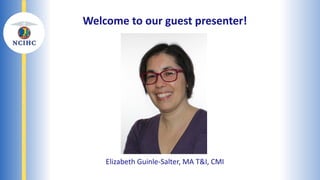
Welcome to our guest presenter!
Elizabeth Guinle-Salter, MA T&I, CMI
Virtually Present: Preparing Healthcare
Interpreters to Thrive in Remote
Modalities
Elizabeth Guinle-Salter MA T&I, CMI
OBJECTIVES
• Set up the remote working environment and tools to work
successfully for video or phone interpreting modalities
• Identify early signs and symptoms of voice and hearing injuries
suffered by interpreters in a remote modality, and train interpreters
how to apply prevention and protection strategies to help avoid
injuries
• Develop and understand how to apply effective problem-solving
strategies for some common problems that remote phone or video
interpreters may confront during interpreting encounters
REMOTE INTERPRETING WORKSPACE
SETUPS
Why should we teach interpreters workspace setups and
equipment?
• Cognitive load
• Patient safety
• Injury prevention
• Privacy
• Integrity of profession
Remote
Interpreting
Workspace
Focus Areas
• Internet speed
• Type of connection
• Laptop or Desktop
• Two screens or one
• Separate or inbuilt camera
• HIPAA (Health Insurance Portability and
Accountability Act of 1996)/others
• Software
• Desk
• Chair
• Headset or speaker
Remote
Interpreting
Workspace
Focus areas
• Acoustics
• Sound mixing devices
• Home workspace boundaries
• Dress professionally & for video
• Lighting
• Backgrounds, virtual or physical, neutral!
True Life
Inspired
Recreation!
Opportunities
to encourage
• Resources at fingertips
• Glossary building
• Expand field knowledge
INJURIES
What do we need to teach our interpreters?
• Strategies to prevent on the job injuries
• Awareness of signs/symptoms and to act on them!
• Identify the limitations in their ability to prevent injuries and
address these limitations regardless
Simple
Injury
Prevention
Tips
• Ensure the setup of the workspace/equipment
addresses safety
• Routine hearing and voice medical visits
• Limit background noise
• Breaks! (regular and after long session)
• If interpreter cannot hear others while
wearing headset, headset audio is too loud
• Speaker/headset volume to 50%, mic volume
to 100%
• Slower speech not louder speech
• Sleep and Hydration!
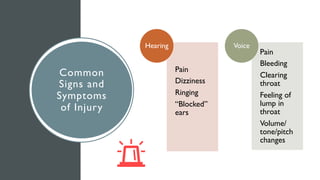
Common
Signs and
Symptoms
of Injury
Pain
Dizziness
Ringing
“Blocked”
ears
Hearing
Pain
Bleeding
Clearing
throat
Feeling of
lump in
throat
Volume/
tone/pitch
changes
Voice
Limitations:
Teach them
to Have a
Script
Provider/Patient behaviors that hurt
interpreters hearing or voice
• Multiple voices speaking [loudly] at the same time
The interpreter is requesting that parties speak one at a
time to be heard.The interpreter requests repetition.
• Items being dropped or colliding
The interpreter is experiencing ear pain from the noise
and requests that [i.e., the pills are not shaken]. The
interpreter requests repetition.
• Self advocate to avoid injuries
Limitations:
Teach them
to Have a
Script
Equipment and connections used by
providers/patients that hurt interpreters
hearing or voice
• Video connections with audio problems
The interpreter cannot safely interpret with this
audio connection and requests to switch to a phone
conference connection.
Limitations:
Teach them
to Have a
Script
• Phone connections that have audio problems
The interpreter requests that the…
[provider/patient moves away from background
noise]
[provider/patient disconnects and dials back in]
[provider/patient switches to other device]
• Self advocate to avoid injuries
REMOTE MODALITIES: COMMON
PROBLEMS AND STRATEGIES
What are some common problems?
• Interpreter cannot hear
• Provider/patient poor internet connection causing audio/video problems
• Not seeing nonverbal cues or poor camera positioning
• Ethical problems
• Misguided expectations upon the role of the interpreter
• Managing the flow
• Inappropriate modality for encounter
Common
Problems
and Scripts
• Poor provider awareness and control of
unnecessary noise
The interpreter is unable to hear and requests
that… [say what is needed]
• Poor audio/video/internet connection
The interpreter observes… [video glitching/audio
cutting out]. Can we… [convert to audio
connection only/change device]…
• Not being able to see [nonverbal
communication] due to camera
positioning
The interpreter cannot see the [patient/provider]
and requests the camera be adjusted.
Common
Problems
and Scripts
• Left connected alone with patient
The interpreter is not able to be left connected to
the patient without a provider. Please call back when
you are ready.
• Being asked to stay connected “just in
case”
The interpreter must interpret everything said when
connected
• Being asked to provide identifying
information for documentation that the
interpreter did not interpret
The interpreter did not interpret the [form
name/content of document] but can do so now
and then provide you with the identifying
information.
Common
Problems
and Scripts
Too fast, too much or too disjointed
The interpreter requests that you speak in
[complete sentences or ideas] [shorter
passages] [at a slower pace].
Interpreting
Hearing & Listening
Managing flow
0
0.5
1
1.5
2
2.5
3
3.5
4
4.5
4.5
4.5
3 Visual example of
effort on just three
competing tasks
Teach
Interpreters
to Clarify
Common
Misguided
Expectations
and When to
Hand over
Misguided expectations such as:
• No breaks required
• No replacement for long encounters necessary
• No need to transfer an encounter to a colleague
• Interpreters are IT support specialists
• No need to debrief/escalate
Hand over when is it an inappropriate modality:
• Patient cannot speak, speak beyond an inaudible
whisper
• Hard of hearing patient not wearing hearing
aids/using devices
• Some end-of-life discussions/breaking bad news
• When culturally unacceptable
• Some psych cases or those with cognitive problems
POSITIVE LASTING CHANGES
• Self advocacy skills and confidence to address problems
• Standards and ethics of the profession
• Take a seat at the table!
• Foster a culture of ongoing professional development.
READING ITEMS MENTIONED
NCIHC Code of Ethics and Standards of Practice: https://www.ncihc.org/ethics-and-standards-of-
practice
CHIA standards: https://chiaonline.org/CHIA-Standards
IMIA standards: https://www.imiaweb.org/standards/standards.asp
Basic Concepts and Models for Interpreter andTranslatorTraining, (2009) Daniel Gile
HIPAA: https://www.cdc.gov/phlp/publications/topic/healthinformationprivacy.html
UN Article: https://untoday.org/we-miss-being-able-to-understand-the-voices-in-our-
heads/?fbclid=IwAR32dLaj773oMZFMBcTc9arrCDlHlmXZTiAKbtt2v-ectjBXIHiwBwT6TeU
Voice: https://www.nidcd.nih.gov/health/taking-care-your-voice,
https://www.nidcd.nih.gov/health/hoarseness
Hearing: https://medlineplus.gov/ency/article/001061.htm
OSHA: https://www.osha.gov/
VIRTUALLY PRESENT: PREPARING HEALTHCARE
INTERPRETERS TO THRIVE IN REMOTE MODALITIES
Virtually Present: Preparing Healthcare
Interpreters to Thrive in Remote
Modalities
Elizabeth Guinle-Salter MA T&I, CMI
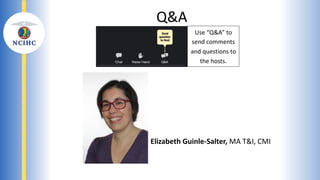
Q&A
Use “Q&A” to
send comments
and questions to
the hosts.
Elizabeth Guinle-Salter, MA T&I, CMI
Virtually Present: Preparing Healthcare
Interpreters to Thrive in Remote
Modalities
Elizabeth Guinle-Salter MA T&I, CMI
• Upcoming webinars
• Webinar evaluation form
• Follow up via email: TrainersWebinars@ncihc.org
• ncihc.org/participate
• ncihc.org/trainerswebinars
Announcements
Home for Trainers Interpreter Trainers Webinars Workgroup
An initiative of the Standards and Training Committee
ncihc.org/trainerswebinars
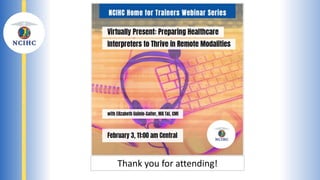
Virtually Present: Preparing Healthcare
Interpreters to Thrive in Remote
Modalities
Elizabeth Guinle-Salter MA T&I, CMI
Thank you for attending!

NCIHC HFT51 Virtually Present Slides

  • 1.
    Virtually Present: PreparingHealthcare Interpreters to Thrive in Remote Modalities Elizabeth Guinle-Salter MA T&I, CMI
  • 2.
    Virtually Present: PreparingHealthcare Interpreters to Thrive in Remote Modalities Elizabeth Guinle-Salter MA T&I, CMI Housekeeping • This session is being recorded • Certificate of Attendance *must attend full 90 minutes *certificates will be emailed by February 24, 2022 • Use “Q&A” to send comments / questions to the hosts
  • 3.
    Virtually Present: PreparingHealthcare Interpreters to Thrive in Remote Modalities Elizabeth Guinle-Salter MA T&I, CMI Welcome to our guest presenter! Elizabeth Guinle-Salter, MA T&I, CMI
  • 4.
    Virtually Present: PreparingHealthcare Interpreters to Thrive in Remote Modalities Elizabeth Guinle-Salter MA T&I, CMI
  • 5.
    OBJECTIVES • Set upthe remote working environment and tools to work successfully for video or phone interpreting modalities • Identify early signs and symptoms of voice and hearing injuries suffered by interpreters in a remote modality, and train interpreters how to apply prevention and protection strategies to help avoid injuries • Develop and understand how to apply effective problem-solving strategies for some common problems that remote phone or video interpreters may confront during interpreting encounters
  • 6.
    REMOTE INTERPRETING WORKSPACE SETUPS Whyshould we teach interpreters workspace setups and equipment? • Cognitive load • Patient safety • Injury prevention • Privacy • Integrity of profession
  • 7.
    Remote Interpreting Workspace Focus Areas • Internetspeed • Type of connection • Laptop or Desktop • Two screens or one • Separate or inbuilt camera • HIPAA (Health Insurance Portability and Accountability Act of 1996)/others • Software • Desk • Chair • Headset or speaker
  • 8.
    Remote Interpreting Workspace Focus areas • Acoustics •Sound mixing devices • Home workspace boundaries • Dress professionally & for video • Lighting • Backgrounds, virtual or physical, neutral!
  • 9.
  • 10.
    Opportunities to encourage • Resourcesat fingertips • Glossary building • Expand field knowledge
  • 11.
    INJURIES What do weneed to teach our interpreters? • Strategies to prevent on the job injuries • Awareness of signs/symptoms and to act on them! • Identify the limitations in their ability to prevent injuries and address these limitations regardless
  • 12.
    Simple Injury Prevention Tips • Ensure thesetup of the workspace/equipment addresses safety • Routine hearing and voice medical visits • Limit background noise • Breaks! (regular and after long session) • If interpreter cannot hear others while wearing headset, headset audio is too loud • Speaker/headset volume to 50%, mic volume to 100% • Slower speech not louder speech • Sleep and Hydration!
  • 13.
  • 14.
    Limitations: Teach them to Havea Script Provider/Patient behaviors that hurt interpreters hearing or voice • Multiple voices speaking [loudly] at the same time The interpreter is requesting that parties speak one at a time to be heard.The interpreter requests repetition. • Items being dropped or colliding The interpreter is experiencing ear pain from the noise and requests that [i.e., the pills are not shaken]. The interpreter requests repetition. • Self advocate to avoid injuries
  • 15.
    Limitations: Teach them to Havea Script Equipment and connections used by providers/patients that hurt interpreters hearing or voice • Video connections with audio problems The interpreter cannot safely interpret with this audio connection and requests to switch to a phone conference connection.
  • 16.
    Limitations: Teach them to Havea Script • Phone connections that have audio problems The interpreter requests that the… [provider/patient moves away from background noise] [provider/patient disconnects and dials back in] [provider/patient switches to other device] • Self advocate to avoid injuries
  • 17.
    REMOTE MODALITIES: COMMON PROBLEMSAND STRATEGIES What are some common problems? • Interpreter cannot hear • Provider/patient poor internet connection causing audio/video problems • Not seeing nonverbal cues or poor camera positioning • Ethical problems • Misguided expectations upon the role of the interpreter • Managing the flow • Inappropriate modality for encounter
  • 18.
    Common Problems and Scripts • Poorprovider awareness and control of unnecessary noise The interpreter is unable to hear and requests that… [say what is needed] • Poor audio/video/internet connection The interpreter observes… [video glitching/audio cutting out]. Can we… [convert to audio connection only/change device]… • Not being able to see [nonverbal communication] due to camera positioning The interpreter cannot see the [patient/provider] and requests the camera be adjusted.
  • 19.
    Common Problems and Scripts • Leftconnected alone with patient The interpreter is not able to be left connected to the patient without a provider. Please call back when you are ready. • Being asked to stay connected “just in case” The interpreter must interpret everything said when connected • Being asked to provide identifying information for documentation that the interpreter did not interpret The interpreter did not interpret the [form name/content of document] but can do so now and then provide you with the identifying information.
  • 20.
    Common Problems and Scripts Too fast,too much or too disjointed The interpreter requests that you speak in [complete sentences or ideas] [shorter passages] [at a slower pace]. Interpreting Hearing & Listening Managing flow 0 0.5 1 1.5 2 2.5 3 3.5 4 4.5 4.5 4.5 3 Visual example of effort on just three competing tasks
  • 21.
    Teach Interpreters to Clarify Common Misguided Expectations and Whento Hand over Misguided expectations such as: • No breaks required • No replacement for long encounters necessary • No need to transfer an encounter to a colleague • Interpreters are IT support specialists • No need to debrief/escalate Hand over when is it an inappropriate modality: • Patient cannot speak, speak beyond an inaudible whisper • Hard of hearing patient not wearing hearing aids/using devices • Some end-of-life discussions/breaking bad news • When culturally unacceptable • Some psych cases or those with cognitive problems
  • 22.
    POSITIVE LASTING CHANGES •Self advocacy skills and confidence to address problems • Standards and ethics of the profession • Take a seat at the table! • Foster a culture of ongoing professional development.
  • 23.
    READING ITEMS MENTIONED NCIHCCode of Ethics and Standards of Practice: https://www.ncihc.org/ethics-and-standards-of- practice CHIA standards: https://chiaonline.org/CHIA-Standards IMIA standards: https://www.imiaweb.org/standards/standards.asp Basic Concepts and Models for Interpreter andTranslatorTraining, (2009) Daniel Gile HIPAA: https://www.cdc.gov/phlp/publications/topic/healthinformationprivacy.html UN Article: https://untoday.org/we-miss-being-able-to-understand-the-voices-in-our- heads/?fbclid=IwAR32dLaj773oMZFMBcTc9arrCDlHlmXZTiAKbtt2v-ectjBXIHiwBwT6TeU Voice: https://www.nidcd.nih.gov/health/taking-care-your-voice, https://www.nidcd.nih.gov/health/hoarseness Hearing: https://medlineplus.gov/ency/article/001061.htm OSHA: https://www.osha.gov/
  • 24.
    VIRTUALLY PRESENT: PREPARINGHEALTHCARE INTERPRETERS TO THRIVE IN REMOTE MODALITIES
  • 25.
    Virtually Present: PreparingHealthcare Interpreters to Thrive in Remote Modalities Elizabeth Guinle-Salter MA T&I, CMI Q&A Use “Q&A” to send comments and questions to the hosts. Elizabeth Guinle-Salter, MA T&I, CMI
  • 26.
    Virtually Present: PreparingHealthcare Interpreters to Thrive in Remote Modalities Elizabeth Guinle-Salter MA T&I, CMI • Upcoming webinars • Webinar evaluation form • Follow up via email: TrainersWebinars@ncihc.org • ncihc.org/participate • ncihc.org/trainerswebinars Announcements Home for Trainers Interpreter Trainers Webinars Workgroup An initiative of the Standards and Training Committee ncihc.org/trainerswebinars
  • 27.
    Virtually Present: PreparingHealthcare Interpreters to Thrive in Remote Modalities Elizabeth Guinle-Salter MA T&I, CMI Thank you for attending!