Simultaneous Translation
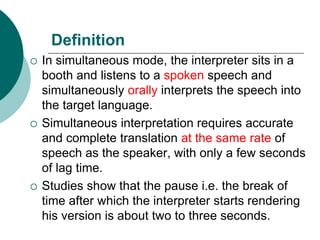
Definition
 In simultaneous mode, the interpreter sits in a
booth and listens to a spoken speech and
simultaneously orally interprets the speech into
the target language.
 Simultaneous interpretation requires accurate
and complete translation at the same rate of
speech as the speaker, with only a few seconds
of lag time.
 Studies show that the pause i.e. the break of
time after which the interpreter starts rendering
his version is about two to three seconds.
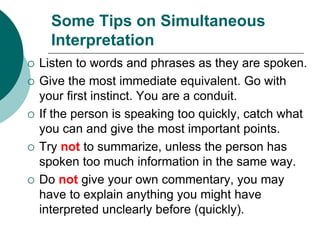
Some Tips on Simultaneous
Interpretation
 Listen to words and phrases as they are spoken.
 Give the most immediate equivalent. Go with
your first instinct. You are a conduit.
 If the person is speaking too quickly, catch what
you can and give the most important points.
 Try not to summarize, unless the person has
spoken too much information in the same way.
 Do not give your own commentary, you may
have to explain anything you might have
interpreted unclearly before (quickly).
 Keep a notepad next to you to write down:
 Words you do not know the translation of. Look
them up at home and memorize.
 Compile a vocabulary list depending on the
topic of the speech and always try to be
prepared.
 Don’t worry about confusing near synonyms
e.g. “glorify,” “praise,” etc.
 Practice, practice, practice.
 Listen to many recordings in Arabic and English and
interpret them (keep a record of your problems).

Introduction to Simultaneous Interpreting.ppt

  • 1.
  • 2.
    Definition  In simultaneousmode, the interpreter sits in a booth and listens to a spoken speech and simultaneously orally interprets the speech into the target language.  Simultaneous interpretation requires accurate and complete translation at the same rate of speech as the speaker, with only a few seconds of lag time.  Studies show that the pause i.e. the break of time after which the interpreter starts rendering his version is about two to three seconds.
  • 3.
    Some Tips onSimultaneous Interpretation  Listen to words and phrases as they are spoken.  Give the most immediate equivalent. Go with your first instinct. You are a conduit.  If the person is speaking too quickly, catch what you can and give the most important points.  Try not to summarize, unless the person has spoken too much information in the same way.  Do not give your own commentary, you may have to explain anything you might have interpreted unclearly before (quickly).
  • 4.
     Keep anotepad next to you to write down:  Words you do not know the translation of. Look them up at home and memorize.  Compile a vocabulary list depending on the topic of the speech and always try to be prepared.  Don’t worry about confusing near synonyms e.g. “glorify,” “praise,” etc.  Practice, practice, practice.  Listen to many recordings in Arabic and English and interpret them (keep a record of your problems).