Note 
Note-Taking for 
Consecutive Interpreting 
Cristiano Mazzei 
Century College 
Director, Translating & Interpreting (TRIN) Program 
www.century.edu/trin 
blog: http://trincentury.wordpress.com/
Importance of note 
note-taking 
y 
Katharine Allen (51stATA Conference, Denver) 
◦ 
Importance of developing note-taking skills in community interpreting 
x 
so that we’re not interrupting speakers all the time for short consecutive interpretation. 
◦ 
Community interpreting training programs are teaching would-be interpreters to interrupt people all the time 
x 
Sometimes the medical provider is giving a long explanation to the patient about his/her condition and their plans for patient recovery. 
◦ 
If interrupted they might lose track of what they’re saying, etc.
Importance of note 
note-taking 
y 
In court, 
◦ 
Many interpreters are now using digital recorders in the long consecutive mode 
x 
Then providing simultaneous interpretation 
y 
However, recorders sometimes fail (technical problems, etc)
Note 
Note-taking? 
y 
But, long consecutive interpreting with note-taking may not be the best model all the time 
◦ 
the distance between the original speech and the interpreted rendition is too long 
x 
paralinguistic elements (nonverbal communication, intonation, emotional outbursts, etc) are lost. 
◦ 
Maybe in these emotionally charged settings, the simultaneous mode would be the best format? Thoughts?
Jean 
Jean-Fran François Rozan (1956) 
ois ◦ 
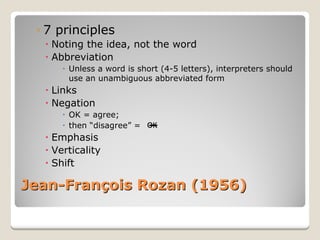
7 principles 
x 
Noting the idea, not the word 
x 
Abbreviation 
x 
Unless a word is short (4-5 letters), interpreters should use an unambiguous abbreviated form 
x 
Links 
x 
Negation 
x 
OK = agree; 
x 
then “disagree”= 
x 
Emphasis 
x 
Verticality 
x 
Shift 
OK
Notes 
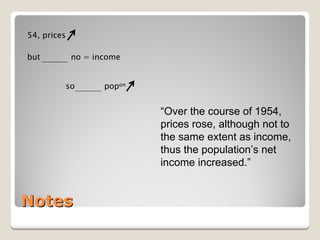
54, pricesbutno = incomesopopon 
“Over the course of 1954, prices rose, although not to the same extent as income, thus the population’s net income increased.”
Andrew Gillies (2005) 
y 
Macro 
◦ 
Looking at the bigger picture 
◦ 
Structure, framework, the way the speech is built up 
y 
Micro-level 
x 
Words, expressions 
y 
Note-taking for consecutive interpreting 
x 
Skeleton structure of the speech. 
x 
Visual representation of your analysis of the source speech.
Note 
Note-taking 
y 
Different tasks 
x 
Phase 1: listening and analysis, note-taking, short-term memory operations, coordination of these tasks 
x 
Phase 2: note-reading, remembering, production 
y 
Difficulties: 
x 
If you’re thinking too much about how to note something, you will listen less well. 
x 
If your notes are unclear or illegible your production will suffer because you’ll put too much effort into reading them.
Note 
Note-taking 
y 
Dissecting the speech 
x 
Analyzing its structure, progression 
x 
Analyzing the communicative function of different parts of the speech 
x 
Recognizing the main ideas and secondary ones 
x 
Spotting the links between them
Mini Summaries 
y 
To summarize: 
◦ 
Function and structure of the speech’s parts. 
◦ 
Not the content!
Mind Maps 
y 
Way of organizing information on a piece of paper 
y 
Organic chart 
y 
Words and drawings are connected to one-another on the page in various ways 
◦ 
Lines 
◦ 
Position on the page relative to one another 
y 
How the mind associates and recalls information
Mind Maps 
y 
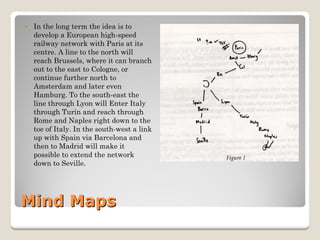
In the long term the idea is to develop a European high-speed railway network with Paris at its centre. A line to the north will reach Brussels, where it can branch out to the east to Cologne, or continue further north to Amsterdam and later even Hamburg. To the south-east the line through Lyon will Enter Italy through Turin and reach through Rome and Naples right down to the toe of Italy. In the south-west a link up with Spain via Barcelona and then to Madrid will make it possible to extend the network down to Seville.
SOV 
y 
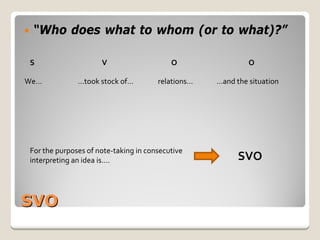
“Who did what to whom?” 
y 
The sentence 
◦ 
Basic unit of communication 
x 
Subject 
x 
Verb 
x 
Object
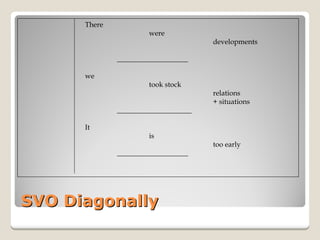
SVO 
y 
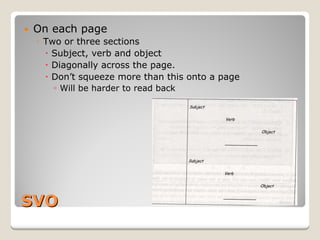
“Who does what to whom (or to what)?” 
S 
V 
O 
O 
We… 
…took stock of… 
relations… 
…and the situation 
For the purposes of note‐taking in consecutive interpreting an idea is…. 
SVO
SVO 
y 
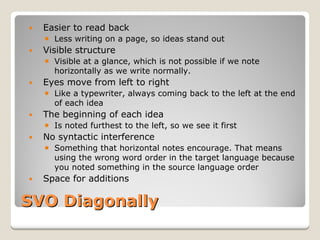
On each page 
◦ 
Two or three sections 
x 
Subject, verb and object 
x 
Diagonally across the page. 
x 
Don’t squeeze more than this onto a page 
◦ 
Will be harder to read back
SVO Diagonally 
y 
Easier to read back 
ƒ 
Less writing on a page, so ideas stand out 
y 
Visible structure 
ƒ 
Visible at a glance, which is not possible if we note horizontally as we write normally. 
y 
Eyes move from left to right 
ƒ 
Like a typewriter, always coming back to the left at the end of each idea 
y 
The beginning of each idea 
ƒ 
Is noted furthest to the left, so we see it first 
y 
No syntactic interference 
ƒ 
Something that horizontal notes encourage. That means using the wrong word order in the target language because you noted something in the source language order 
y 
Space for additions
SVO Diagonally 
Thereweredevelopments____________________ wetook stockrelations+ situations_____________________ Itistoo early____________________
Links 
y 
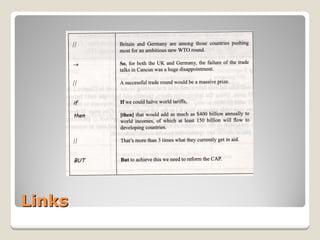
Links 
◦ 
Signal the way the speaker wants to listener to relate what is about to be said to what has been said before 
y 
Speech 
x 
Ideas 
x 
Links between them
Links 
y 
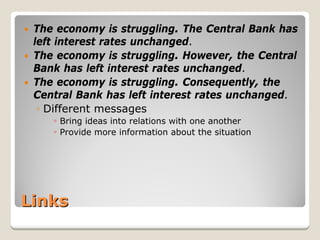
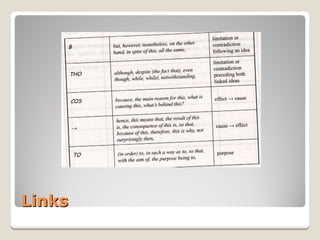
The economy is struggling. The Central Bank has left interest rates unchanged. 
y 
The economy is struggling. However, the Central Bank has left interest rates unchanged. 
y 
The economy is struggling. Consequently, the Central Bank has left interest rates unchanged. 
◦ 
Different messages 
◦ 
Bring ideas into relations with one another 
◦ 
Provide more information about the situation
Links
Links
Parallel Values 
y 
It’s not uncommon for speakers to have the same subject doing many different things. 
y 
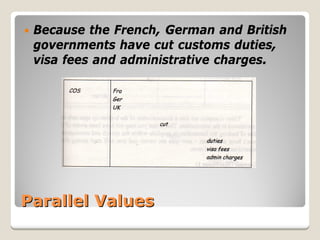
By noting the verbs parallel to one another on the page 
◦ 
Clearly see they have the same subject
Parallel Values 
y 
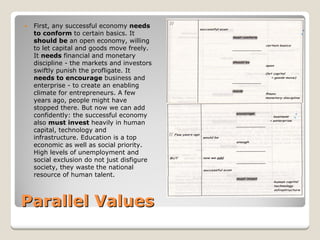
First, any successful economy needs to conform to certain basics. It should bean open economy, willing to let capital and goods move freely. It needsfinancial and monetary discipline -the markets and investors swiftly punish the profligate. It needs to encouragebusiness and enterprise -to create an enabling climate for entrepreneurs. A few years ago, people might have stopped there. But now we can add confidently: the successful economy also must invest heavily in human capital, technology and infrastructure. Education is a top economic as well as social priority. High levels of unemployment and social exclusion do not just disfigure society, they waste the national resource of human talent.
Parallel Values 
◦ 
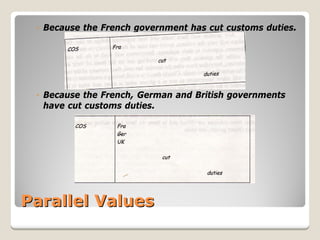
Because the French government has cut customs duties. 
◦ 
Because the French, German and British governments have cut customs duties.
Parallel Values 
y 
Because the French, German and British governments have cut customs duties, visa fees and administrative charges.
Brackets 
y 
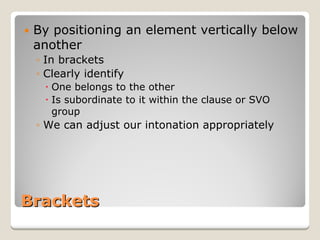
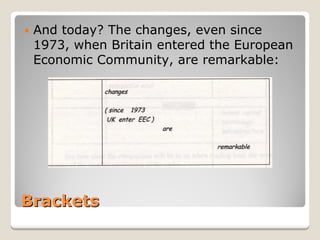
By positioning an element vertically below another 
◦ 
In brackets 
◦ 
Clearly identify 
x 
One belongs to the other 
x 
Is subordinate to it within the clause or SVO group 
◦ 
We can adjust our intonation appropriately
Brackets 
y 
And today? The changes, even since 1973, when Britain entered the European Economic Community, are remarkable:
Symbols 
y 
First thing students interpreters ask about 
y 
Knowing a reasonable number of useful symbols can make our lives easier 
◦ 
But unimportant when compared to all of what we have read before 
◦ 
If you don’t have a consistent and meaningful note-taking system 
x 
No symbol is going to help you
Symbols 
y 
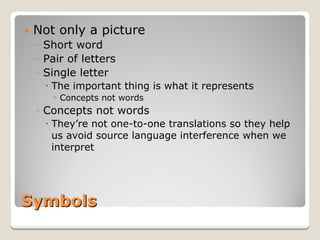
Not only a picture 
◦ 
Short word 
◦ 
Pair of letters 
◦ 
Single letter 
x 
The important thing is what it represents 
◦ 
Concepts not words 
◦ 
Concepts not words 
x 
They’re not one-to-one translations so they help us avoid source language interference when we interpret
Symbols 
y 
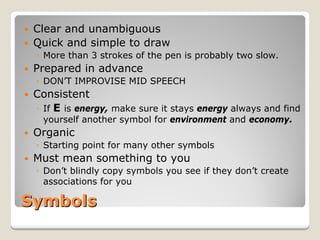
Clear and unambiguous 
y 
Quick and simple to draw 
◦ 
More than 3 strokes of the pen is probably two slow. 
y 
Prepared in advance 
◦ 
DON’T IMPROVISE MID SPEECH 
y 
Consistent 
◦ 
If E is energy, make sure it stays energy always and find yourself another symbol for environment and economy. 
y 
Organic 
◦ 
Starting point for many other symbols 
y 
Must mean something to you 
◦ 
Don’t blindly copy symbols you see if they don’t create associations for you
Symbols 
- Organic 
y 
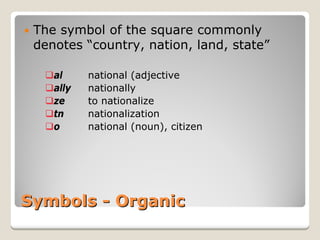
The symbol of the square commonly denotes “country, nation, land, state” 
‰ 
alnational (adjective 
‰ 
allynationally 
‰ 
zeto nationalize 
‰ 
tnnationalization 
‰ 
onational (noun), citizen
Symbols 
–– The Arrow 
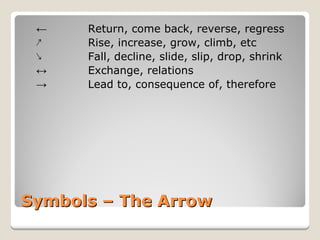
← Return, come back, reverse, regress 
↗ Rise, increase, grow, climb, etc 
↘ Fall, decline, slide, slip, drop, shrink 
↔ Exchange, relations 
→ Lead to, consequence of, therefore
Symbols 
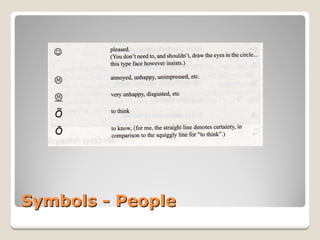
- People
Symbols 
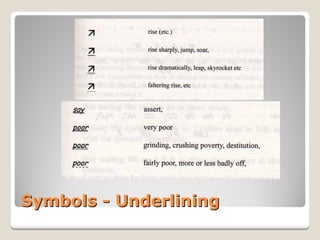
- Underlining
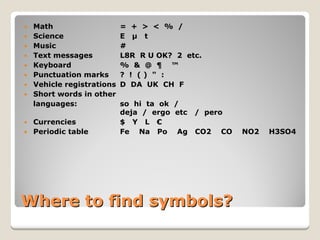
Where to find symbols? 
y 
Math=+><%/ 
y 
ScienceEμt 
y 
Music# 
y 
Text messagesL8RR U OK?2etc. 
y 
Keyboard%&@¶™ 
y 
Punctuation marks?!()": 
y 
Vehicle registrationsDDAUKCHF 
y 
Short words in other 
languages: so hi ta ok / deja/ergoetc/pero 
y 
Currencies$ YL € 
y 
Periodic tableFe Na Po Ag CO2 CO NO2 H3SO4
Reproduction/ Delivery 
y 
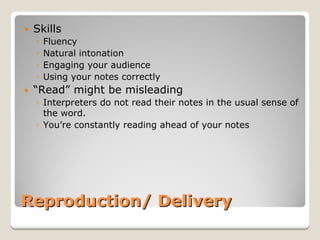
Skills 
◦ 
Fluency 
◦ 
Natural intonation 
◦ 
Engaging your audience 
◦ 
Using your notes correctly 
y 
“Read”might be misleading 
◦ 
Interpreters do not read their notes in the usual sense of the word. 
◦ 
You’re constantly reading ahead of your notes
Reproduction/ Delivery 
◦ 
Good speakers vary 
x 
Volume 
x 
Speed 
x 
Tone of delivery 
◦ 
Interpreters will want to do the same 
x 
Based on 
◦ 
What the speaker said 
◦ 
Memory 
◦ 
Notes taken
References 
y 
Rozan, Jean-François. Note-taking in Consecutive Interpreting. Trans. Andrew Gillies. Tertium. Poland, 2004. 
y 
Gillies, Andrew.Note-Taking for Consecutive Interpreting: A Short Course. St. Jerome. 2005 
y 
http://interpreters.free.fr/

Note taking for consecutive interpreting

  • 1.
    Note Note-Taking for Consecutive Interpreting Cristiano Mazzei Century College Director, Translating & Interpreting (TRIN) Program www.century.edu/trin blog: http://trincentury.wordpress.com/
  • 2.
    Importance of note note-taking y Katharine Allen (51stATA Conference, Denver) ◦ Importance of developing note-taking skills in community interpreting x so that we’re not interrupting speakers all the time for short consecutive interpretation. ◦ Community interpreting training programs are teaching would-be interpreters to interrupt people all the time x Sometimes the medical provider is giving a long explanation to the patient about his/her condition and their plans for patient recovery. ◦ If interrupted they might lose track of what they’re saying, etc.
  • 3.
    Importance of note note-taking y In court, ◦ Many interpreters are now using digital recorders in the long consecutive mode x Then providing simultaneous interpretation y However, recorders sometimes fail (technical problems, etc)
  • 4.
    Note Note-taking? y But, long consecutive interpreting with note-taking may not be the best model all the time ◦ the distance between the original speech and the interpreted rendition is too long x paralinguistic elements (nonverbal communication, intonation, emotional outbursts, etc) are lost. ◦ Maybe in these emotionally charged settings, the simultaneous mode would be the best format? Thoughts?
  • 5.
    Jean Jean-Fran FrançoisRozan (1956) ois ◦ 7 principles x Noting the idea, not the word x Abbreviation x Unless a word is short (4-5 letters), interpreters should use an unambiguous abbreviated form x Links x Negation x OK = agree; x then “disagree”= x Emphasis x Verticality x Shift OK
  • 6.
    Notes 54, pricesbutno= incomesopopon “Over the course of 1954, prices rose, although not to the same extent as income, thus the population’s net income increased.”
  • 7.
    Andrew Gillies (2005) y Macro ◦ Looking at the bigger picture ◦ Structure, framework, the way the speech is built up y Micro-level x Words, expressions y Note-taking for consecutive interpreting x Skeleton structure of the speech. x Visual representation of your analysis of the source speech.
  • 8.
    Note Note-taking y Different tasks x Phase 1: listening and analysis, note-taking, short-term memory operations, coordination of these tasks x Phase 2: note-reading, remembering, production y Difficulties: x If you’re thinking too much about how to note something, you will listen less well. x If your notes are unclear or illegible your production will suffer because you’ll put too much effort into reading them.
  • 9.
    Note Note-taking y Dissecting the speech x Analyzing its structure, progression x Analyzing the communicative function of different parts of the speech x Recognizing the main ideas and secondary ones x Spotting the links between them
  • 10.
    Mini Summaries y To summarize: ◦ Function and structure of the speech’s parts. ◦ Not the content!
  • 11.
    Mind Maps y Way of organizing information on a piece of paper y Organic chart y Words and drawings are connected to one-another on the page in various ways ◦ Lines ◦ Position on the page relative to one another y How the mind associates and recalls information
  • 12.
    Mind Maps y In the long term the idea is to develop a European high-speed railway network with Paris at its centre. A line to the north will reach Brussels, where it can branch out to the east to Cologne, or continue further north to Amsterdam and later even Hamburg. To the south-east the line through Lyon will Enter Italy through Turin and reach through Rome and Naples right down to the toe of Italy. In the south-west a link up with Spain via Barcelona and then to Madrid will make it possible to extend the network down to Seville.
  • 13.
    SOV y “Whodid what to whom?” y The sentence ◦ Basic unit of communication x Subject x Verb x Object
  • 14.
    SVO y “Whodoes what to whom (or to what)?” S V O O We… …took stock of… relations… …and the situation For the purposes of note‐taking in consecutive interpreting an idea is…. SVO
  • 16.
    SVO y Oneach page ◦ Two or three sections x Subject, verb and object x Diagonally across the page. x Don’t squeeze more than this onto a page ◦ Will be harder to read back
  • 17.
    SVO Diagonally y Easier to read back ƒ Less writing on a page, so ideas stand out y Visible structure ƒ Visible at a glance, which is not possible if we note horizontally as we write normally. y Eyes move from left to right ƒ Like a typewriter, always coming back to the left at the end of each idea y The beginning of each idea ƒ Is noted furthest to the left, so we see it first y No syntactic interference ƒ Something that horizontal notes encourage. That means using the wrong word order in the target language because you noted something in the source language order y Space for additions
  • 18.
    SVO Diagonally Thereweredevelopments____________________wetook stockrelations+ situations_____________________ Itistoo early____________________
  • 19.
    Links y Links ◦ Signal the way the speaker wants to listener to relate what is about to be said to what has been said before y Speech x Ideas x Links between them
  • 20.
    Links y Theeconomy is struggling. The Central Bank has left interest rates unchanged. y The economy is struggling. However, the Central Bank has left interest rates unchanged. y The economy is struggling. Consequently, the Central Bank has left interest rates unchanged. ◦ Different messages ◦ Bring ideas into relations with one another ◦ Provide more information about the situation
  • 21.
  • 22.
  • 23.
    Parallel Values y It’s not uncommon for speakers to have the same subject doing many different things. y By noting the verbs parallel to one another on the page ◦ Clearly see they have the same subject
  • 24.
    Parallel Values y First, any successful economy needs to conform to certain basics. It should bean open economy, willing to let capital and goods move freely. It needsfinancial and monetary discipline -the markets and investors swiftly punish the profligate. It needs to encouragebusiness and enterprise -to create an enabling climate for entrepreneurs. A few years ago, people might have stopped there. But now we can add confidently: the successful economy also must invest heavily in human capital, technology and infrastructure. Education is a top economic as well as social priority. High levels of unemployment and social exclusion do not just disfigure society, they waste the national resource of human talent.
  • 25.
    Parallel Values ◦ Because the French government has cut customs duties. ◦ Because the French, German and British governments have cut customs duties.
  • 26.
    Parallel Values y Because the French, German and British governments have cut customs duties, visa fees and administrative charges.
  • 27.
    Brackets y Bypositioning an element vertically below another ◦ In brackets ◦ Clearly identify x One belongs to the other x Is subordinate to it within the clause or SVO group ◦ We can adjust our intonation appropriately
  • 28.
    Brackets y Andtoday? The changes, even since 1973, when Britain entered the European Economic Community, are remarkable:
  • 29.
    Symbols y Firstthing students interpreters ask about y Knowing a reasonable number of useful symbols can make our lives easier ◦ But unimportant when compared to all of what we have read before ◦ If you don’t have a consistent and meaningful note-taking system x No symbol is going to help you
  • 30.
    Symbols y Notonly a picture ◦ Short word ◦ Pair of letters ◦ Single letter x The important thing is what it represents ◦ Concepts not words ◦ Concepts not words x They’re not one-to-one translations so they help us avoid source language interference when we interpret
  • 31.
    Symbols y Clearand unambiguous y Quick and simple to draw ◦ More than 3 strokes of the pen is probably two slow. y Prepared in advance ◦ DON’T IMPROVISE MID SPEECH y Consistent ◦ If E is energy, make sure it stays energy always and find yourself another symbol for environment and economy. y Organic ◦ Starting point for many other symbols y Must mean something to you ◦ Don’t blindly copy symbols you see if they don’t create associations for you
  • 32.
    Symbols - Organic y The symbol of the square commonly denotes “country, nation, land, state” ‰ alnational (adjective ‰ allynationally ‰ zeto nationalize ‰ tnnationalization ‰ onational (noun), citizen
  • 33.
    Symbols –– TheArrow ← Return, come back, reverse, regress ↗ Rise, increase, grow, climb, etc ↘ Fall, decline, slide, slip, drop, shrink ↔ Exchange, relations → Lead to, consequence of, therefore
  • 34.
  • 35.
  • 36.
    Where to findsymbols? y Math=+><%/ y ScienceEμt y Music# y Text messagesL8RR U OK?2etc. y Keyboard%&@¶™ y Punctuation marks?!()": y Vehicle registrationsDDAUKCHF y Short words in other languages: so hi ta ok / deja/ergoetc/pero y Currencies$ YL € y Periodic tableFe Na Po Ag CO2 CO NO2 H3SO4
  • 37.
    Reproduction/ Delivery y Skills ◦ Fluency ◦ Natural intonation ◦ Engaging your audience ◦ Using your notes correctly y “Read”might be misleading ◦ Interpreters do not read their notes in the usual sense of the word. ◦ You’re constantly reading ahead of your notes
  • 38.
    Reproduction/ Delivery ◦ Good speakers vary x Volume x Speed x Tone of delivery ◦ Interpreters will want to do the same x Based on ◦ What the speaker said ◦ Memory ◦ Notes taken
  • 39.
    References y Rozan,Jean-François. Note-taking in Consecutive Interpreting. Trans. Andrew Gillies. Tertium. Poland, 2004. y Gillies, Andrew.Note-Taking for Consecutive Interpreting: A Short Course. St. Jerome. 2005 y http://interpreters.free.fr/