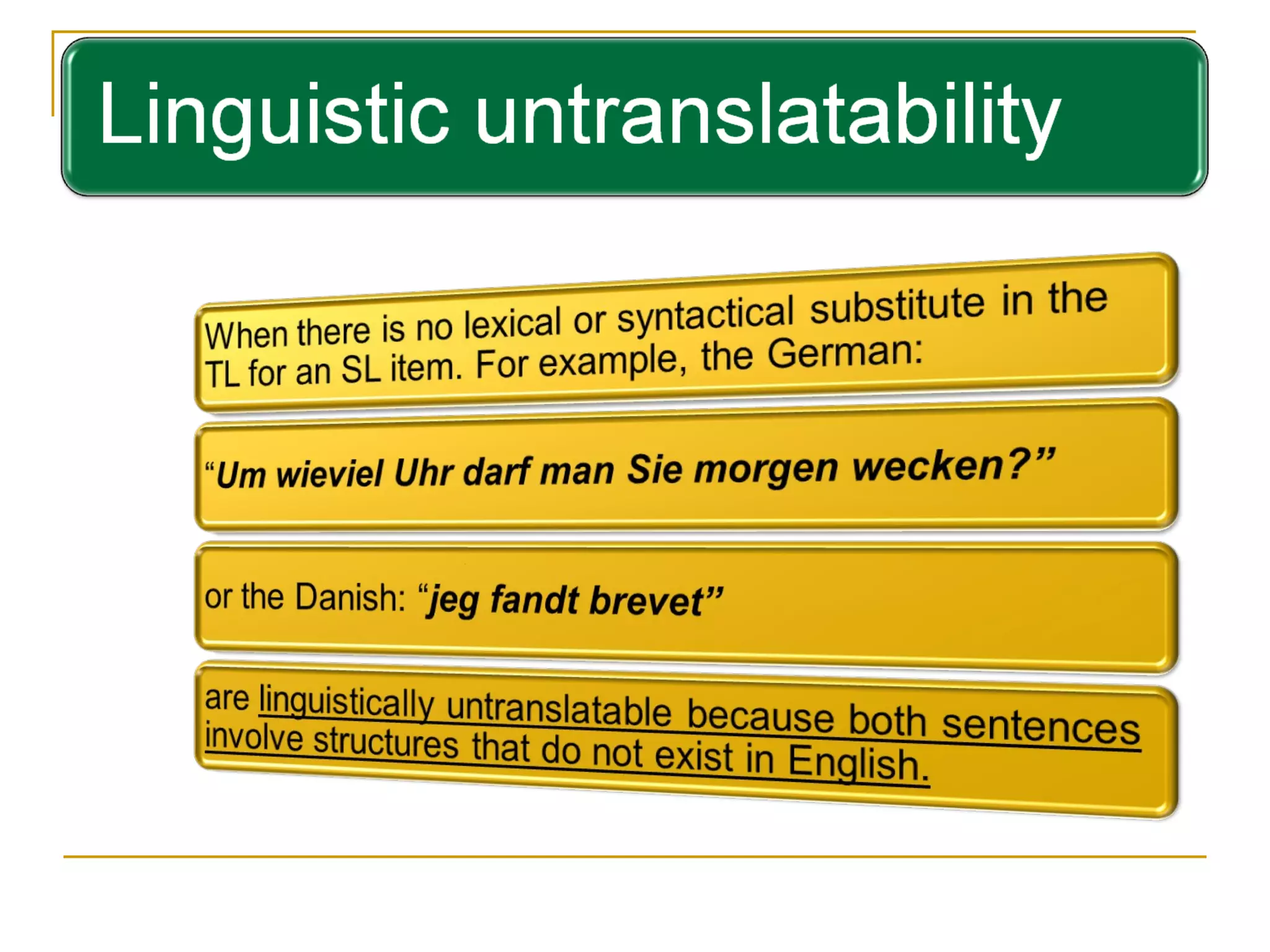
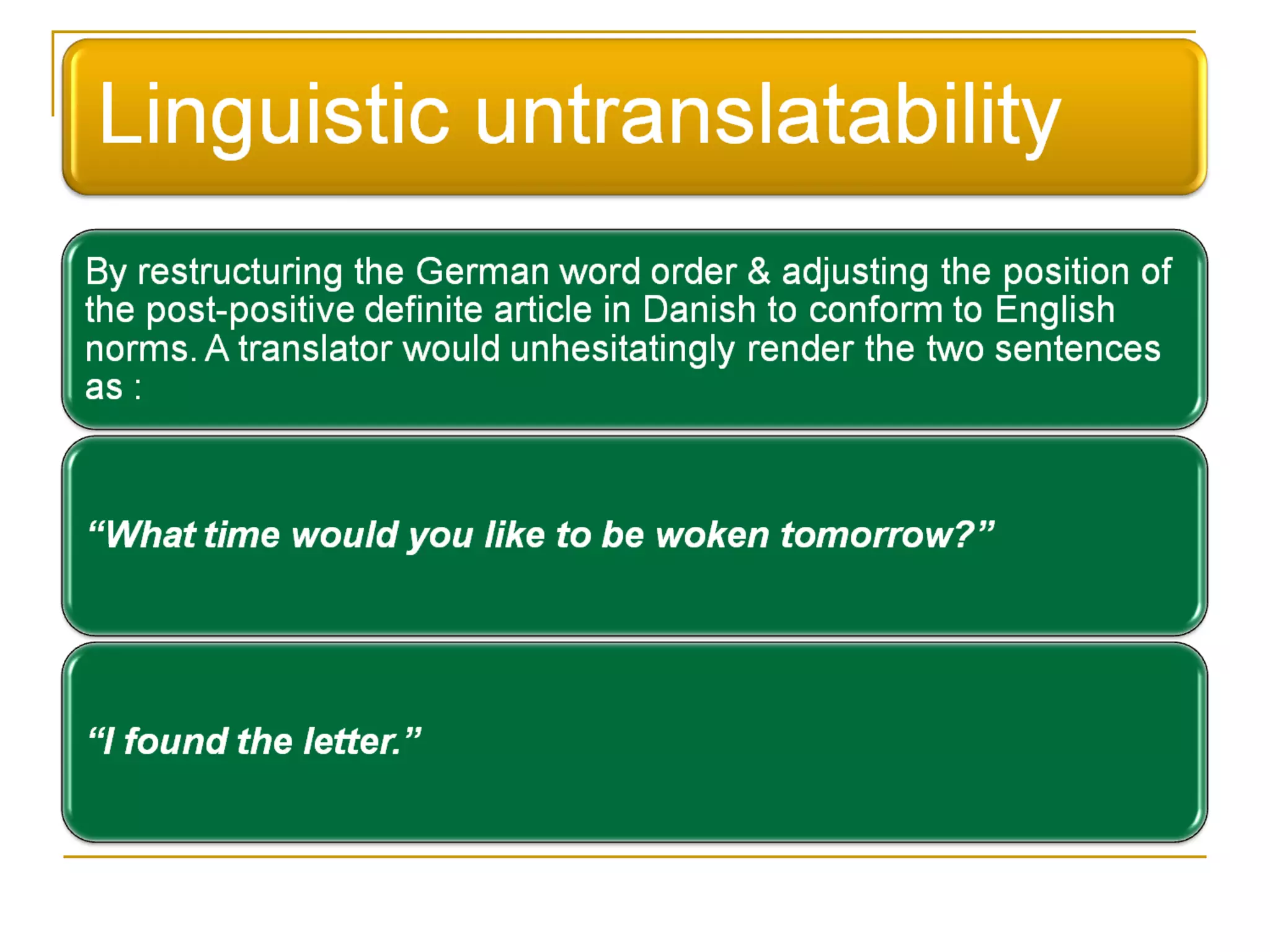
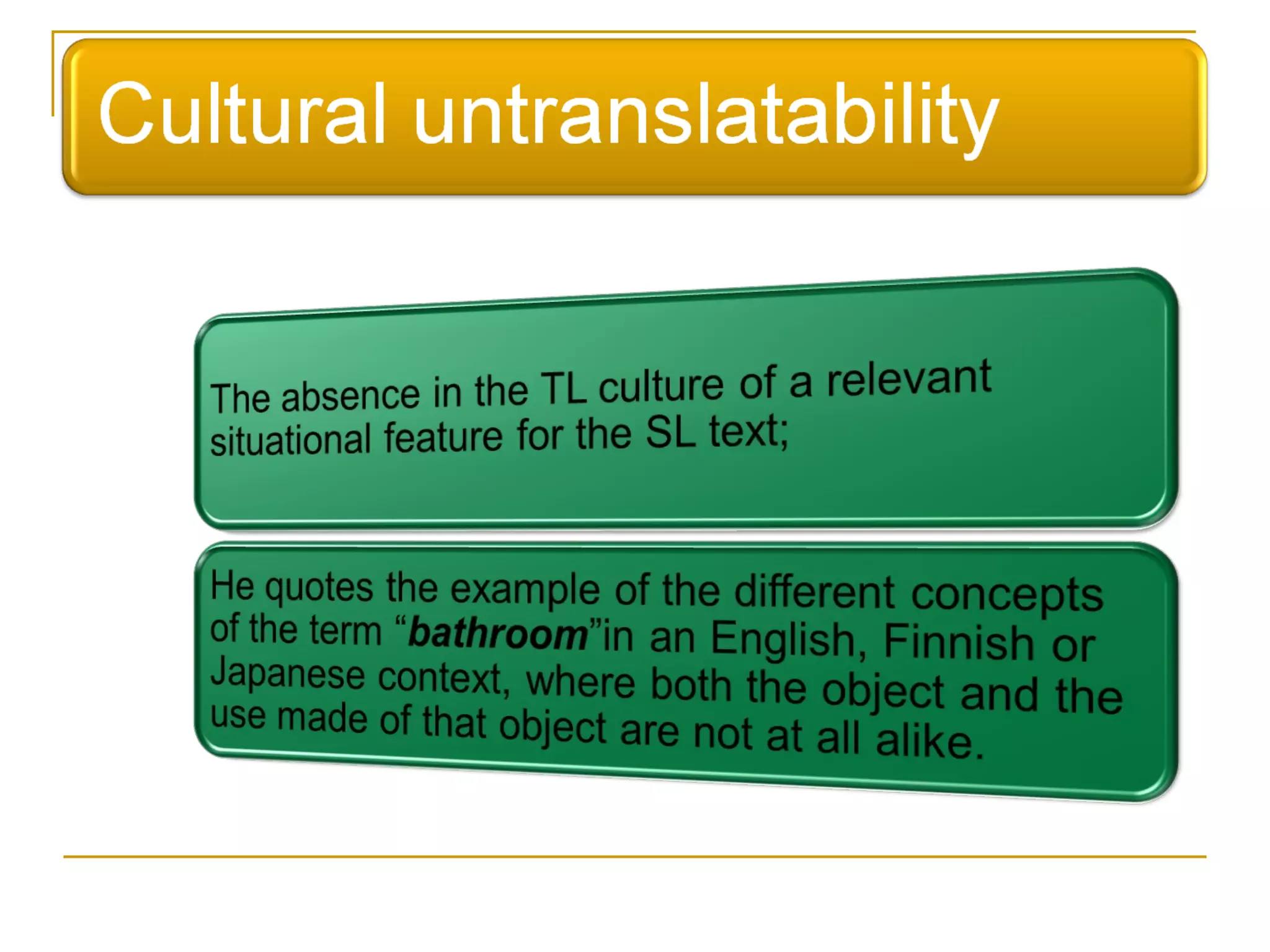
Untranslatability in
Translation

                Prepared by
             Mohsine MAHRAJ
    Hassan II University, Ain Chock, Casablanca
Untranslatability defined


    “The degree of difficulty of translation
    depends on their nature, as well as on
    the translator's abilities.”
Types of untranslatability


    Catford distinguishes two types which
    he terms linguistic and cultural
Examples of untranslatability
1. Register

   Although Thai lgge has words that can be
    used as equivalent to English "I", "you", or
    "he/she/it", they are relatively formal terms;
   In most cases, Thai people use words which
    express the relation between speaker and
    listener according to their respective roles.
   for a mother to say to her child "I'll tell you a
    story", she would say "(mae ja bawk luuk
    nitaan), or "Mother will tell child a story".
Grammar

   Chinese has no tenses per se, only three aspects.
    The English verb to be does not have a direct
    equivalent in Chinese. In an English sentence where
    to be leads to an adjective ("It is blue"), there is no
    to be in Chinese. (There are no adjectives in
    Chinese, instead there are stative verbs that don't
    need an extra verb.) If it states a location, the verb
                    verb
    "zài" ( 在 ) is used, as in "We are in the house". And
    in most other cases, the verb "shì" ( 是 ) is used, as
    in "I am the leader." Any sentence that requires a
    play on those different meanings will not work in
    Chinese.
Vocabulary

   German, as well as Dutch, has a wealth of modal
    particles that are particularly difficult to translate as
    they convey sense or tone more rather than strictly
    grammatical information. The most infamous
    example perhaps is doch (Dutch: toch), which
                                           toch
    roughly means "don't you realize that...?", or "in fact
                                          that
    it is so, though someone is denying it". What makes
                                             it
    translating such words difficult is their different
    meanings depending on intonation or the context.
Family (Siblings)

   In Arabic, "brother" is often translated into ‫أخ‬
    (Akh). However, while this word may describe
    a brother who shares either one or both
    parents, there is a separate word - ‫شقيق‬
    (Shaqeeq) - to describe a brother with whom
    one shares both parents.
Family (Grandparents)

   Swedish, Norwegian and Danish have the
    terms farmor and farfar for paternal
    grandparents, and mormor and morfar for
    maternal grandparents. The English terms
    great-grandfather and great-grandmother
    also have different terms in Swedish,
    depending on lineage. This distinction
    between paternal and maternal grandparents
    is also used in Bengali, Chinese, and Thai.
Family (Aunts and Uncles)

   Arabic contains separate words for "mother's
    brother" ‫( خال‬Khal) and "father's brother" ‫عم‬
    ('am). The closest translation into English is
    "uncle", which gives no indication as to
    lineage, whether maternal or paternal.
    Similarly, in Arabic, there are specific words
    for the father's sister and the mother's sister.
Family (Nephews, Nieces, and Cousins)

   Whereas English has different words for the child of
    one's sibling based on its gender (nephew for the
    son of one's sibling, niece for the daughter), the
    word cousin applies to both genders of children
    belonging to one's aunt or uncle. Many languages
    approach these concepts very differently:
   Spanish distinguishes in both cases: the son of a
    sibling is sobrino, whereas a daughter is sobrina,
               sobrino                        sobrina
    equally a male cousin is primo, while a female
                              primo
    cousin is prima.
               prima
Family (Nephews, Nieces, and Cousins)

   Though Italian distinguishes between
     male (cugino) and female (cugina) cousins
           cugino               cugina
    where English does not, it uses “nipote”
    (nephew/niece) for both genders
Family (Relations by marriage)

   in American English the term "my brother-in-
    law" covers "my spouse's brother", "my
    law
    sister's husband", and "my spouse's sister's
    husband". In British English, the last of these
    is not considered strictly correct.
Puns and Wordplay

   Similarly, consider the Italian adage
    "traduttore, traditore": a literal translation is
                  traditore
    "translator, traitor". The pun is lost, though
    the meaning persists. (A similar solution can
    be given, however, in Hungarian, by saying a
    “fordítás: ferdítés”, which roughly translates
               ferdítés”
    as "translation is distortion".)
Procedures to compensate for
this problem

    The translation procedures that are
    available in cases of lacunae, or lexical
    gaps, include the following:
Adaptation

   An adaptation, also known as a free
    translation, is a translation procedure
    whereby the translator replaces a social, or
    cultural, reality in the source text with a
    corresponding reality in the target text; this
    new reality would be more usual to the
    audience of the target text.
Adaptation

    In the Belgian comic book “The Adventures
    of Tintin”, Tintin's trusty canine sidekick
    “Milou” is translated as “Snowy” in English,
    “Bobbie” in Dutch, and “Struppi” in German;
    likewise the detectives “Dupont and Dupond”
    become “Thomson and Thompson” in
    English, “Jansen and Janssen” in Dutch,
    “Schultze and Schulze” in German,
    “Hernández and Fernández” in Spanish
Borrowing

   Borrowing is a translation procedure
    whereby the translator uses a word or
    expression from the source text in the target
    text unmodified.
   In English text, borrowings not sufficiently
    anglicized are normally in italics.
Calque

   Calque entails taking an expression,
    breaking it down to individual elements and
    translating each element into the target
    language word for word.
   the German word:
    "Alleinvertretungsanspruch" can be
    calqued to "single-representation-claim", but
    a proper translation would result in:
    "Exclusive Mandate” .
Compensation

   Compensation is a translation procedure
    whereby the translator solves the problem of
    aspects of the source text that cannot take
    the same form in the target language by
    replacing these aspects with other elements
    or forms in the source text.
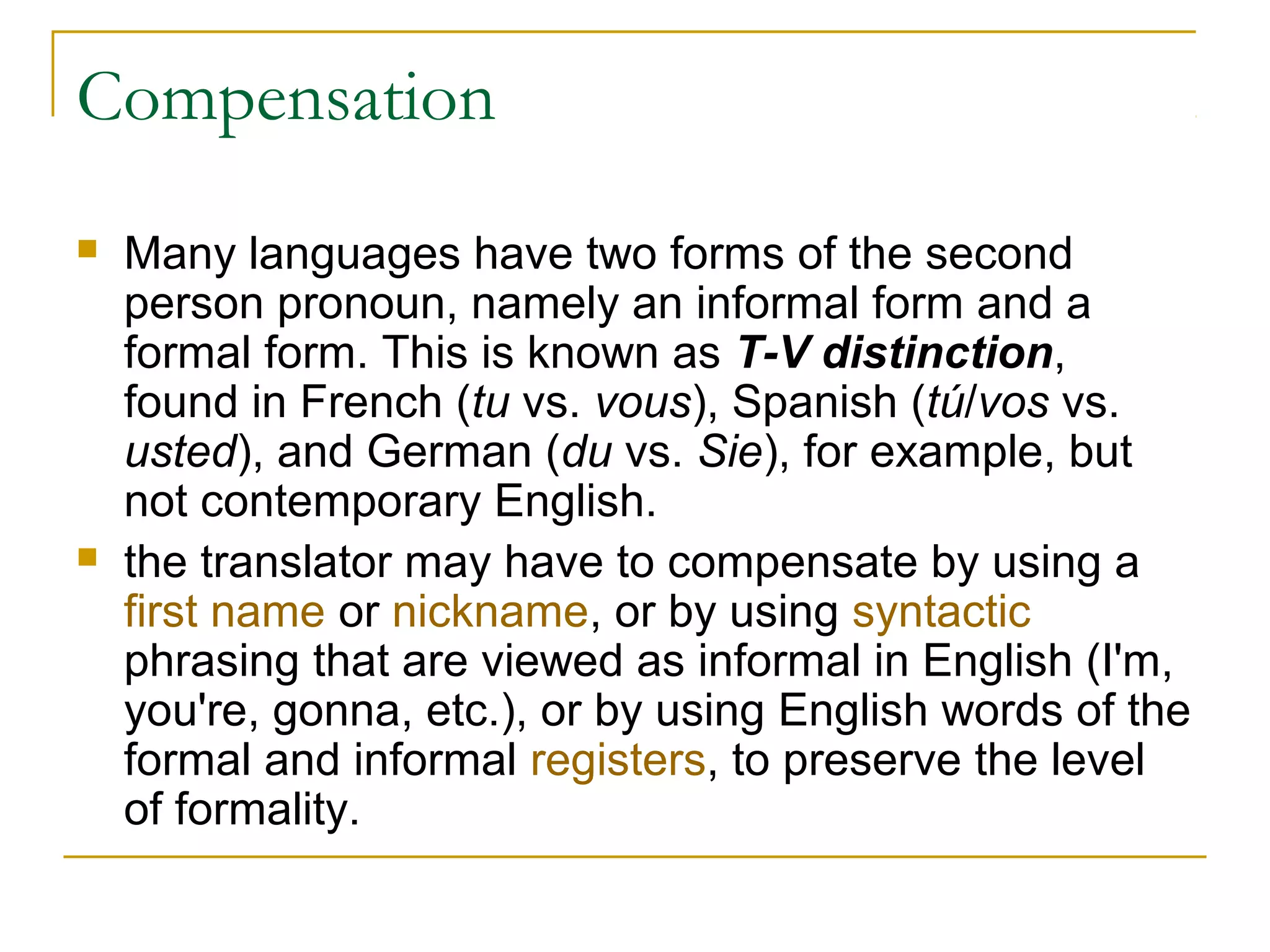
Compensation
   Many languages have two forms of the second
    person pronoun, namely an informal form and a
    formal form. This is known as T-V distinction,
    found in French (tu vs. vous), Spanish (tú/vos vs.
    usted), and German (du vs. Sie), for example, but
    not contemporary English.
   the translator may have to compensate by using a
    first name or nickname, or by using syntactic
    phrasing that are viewed as informal in English (I'm,
    you're, gonna, etc.), or by using English words of the
    formal and informal registers, to preserve the level
    of formality.
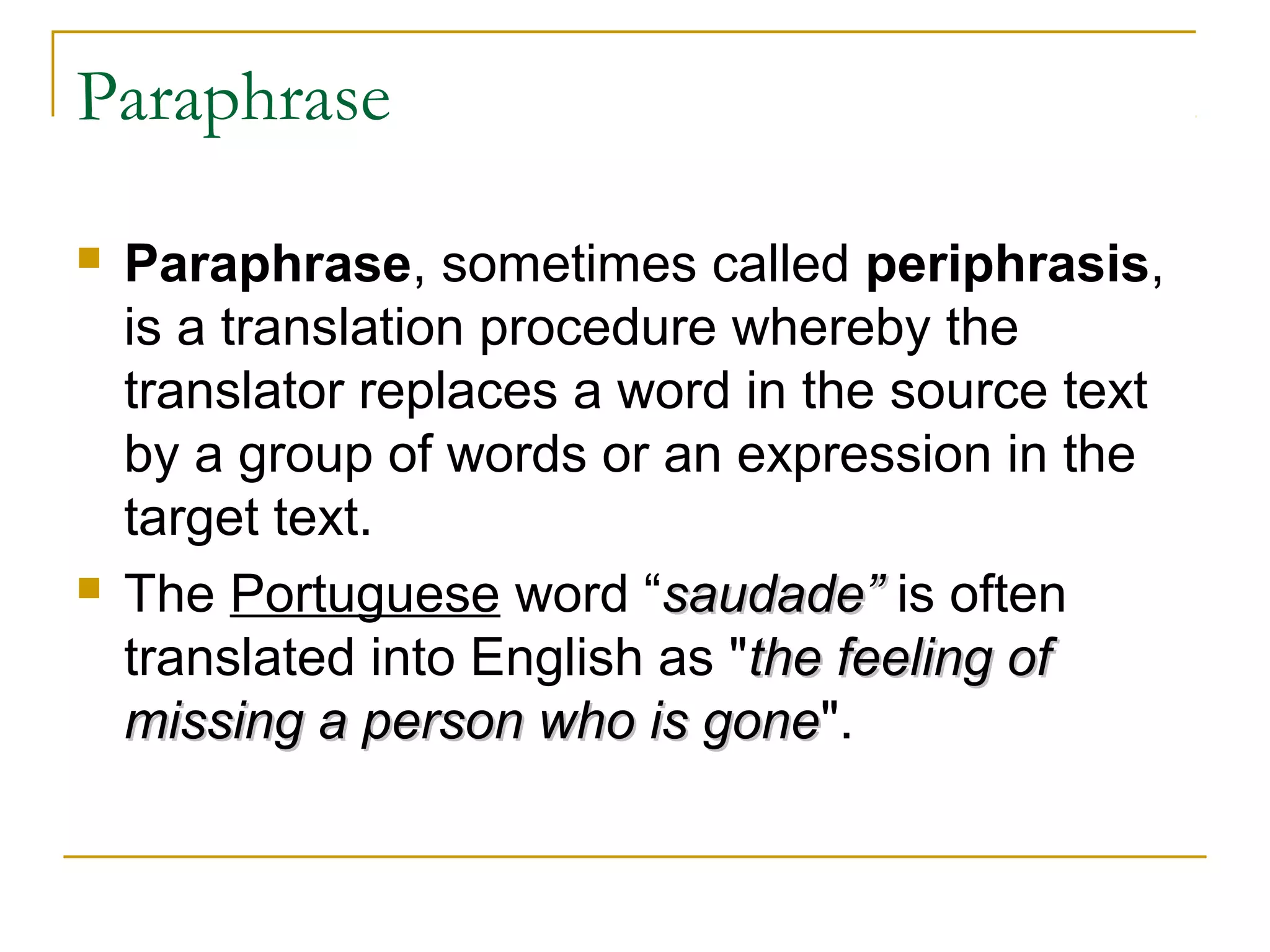
Paraphrase

   Paraphrase, sometimes called periphrasis,
    is a translation procedure whereby the
    translator replaces a word in the source text
    by a group of words or an expression in the
    target text.
   The Portuguese word “saudade” is often
    translated into English as "the feeling of
    missing a person who is gone".
                              gone
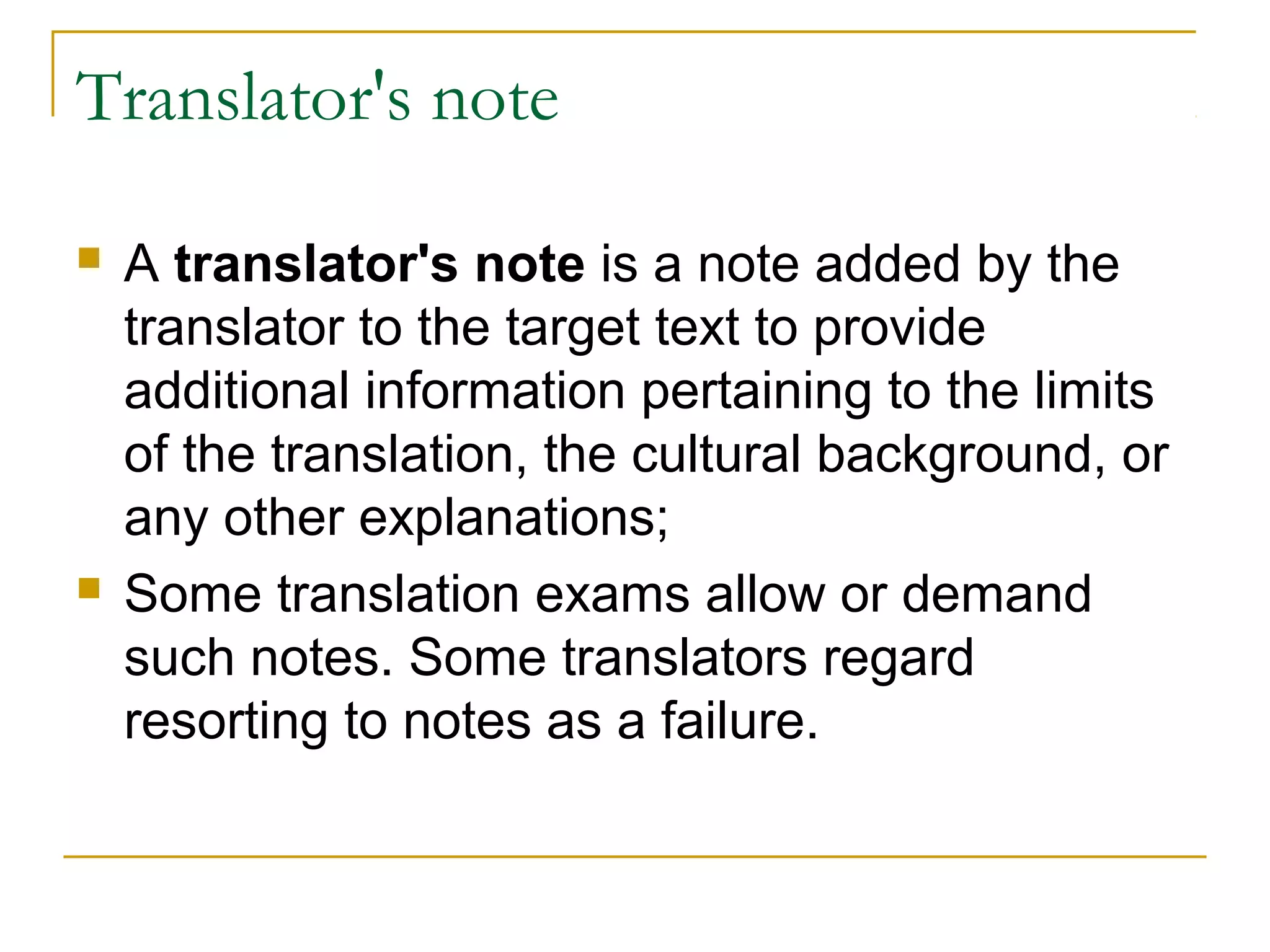
Translator's note

   A translator's note is a note added by the
    translator to the target text to provide
    additional information pertaining to the limits
    of the translation, the cultural background, or
    any other explanations;
   Some translation exams allow or demand
    such notes. Some translators regard
    resorting to notes as a failure.
Thank You for your
    Attention

Untranslatability in translation

  • 1.
    Untranslatability in Translation Prepared by Mohsine MAHRAJ Hassan II University, Ain Chock, Casablanca
  • 3.
    Untranslatability defined “The degree of difficulty of translation depends on their nature, as well as on the translator's abilities.”
  • 5.
    Types of untranslatability Catford distinguishes two types which he terms linguistic and cultural
  • 9.
  • 10.
    1. Register  Although Thai lgge has words that can be used as equivalent to English "I", "you", or "he/she/it", they are relatively formal terms;  In most cases, Thai people use words which express the relation between speaker and listener according to their respective roles.  for a mother to say to her child "I'll tell you a story", she would say "(mae ja bawk luuk nitaan), or "Mother will tell child a story".
  • 11.
    Grammar  Chinese has no tenses per se, only three aspects. The English verb to be does not have a direct equivalent in Chinese. In an English sentence where to be leads to an adjective ("It is blue"), there is no to be in Chinese. (There are no adjectives in Chinese, instead there are stative verbs that don't need an extra verb.) If it states a location, the verb verb "zài" ( 在 ) is used, as in "We are in the house". And in most other cases, the verb "shì" ( 是 ) is used, as in "I am the leader." Any sentence that requires a play on those different meanings will not work in Chinese.
  • 12.
    Vocabulary  German, as well as Dutch, has a wealth of modal particles that are particularly difficult to translate as they convey sense or tone more rather than strictly grammatical information. The most infamous example perhaps is doch (Dutch: toch), which toch roughly means "don't you realize that...?", or "in fact that it is so, though someone is denying it". What makes it translating such words difficult is their different meanings depending on intonation or the context.
  • 13.
    Family (Siblings)  In Arabic, "brother" is often translated into ‫أخ‬ (Akh). However, while this word may describe a brother who shares either one or both parents, there is a separate word - ‫شقيق‬ (Shaqeeq) - to describe a brother with whom one shares both parents.
  • 14.
    Family (Grandparents)  Swedish, Norwegian and Danish have the terms farmor and farfar for paternal grandparents, and mormor and morfar for maternal grandparents. The English terms great-grandfather and great-grandmother also have different terms in Swedish, depending on lineage. This distinction between paternal and maternal grandparents is also used in Bengali, Chinese, and Thai.
  • 15.
    Family (Aunts andUncles)  Arabic contains separate words for "mother's brother" ‫( خال‬Khal) and "father's brother" ‫عم‬ ('am). The closest translation into English is "uncle", which gives no indication as to lineage, whether maternal or paternal. Similarly, in Arabic, there are specific words for the father's sister and the mother's sister.
  • 16.
    Family (Nephews, Nieces,and Cousins)  Whereas English has different words for the child of one's sibling based on its gender (nephew for the son of one's sibling, niece for the daughter), the word cousin applies to both genders of children belonging to one's aunt or uncle. Many languages approach these concepts very differently:  Spanish distinguishes in both cases: the son of a sibling is sobrino, whereas a daughter is sobrina, sobrino sobrina equally a male cousin is primo, while a female primo cousin is prima. prima
  • 17.
    Family (Nephews, Nieces,and Cousins)  Though Italian distinguishes between male (cugino) and female (cugina) cousins cugino cugina where English does not, it uses “nipote” (nephew/niece) for both genders
  • 18.
    Family (Relations bymarriage)  in American English the term "my brother-in- law" covers "my spouse's brother", "my law sister's husband", and "my spouse's sister's husband". In British English, the last of these is not considered strictly correct.
  • 19.
    Puns and Wordplay  Similarly, consider the Italian adage "traduttore, traditore": a literal translation is traditore "translator, traitor". The pun is lost, though the meaning persists. (A similar solution can be given, however, in Hungarian, by saying a “fordítás: ferdítés”, which roughly translates ferdítés” as "translation is distortion".)
  • 20.
    Procedures to compensatefor this problem The translation procedures that are available in cases of lacunae, or lexical gaps, include the following:
  • 21.
    Adaptation  An adaptation, also known as a free translation, is a translation procedure whereby the translator replaces a social, or cultural, reality in the source text with a corresponding reality in the target text; this new reality would be more usual to the audience of the target text.
  • 22.
    Adaptation  In the Belgian comic book “The Adventures of Tintin”, Tintin's trusty canine sidekick “Milou” is translated as “Snowy” in English, “Bobbie” in Dutch, and “Struppi” in German; likewise the detectives “Dupont and Dupond” become “Thomson and Thompson” in English, “Jansen and Janssen” in Dutch, “Schultze and Schulze” in German, “Hernández and Fernández” in Spanish
  • 23.
    Borrowing  Borrowing is a translation procedure whereby the translator uses a word or expression from the source text in the target text unmodified.  In English text, borrowings not sufficiently anglicized are normally in italics.
  • 24.
    Calque  Calque entails taking an expression, breaking it down to individual elements and translating each element into the target language word for word.  the German word: "Alleinvertretungsanspruch" can be calqued to "single-representation-claim", but a proper translation would result in: "Exclusive Mandate” .
  • 25.
    Compensation  Compensation is a translation procedure whereby the translator solves the problem of aspects of the source text that cannot take the same form in the target language by replacing these aspects with other elements or forms in the source text.
  • 26.
    Compensation  Many languages have two forms of the second person pronoun, namely an informal form and a formal form. This is known as T-V distinction, found in French (tu vs. vous), Spanish (tú/vos vs. usted), and German (du vs. Sie), for example, but not contemporary English.  the translator may have to compensate by using a first name or nickname, or by using syntactic phrasing that are viewed as informal in English (I'm, you're, gonna, etc.), or by using English words of the formal and informal registers, to preserve the level of formality.
  • 27.
    Paraphrase  Paraphrase, sometimes called periphrasis, is a translation procedure whereby the translator replaces a word in the source text by a group of words or an expression in the target text.  The Portuguese word “saudade” is often translated into English as "the feeling of missing a person who is gone". gone
  • 28.
    Translator's note  A translator's note is a note added by the translator to the target text to provide additional information pertaining to the limits of the translation, the cultural background, or any other explanations;  Some translation exams allow or demand such notes. Some translators regard resorting to notes as a failure.
  • 29.
    Thank You foryour Attention