Interpretation Principles and Techniques
Principles of Interpretation… Consider who is the audience Create a story with a message Information is relevant to audience Story creates awareness Provokes thought, response, reaction & action Is an art and can be learned
A combination of essential Ingredients   What is your Interpretive message? Who are your audience? What environment are you in? What technique will you use?
Types of Interpretation Personal Non Personal
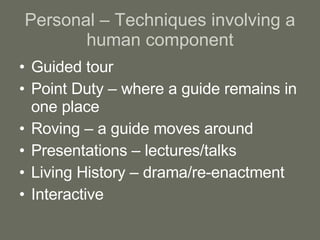
Personal – Techniques involving a human component Guided tour Point Duty – where a guide remains in one place Roving – a guide moves around Presentations – lectures/talks Living History – drama/re-enactment Interactive
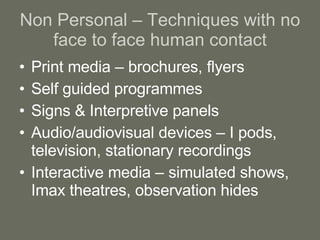
Non Personal – Techniques with no face to face human contact Print media – brochures, flyers Self guided programmes  Signs & Interpretive panels Audio/audiovisual devices – I pods, television, stationary recordings Interactive media – simulated shows, Imax theatres, observation hides
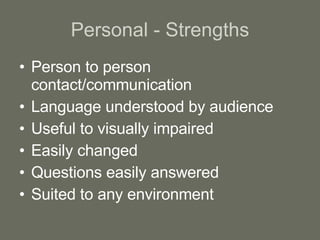
Personal - Strengths Person to person contact/communication Language understood by audience Useful to visually impaired Easily changed Questions easily answered Suited to any environment
Personal - weaknesses No good for foreign language speakers Not as good for hearing impaired People must move at pace of speaker
Non Personal - Strengths translated into many languages Used at a persons own pace used in many environments Wide distribution area Easily replicated A picture says a thousand words Informative
Non personal - Weaknesses Expensive Inflexible and not easy to change Immediate feedback difficult Open to misinterpretation Requires technological expertise to set up Often missed if not positioned right (signs)

Interpretation Principles And Techniques

  • 1.
  • 2.
    Principles of Interpretation…Consider who is the audience Create a story with a message Information is relevant to audience Story creates awareness Provokes thought, response, reaction & action Is an art and can be learned
  • 3.
    A combination ofessential Ingredients What is your Interpretive message? Who are your audience? What environment are you in? What technique will you use?
  • 4.
    Types of InterpretationPersonal Non Personal
  • 5.
    Personal – Techniquesinvolving a human component Guided tour Point Duty – where a guide remains in one place Roving – a guide moves around Presentations – lectures/talks Living History – drama/re-enactment Interactive
  • 6.
    Non Personal –Techniques with no face to face human contact Print media – brochures, flyers Self guided programmes Signs & Interpretive panels Audio/audiovisual devices – I pods, television, stationary recordings Interactive media – simulated shows, Imax theatres, observation hides
  • 7.
    Personal - StrengthsPerson to person contact/communication Language understood by audience Useful to visually impaired Easily changed Questions easily answered Suited to any environment
  • 8.
    Personal - weaknessesNo good for foreign language speakers Not as good for hearing impaired People must move at pace of speaker
  • 9.
    Non Personal -Strengths translated into many languages Used at a persons own pace used in many environments Wide distribution area Easily replicated A picture says a thousand words Informative
  • 10.
    Non personal -Weaknesses Expensive Inflexible and not easy to change Immediate feedback difficult Open to misinterpretation Requires technological expertise to set up Often missed if not positioned right (signs)