Translation SkillsPresented by: Rawia Al-jehani.Instructor:Dr. Shadia Banjar.Course:462Practicum in Language.Summer.1431-2010Rawia al-jehani
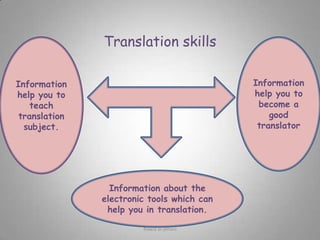
Translation skillsInformation help you to teach translation subject.Information help you to become a good translatorInformation about the electronic tools which can help you in translation.Rawia al-jehani
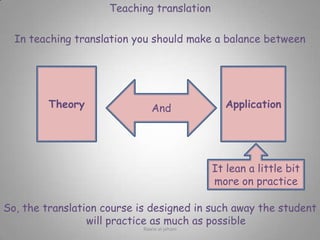
Teaching translationIn teaching translation you should make a balance betweenSo, the translation course is designed in such away the student will practice as much as possibleTheoryApplicationAndIt lean a little bit more on practiceRawia al-jehani
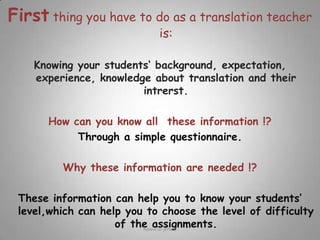
Firstthing you have to do as a translation teacher is:Knowing your students‘ background, expectation, experience, knowledge about translation and their intrerst.How can you know all  these information !?Through a simple questionnaire.Why these information are needed !?These information can help you to know your students’ level,which can help you to choose the level of difficulty of the assignments.Rawia al-jehani
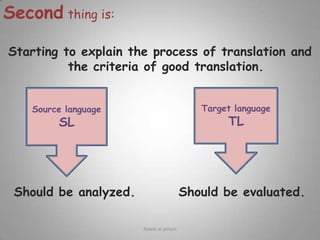
Secondthing is:Starting to explain the process of translation and the criteria of good translation. Should be analyzed.        Should be evaluated.Source languageSLTarget languageTLRawia al-jehani
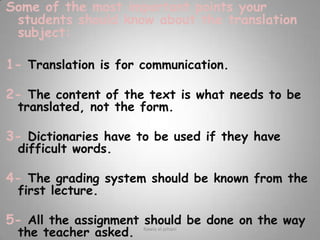
Some of the most important points your students should know about the translation subject:1-Translation is for communication.2- The content of the text is what needs to be translated, not the form.3- Dictionaries have to be used if they have difficult words.4- The grading system should be known from the  first lecture.5- All the assignment should be done on the way the teacher asked. Rawia al-jehani
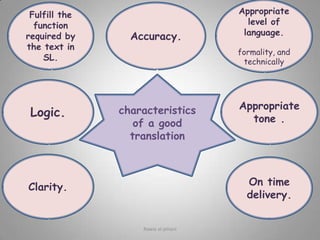
Appropriate level of language.formality, and technicallyFulfill the function required by the text in SL.Accuracy.characteristics of a good translationLogic.Appropriate tone .Clarity.On time delivery.Rawia al-jehani
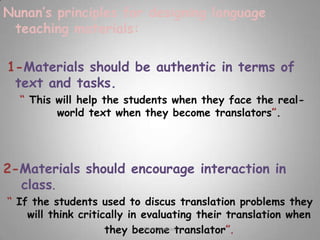
Nunan’s principles for designing language teaching materials: 1-Materials should be authentic in terms of text and tasks.“ This will help the students when they face the real-world text when they become translators”.2-Materials should encourage interaction in class.“ If the students used to discus translation problems they will think critically in evaluating their translation when they become translator”.Rawia al-jehani
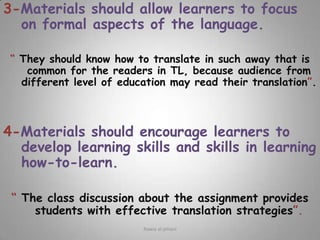
3-Materials should allow learners to focus on formal aspects of the language.“ They should know how to translate in such away that is common for the readers in TL, because audience from different level of education may read their translation”.4-Materials should encourage learners to develop learning skills and skills in learning how-to-learn.“ The class discussion about the assignment provides students with effective translation strategies”.Rawia al-jehani
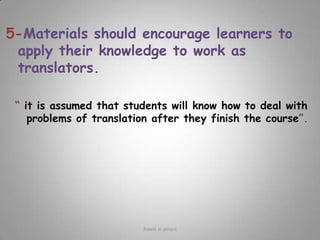
5-Materials should encourage learners to apply their knowledge to work as translators.“ it is assumed that students will know how to deal with problems of translation after they finish the course”.Rawia al-jehani
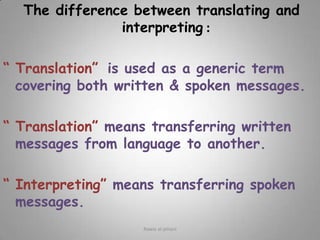
The difference between translating and interpreting :“ Translation” is used as a generic term covering both written & spoken messages.“ Translation” means transferring written messages from language to another. “ Interpreting” means transferring spoken messages.Rawia al-jehani
What can you do for clients as a professional translator:  1-Gives them access to documents written in a language they don’t understand.2- Enables them to communicate their views in another language.3-Improve the image of their companies or organizations by producing a professional document that is correct and uses a style and terminology that are appropriate for the target audience. Rawia al-jehani
4- Helps sell their products and services.5- Saves their money by reducing the number of errors in your documents and eliminating delays and the need for expensive patch-up jobs later.-Saves them from the worry and problems that arise from working with non-professional.7 - saves them from possible embarrassment by pointing out any problems in cross-cultural communicationRawia al-jehani
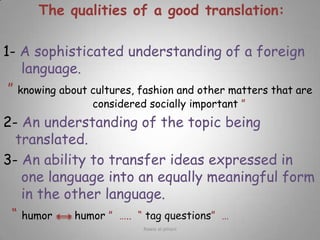
The qualities of a good translation: 1- A sophisticated understanding of a foreign language.” knowing about cultures, fashion and other matters that are considered socially important ”2- An understanding of the topic being translated.3- An ability to transfer ideas expressed in one language into an equally meaningful form in the other language.“ humor       humor ”  …..  “ tag questions”  …Rawia al-jehani
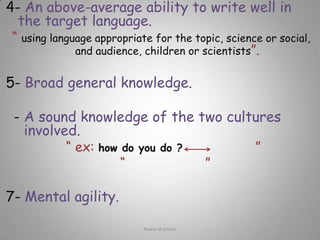
4-An above-average ability to write well in the target language.“ using language appropriate for the topic, science or social, and audience, children or scientists”.5- Broad general knowledge.6- A sound knowledge of the two cultures involved.“ ex: how do you do ?اهلا وسهلا” “هند فتاة جميلة كالقمر”7- Mental agility. Rawia al-jehani
8- Sensitivity and attention to details.9- An understanding of specialized terminology in the field of the translation.“Make further research if necessary”10-Training or experience.Rawia al-jehani
Can translators work in both language directions equally well?  It is very rare for a translator to be able to translate written texts equally well in both directions even if both languages are spoken fluently.Writing well, with correct grammar and full expressiveness, required particular skills and greater expertise than spoken fluency.WHY?Rawia al-jehani
If your native language is Arabic and you want to  translate EA: you will produce text in the desired style of TL and with less grammatical errors, but you may make mistakes in comprehension SL.AE: It is less likely to make mistakes in comprehension , but it is more likely to make grammatical errors.However, good translation is not impossibleBut, sometimes it requires familiarity with the field of the topic being translated. Rawia al-jehani
How much you can ask for your translation?Being a professional translator means that you have expertise in the two languages and also have a background in special field such as law, particular area of science or technology.Having all these mean that you have spend long hours reading in that field you specialized in to broad your knowledge or you may have postgraduate level.Beside these, translation work is often highly complex and demanding intellectually and working hours.So, as a translator you should be paid for your work at a level appropriate with your skills, knowledge and training.Rawia al-jehani
The billing unit varies from translator to another. Translators normally charge based on:1-The length of the source text or the length of The target text.2-The subject matter.3-The degree complexity.4-The deadline.5-The country where the translation is made.If you pay in peanuts , expect to get monkeys.Rawia al-jehani
How long translation will take !?It depend on :1- The length of the text .2-Its difficulty ”specialized terms, requires research or editing”.3-The translator ability and familiarity with the topic.4-The translator existing workload.The time varies from a translator to anotherBut, The average is 10 pages a dayRawia al-jehani
Is it acceptable for you as a translator to make changes to the text?Literal word-for word translation often results in a different meaning or nuance, so you should discuss with your client how much freedom you have.
Slight changes are acceptable as long as the intended meaning is conveyed.
Beside the intended meaning, making the text more suitable for the target audience allows slight changes according to the target culture to avoid communication breakdown caused by cultural differences.Rawia al-jehani
Should you offer your translation to be checked !?If the translator does not have a full written competence, the translation is better checked by a native speaker.“This will help eliminate any incorrect, long-winded, awkward expressions and enable parts where the meaning is not conveyed clearly to be written”.Make sure that the checker is provided with the same information as the translator, and he/she should be an experienced translator Beside being a native speaker.
For legal purposes, the translator can provide a notarized statement that the translation is true and accurate to the best of his or her knowledge.Rawia al-jehani
How clients select translator to hire them?The clients select translator on the basis of relevant qualifications and experience, appropriate resources, availability, and cost.1-They keep an eye out for good translations in a related field and they track down the translator . 2-They ask potential translators for references or samples of work they have already done (both source &target texts). 3-They ask prospective translators do a half-page sample text.4-They make sure of the translator’s abilities through cross-checks and on-going checks.Rawia al-jehani
Working with a translation company:Some clients need to employ a translation companies, because translation companies offer additional services and quality control, and have the facilities to provide camera-ready artwork and can handle large volumes, tight deadlines and complex or unusual subjects.
some translation companies rely on both freelance and in-house translators.
It is recommended to be consistent in working with a specific company for the translator and the client.Rawia al-jehani
what are the things which the client should provide the translator with before starting the work:The more preparation and corporation a person does with his /her translator, the better the outcome is:Before assigning the work to a translator1-Take care that the original text is written clearly.  “it is impossible to translate something doesn't make sense into something does make sense”.2-Don’t send a document till the translator is available.3-Show the translator the actual document in advance.4-Provide clearly legible text (not a handwritten copy).5- If the material is to be published, agree on who will do the proofreading.Rawia al-jehani
B) Information to provide the translator:1- Inform your translator on the purpose of the translation (whether it is for information, publication) and intended readers( Americans, British).2- Mark any sections that are not to be translated.3- Provide the translator with as much background material as possible ( relevant web site).4- Inform the translator of any particular style that should be followed( in-house style or the style of existing documents).5- Inform the translator fully on any particular format.  Rawia al-jehani
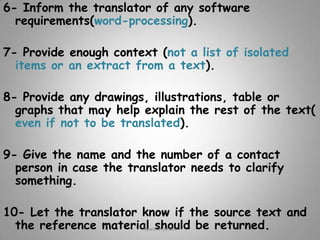
6- Inform the translator of any software requirements(word-processing).7- Provide enough context (not a list of isolated items or an extract from a text).8- Provide any drawings, illustrations, table or graphs that may help explain the rest of the text( even if not to be translated).9- Give the name and the number of a contact person in case the translator needs to clarify something.10- Let the translator know if the source text and the reference material should be returned. Rawia al-jehani
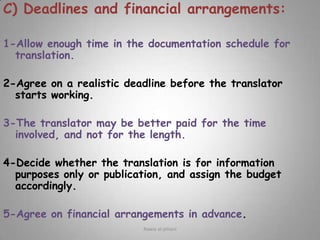
C) Deadlines and financial arrangements:1-Allow enough time in the documentation schedule for translation.2-Agree on a realistic deadline before the translator starts working.3-The translator may be better paid for the time involved, and not for the length.4-Decide whether the translation is for information purposes only or publication, and assign the budget accordingly.5-Agree on financial arrangements in advance.Rawia al-jehani
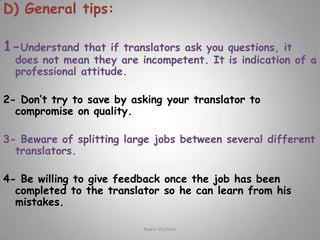
D) General tips:1-Understand that if translators ask you questions, it does not mean they are incompetent. It is indication of a professional attitude.2- Don’t try to save by asking your translator to compromise on quality.3- Beware of splitting large jobs between several different translators.4- Be willing to give feedback once the job has been completed to the translator so he can learn from his mistakes. Rawia al-jehani
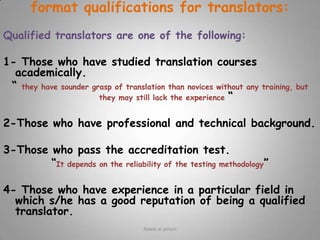
format qualifications for translators: Qualified translators are one of the following:1- Those who have studied translation courses academically.“ they have sounder grasp of translation than novices without any training, but they may still lack the experience “2-Those who have professional and technical background.3-Those who pass the accreditation test.“It depends on the reliability of the testing methodology”4- Those who have experience in a particular field in which s/he has a good reputation of being a qualified translator.Rawia al-jehani
Translator ethics commitment towards:1-Himself “to develop his knowledge and skills”.2- His client “not to undertake work beyond his ability unless he inform the client”.3- His work ”to be responsible for the quality of his work”.4- His audience ”to be neutral and accurate”.5- His career's probity ”not to disclose any information existed in his work”.Rawia al-jehani
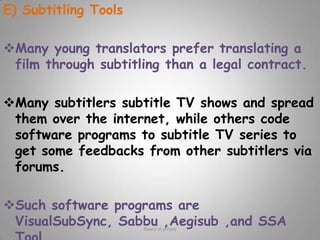
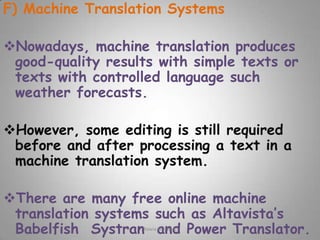
Is machine translation a viable alternative?Machine translation packages can sometimes serve a simple purpose by providing a very rough idea of the document. Using machine translation requires extensive pre-editing and post-editing by human experts.Rawia al-jehani
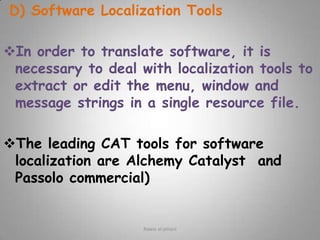
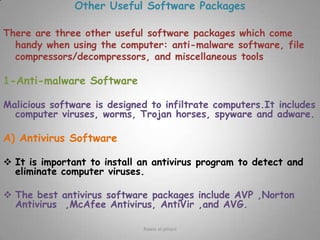
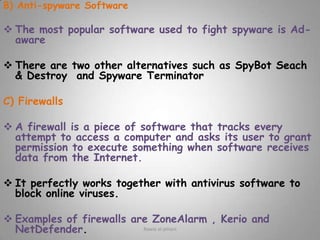
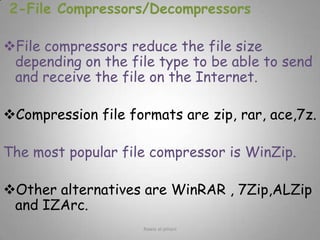
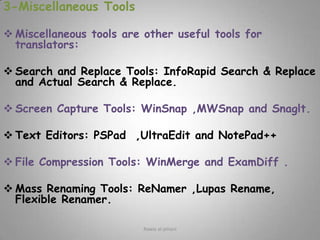
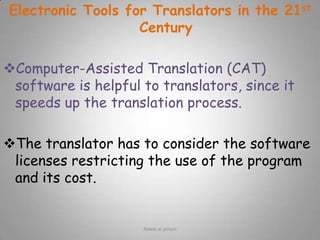
Rawia al-jehaniElectronic Tools for Translators in the 21st CenturyComputer-Assisted Translation (CAT) software is helpful to translators, since it speeds up the translation process.
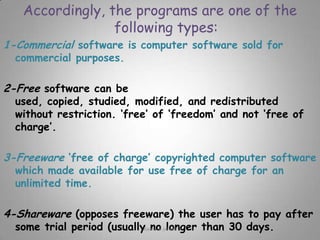
The translator has to consider the software licenses restricting the use of the program and its cost.  Accordingly, the programs are one of the following types: 1-Commercial software is computer software sold for commercial purposes.2-Free software can be used, copied, studied, modified, and redistributed without restriction. ‘free’ of ‘freedom’ and not ‘free of charge’.3-Freeware ‘free of charge’ copyrighted computer software which made available for use free of charge for an unlimited time.4-Shareware (opposes freeware) the user has to pay after some trial period (usually no longer than 30 days. Rawia al-jehani
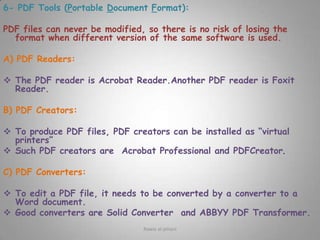
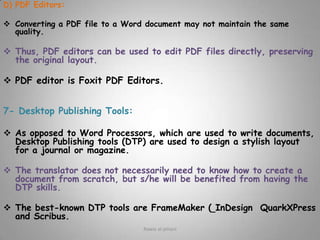
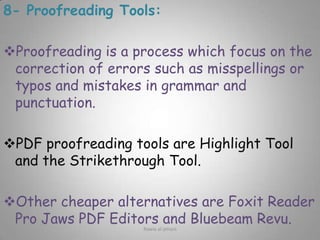
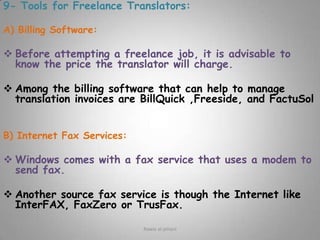
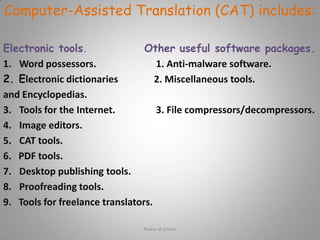
CAT technology is either:electronic tools.Or other useful software packages.Electronic tools used for translation are nine:word possessors.electronic dictionaries. tools for the internet.image editors. CAT tool.PDF tools.desktop publishing tools. proofreading tools. tools for freelance translators.Rawia al-jehani
1-Word Possessors Word possessors allow translators to type.
They contain spelling and grammar checkers as subprograms.
They can count the total number of words.
The most popular word possessors are Microsoft Word and Open Office Writer.Rawia al-jehani
2- Electronic Dictionaries and Encyclopedias Electronic dictionaries have the advantage of speed and convenience of lookup, and popularity over their printed counterparts.
They show three fields: pronunciation, function, and etymology  Examples of Oxford or Collins CD-ROM, Merriam-Webster’s ,Online Dictionary. .The best electronic encyclopedia is Wikipedia containing up-to-date articles written be people from all around the world. Rawia al-jehani
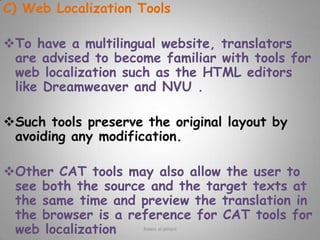
3-Tools for the Internet a- Web Browser The Internet is a World Wide Web, a network of sites that can be searched and retrieved by a special protocol know as Hyper Text Transfer Protocol (HTTP).
In order to surf through these sites, it is necessary to use a web explorer known as “browser”
The most popular browsers are Internet Explorer ,Mozilla Firefox ,Opera .
Web browsers allow the user :1- to do searches in Google or Wikipedia.2- to load Web pages in separate tabs of a single browser window to jump between them quickly and easily. Rawia al-jehani
b) E-mail Software Most Internet users use free webmail e-mail services such as Hotmail, Yahoo.
To keep track of inbox messages, it is better to use an email application like Microsoft Outlook, commercial).
E-mail software allow the user 1- to retrieve emails from a remote server2- to download messages from webmail accounts Rawia al-jehani
c) Search Engines Translators frequently need to research topics to overcome their lack of knowledge in a specific field through search engines like Google or AltaVista .
Search engines use Boolean operators to search the selected terms through the web d) Specialized DatabasesA lot of information, that cannot be retrieved by search engines, can be retrieved by “Invisible Web” or specialized database.
Some medical and scientific online database are the Web of Knowledge.Rawia al-jehani
e) Chats and Other Online Communication Systems Translators can be exchange ideas and opinions in the real time with other translators or specialists, and they can be in touch with clients.
e.g  MSN Messenger or Gaimf) Blogs:A blog can be created by following easy steps in a free weblog publishing system as Blogger after which a person can talk about any topic and can publish.

Translation skills presentation

  • 1.
    Translation SkillsPresented by:Rawia Al-jehani.Instructor:Dr. Shadia Banjar.Course:462Practicum in Language.Summer.1431-2010Rawia al-jehani
  • 2.
    Translation skillsInformation helpyou to teach translation subject.Information help you to become a good translatorInformation about the electronic tools which can help you in translation.Rawia al-jehani
  • 3.
    Teaching translationIn teachingtranslation you should make a balance betweenSo, the translation course is designed in such away the student will practice as much as possibleTheoryApplicationAndIt lean a little bit more on practiceRawia al-jehani
  • 4.
    Firstthing you haveto do as a translation teacher is:Knowing your students‘ background, expectation, experience, knowledge about translation and their intrerst.How can you know all these information !?Through a simple questionnaire.Why these information are needed !?These information can help you to know your students’ level,which can help you to choose the level of difficulty of the assignments.Rawia al-jehani
  • 5.
    Secondthing is:Starting toexplain the process of translation and the criteria of good translation. Should be analyzed. Should be evaluated.Source languageSLTarget languageTLRawia al-jehani
  • 6.
    Some of themost important points your students should know about the translation subject:1-Translation is for communication.2- The content of the text is what needs to be translated, not the form.3- Dictionaries have to be used if they have difficult words.4- The grading system should be known from the first lecture.5- All the assignment should be done on the way the teacher asked. Rawia al-jehani
  • 7.
    Appropriate level oflanguage.formality, and technicallyFulfill the function required by the text in SL.Accuracy.characteristics of a good translationLogic.Appropriate tone .Clarity.On time delivery.Rawia al-jehani
  • 8.
    Nunan’s principles fordesigning language teaching materials: 1-Materials should be authentic in terms of text and tasks.“ This will help the students when they face the real-world text when they become translators”.2-Materials should encourage interaction in class.“ If the students used to discus translation problems they will think critically in evaluating their translation when they become translator”.Rawia al-jehani
  • 9.
    3-Materials should allowlearners to focus on formal aspects of the language.“ They should know how to translate in such away that is common for the readers in TL, because audience from different level of education may read their translation”.4-Materials should encourage learners to develop learning skills and skills in learning how-to-learn.“ The class discussion about the assignment provides students with effective translation strategies”.Rawia al-jehani
  • 10.
    5-Materials should encouragelearners to apply their knowledge to work as translators.“ it is assumed that students will know how to deal with problems of translation after they finish the course”.Rawia al-jehani
  • 11.
    The difference betweentranslating and interpreting :“ Translation” is used as a generic term covering both written & spoken messages.“ Translation” means transferring written messages from language to another. “ Interpreting” means transferring spoken messages.Rawia al-jehani
  • 12.
    What can youdo for clients as a professional translator:  1-Gives them access to documents written in a language they don’t understand.2- Enables them to communicate their views in another language.3-Improve the image of their companies or organizations by producing a professional document that is correct and uses a style and terminology that are appropriate for the target audience. Rawia al-jehani
  • 13.
    4- Helps selltheir products and services.5- Saves their money by reducing the number of errors in your documents and eliminating delays and the need for expensive patch-up jobs later.-Saves them from the worry and problems that arise from working with non-professional.7 - saves them from possible embarrassment by pointing out any problems in cross-cultural communicationRawia al-jehani
  • 14.
    The qualities ofa good translation: 1- A sophisticated understanding of a foreign language.” knowing about cultures, fashion and other matters that are considered socially important ”2- An understanding of the topic being translated.3- An ability to transfer ideas expressed in one language into an equally meaningful form in the other language.“ humor humor ” ….. “ tag questions” …Rawia al-jehani
  • 15.
    4-An above-average abilityto write well in the target language.“ using language appropriate for the topic, science or social, and audience, children or scientists”.5- Broad general knowledge.6- A sound knowledge of the two cultures involved.“ ex: how do you do ?اهلا وسهلا” “هند فتاة جميلة كالقمر”7- Mental agility. Rawia al-jehani
  • 16.
    8- Sensitivity andattention to details.9- An understanding of specialized terminology in the field of the translation.“Make further research if necessary”10-Training or experience.Rawia al-jehani
  • 17.
    Can translators workin both language directions equally well?  It is very rare for a translator to be able to translate written texts equally well in both directions even if both languages are spoken fluently.Writing well, with correct grammar and full expressiveness, required particular skills and greater expertise than spoken fluency.WHY?Rawia al-jehani
  • 18.
    If your nativelanguage is Arabic and you want to translate EA: you will produce text in the desired style of TL and with less grammatical errors, but you may make mistakes in comprehension SL.AE: It is less likely to make mistakes in comprehension , but it is more likely to make grammatical errors.However, good translation is not impossibleBut, sometimes it requires familiarity with the field of the topic being translated. Rawia al-jehani
  • 19.
    How much youcan ask for your translation?Being a professional translator means that you have expertise in the two languages and also have a background in special field such as law, particular area of science or technology.Having all these mean that you have spend long hours reading in that field you specialized in to broad your knowledge or you may have postgraduate level.Beside these, translation work is often highly complex and demanding intellectually and working hours.So, as a translator you should be paid for your work at a level appropriate with your skills, knowledge and training.Rawia al-jehani
  • 20.
    The billing unitvaries from translator to another. Translators normally charge based on:1-The length of the source text or the length of The target text.2-The subject matter.3-The degree complexity.4-The deadline.5-The country where the translation is made.If you pay in peanuts , expect to get monkeys.Rawia al-jehani
  • 21.
    How long translationwill take !?It depend on :1- The length of the text .2-Its difficulty ”specialized terms, requires research or editing”.3-The translator ability and familiarity with the topic.4-The translator existing workload.The time varies from a translator to anotherBut, The average is 10 pages a dayRawia al-jehani
  • 22.
    Is it acceptablefor you as a translator to make changes to the text?Literal word-for word translation often results in a different meaning or nuance, so you should discuss with your client how much freedom you have.
  • 23.
    Slight changes areacceptable as long as the intended meaning is conveyed.
  • 24.
    Beside the intendedmeaning, making the text more suitable for the target audience allows slight changes according to the target culture to avoid communication breakdown caused by cultural differences.Rawia al-jehani
  • 25.
    Should you offeryour translation to be checked !?If the translator does not have a full written competence, the translation is better checked by a native speaker.“This will help eliminate any incorrect, long-winded, awkward expressions and enable parts where the meaning is not conveyed clearly to be written”.Make sure that the checker is provided with the same information as the translator, and he/she should be an experienced translator Beside being a native speaker.
  • 26.
    For legal purposes,the translator can provide a notarized statement that the translation is true and accurate to the best of his or her knowledge.Rawia al-jehani
  • 27.
    How clients selecttranslator to hire them?The clients select translator on the basis of relevant qualifications and experience, appropriate resources, availability, and cost.1-They keep an eye out for good translations in a related field and they track down the translator . 2-They ask potential translators for references or samples of work they have already done (both source &target texts). 3-They ask prospective translators do a half-page sample text.4-They make sure of the translator’s abilities through cross-checks and on-going checks.Rawia al-jehani
  • 28.
    Working with atranslation company:Some clients need to employ a translation companies, because translation companies offer additional services and quality control, and have the facilities to provide camera-ready artwork and can handle large volumes, tight deadlines and complex or unusual subjects.
  • 29.
    some translation companiesrely on both freelance and in-house translators.
  • 30.
    It is recommendedto be consistent in working with a specific company for the translator and the client.Rawia al-jehani
  • 31.
    what are thethings which the client should provide the translator with before starting the work:The more preparation and corporation a person does with his /her translator, the better the outcome is:Before assigning the work to a translator1-Take care that the original text is written clearly. “it is impossible to translate something doesn't make sense into something does make sense”.2-Don’t send a document till the translator is available.3-Show the translator the actual document in advance.4-Provide clearly legible text (not a handwritten copy).5- If the material is to be published, agree on who will do the proofreading.Rawia al-jehani
  • 32.
    B) Information toprovide the translator:1- Inform your translator on the purpose of the translation (whether it is for information, publication) and intended readers( Americans, British).2- Mark any sections that are not to be translated.3- Provide the translator with as much background material as possible ( relevant web site).4- Inform the translator of any particular style that should be followed( in-house style or the style of existing documents).5- Inform the translator fully on any particular format. Rawia al-jehani
  • 33.
    6- Inform thetranslator of any software requirements(word-processing).7- Provide enough context (not a list of isolated items or an extract from a text).8- Provide any drawings, illustrations, table or graphs that may help explain the rest of the text( even if not to be translated).9- Give the name and the number of a contact person in case the translator needs to clarify something.10- Let the translator know if the source text and the reference material should be returned. Rawia al-jehani
  • 34.
    C) Deadlines andfinancial arrangements:1-Allow enough time in the documentation schedule for translation.2-Agree on a realistic deadline before the translator starts working.3-The translator may be better paid for the time involved, and not for the length.4-Decide whether the translation is for information purposes only or publication, and assign the budget accordingly.5-Agree on financial arrangements in advance.Rawia al-jehani
  • 35.
    D) General tips:1-Understandthat if translators ask you questions, it does not mean they are incompetent. It is indication of a professional attitude.2- Don’t try to save by asking your translator to compromise on quality.3- Beware of splitting large jobs between several different translators.4- Be willing to give feedback once the job has been completed to the translator so he can learn from his mistakes. Rawia al-jehani
  • 36.
    format qualifications fortranslators: Qualified translators are one of the following:1- Those who have studied translation courses academically.“ they have sounder grasp of translation than novices without any training, but they may still lack the experience “2-Those who have professional and technical background.3-Those who pass the accreditation test.“It depends on the reliability of the testing methodology”4- Those who have experience in a particular field in which s/he has a good reputation of being a qualified translator.Rawia al-jehani
  • 37.
    Translator ethics commitment towards:1-Himself“to develop his knowledge and skills”.2- His client “not to undertake work beyond his ability unless he inform the client”.3- His work ”to be responsible for the quality of his work”.4- His audience ”to be neutral and accurate”.5- His career's probity ”not to disclose any information existed in his work”.Rawia al-jehani
  • 38.
    Is machine translationa viable alternative?Machine translation packages can sometimes serve a simple purpose by providing a very rough idea of the document. Using machine translation requires extensive pre-editing and post-editing by human experts.Rawia al-jehani
  • 39.
    Rawia al-jehaniElectronic Toolsfor Translators in the 21st CenturyComputer-Assisted Translation (CAT) software is helpful to translators, since it speeds up the translation process.
  • 40.
    The translator hasto consider the software licenses restricting the use of the program and its cost. Accordingly, the programs are one of the following types: 1-Commercial software is computer software sold for commercial purposes.2-Free software can be used, copied, studied, modified, and redistributed without restriction. ‘free’ of ‘freedom’ and not ‘free of charge’.3-Freeware ‘free of charge’ copyrighted computer software which made available for use free of charge for an unlimited time.4-Shareware (opposes freeware) the user has to pay after some trial period (usually no longer than 30 days. Rawia al-jehani
  • 41.
    CAT technology iseither:electronic tools.Or other useful software packages.Electronic tools used for translation are nine:word possessors.electronic dictionaries. tools for the internet.image editors. CAT tool.PDF tools.desktop publishing tools. proofreading tools. tools for freelance translators.Rawia al-jehani
  • 42.
    1-Word Possessors Word possessorsallow translators to type.
  • 43.
    They contain spellingand grammar checkers as subprograms.
  • 44.
    They can countthe total number of words.
  • 45.
    The most popularword possessors are Microsoft Word and Open Office Writer.Rawia al-jehani
  • 46.
    2- Electronic Dictionariesand Encyclopedias Electronic dictionaries have the advantage of speed and convenience of lookup, and popularity over their printed counterparts.
  • 47.
    They show threefields: pronunciation, function, and etymology  Examples of Oxford or Collins CD-ROM, Merriam-Webster’s ,Online Dictionary. .The best electronic encyclopedia is Wikipedia containing up-to-date articles written be people from all around the world. Rawia al-jehani
  • 48.
    3-Tools for theInternet a- Web Browser The Internet is a World Wide Web, a network of sites that can be searched and retrieved by a special protocol know as Hyper Text Transfer Protocol (HTTP).
  • 49.
    In order tosurf through these sites, it is necessary to use a web explorer known as “browser”
  • 50.
    The most popularbrowsers are Internet Explorer ,Mozilla Firefox ,Opera .
  • 51.
    Web browsers allowthe user :1- to do searches in Google or Wikipedia.2- to load Web pages in separate tabs of a single browser window to jump between them quickly and easily. Rawia al-jehani
  • 52.
    b) E-mail Software MostInternet users use free webmail e-mail services such as Hotmail, Yahoo.
  • 53.
    To keep trackof inbox messages, it is better to use an email application like Microsoft Outlook, commercial).
  • 54.
    E-mail software allowthe user 1- to retrieve emails from a remote server2- to download messages from webmail accounts Rawia al-jehani
  • 55.
    c) Search Engines Translatorsfrequently need to research topics to overcome their lack of knowledge in a specific field through search engines like Google or AltaVista .
  • 56.
    Search engines useBoolean operators to search the selected terms through the web d) Specialized DatabasesA lot of information, that cannot be retrieved by search engines, can be retrieved by “Invisible Web” or specialized database.
  • 57.
    Some medical andscientific online database are the Web of Knowledge.Rawia al-jehani
  • 58.
    e) Chats andOther Online Communication Systems Translators can be exchange ideas and opinions in the real time with other translators or specialists, and they can be in touch with clients.
  • 59.
    e.g MSNMessenger or Gaimf) Blogs:A blog can be created by following easy steps in a free weblog publishing system as Blogger after which a person can talk about any topic and can publish.