Dr.S.Sivasankar SR MCh, JIPMER
24.10.2012
 Persistant truncus arteriosus
 Truncus Arteriosus communis
 Common aortico pulmonary trunk
June 10, 2014 Dr S.Sivasankar
• Definition
• History
• Embryology
• Anatomy and classification
• Pathophysiology
• Presentation
• Workup
• Treatment
• Conclusion
June 10, 2014 Dr S.Sivasankar
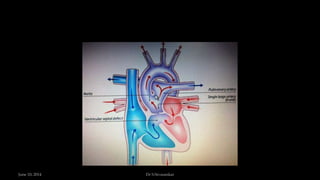
• Congenital cyanotic cardiac defect with a single common
arterial trunk giving rise to systemic, pulmonary and coronary
circulations proximal to brachiocephalic branches

• Associated with a large perimembranous VSD below the truncus

June 10, 2014 Dr S.Sivasankar
• TOF with pulm. Atresia with MAPCA (Collet Edwards type 4)
• Hearts with common arterial trunk but, intact septum
June 10, 2014 Dr S.Sivasankar
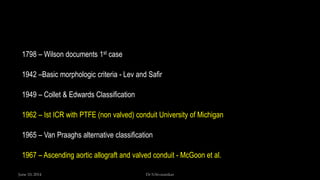
1798 – Wilson documents 1st case
1942 –Basic morphologic criteria - Lev and Safir
1949 – Collet & Edwards Classification
1962 – Ist ICR with PTFE (non valved) conduit University of Michigan
1965 – Van Praaghs alternative classification
1967 – Ascending aortic allograft and valved conduit - McGoon et al.
June 10, 2014 Dr S.Sivasankar
1971 – first conduit repair in infancy by Barratt-Boyes
June 10, 2014 Dr S.Sivasankar
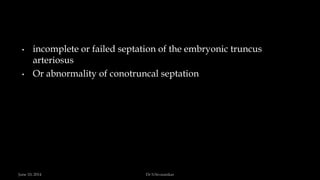
• incomplete or failed septation of the embryonic truncus
arteriosus
• Or abnormality of conotruncal septation
June 10, 2014 Dr S.Sivasankar
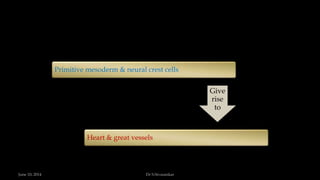
Primitive mesoderm & neural crest cells
Heart & great vessels
Give
rise
to
June 10, 2014 Dr S.Sivasankar
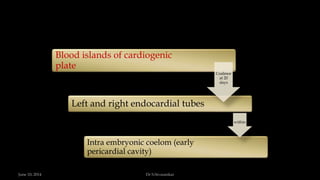
Blood islands of cardiogenic
plate
Left and right endocardial tubes
Intra embryonic coelom (early
pericardial cavity)
Coalesce
at 20
days
within
June 10, 2014 Dr S.Sivasankar
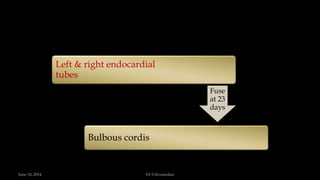
Left & right endocardial
tubes
Bulbous cordis
Fuse
at 23
days
June 10, 2014 Dr S.Sivasankar
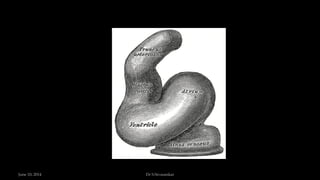
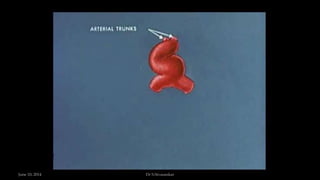
At this period, bulbo ventricular structures rotate anteriorly and
to the right
to form the heart loop
June 10, 2014 Dr S.Sivasankar
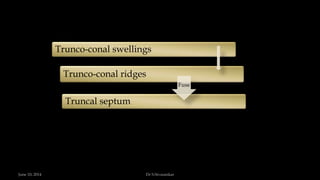
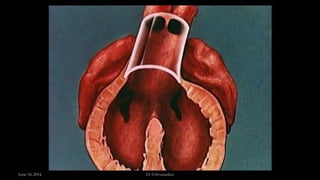
Trunco-conal swellings
Trunco-conal ridges
Truncal septum
Fuse
June 10, 2014 Dr S.Sivasankar
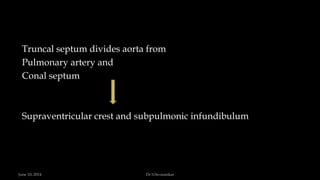
Truncal septum divides aorta from
Pulmonary artery and
Conal septum
Supraventricular crest and subpulmonic infundibulum
June 10, 2014 Dr S.Sivasankar
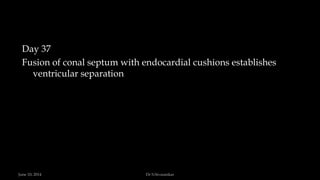
Day 37
Fusion of conal septum with endocardial cushions establishes
ventricular separation
June 10, 2014 Dr S.Sivasankar
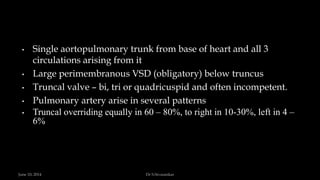
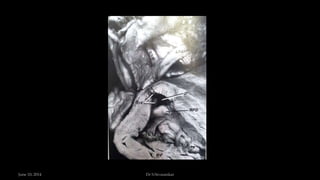
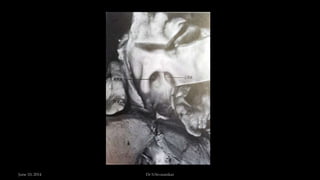
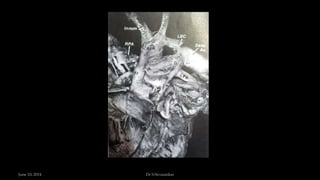
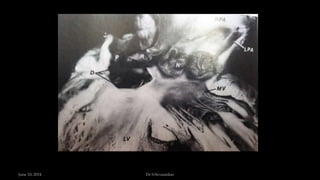
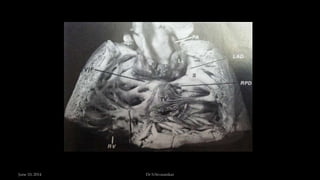
• Single aortopulmonary trunk from base of heart and all 3
circulations arising from it
• Large perimembranous VSD (obligatory) below truncus
• Truncal valve – bi, tri or quadricuspid and often incompetent.
• Pulmonary artery arise in several patterns
• Truncal overriding equally in 60 – 80%, to right in 10-30%, left in 4 –
6%
June 10, 2014 Dr S.Sivasankar
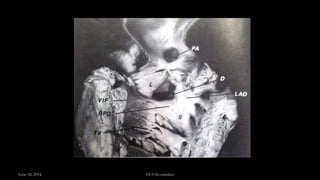
Coronary anomalies
• Stenotic ostia,
• Single ostium
• high & low take off,
• abnormal branching & course
anterior descending from RCA & cross RV
circumflex from RCA
RCA from LAD
intramuscular course
June 10, 2014 Dr S.Sivasankar
• Right aortic arch – 30%
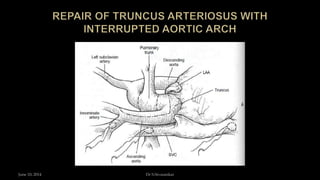
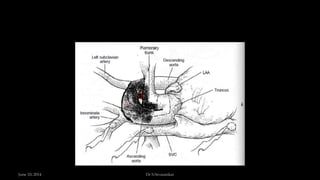
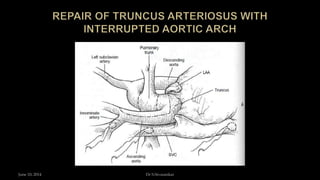
• Interrupted aortic arch – 10% (distal to left common carotid)
• Di George syndrome with hypocalcemia - 33%
• PFO
• OS-ASD
• Tricuspid valve lesions
• 22q11 chromosome deletion
June 10, 2014 Dr S.Sivasankar
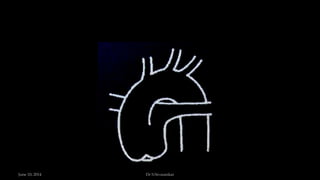
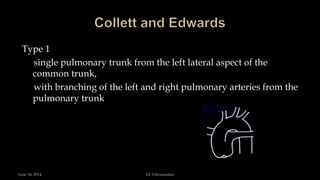
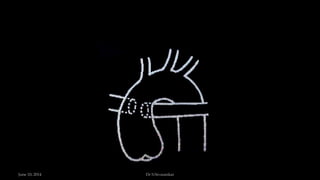
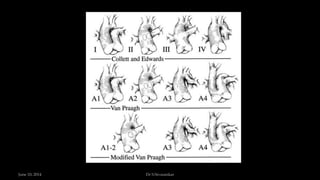
Type 1
single pulmonary trunk from the left lateral aspect of the
common trunk,
with branching of the left and right pulmonary arteries from the
pulmonary trunk
June 10, 2014 Dr S.Sivasankar
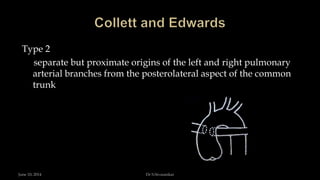
Type 2
separate but proximate origins of the left and right pulmonary
arterial branches from the posterolateral aspect of the common
trunk
June 10, 2014 Dr S.Sivasankar
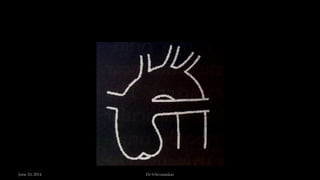
Type 3
branch pulmonary arteries originate independently from the
common trunk
June 10, 2014 Dr S.Sivasankar
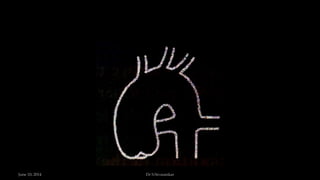
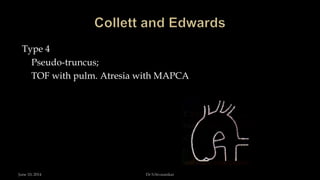
Type 4
Pseudo-truncus;
TOF with pulm. Atresia with MAPCA
June 10, 2014 Dr S.Sivasankar
Type A1
Identical to the type I of Collett and Edwards
June 10, 2014 Dr S.Sivasankar
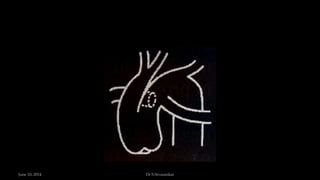
Type A2
Collett and Edwards type II and most cases of type III
June 10, 2014 Dr S.Sivasankar
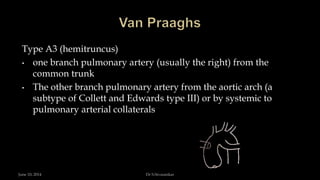
Type A3 (hemitruncus)
• one branch pulmonary artery (usually the right) from the
common trunk
• The other branch pulmonary artery from the aortic arch (a
subtype of Collett and Edwards type III) or by systemic to
pulmonary arterial collaterals
June 10, 2014 Dr S.Sivasankar
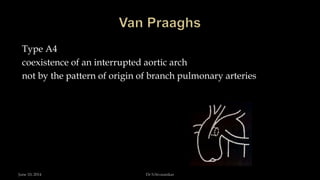
Type A4
coexistence of an interrupted aortic arch
not by the pattern of origin of branch pulmonary arteries
June 10, 2014 Dr S.Sivasankar
 Cyanotic congenital heart disease with increased pulmonary
blood flow
 Fetal pulmonary blood flow less than 10%
 PVR falls in early infancy improving PBF hence good oxygen
saturation
 Hypoxia in this period implies pulmonary arterial narrowing
 Equilibration of RV LV pressures
June 10, 2014 Dr S.Sivasankar
As the PBF increases PAH
Increased pulmonary venous return
CCF
June 10, 2014 Dr S.Sivasankar
History
• Cyanosis at birth
• Early CCF
• Failure to thrive,
• Respiratory tract infections
June 10, 2014 Dr S.Sivasankar
Physical examination
• Cyanosis
• Signs of CCF
• Bounding peripheral pulses, wide pulse pressure
• Single S2
• Harsh systolic regurgitant murmur – VSD
• EDM – truncal valve regurgitation
June 10, 2014 Dr S.Sivasankar
Survival
50% survival in 1 month
18% survival in 6 months
12% survival in 1 year
Modes of death
. Congestive heart failure in early life
. SBE, cerebral abscess → Eisenmenger syndrome (death in 3rd
decade)
. Adversely affected by truncal regurgitation, IAA, CoA
. Survival is favorably affected by PS
June 10, 2014 Dr S.Sivasankar
 Prenatal and early postnatal diagnosis common
 Proper evaluation of cyanotic infants clinches diagnosis
ABG
Pulse oximetry
ECG
CXR
TTE, TOE
June 10, 2014 Dr S.Sivasankar
ECG
• Normal QRS axis
• Bi-ventricular hypertrophy – 70%
June 10, 2014 Dr S.Sivasankar
CXR
• Cardiomegaly
• Pulmonary plethora
• Right aortic arch – 30%
June 10, 2014 Dr S.Sivasankar
 Echo – single truncal valve; no pulmonary valve
 CARDIAC CATHETERISATION
• Delineation of anatomy in complex forms.
• Assess PVR in late presentations.
June 10, 2014 Dr S.Sivasankar
Medical
Surgical
• Palliative
• Defintive
June 10, 2014 Dr S.Sivasankar
 Treat CCF – diuretics, digoxin
 Ensure oxygen delivery – intubation and mechanical ventilation
 Hypocalcemia correction in syndromic
 Prostaglandin I.V.in Van Praagh Type A4
June 10, 2014 Dr S.Sivasankar
 Improved greatly after early corrective surgery policy
 Increased mortality is associated with other coexisting
anomolies,
truncal valve insufficiency presurgically
truncal valve replacement
• Survival rates – 92% at 1 year;
60% at 20 years
June 10, 2014 Dr S.Sivasankar
Significant late deaths due to re-operations
truncal valve replacement
conduit replacement (now treated more with PCI)
June 10, 2014 Dr S.Sivasankar
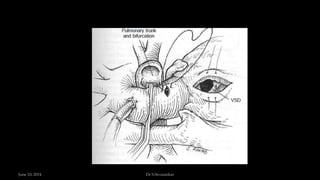
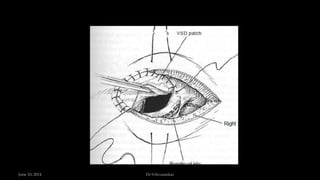
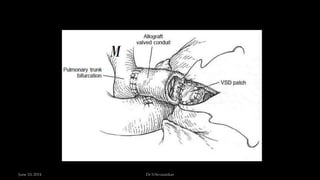
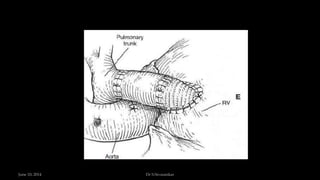
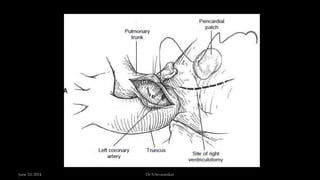
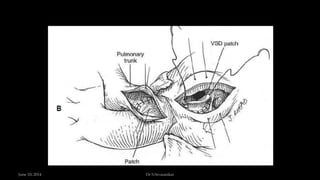
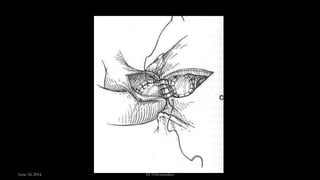
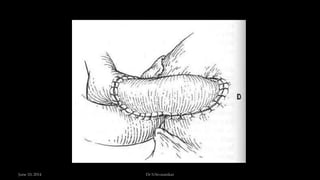
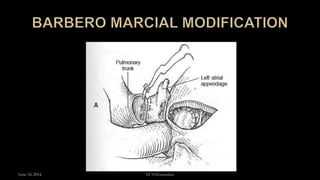
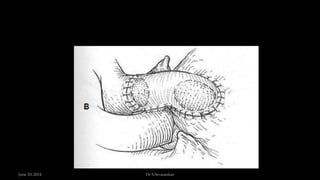
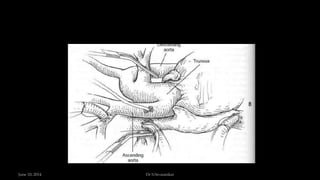
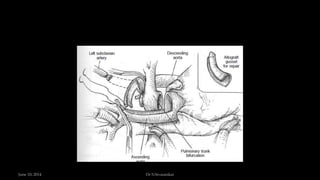
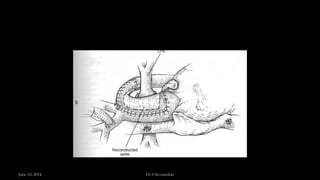
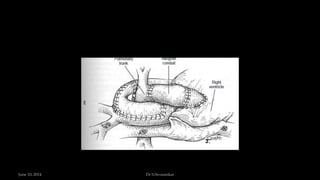
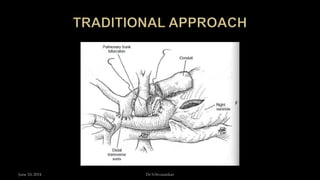
complete primary repair
• closure of the ventricular septal defect
• committing the common arterial trunk to the left ventricle
• reconstruction of the right ventricular outflow tract.
June 10, 2014 Dr S.Sivasankar
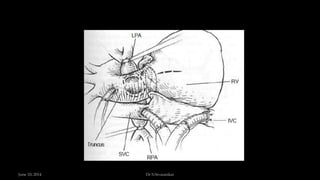
 Median sternotomy
 Aortic cannula placed distally at base of innominate
 Bicaval cannulation
 RSPV vent
 Pulmonary arteries snared
 Full flow, moderate hypothermia for simple forms( I & II)
 Cold antegrade cardioplegia +/- RCP if there is truncal regurgitation.
June 10, 2014 Dr S.Sivasankar
Thank you
June 10, 2014 Dr S.Sivasankar

Truncus arteriosus Dr Shiva CTVS JIPMER

  • 1.
    Dr.S.Sivasankar SR MCh,JIPMER 24.10.2012
  • 2.
     Persistant truncusarteriosus  Truncus Arteriosus communis  Common aortico pulmonary trunk June 10, 2014 Dr S.Sivasankar
  • 3.
    • Definition • History •Embryology • Anatomy and classification • Pathophysiology • Presentation • Workup • Treatment • Conclusion June 10, 2014 Dr S.Sivasankar
  • 4.
    • Congenital cyanoticcardiac defect with a single common arterial trunk giving rise to systemic, pulmonary and coronary circulations proximal to brachiocephalic branches • Associated with a large perimembranous VSD below the truncus June 10, 2014 Dr S.Sivasankar
  • 5.
    • TOF withpulm. Atresia with MAPCA (Collet Edwards type 4) • Hearts with common arterial trunk but, intact septum June 10, 2014 Dr S.Sivasankar
  • 6.
    June 10, 2014Dr S.Sivasankar
  • 7.
    June 10, 2014Dr S.Sivasankar
  • 8.
    1798 – Wilsondocuments 1st case 1942 –Basic morphologic criteria - Lev and Safir 1949 – Collet & Edwards Classification 1962 – Ist ICR with PTFE (non valved) conduit University of Michigan 1965 – Van Praaghs alternative classification 1967 – Ascending aortic allograft and valved conduit - McGoon et al. June 10, 2014 Dr S.Sivasankar
  • 9.
    1971 – firstconduit repair in infancy by Barratt-Boyes June 10, 2014 Dr S.Sivasankar
  • 10.
    June 10, 2014Dr S.Sivasankar
  • 11.
    • incomplete orfailed septation of the embryonic truncus arteriosus • Or abnormality of conotruncal septation June 10, 2014 Dr S.Sivasankar
  • 12.
    Primitive mesoderm &neural crest cells Heart & great vessels Give rise to June 10, 2014 Dr S.Sivasankar
  • 13.
    Blood islands ofcardiogenic plate Left and right endocardial tubes Intra embryonic coelom (early pericardial cavity) Coalesce at 20 days within June 10, 2014 Dr S.Sivasankar
  • 14.
    Left & rightendocardial tubes Bulbous cordis Fuse at 23 days June 10, 2014 Dr S.Sivasankar
  • 15.
    June 10, 2014Dr S.Sivasankar
  • 16.
    At this period,bulbo ventricular structures rotate anteriorly and to the right to form the heart loop June 10, 2014 Dr S.Sivasankar
  • 17.
    June 10, 2014Dr S.Sivasankar
  • 18.
    Trunco-conal swellings Trunco-conal ridges Truncalseptum Fuse June 10, 2014 Dr S.Sivasankar
  • 19.
    Truncal septum dividesaorta from Pulmonary artery and Conal septum Supraventricular crest and subpulmonic infundibulum June 10, 2014 Dr S.Sivasankar
  • 20.
    Day 37 Fusion ofconal septum with endocardial cushions establishes ventricular separation June 10, 2014 Dr S.Sivasankar
  • 21.
    June 10, 2014Dr S.Sivasankar
  • 22.
    June 10, 2014Dr S.Sivasankar
  • 23.
    • Single aortopulmonarytrunk from base of heart and all 3 circulations arising from it • Large perimembranous VSD (obligatory) below truncus • Truncal valve – bi, tri or quadricuspid and often incompetent. • Pulmonary artery arise in several patterns • Truncal overriding equally in 60 – 80%, to right in 10-30%, left in 4 – 6% June 10, 2014 Dr S.Sivasankar
  • 24.
    Coronary anomalies • Stenoticostia, • Single ostium • high & low take off, • abnormal branching & course anterior descending from RCA & cross RV circumflex from RCA RCA from LAD intramuscular course June 10, 2014 Dr S.Sivasankar
  • 25.
    • Right aorticarch – 30% • Interrupted aortic arch – 10% (distal to left common carotid) • Di George syndrome with hypocalcemia - 33% • PFO • OS-ASD • Tricuspid valve lesions • 22q11 chromosome deletion June 10, 2014 Dr S.Sivasankar
  • 26.
    June 10, 2014Dr S.Sivasankar
  • 27.
    June 10, 2014Dr S.Sivasankar
  • 28.
    Type 1 single pulmonarytrunk from the left lateral aspect of the common trunk, with branching of the left and right pulmonary arteries from the pulmonary trunk June 10, 2014 Dr S.Sivasankar
  • 29.
    June 10, 2014Dr S.Sivasankar
  • 30.
    Type 2 separate butproximate origins of the left and right pulmonary arterial branches from the posterolateral aspect of the common trunk June 10, 2014 Dr S.Sivasankar
  • 31.
    June 10, 2014Dr S.Sivasankar
  • 32.
    Type 3 branch pulmonaryarteries originate independently from the common trunk June 10, 2014 Dr S.Sivasankar
  • 33.
    June 10, 2014Dr S.Sivasankar
  • 34.
    Type 4 Pseudo-truncus; TOF withpulm. Atresia with MAPCA June 10, 2014 Dr S.Sivasankar
  • 35.
    June 10, 2014Dr S.Sivasankar
  • 36.
    June 10, 2014Dr S.Sivasankar
  • 37.
    Type A1 Identical tothe type I of Collett and Edwards June 10, 2014 Dr S.Sivasankar
  • 38.
    June 10, 2014Dr S.Sivasankar
  • 39.
    Type A2 Collett andEdwards type II and most cases of type III June 10, 2014 Dr S.Sivasankar
  • 40.
    June 10, 2014Dr S.Sivasankar
  • 41.
    Type A3 (hemitruncus) •one branch pulmonary artery (usually the right) from the common trunk • The other branch pulmonary artery from the aortic arch (a subtype of Collett and Edwards type III) or by systemic to pulmonary arterial collaterals June 10, 2014 Dr S.Sivasankar
  • 42.
    June 10, 2014Dr S.Sivasankar
  • 43.
    Type A4 coexistence ofan interrupted aortic arch not by the pattern of origin of branch pulmonary arteries June 10, 2014 Dr S.Sivasankar
  • 44.
    June 10, 2014Dr S.Sivasankar
  • 45.
    June 10, 2014Dr S.Sivasankar
  • 46.
    June 10, 2014Dr S.Sivasankar
  • 47.
    June 10, 2014Dr S.Sivasankar
  • 48.
    June 10, 2014Dr S.Sivasankar
  • 49.
    June 10, 2014Dr S.Sivasankar
  • 50.
    June 10, 2014Dr S.Sivasankar
  • 51.
    June 10, 2014Dr S.Sivasankar
  • 52.
     Cyanotic congenitalheart disease with increased pulmonary blood flow  Fetal pulmonary blood flow less than 10%  PVR falls in early infancy improving PBF hence good oxygen saturation  Hypoxia in this period implies pulmonary arterial narrowing  Equilibration of RV LV pressures June 10, 2014 Dr S.Sivasankar
  • 53.
    As the PBFincreases PAH Increased pulmonary venous return CCF June 10, 2014 Dr S.Sivasankar
  • 54.
    History • Cyanosis atbirth • Early CCF • Failure to thrive, • Respiratory tract infections June 10, 2014 Dr S.Sivasankar
  • 55.
    Physical examination • Cyanosis •Signs of CCF • Bounding peripheral pulses, wide pulse pressure • Single S2 • Harsh systolic regurgitant murmur – VSD • EDM – truncal valve regurgitation June 10, 2014 Dr S.Sivasankar
  • 56.
    Survival 50% survival in1 month 18% survival in 6 months 12% survival in 1 year Modes of death . Congestive heart failure in early life . SBE, cerebral abscess → Eisenmenger syndrome (death in 3rd decade) . Adversely affected by truncal regurgitation, IAA, CoA . Survival is favorably affected by PS June 10, 2014 Dr S.Sivasankar
  • 57.
     Prenatal andearly postnatal diagnosis common  Proper evaluation of cyanotic infants clinches diagnosis ABG Pulse oximetry ECG CXR TTE, TOE June 10, 2014 Dr S.Sivasankar
  • 58.
    ECG • Normal QRSaxis • Bi-ventricular hypertrophy – 70% June 10, 2014 Dr S.Sivasankar
  • 59.
    CXR • Cardiomegaly • Pulmonaryplethora • Right aortic arch – 30% June 10, 2014 Dr S.Sivasankar
  • 60.
     Echo –single truncal valve; no pulmonary valve  CARDIAC CATHETERISATION • Delineation of anatomy in complex forms. • Assess PVR in late presentations. June 10, 2014 Dr S.Sivasankar
  • 61.
  • 62.
     Treat CCF– diuretics, digoxin  Ensure oxygen delivery – intubation and mechanical ventilation  Hypocalcemia correction in syndromic  Prostaglandin I.V.in Van Praagh Type A4 June 10, 2014 Dr S.Sivasankar
  • 63.
     Improved greatlyafter early corrective surgery policy  Increased mortality is associated with other coexisting anomolies, truncal valve insufficiency presurgically truncal valve replacement • Survival rates – 92% at 1 year; 60% at 20 years June 10, 2014 Dr S.Sivasankar
  • 64.
    Significant late deathsdue to re-operations truncal valve replacement conduit replacement (now treated more with PCI) June 10, 2014 Dr S.Sivasankar
  • 65.
    complete primary repair •closure of the ventricular septal defect • committing the common arterial trunk to the left ventricle • reconstruction of the right ventricular outflow tract. June 10, 2014 Dr S.Sivasankar
  • 66.
     Median sternotomy Aortic cannula placed distally at base of innominate  Bicaval cannulation  RSPV vent  Pulmonary arteries snared  Full flow, moderate hypothermia for simple forms( I & II)  Cold antegrade cardioplegia +/- RCP if there is truncal regurgitation. June 10, 2014 Dr S.Sivasankar
  • 67.
    June 10, 2014Dr S.Sivasankar
  • 68.
    June 10, 2014Dr S.Sivasankar
  • 69.
    June 10, 2014Dr S.Sivasankar
  • 70.
    June 10, 2014Dr S.Sivasankar
  • 71.
    June 10, 2014Dr S.Sivasankar
  • 72.
    June 10, 2014Dr S.Sivasankar
  • 73.
    June 10, 2014Dr S.Sivasankar
  • 74.
    June 10, 2014Dr S.Sivasankar
  • 75.
    June 10, 2014Dr S.Sivasankar
  • 76.
    June 10, 2014Dr S.Sivasankar
  • 77.
    June 10, 2014Dr S.Sivasankar
  • 78.
    June 10, 2014Dr S.Sivasankar
  • 79.
    June 10, 2014Dr S.Sivasankar
  • 80.
    June 10, 2014Dr S.Sivasankar
  • 81.
    June 10, 2014Dr S.Sivasankar
  • 82.
    June 10, 2014Dr S.Sivasankar
  • 83.
    June 10, 2014Dr S.Sivasankar
  • 84.
    June 10, 2014Dr S.Sivasankar
  • 85.
    June 10, 2014Dr S.Sivasankar
  • 86.
    Thank you June 10,2014 Dr S.Sivasankar