Total Anomalous Pulmonary Venous Connection Seoul National University Hospital Department of Thoracic & Cardiovascular Surgery
Total Anomalous Pulmonary Venous Connection Definition Cardiac malformation  in  which there is no direct  connection between any pulmonary vein & left atrium,  but  all the pulmonary veins connect to right atrium  or one of  it’s tributaries.  A PFO or an ASD  is present essentially all persons who survive  after birth. History Wilson    :  1st description in 1798 Muller   :  1st  closed partial  approach in 1951 Lewis & Varco  :  Successful open repair in 1956
Total Anomalous Pulmonary Venous Connection Origin of anomalous connection 1. Drainage to right atrium 2. Drainage to right common cardinal system (SVC or azygous vein) 3. Drainage to left common cardinal system (Left innominate vein or coronary sinus) 4. Drainage to umbilical-vitelline system (Portal vein, ductus venosus, and so on)
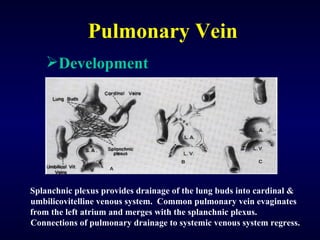
Pulmonary Vein Splanchnic plexus provides drainage of the lung buds into cardinal & umbilicovitelline venous system.  Common pulmonary vein evaginates  from the left atrium and merges with the splanchnic plexus.  Connections of pulmonary drainage to systemic venous system regress. Development
TAPVC Pathophysiology Entire pulmonary venous return drains into the right atrium, usually via a common pulmonary vein confluence, resulting in complete pulmonary and systemic venous mixing. Oxygenated blood reaches the left heart via an inter-atrial connection (i.e.,ASD, PFO). Mechanical or functional obstruction of the pulmonary venous return leads to cyanosis, acidosis, pulmonary hypertension, & congestion.
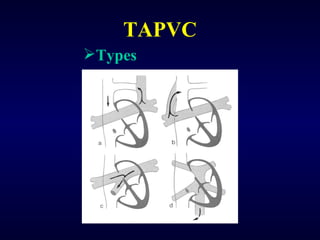
TAPVC 1.  Pulmonary venous anatomy 1) Type  : Supracardiac  45% Cardiac  25% Infracardiac  25% Mixed  5% 2) Pulmonary venous obstruction . Junction of connecting vein  or compression, or long narrow connect vein . Functional obstruction  (restrictive PFO) 2.  Chamber & septal anatomy .  LA &  LV  :  small .  ASD or PFO  :  small  in 1/2,  rarely no ASD or PFO 3.  Pulmonary vasculature . Increased arterial  muscularity . Structural change 4.  Associated condition . PDA  :  15% . VSD  :  occasionally . TOF, DORV, IAA  :  rarely Morphology
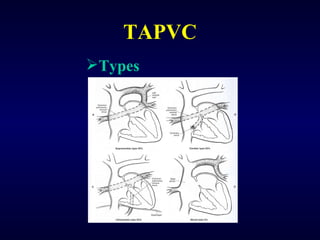
TAPVC Types
TAPVC Types
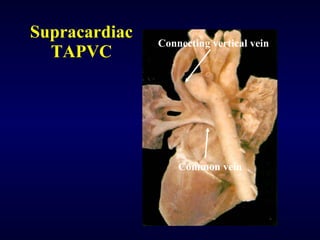
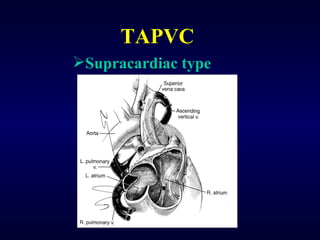
Supracardiac TAPVC Common vein Connecting vertical vein
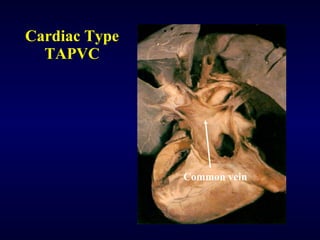
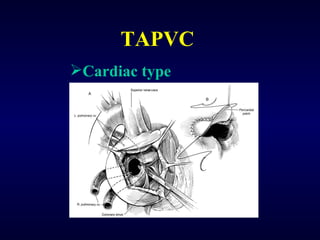
Cardiac Type TAPVC Common vein
TAPVC Clinical features & diagnosis 1.  Presentation . Critically ill infants during 1st few week of life . Unexplained tachypnea  &  unimpressive cyanosis . Metabolic acidosis : pulmonary venous obstruction 2.  Examination . No particularly overactive heart & unimpressive heart sound 3.  Chest radiography . Normal heart size with diffuse haziness or ground  glass  if  pulmonary venous obstruction . Large heart size with high pulmonary blood flow . Figure of  8, snowman configuration 4.  Echocardiography 5.  Cardiac catheterization & cineangiography
TAPVC Natural history 1.  Incidence . Relatively uncommon anomaly,  1.5~3% of CHD 2.  Survival . Unfavorable prognosis 50% survival in 3months 20% survival in one year . Usually have pulmonary venous obstruction due to long pulmonary venous pathway & a small PFO  . Those who survive the first year of life usually  have  large ASD, no pulmonary venous obstruction
TAPVC Indications for operation Investigation must be undertaken promptly in any  neonate or infant, no matter how young, who develops  signs or symptoms suggestive of TAPVC   Immediate operation in any neonate or infant whom are importantly ill with TAPVC Prompt operation in any 6-12 months old infant Advisable if severe pulmonary vascular disease has not developed in old patients (under 8 units)
TAPVC Operative techniques Operation should be undertaken as an emergency after diagnosis by echocardiography who enter the hospital critically ill.  Preoperative preparation & stabilization  is contraindicated. 1.  TAPVR to Lt. innominate vein 2.  TAPVR to SVC 3.  TAPVR to coronary sinus  4.  TAPVR to right atrium 5.  TAPVR to infradiaphragmatic vein
TAPVC Supracardiac type
TAPVC Cardiac type
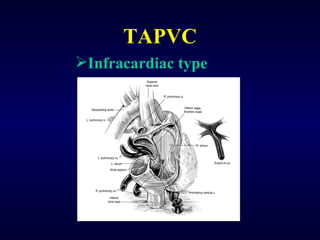
TAPVC Infracardiac type
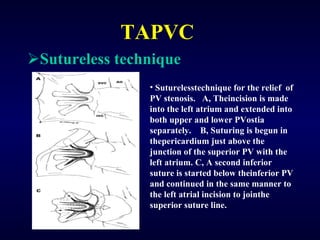
Sutureless technique Suturelesstechnique for the relief  of PV stenosis.  A, Theincision is made  into the left atrium and extended into both upper and lower PVostia separately.  B, Suturing is begun in thepericardium just above the junction of the superior PV with the left atrium. C, A second inferior suture is started below theinferior PV and continued in the same manner to the left atrial incision to jointhe superior suture line.  TAPVC
Primary Sutureless Repair Rationale Small size of the pulmonary vein is a major risk factor for   later development of PVS after conventional TAPVD repair and   that high mortality of right atrial isomerism is related, at least in part, to   intrinsically small pulmonary veins. Furthermore,   most of the patients with RAI are not anatomic candidates for   biventricular repair. PVS is a risk factor for poor Fontan operation   outcome The acute anatomic benefit for the sutureless   repair is that each vein is its own native size, without any   suture material to cause an excessive inflammatory reaction   or luminal compromise
TAPVC 1.  Survival 2.  Modes of death . Hypertensive crisis . Pulmonary venous stenosis  3. Incremental risk factors  for death  . Infracardiac drainage . Pulmonary venous obstruction . Poor preoperative state . Small size of pulmonary vein . Increased PVR . Small left ventricle 4.  Functional status 5.  Hemodynamic result 6.  Cardiac rhythm 7.  Reoperation   . Anastomotic stricture  (5~10%) . Pulmonary vein stenosis Surgical results
TAPVC Special situation & controversies 1.  Delayed operation   In critical patients with obstruction at atrial level,  balloon dilation and 1-2 days later operation  2.  Mixed total anomalous venous connection 3.  Operative exposure 4.  Surgical enlargement of left atrium Decrease in atrial volume of more than 50%  result in reduction in cardiac output ? 5.  Pulmonary vein stenosis
Residual TAPVC   PVD in remained anomalous veins Possible pressure-sensitive receptors at  the anomalous vein-vena cava junction Axon reflex triggered by right atrial distention Results of  the increased blood flow
Pulmonary Vein Stenosis Etiology 1.  Low grade venous obstruction presents at the  end of procedure results in reactive fibrosis  ( diffuse fibrosis & thickening of vein ) 2.  Self perpetuating stenosis 3.  Intraatrial thickening 4.  Diffuse pulmonary vein stenosis 5.  Congenital nature ( hypoplasia, focal stenosis,  discrete ostial stenosis)
Pulmonary Vein Stenosis Factors of development 1. Small confluent pulmonary vein 2. Suture material 3. TAPVC type? 4. Undue trauma toward  pulmonary  vein ostium and tension 5. Steroid therapy
Congenital PV Stenosis Clinical features Occur in about 0.4% of congenital heart defects and one or multiple veins may be affected.  Histologically, the lesion   is characterized by fibrous intimal thickening in most cases   and medial hypertrophy in many  The first surgical repair   of congenital PV stenosis was reported by Kawashima and colleagues   in 1971 and surgical approaches have evolved over the years,   but results have been generally disappointing.  Diffuse restenosis   has been documented as a significant cause of late mortality   after repair
Acquired PV Stenosis Characteristics Anatomically localized to the anastomosis,   and the natural history is more favorable, or the   stenosis may extend diffusely into the branch pulmonary veins. It can sometimes   be difficult to distinguish these forms of acquired PV stenosis   at the time of presentation.  Acquired PV stenosis occurs in   approximately  7% to  11% of early survivors after total anomalous   pulmonary venous connection repair  Results of repair   of acquired PV stenosis have also been less than optimal due   to the problem of restenosis
Acquired PV Stenosis Anatomic features Post-repair pulmonary   vein stenosis appears to have three basic subtypes.  The most   minimal form of the disease is limited to the anastomotic area   with sparing of the pulmonary veins and confluence, suggesting   a technical error or imperfection at the time of initial repair.   The intermediate form is limited to the pulmonary venous confluence   in addition to the anastomotic area. The most extensive   form of the disease includes a fibrous reaction extending retrograde   deep into the lung parenchyma.
Pulmonary Vein Stenosis Strategy for treatment 1.  Minimize trauma at suture line Suture line (tension or inflexibility, deformation)  Suture material Handling the vein tissue 2.  Avoid postoperative turbulence Constraints imposed by restrictive characteristics   3.  Surgical methods Operative patch venoplasty Sutureless pericardial marsupialization Catheter dilation Stent placement and combination
Complex TAPVC Etiology of high mortality  1.  The interplay of systemic shunt  with  abnormal  pulmonary vasculature contributes to difficulty in maintaining  postoperative pulmonary to systemic  flow ratio. 2.  To limit excessive pulmonary blood flow with banding,  or augmentation with shunt, the end result is similar. 3.  The static matching of this resistance to the cardiac output in  face of abnormal pulmonary vasculature may not allow  appropriate regulation of pulmonary blood flow during dynamic changes.

Total Anomalous Pulmonary Venous Connection

  • 1.
    Total Anomalous PulmonaryVenous Connection Seoul National University Hospital Department of Thoracic & Cardiovascular Surgery
  • 2.
    Total Anomalous PulmonaryVenous Connection Seoul National University Hospital Department of Thoracic & Cardiovascular Surgery
  • 3.
    Total Anomalous PulmonaryVenous Connection Definition Cardiac malformation in which there is no direct connection between any pulmonary vein & left atrium, but all the pulmonary veins connect to right atrium or one of it’s tributaries. A PFO or an ASD is present essentially all persons who survive after birth. History Wilson : 1st description in 1798 Muller : 1st closed partial approach in 1951 Lewis & Varco : Successful open repair in 1956
  • 4.
    Total Anomalous PulmonaryVenous Connection Origin of anomalous connection 1. Drainage to right atrium 2. Drainage to right common cardinal system (SVC or azygous vein) 3. Drainage to left common cardinal system (Left innominate vein or coronary sinus) 4. Drainage to umbilical-vitelline system (Portal vein, ductus venosus, and so on)
  • 5.
    Pulmonary Vein Splanchnicplexus provides drainage of the lung buds into cardinal & umbilicovitelline venous system. Common pulmonary vein evaginates from the left atrium and merges with the splanchnic plexus. Connections of pulmonary drainage to systemic venous system regress. Development
  • 6.
    TAPVC Pathophysiology Entirepulmonary venous return drains into the right atrium, usually via a common pulmonary vein confluence, resulting in complete pulmonary and systemic venous mixing. Oxygenated blood reaches the left heart via an inter-atrial connection (i.e.,ASD, PFO). Mechanical or functional obstruction of the pulmonary venous return leads to cyanosis, acidosis, pulmonary hypertension, & congestion.
  • 7.
    TAPVC 1. Pulmonary venous anatomy 1) Type : Supracardiac 45% Cardiac 25% Infracardiac 25% Mixed 5% 2) Pulmonary venous obstruction . Junction of connecting vein or compression, or long narrow connect vein . Functional obstruction (restrictive PFO) 2. Chamber & septal anatomy . LA & LV : small . ASD or PFO : small in 1/2, rarely no ASD or PFO 3. Pulmonary vasculature . Increased arterial muscularity . Structural change 4. Associated condition . PDA : 15% . VSD : occasionally . TOF, DORV, IAA : rarely Morphology
  • 8.
  • 9.
  • 10.
    Supracardiac TAPVC Commonvein Connecting vertical vein
  • 11.
    Cardiac Type TAPVCCommon vein
  • 12.
    TAPVC Clinical features& diagnosis 1. Presentation . Critically ill infants during 1st few week of life . Unexplained tachypnea & unimpressive cyanosis . Metabolic acidosis : pulmonary venous obstruction 2. Examination . No particularly overactive heart & unimpressive heart sound 3. Chest radiography . Normal heart size with diffuse haziness or ground glass if pulmonary venous obstruction . Large heart size with high pulmonary blood flow . Figure of 8, snowman configuration 4. Echocardiography 5. Cardiac catheterization & cineangiography
  • 13.
    TAPVC Natural history1. Incidence . Relatively uncommon anomaly, 1.5~3% of CHD 2. Survival . Unfavorable prognosis 50% survival in 3months 20% survival in one year . Usually have pulmonary venous obstruction due to long pulmonary venous pathway & a small PFO . Those who survive the first year of life usually have large ASD, no pulmonary venous obstruction
  • 14.
    TAPVC Indications foroperation Investigation must be undertaken promptly in any neonate or infant, no matter how young, who develops signs or symptoms suggestive of TAPVC Immediate operation in any neonate or infant whom are importantly ill with TAPVC Prompt operation in any 6-12 months old infant Advisable if severe pulmonary vascular disease has not developed in old patients (under 8 units)
  • 15.
    TAPVC Operative techniquesOperation should be undertaken as an emergency after diagnosis by echocardiography who enter the hospital critically ill. Preoperative preparation & stabilization is contraindicated. 1. TAPVR to Lt. innominate vein 2. TAPVR to SVC 3. TAPVR to coronary sinus 4. TAPVR to right atrium 5. TAPVR to infradiaphragmatic vein
  • 16.
  • 17.
  • 18.
  • 19.
    Sutureless technique Suturelesstechniquefor the relief of PV stenosis. A, Theincision is made into the left atrium and extended into both upper and lower PVostia separately. B, Suturing is begun in thepericardium just above the junction of the superior PV with the left atrium. C, A second inferior suture is started below theinferior PV and continued in the same manner to the left atrial incision to jointhe superior suture line. TAPVC
  • 20.
    Primary Sutureless RepairRationale Small size of the pulmonary vein is a major risk factor for later development of PVS after conventional TAPVD repair and that high mortality of right atrial isomerism is related, at least in part, to intrinsically small pulmonary veins. Furthermore, most of the patients with RAI are not anatomic candidates for biventricular repair. PVS is a risk factor for poor Fontan operation outcome The acute anatomic benefit for the sutureless repair is that each vein is its own native size, without any suture material to cause an excessive inflammatory reaction or luminal compromise
  • 21.
    TAPVC 1. Survival 2. Modes of death . Hypertensive crisis . Pulmonary venous stenosis 3. Incremental risk factors for death . Infracardiac drainage . Pulmonary venous obstruction . Poor preoperative state . Small size of pulmonary vein . Increased PVR . Small left ventricle 4. Functional status 5. Hemodynamic result 6. Cardiac rhythm 7. Reoperation . Anastomotic stricture (5~10%) . Pulmonary vein stenosis Surgical results
  • 22.
    TAPVC Special situation& controversies 1. Delayed operation In critical patients with obstruction at atrial level, balloon dilation and 1-2 days later operation 2. Mixed total anomalous venous connection 3. Operative exposure 4. Surgical enlargement of left atrium Decrease in atrial volume of more than 50% result in reduction in cardiac output ? 5. Pulmonary vein stenosis
  • 23.
    Residual TAPVC PVD in remained anomalous veins Possible pressure-sensitive receptors at the anomalous vein-vena cava junction Axon reflex triggered by right atrial distention Results of the increased blood flow
  • 24.
    Pulmonary Vein StenosisEtiology 1. Low grade venous obstruction presents at the end of procedure results in reactive fibrosis ( diffuse fibrosis & thickening of vein ) 2. Self perpetuating stenosis 3. Intraatrial thickening 4. Diffuse pulmonary vein stenosis 5. Congenital nature ( hypoplasia, focal stenosis, discrete ostial stenosis)
  • 25.
    Pulmonary Vein StenosisFactors of development 1. Small confluent pulmonary vein 2. Suture material 3. TAPVC type? 4. Undue trauma toward pulmonary vein ostium and tension 5. Steroid therapy
  • 26.
    Congenital PV StenosisClinical features Occur in about 0.4% of congenital heart defects and one or multiple veins may be affected. Histologically, the lesion is characterized by fibrous intimal thickening in most cases and medial hypertrophy in many The first surgical repair of congenital PV stenosis was reported by Kawashima and colleagues in 1971 and surgical approaches have evolved over the years, but results have been generally disappointing. Diffuse restenosis has been documented as a significant cause of late mortality after repair
  • 27.
    Acquired PV StenosisCharacteristics Anatomically localized to the anastomosis, and the natural history is more favorable, or the stenosis may extend diffusely into the branch pulmonary veins. It can sometimes be difficult to distinguish these forms of acquired PV stenosis at the time of presentation. Acquired PV stenosis occurs in approximately 7% to 11% of early survivors after total anomalous pulmonary venous connection repair Results of repair of acquired PV stenosis have also been less than optimal due to the problem of restenosis
  • 28.
    Acquired PV StenosisAnatomic features Post-repair pulmonary vein stenosis appears to have three basic subtypes. The most minimal form of the disease is limited to the anastomotic area with sparing of the pulmonary veins and confluence, suggesting a technical error or imperfection at the time of initial repair. The intermediate form is limited to the pulmonary venous confluence in addition to the anastomotic area. The most extensive form of the disease includes a fibrous reaction extending retrograde deep into the lung parenchyma.
  • 29.
    Pulmonary Vein StenosisStrategy for treatment 1. Minimize trauma at suture line Suture line (tension or inflexibility, deformation) Suture material Handling the vein tissue 2. Avoid postoperative turbulence Constraints imposed by restrictive characteristics 3. Surgical methods Operative patch venoplasty Sutureless pericardial marsupialization Catheter dilation Stent placement and combination
  • 30.
    Complex TAPVC Etiologyof high mortality 1. The interplay of systemic shunt with abnormal pulmonary vasculature contributes to difficulty in maintaining postoperative pulmonary to systemic flow ratio. 2. To limit excessive pulmonary blood flow with banding, or augmentation with shunt, the end result is similar. 3. The static matching of this resistance to the cardiac output in face of abnormal pulmonary vasculature may not allow appropriate regulation of pulmonary blood flow during dynamic changes.