AV SEPTAL DEFECTS
Murtaza Kamal
1
Scope of today’s talk
• Introduction & Nomenclature
• Demographics
• Embryogenesis
• Natural & Unnatural history
• Clinical features
• Management
2
Contributions…
3
Introduction & Nomenclature
•Group of anomalies
•Defect of AV septum+ AV valves
•AVCD, EDD, AVSD
•Spectrum (PTIC):
• Partial—> Transitional—> Intermediate—> Complete
4
Intro & Nomenclature cont…
•Partial:
• Primum ASD
• 2 distinct but focally contagious Rt+ Lt AVV orifices
• DO NOT CALL MITRAL+ TRICUSPID… WHY???
• Lt AVV: Invariably cleft
5
Intro & Nomenclature cont…
•Transitional:
• Partial AVSD+
• Small/ restrictive inlet VSD partially occluded by dense choral
attachments to ventricular septum
6
Intro & Nomenclature cont…
•Intermediate:
• Subtype of complete AVSD
• Distinct Rt+ Lt AVV orifices+
• Large inlet VSD
7
•Complete:
• Primum ASD+
• Large inlet VSD+
• Common AVV with single orifice
Intro & Nomenclature cont…
8
Intro & Nomenclature cont…
Type to enter a caption.
9
Intro & Nomenclature cont…
•Conflicting + confusing terminologies of subtypes
•Importance:
• Description of AVV morphology
• Chamber sizes
• Magnitude of shunting
10
Anatomic features shared by
all forms
•AVV leaflets insert at same level at cardiac crux
•AV septum absence
•Aortic valve: Unwedged+ anteriorly displaced
•Elongated LVOT
•LV papillary muscles: Counter clockwise rotation
•Cleft lt. AVV component, directed towards ventricular septum
11
Demographics
•4-5% of all CHD
•0.19/ 1000 live births
•Fetal Echo: MC anomaly (18%) of abnormal fetal hearts
•High chances of extra cardiac malformations
•Overall mortality: 48% (Extracardiac anomaly: Independent risk)
•(Allan et al. Prospective diagnosis of 1006 consecutive cases of
CHD in fetus. J Am Coll Cardiol. 1994;23:1452-58)
•Females> Males
12
Associations…
•40-50% kids with Down syndrome—> Have CHD—> Out of these 45%
have AVSD
• Down syndrome with AVSD: 75% Complete AVSD
• 50% of patients with AVSD—> Have Down syndrome
• Black africans with DS> Whites> Hispanics with DS
•Heterotaxy (Asplenia> Polysplenia): Complete AVSD
•Ellis van creveld syndrome: Complete AVSD
13
Embryogenesis
14
Development
•Extracellular matrix (Cardiac jelly) secreted by myocardium in intra
myocardium endocardial space
•This matrix induces Epithelial to mesenchymal transformation of
Endocardium (EMT)
•Generation of migratory endocardial cushion cells required for
cardiac separation in outflow tracts (Outflow cushions) and b/w AVV
(AV cushions)
15
Development
16
Development
17
Embryogenesis
•Faulty development of AV endocardial cushions
•Dorsal mesenchymal protrusion
•In partial: Incomplete fusion of superior+ inferior endocardial
cushions—> Cleft in mid portion of lt AVV anterior leaflet
•In complete: Lack of fusion b/w superior+ inferior cushions—>
Separate anterior and posterior bridging leaflets along subjacent
ventricular septum
18
Embryogenesis
•Failure of EC to fuse create a defect in AV septum
•Results in downward displacement of anterior lt AVV leaflet to septal
rt AVV—> SAME SEPTAL INSERTION LEVEL
•Distance from apex to aortic valve> Cardiac crux to LV apex
•Anterior displacement of LVOT—> Elongation+ Narrowing of LVOT
(GOOSENECK DEFORMITY)
•Post surgery—> Progressive sub- aortic stenosis can develop
19
Embryogenesis…
20
Embryogenesis
•Dextrodorsal conus cushion contributes to development of rt. AVV+
outflow tracts lie adjacent to their respective inflow tracts—> Hence,
AVSDs can be associated with Cono-truncal anomalies
•Shift of AVV orifice—> May result in connection of valve primarily to
only 1 ventricle (MC: Rt.)—> Unbalanced ventricles
21
Partial AVSD
22
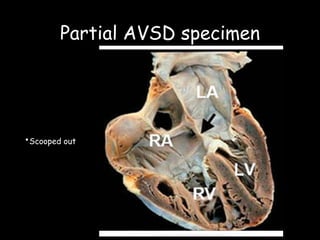
Partial AVSD: Pathology
•Rt+ lt AVV orifices separated by a tongue of tissue
•Primum ASD+ Cleft lt. AVV anterior leaflet
•Located anterior+ inferior to fossa ovalis
•Boundaries:
• Posterosuperiorly: Cresentric rim of atrial septal tissue
• Anteroinferiorly: AVV continuity
•Can’t be closed by trans catheter devices
23
Partial AVSD specimen
•Scooped out
24
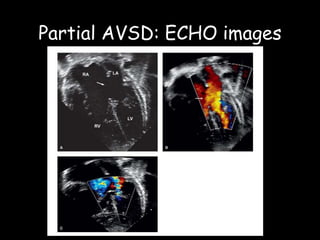
Partial AVSD: ECHO images
25
Partial AVSD pathology cont…
•Cleft in lt. AVV—> Dirested towards mid portion of ventricular
septum
•Contrast: Towards aortic valve annulus
•Lt AVV orifice—> Triangular rather than elliptical
•Resembles mirror image TV orifice
•Cleft lt AVV—> Regurgitant—> Becomes thickened —> Exhibits
histologic alterations resembling myxomatous MVP
26
Associated anomalies with
partial AVSD
•Secundum ASD
•PDA
•Persistant LSVC to CS
•PS/ TS/ TA
•Cor triatriatum/ VSD- membranous/ PV anomalies
•COA/ HLHS/ HRHS
27
CFs Partial AVSDs
•May be asymptomatic till adulthood
•Childhood:
• Symptoms of increased PBF
• Tachypnea+ poor wt gain occur earlier
• Severe if associated with moderate/ severe Lt AVVR/ other
harm-dynamically significant cardiac anomalies
• Compared to second ASD: Earlier+ more severe symptoms
28
CFs Partial AVSDs
•S2: Wide+ fixed split
•Murmur:
• ESM: PV turbulent flow (ULSB)
• PSM: Lt AVVR (Apex)
• MDM: LLSB, If large shunt/ significant lt. AVVR
29
Imaging
•2D ECHO: Primary imaging technique
•TEE: Good for bigger patients, associated complex abnormalities
•3D ECHO:
• Surgical view (From LA)
• AVV abnormality
• Leaflet morphology
• Cleft, commissures, sub valvular apparatus
30
Internal cardiac crux
•Most consistent ECHO imaging landmark: A4CV
•Primum ASD seen as absence of lower atrial septum
•Size estimation best (+ Subcostal 4CV)
•AVV also visualised well
31
Internal cardiac crux
32
Transitional AVSD
•Aneurysmal replacement of a portion of inlet ventricular septum
•Small shunts occur through this tricuspid pouch
•Dense chordal attachments eventually obstruct flow
•Doppler ECHO: Not useful in estimating lt. AVV stenosis; Primum ASD
decompresses LA
33
Lt AVV abnormalities
•Lt AVV abnormalities in both
•MC: Cleft (Multiple jets can be present)
• Lt AVVR directed into RA: Successful repair of cleft+ Primum
ASD closure
• Lt AVVR directed into LA: Not completely eliminated by cleft
repair (signifies other intrinsic abnormalities with valve)
• Degree of pre op regurgitation decides post op residual
regurgitation
34
Lt AVV abnormalities
•DO lt AVV:
• 3-5%
• Tongue of tissue divides lt AVV into 2 orifices
• Combined effective valve area: Always less than valve area of a
single orifice lt AVV—> Predisposes to post op stenosis
• Subcostal + PSAV
•Parachute MV
35
DO lt AVV
36
Do not underestimate sub
valvular apparatus
•2010 Ando+ Takahashi: 138 C-ACSD: Assessed anatomic factors associate with
more difficult VSD patch placement / cleft approximation—> 4 risk factors for
at least moderate lt. AVVR:
•1. Papillary msl abnormalities:
•MC—> Imbalance of papillary msl
•Laterally displaced AL papillae msl
•Dominent AL papillary msl with short, thickened or absent cords,
eccentrically positioned cleft (Colen et al.)
37
Do not underestimate sub
valvular apparatus
•2. Dense chordal attachments of ABL obscuring rt side of crest of
ventricular septum
•3. DO lt. AVV
•4. Severe length discrepancies of cleft
38
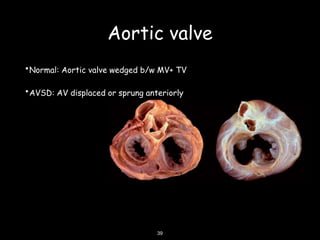
Aortic valve
•Normal: Aortic valve wedged b/w MV+ TV
•AVSD: AV displaced or sprung anteriorly
39
Gooseneck deformity of LVOT
•KK
40
LVOT obstruction
•Elongated LVOT—> Predisposes to progressive sub aortic obstruction
•MC if 2 distinct AVV +nt: Superior bridging leaflet attaching to crest
of ventricular septum
•Discrete sub aortic fibro muscular ridges, septal HT, abnormal lt.
AVV chordal attachments, abnormally oriented papillary msls
•Can develop de novo after repair
•Often progressive: More common in partial AVSD
41
Mechanisms of LVOT
obstruction
• Tissue from an aneurysm of membranous septum bowing into LVOT
•Attachment of superior bridging leaflet to ventricular septum
•Extension of AL papillae msl to LVOT
•Discrete fibrous sub aortic stenosis
42
LVOT obstruction
43
Also do not miss these…
•Associated lesions:
•TOF/ DORV/ PA: Less frequent with partial AVSD
•AVV abnormalities, LV hypoplasia: MC in 2 orifice AVV connections
•COA: Equal frequency in both
44
CXR
•Cardiomegaly+ Prominent PV markings
•RA enlargement: Jet of lt. AVVR directed
45
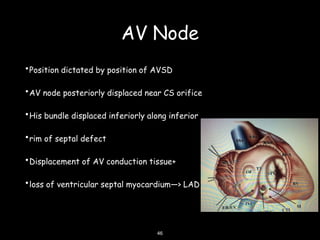
AV Node
•Position dictated by position of AVSD
•AV node posteriorly displaced near CS orifice
•His bundle displaced inferiorly along inferior
•rim of septal defect
•Displacement of AV conduction tissue+
•loss of ventricular septal myocardium—> LAD
46
ECG changes
•25%: Prolongation of PR interval
•Increased conduction time from high RA to low septal RA
•50%: P wave changes (RA/ LA/ Biatrial enlargement)
•Mean QRS Axis: -30 to -120
•RV volume overload—> RVH+ some variation in rsR’ pattern of rt precordial
leads: 80%
•10%: qR pattern
•LVH: Lt AVVR
47
Cardiac cath & Angiography
•Rarely needed
•Older patients: PVOD/ CAD
•Higher spo2 in RA + Inflow portion of RV samples compared to SVC/
IVC
•Gooseneck deformity
48
Partial AVSD: Special forms
•1. Malaligned atrial septum/ DORA
•2. Common atrium
49
Malaligned atrial septum/
DORA
•Deviation of atrial septum to lt. Of AV junction
•Both rt+ lt. AVV —> Visualised from RA—> Connected to both
ventricles through large premium ASD
•If extreme deviation to left—> PVs isolated + obstructed (like cor-
triatriatum)
50
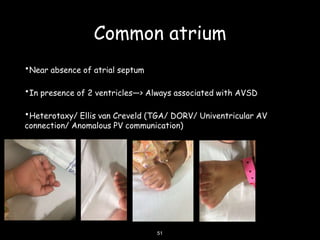
Common atrium
•Near absence of atrial septum
•In presence of 2 ventricles—> Always associated with AVSD
•Heterotaxy/ Ellis van Creveld (TGA/ DORV/ Univentricular AV
connection/ Anomalous PV communication)
51
CA
•Presents in infancy with symptoms of increased PBF
•Symptomatic earlier than isolated premium ASD
•CXR/ ECG—> Indistinguishable from other forms
•Cath: Spo2 of pulmonary+ systemic arteries are nearly equal
•PBV> SBF
•RV pressure overload more than premium ASD
•Early surgery: PVOD
52
COMPLETE AVSD
53
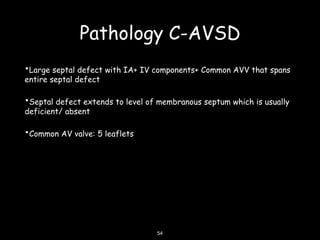
Pathology C-AVSD
•Large septal defect with IA+ IV components+ Common AVV that spans
entire septal defect
•Septal defect extends to level of membranous septum which is usually
deficient/ absent
•Common AV valve: 5 leaflets
54
Common AV valve
Bridging portion of LIL
RSL
RLL
TV
AL
PL
RSL
RLL
LIL
SL
RIL
Chapter 34
Atrioventricular Septal Defect
LLL
Bridging portion of LIL
RSL
RLL
TV
AL
PL
RSL
RLL
LIL
SL
RIL
Chapter 34
Atrioventricular Septal Defect
LLL
Bridging portion of LIL
RSL
RIL
LLL
Bridging portion of LIL
RSL
RLL
TV
AL
PL
RSL
RLL
LIL
SL
RIL
Chapter 34
Atrioventricular Septal Defect
TV
AL
PL
RSL
RLL
LIL
55
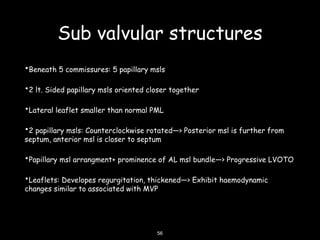
Sub valvular structures
•Beneath 5 commissures: 5 papillary msls
•2 lt. Sided papillary msls oriented closer together
•Lateral leaflet smaller than normal PML
•2 papillary msls: Counterclockwise rotated—> Posterior msl is further from
septum, anterior msl is closer to septum
•Papillary msl arrangment+ prominence of AL msl bundle—> Progressive LVOTO
•Leaflets: Developes regurgitation, thickened—> Exhibit haemodynamic
changes similar to associated with MVP
56
Likelihood of associated lesions
based on Rastelli classification
•Type A: Isolated/ Down syndrome
•Type C: Other complex anomalies:
• TOF/ DORV/ TGA/ Heterotaxy syndrome
•Coronary artery anomalies tend to be associated with co-existant
conotruncal malformations rather than AVSD
•Type C+ TOF—> Down syndrome
• + DORV—> Asplenia
57
CFs
•Features of increased PBF: All will have in infancy
•If asymptomatic—> Suspect premature development of PVOD
•AVVR compounds problems
•After Sx—> MCC of reoperation—> Lt AVVR (22%)
•> MODERATE lt AVVR within 1 month of sx—> Strong predictor of
persistent AVVR at 6 Mts follow up
58
CFs cont…
•Hyperactive precordium
•S1: Accentuated
•S2: Quiet variable
• Accentuated due to inc PA pressure
•Murmurs:
• Loud PSM: Lt AVVR
• ESM: ULSB: Inc PBF
• MDM: Inc flow across common AVV
•Non cyanotic: If severe PVOD not present
59
ECHO
•Assess internal cardiac crux
•Additional findings: ASD/ PDA (44%): Surgeons routinely check for
ductal patency at time of AVSD repair
•Fetal echo: MC 18%: Detected easily in 4CV
60
C-AVSD
61
Fetal echo
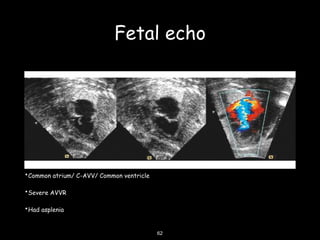
•Common atrium/ C-AVV/ Common ventricle
•Severe AVVR
•Had asplenia
62
What surgeon needs…
•Morphology of AVV in detail
•Competence+ ventricular commitment of AVV orifices
•Whether tongue of tissue connects superior+ inferior bridging
leaflets to form 2 distinct orifices
•EN FACE VIEW: Sub costal 4C coronal view—> Rotate
counterclockwise until AVV leaflets appear facing forward / Angulate
probe superiorly+ inferiorly
•In OT—> TEE trans gastric SAV
63
Some more details
•Single LV papillary msl
•Reduces effective valve area—> Complicates sx repair
•Leaflet hypoplasia—> Compromised repair
64
Concept of “BALANCE”
65
Unbalanced AVSD
•10% of all AVSDs
•2/3rd: RV dominent
• LV hypoplastic + left sided structures hypoplastic( COA/ Arch
abnormalities)
•1/3rd: LV dominent
• RV hypoplasia+ rt sided structure hypoplastic (PS/ PA)
• Down Syndrome
66
Importance of balance
•Single vs 2 ventricle repair
•1.5 ventricle repair: Repair of intracardiac shunts+ BDG to unload RV
67
Cohen formula
•Trace circumference
•Draw line: Drawn over place of IVS (Tip of infundibular septum to
crest of muscular septum)
68
Cohen formula cont…
•Left AVV component area/ Total AVV area
• 0.4- 0.6: Balanced—> 2 ventricular repair
• < 0.4: RV dominence
• > 0.6: LV dominence
• <0.19: Extreme imbalance—> Single ventricular palliation
69
Problem… (Son et al…)
70
CXR
•Cardiomegaly
•RAE: Increased convexity of rt heart border
•LAE: Flattening of lt. Ht border
•PA: Prominent
•PV markings: Increased
71
ECG
•PR interval prolongation: 25%
• Increased intra atrial/ AV node conduction time
•> 50%: Meet voltage criteria for atrial enlargement
•QRS axis: Superior/ NW (-60 to -135)
•RVH: V1—> rsR, RSR’, Rr’, qR, R pattern
•LVH: Sometimes
72
Cardiac cath
•PVOD
•Increased spo2 at RA/ RV levels
•PA systolic pressure:
• At/ near systemic level (C-AVSD)
• < 60% systemic (P-AVSD)
•AVVR
•Goose neck deformity
73
Timing of intervention
•3-6 months: Sx
•Down syndrome—> Earlier : Propensity to develop PVOD
74
Special forms of C-AVSD
•Intermediate defect
•Large inlet VSD without premium ASD
•Down syndrome
75
Intermediate defect
•Anterior+ posterior bridging leaflets fused atop ventricular septum+
common AVV divided into rt+ lt orifices
•Large primum ASD+ Large inlet VSD
•Clinical presentation same
•Sx repair: Does not have to include division of separate rt+ lt AVV
component
•Cleft in lt AVV closed; Bridging leaflets often have insufficient tissue
to reconstruct a competent anterior leaflet
76
Large inlet VSD without primum
ASD
•Very rare form of C-AVSD
•2 distinct AVV orifices with a connecting tongue of tissue
•Leaflets connected more superiorly—> Obliterating primum ASD
•LVOT is relatively less elongated
77
Large inlet VSD without primum
ASD
78
Down syndrome+ AVSD
•DS in > 50% patients with C-AVSD
•DS+ C-AVSD: More likely to have TOF
•Splenic abnormalities+ abnormalities of sidedness: Rare
•Unbalanced AVSD: LV morphology
•Do not have: LVOT obstruction, LV hypoplasia, COA, additional
muscular VSD
•Have pulmonary parenchyma hypoplasia—> Developes PVOD earlier
79
Down syndrome+ AVSD
•Have chronic naso- pharyngeal obstruction, relative hypoventilation+
sleep apnea—> CO2 retention+ relative hypoxia+ increased PVR
•Higher ratio of pulmonary to systemic resistance than normal kids—>
Difference resolves on giving 100% o2—> Hence, apparent hypoxia+
hypoventilation can be corrected during haemodynamic evaluation
•11% patients: Fixed+ elevated PVRin < 1year old kids
•Sx outcomes for kids with DS+ without DS—> Same presently
80
Sx treatment of AVSD
81
Partial AVSD
•Objectives: Closure of IA communication+ restoration and
preservation of Lt AVV competence
•Closure of IA communication by autologous/ bovine pericardial patch
avoiding injury to conduction tissue+ approximation of edges of valve
cleft
•PHN: 31%- Moderate to severe lt AVVR
•1%: Risk of hospital death
•Good long term survival (20y+ 40y survival after repair- 87%+ 76%)
82
Partial AVSD
•Age < 20y+ closure of lt. AVV cleft—> Improved survival
•11%: Reoperation—> MCC-AVVR/ stenosis
•Optimum time of sx: 5-8 years
•Post op arrythmias+ blocks: Rare
83
Complete AVSD
•To be done early (3-6 Mts)
•Symptomatic infants: Palliative PA banding vs complete repair
•Objectives of surgical repair:
• Closure of IA+ IV communication
• Construction of 2 separate+ competent AVV from available
leaflet tissue
• Repair of associated defects
84
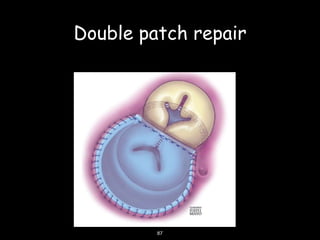
Techniques of closure
•1. Single patch repair
•2. Double patch repair
•3. Australian technique
85
Single patch repair
86
Double patch repair
87
Australian technique
88
Surgery cont…
•2.5%: In hospital mortality
•MCC of reoperation: Lt AVVR
•Major complication rate: <4%
89
Special problems in C-AVSD
repair
•Parachute deformity of lt. AVV:
• Closure of cleft—> Can lead to obstructed orifice
• If significant lt AVVR—> Valve replacement only suitable
option
• Current recommendation: Close zone of apposition, partially/
completely to reduce post op regurgitation—> Leaves mild
stenosis—> Usually tolerated well
90
Special problems in C-AVSD
repair
•DO lt AVV:
• Do not join the 2 orifice to make 1
• Combined opening of both is satisfactory for adequate function
• Leave accessory orifice alone
•RV/ LV Hypoplasia:
• PA banding f/by single ventricular repair
91
Special problems in C-AVSD
repair
•TOF:
• Better to approach combined RA+ RV approach
•Sub aortic stenosis:
• If detected during initial pre op period—> Fibromuscular
membrane—> Do resection
• Presentation late: Due to uncorrected deficiency in inlet septum—
> Endocardial fibrous tags+ fibromuscular ridges—> Resection
92
Thanks…
93

ATRIOVENTRICULAR SEPTAL DEFECT

  • 1.
  • 2.
    Scope of today’stalk • Introduction & Nomenclature • Demographics • Embryogenesis • Natural & Unnatural history • Clinical features • Management 2
  • 3.
  • 4.
    Introduction & Nomenclature •Groupof anomalies •Defect of AV septum+ AV valves •AVCD, EDD, AVSD •Spectrum (PTIC): • Partial—> Transitional—> Intermediate—> Complete 4
  • 5.
    Intro & Nomenclaturecont… •Partial: • Primum ASD • 2 distinct but focally contagious Rt+ Lt AVV orifices • DO NOT CALL MITRAL+ TRICUSPID… WHY??? • Lt AVV: Invariably cleft 5
  • 6.
    Intro & Nomenclaturecont… •Transitional: • Partial AVSD+ • Small/ restrictive inlet VSD partially occluded by dense choral attachments to ventricular septum 6
  • 7.
    Intro & Nomenclaturecont… •Intermediate: • Subtype of complete AVSD • Distinct Rt+ Lt AVV orifices+ • Large inlet VSD 7
  • 8.
    •Complete: • Primum ASD+ •Large inlet VSD+ • Common AVV with single orifice Intro & Nomenclature cont… 8
  • 9.
    Intro & Nomenclaturecont… Type to enter a caption. 9
  • 10.
    Intro & Nomenclaturecont… •Conflicting + confusing terminologies of subtypes •Importance: • Description of AVV morphology • Chamber sizes • Magnitude of shunting 10
  • 11.
    Anatomic features sharedby all forms •AVV leaflets insert at same level at cardiac crux •AV septum absence •Aortic valve: Unwedged+ anteriorly displaced •Elongated LVOT •LV papillary muscles: Counter clockwise rotation •Cleft lt. AVV component, directed towards ventricular septum 11
  • 12.
    Demographics •4-5% of allCHD •0.19/ 1000 live births •Fetal Echo: MC anomaly (18%) of abnormal fetal hearts •High chances of extra cardiac malformations •Overall mortality: 48% (Extracardiac anomaly: Independent risk) •(Allan et al. Prospective diagnosis of 1006 consecutive cases of CHD in fetus. J Am Coll Cardiol. 1994;23:1452-58) •Females> Males 12
  • 13.
    Associations… •40-50% kids withDown syndrome—> Have CHD—> Out of these 45% have AVSD • Down syndrome with AVSD: 75% Complete AVSD • 50% of patients with AVSD—> Have Down syndrome • Black africans with DS> Whites> Hispanics with DS •Heterotaxy (Asplenia> Polysplenia): Complete AVSD •Ellis van creveld syndrome: Complete AVSD 13
  • 14.
  • 15.
    Development •Extracellular matrix (Cardiacjelly) secreted by myocardium in intra myocardium endocardial space •This matrix induces Epithelial to mesenchymal transformation of Endocardium (EMT) •Generation of migratory endocardial cushion cells required for cardiac separation in outflow tracts (Outflow cushions) and b/w AVV (AV cushions) 15
  • 16.
  • 17.
  • 18.
    Embryogenesis •Faulty development ofAV endocardial cushions •Dorsal mesenchymal protrusion •In partial: Incomplete fusion of superior+ inferior endocardial cushions—> Cleft in mid portion of lt AVV anterior leaflet •In complete: Lack of fusion b/w superior+ inferior cushions—> Separate anterior and posterior bridging leaflets along subjacent ventricular septum 18
  • 19.
    Embryogenesis •Failure of ECto fuse create a defect in AV septum •Results in downward displacement of anterior lt AVV leaflet to septal rt AVV—> SAME SEPTAL INSERTION LEVEL •Distance from apex to aortic valve> Cardiac crux to LV apex •Anterior displacement of LVOT—> Elongation+ Narrowing of LVOT (GOOSENECK DEFORMITY) •Post surgery—> Progressive sub- aortic stenosis can develop 19
  • 20.
  • 21.
    Embryogenesis •Dextrodorsal conus cushioncontributes to development of rt. AVV+ outflow tracts lie adjacent to their respective inflow tracts—> Hence, AVSDs can be associated with Cono-truncal anomalies •Shift of AVV orifice—> May result in connection of valve primarily to only 1 ventricle (MC: Rt.)—> Unbalanced ventricles 21
  • 22.
  • 23.
    Partial AVSD: Pathology •Rt+lt AVV orifices separated by a tongue of tissue •Primum ASD+ Cleft lt. AVV anterior leaflet •Located anterior+ inferior to fossa ovalis •Boundaries: • Posterosuperiorly: Cresentric rim of atrial septal tissue • Anteroinferiorly: AVV continuity •Can’t be closed by trans catheter devices 23
  • 24.
  • 25.
  • 26.
    Partial AVSD pathologycont… •Cleft in lt. AVV—> Dirested towards mid portion of ventricular septum •Contrast: Towards aortic valve annulus •Lt AVV orifice—> Triangular rather than elliptical •Resembles mirror image TV orifice •Cleft lt AVV—> Regurgitant—> Becomes thickened —> Exhibits histologic alterations resembling myxomatous MVP 26
  • 27.
    Associated anomalies with partialAVSD •Secundum ASD •PDA •Persistant LSVC to CS •PS/ TS/ TA •Cor triatriatum/ VSD- membranous/ PV anomalies •COA/ HLHS/ HRHS 27
  • 28.
    CFs Partial AVSDs •Maybe asymptomatic till adulthood •Childhood: • Symptoms of increased PBF • Tachypnea+ poor wt gain occur earlier • Severe if associated with moderate/ severe Lt AVVR/ other harm-dynamically significant cardiac anomalies • Compared to second ASD: Earlier+ more severe symptoms 28
  • 29.
    CFs Partial AVSDs •S2:Wide+ fixed split •Murmur: • ESM: PV turbulent flow (ULSB) • PSM: Lt AVVR (Apex) • MDM: LLSB, If large shunt/ significant lt. AVVR 29
  • 30.
    Imaging •2D ECHO: Primaryimaging technique •TEE: Good for bigger patients, associated complex abnormalities •3D ECHO: • Surgical view (From LA) • AVV abnormality • Leaflet morphology • Cleft, commissures, sub valvular apparatus 30
  • 31.
    Internal cardiac crux •Mostconsistent ECHO imaging landmark: A4CV •Primum ASD seen as absence of lower atrial septum •Size estimation best (+ Subcostal 4CV) •AVV also visualised well 31
  • 32.
  • 33.
    Transitional AVSD •Aneurysmal replacementof a portion of inlet ventricular septum •Small shunts occur through this tricuspid pouch •Dense chordal attachments eventually obstruct flow •Doppler ECHO: Not useful in estimating lt. AVV stenosis; Primum ASD decompresses LA 33
  • 34.
    Lt AVV abnormalities •LtAVV abnormalities in both •MC: Cleft (Multiple jets can be present) • Lt AVVR directed into RA: Successful repair of cleft+ Primum ASD closure • Lt AVVR directed into LA: Not completely eliminated by cleft repair (signifies other intrinsic abnormalities with valve) • Degree of pre op regurgitation decides post op residual regurgitation 34
  • 35.
    Lt AVV abnormalities •DOlt AVV: • 3-5% • Tongue of tissue divides lt AVV into 2 orifices • Combined effective valve area: Always less than valve area of a single orifice lt AVV—> Predisposes to post op stenosis • Subcostal + PSAV •Parachute MV 35
  • 36.
  • 37.
    Do not underestimatesub valvular apparatus •2010 Ando+ Takahashi: 138 C-ACSD: Assessed anatomic factors associate with more difficult VSD patch placement / cleft approximation—> 4 risk factors for at least moderate lt. AVVR: •1. Papillary msl abnormalities: •MC—> Imbalance of papillary msl •Laterally displaced AL papillae msl •Dominent AL papillary msl with short, thickened or absent cords, eccentrically positioned cleft (Colen et al.) 37
  • 38.
    Do not underestimatesub valvular apparatus •2. Dense chordal attachments of ABL obscuring rt side of crest of ventricular septum •3. DO lt. AVV •4. Severe length discrepancies of cleft 38
  • 39.
    Aortic valve •Normal: Aorticvalve wedged b/w MV+ TV •AVSD: AV displaced or sprung anteriorly 39
  • 40.
  • 41.
    LVOT obstruction •Elongated LVOT—>Predisposes to progressive sub aortic obstruction •MC if 2 distinct AVV +nt: Superior bridging leaflet attaching to crest of ventricular septum •Discrete sub aortic fibro muscular ridges, septal HT, abnormal lt. AVV chordal attachments, abnormally oriented papillary msls •Can develop de novo after repair •Often progressive: More common in partial AVSD 41
  • 42.
    Mechanisms of LVOT obstruction •Tissue from an aneurysm of membranous septum bowing into LVOT •Attachment of superior bridging leaflet to ventricular septum •Extension of AL papillae msl to LVOT •Discrete fibrous sub aortic stenosis 42
  • 43.
  • 44.
    Also do notmiss these… •Associated lesions: •TOF/ DORV/ PA: Less frequent with partial AVSD •AVV abnormalities, LV hypoplasia: MC in 2 orifice AVV connections •COA: Equal frequency in both 44
  • 45.
    CXR •Cardiomegaly+ Prominent PVmarkings •RA enlargement: Jet of lt. AVVR directed 45
  • 46.
    AV Node •Position dictatedby position of AVSD •AV node posteriorly displaced near CS orifice •His bundle displaced inferiorly along inferior •rim of septal defect •Displacement of AV conduction tissue+ •loss of ventricular septal myocardium—> LAD 46
  • 47.
    ECG changes •25%: Prolongationof PR interval •Increased conduction time from high RA to low septal RA •50%: P wave changes (RA/ LA/ Biatrial enlargement) •Mean QRS Axis: -30 to -120 •RV volume overload—> RVH+ some variation in rsR’ pattern of rt precordial leads: 80% •10%: qR pattern •LVH: Lt AVVR 47
  • 48.
    Cardiac cath &Angiography •Rarely needed •Older patients: PVOD/ CAD •Higher spo2 in RA + Inflow portion of RV samples compared to SVC/ IVC •Gooseneck deformity 48
  • 49.
    Partial AVSD: Specialforms •1. Malaligned atrial septum/ DORA •2. Common atrium 49
  • 50.
    Malaligned atrial septum/ DORA •Deviationof atrial septum to lt. Of AV junction •Both rt+ lt. AVV —> Visualised from RA—> Connected to both ventricles through large premium ASD •If extreme deviation to left—> PVs isolated + obstructed (like cor- triatriatum) 50
  • 51.
    Common atrium •Near absenceof atrial septum •In presence of 2 ventricles—> Always associated with AVSD •Heterotaxy/ Ellis van Creveld (TGA/ DORV/ Univentricular AV connection/ Anomalous PV communication) 51
  • 52.
    CA •Presents in infancywith symptoms of increased PBF •Symptomatic earlier than isolated premium ASD •CXR/ ECG—> Indistinguishable from other forms •Cath: Spo2 of pulmonary+ systemic arteries are nearly equal •PBV> SBF •RV pressure overload more than premium ASD •Early surgery: PVOD 52
  • 53.
  • 54.
    Pathology C-AVSD •Large septaldefect with IA+ IV components+ Common AVV that spans entire septal defect •Septal defect extends to level of membranous septum which is usually deficient/ absent •Common AV valve: 5 leaflets 54
  • 55.
    Common AV valve Bridgingportion of LIL RSL RLL TV AL PL RSL RLL LIL SL RIL Chapter 34 Atrioventricular Septal Defect LLL Bridging portion of LIL RSL RLL TV AL PL RSL RLL LIL SL RIL Chapter 34 Atrioventricular Septal Defect LLL Bridging portion of LIL RSL RIL LLL Bridging portion of LIL RSL RLL TV AL PL RSL RLL LIL SL RIL Chapter 34 Atrioventricular Septal Defect TV AL PL RSL RLL LIL 55
  • 56.
    Sub valvular structures •Beneath5 commissures: 5 papillary msls •2 lt. Sided papillary msls oriented closer together •Lateral leaflet smaller than normal PML •2 papillary msls: Counterclockwise rotated—> Posterior msl is further from septum, anterior msl is closer to septum •Papillary msl arrangment+ prominence of AL msl bundle—> Progressive LVOTO •Leaflets: Developes regurgitation, thickened—> Exhibit haemodynamic changes similar to associated with MVP 56
  • 57.
    Likelihood of associatedlesions based on Rastelli classification •Type A: Isolated/ Down syndrome •Type C: Other complex anomalies: • TOF/ DORV/ TGA/ Heterotaxy syndrome •Coronary artery anomalies tend to be associated with co-existant conotruncal malformations rather than AVSD •Type C+ TOF—> Down syndrome • + DORV—> Asplenia 57
  • 58.
    CFs •Features of increasedPBF: All will have in infancy •If asymptomatic—> Suspect premature development of PVOD •AVVR compounds problems •After Sx—> MCC of reoperation—> Lt AVVR (22%) •> MODERATE lt AVVR within 1 month of sx—> Strong predictor of persistent AVVR at 6 Mts follow up 58
  • 59.
    CFs cont… •Hyperactive precordium •S1:Accentuated •S2: Quiet variable • Accentuated due to inc PA pressure •Murmurs: • Loud PSM: Lt AVVR • ESM: ULSB: Inc PBF • MDM: Inc flow across common AVV •Non cyanotic: If severe PVOD not present 59
  • 60.
    ECHO •Assess internal cardiaccrux •Additional findings: ASD/ PDA (44%): Surgeons routinely check for ductal patency at time of AVSD repair •Fetal echo: MC 18%: Detected easily in 4CV 60
  • 61.
  • 62.
    Fetal echo •Common atrium/C-AVV/ Common ventricle •Severe AVVR •Had asplenia 62
  • 63.
    What surgeon needs… •Morphologyof AVV in detail •Competence+ ventricular commitment of AVV orifices •Whether tongue of tissue connects superior+ inferior bridging leaflets to form 2 distinct orifices •EN FACE VIEW: Sub costal 4C coronal view—> Rotate counterclockwise until AVV leaflets appear facing forward / Angulate probe superiorly+ inferiorly •In OT—> TEE trans gastric SAV 63
  • 64.
    Some more details •SingleLV papillary msl •Reduces effective valve area—> Complicates sx repair •Leaflet hypoplasia—> Compromised repair 64
  • 65.
  • 66.
    Unbalanced AVSD •10% ofall AVSDs •2/3rd: RV dominent • LV hypoplastic + left sided structures hypoplastic( COA/ Arch abnormalities) •1/3rd: LV dominent • RV hypoplasia+ rt sided structure hypoplastic (PS/ PA) • Down Syndrome 66
  • 67.
    Importance of balance •Singlevs 2 ventricle repair •1.5 ventricle repair: Repair of intracardiac shunts+ BDG to unload RV 67
  • 68.
    Cohen formula •Trace circumference •Drawline: Drawn over place of IVS (Tip of infundibular septum to crest of muscular septum) 68
  • 69.
    Cohen formula cont… •LeftAVV component area/ Total AVV area • 0.4- 0.6: Balanced—> 2 ventricular repair • < 0.4: RV dominence • > 0.6: LV dominence • <0.19: Extreme imbalance—> Single ventricular palliation 69
  • 70.
  • 71.
    CXR •Cardiomegaly •RAE: Increased convexityof rt heart border •LAE: Flattening of lt. Ht border •PA: Prominent •PV markings: Increased 71
  • 72.
    ECG •PR interval prolongation:25% • Increased intra atrial/ AV node conduction time •> 50%: Meet voltage criteria for atrial enlargement •QRS axis: Superior/ NW (-60 to -135) •RVH: V1—> rsR, RSR’, Rr’, qR, R pattern •LVH: Sometimes 72
  • 73.
    Cardiac cath •PVOD •Increased spo2at RA/ RV levels •PA systolic pressure: • At/ near systemic level (C-AVSD) • < 60% systemic (P-AVSD) •AVVR •Goose neck deformity 73
  • 74.
    Timing of intervention •3-6months: Sx •Down syndrome—> Earlier : Propensity to develop PVOD 74
  • 75.
    Special forms ofC-AVSD •Intermediate defect •Large inlet VSD without premium ASD •Down syndrome 75
  • 76.
    Intermediate defect •Anterior+ posteriorbridging leaflets fused atop ventricular septum+ common AVV divided into rt+ lt orifices •Large primum ASD+ Large inlet VSD •Clinical presentation same •Sx repair: Does not have to include division of separate rt+ lt AVV component •Cleft in lt AVV closed; Bridging leaflets often have insufficient tissue to reconstruct a competent anterior leaflet 76
  • 77.
    Large inlet VSDwithout primum ASD •Very rare form of C-AVSD •2 distinct AVV orifices with a connecting tongue of tissue •Leaflets connected more superiorly—> Obliterating primum ASD •LVOT is relatively less elongated 77
  • 78.
    Large inlet VSDwithout primum ASD 78
  • 79.
    Down syndrome+ AVSD •DSin > 50% patients with C-AVSD •DS+ C-AVSD: More likely to have TOF •Splenic abnormalities+ abnormalities of sidedness: Rare •Unbalanced AVSD: LV morphology •Do not have: LVOT obstruction, LV hypoplasia, COA, additional muscular VSD •Have pulmonary parenchyma hypoplasia—> Developes PVOD earlier 79
  • 80.
    Down syndrome+ AVSD •Havechronic naso- pharyngeal obstruction, relative hypoventilation+ sleep apnea—> CO2 retention+ relative hypoxia+ increased PVR •Higher ratio of pulmonary to systemic resistance than normal kids—> Difference resolves on giving 100% o2—> Hence, apparent hypoxia+ hypoventilation can be corrected during haemodynamic evaluation •11% patients: Fixed+ elevated PVRin < 1year old kids •Sx outcomes for kids with DS+ without DS—> Same presently 80
  • 81.
  • 82.
    Partial AVSD •Objectives: Closureof IA communication+ restoration and preservation of Lt AVV competence •Closure of IA communication by autologous/ bovine pericardial patch avoiding injury to conduction tissue+ approximation of edges of valve cleft •PHN: 31%- Moderate to severe lt AVVR •1%: Risk of hospital death •Good long term survival (20y+ 40y survival after repair- 87%+ 76%) 82
  • 83.
    Partial AVSD •Age <20y+ closure of lt. AVV cleft—> Improved survival •11%: Reoperation—> MCC-AVVR/ stenosis •Optimum time of sx: 5-8 years •Post op arrythmias+ blocks: Rare 83
  • 84.
    Complete AVSD •To bedone early (3-6 Mts) •Symptomatic infants: Palliative PA banding vs complete repair •Objectives of surgical repair: • Closure of IA+ IV communication • Construction of 2 separate+ competent AVV from available leaflet tissue • Repair of associated defects 84
  • 85.
    Techniques of closure •1.Single patch repair •2. Double patch repair •3. Australian technique 85
  • 86.
  • 87.
  • 88.
  • 89.
    Surgery cont… •2.5%: Inhospital mortality •MCC of reoperation: Lt AVVR •Major complication rate: <4% 89
  • 90.
    Special problems inC-AVSD repair •Parachute deformity of lt. AVV: • Closure of cleft—> Can lead to obstructed orifice • If significant lt AVVR—> Valve replacement only suitable option • Current recommendation: Close zone of apposition, partially/ completely to reduce post op regurgitation—> Leaves mild stenosis—> Usually tolerated well 90
  • 91.
    Special problems inC-AVSD repair •DO lt AVV: • Do not join the 2 orifice to make 1 • Combined opening of both is satisfactory for adequate function • Leave accessory orifice alone •RV/ LV Hypoplasia: • PA banding f/by single ventricular repair 91
  • 92.
    Special problems inC-AVSD repair •TOF: • Better to approach combined RA+ RV approach •Sub aortic stenosis: • If detected during initial pre op period—> Fibromuscular membrane—> Do resection • Presentation late: Due to uncorrected deficiency in inlet septum— > Endocardial fibrous tags+ fibromuscular ridges—> Resection 92
  • 93.