 Walmsley (Quain’s Elements of anatomy 1929)
pointed out the difficulty of defining the
Ventriculo—arterial boundry and supported Henle
in replacing the term Arterial Ring to Arterial Root
 McAlpine (1975) described the lack of rings in all 4
cardiac valve so that the so called Annulus (the
fibrous attachment of the aortic and pulmonary
leaflets) constitutes only a segment and not a circle
or complete fibrous ring
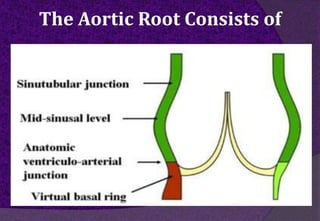
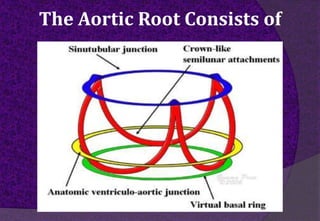
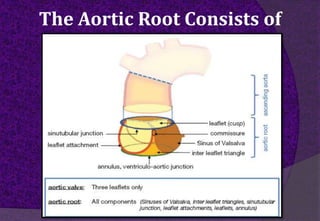
 The Aortic Root, represents the outflow tract
from the left ventricle, provides the
supporting structures for the leaflets of the
aortic valve, and forms the bridge between
the left ventricle and the ascending aorta.
 It extends from the basal attachments of the
leaflets Within the left ventricle to the
sinotubular junction
 Aortic annulus
 Aortic cusps
 Aortic Sinuses
 Sinotubular
Junction (STJ)
The Aortic Root
Consists of
The Aortic Root Consists of
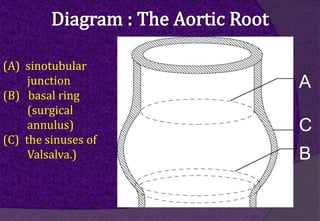
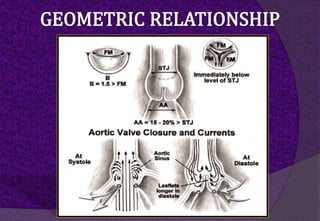
(A) sinotubular
junction
(B) basal ring
(surgical
annulus)
(C) the sinuses of
Valsalva.)
A
C
B
 Aortic valve insufficiency may be caused by
 abnormalities of the leaflets,
 the root, or
 combination of both.
 In some patients, the primary pathology is confined
to the aortic root itself, the leaflets remaining
anatomically normal.
 These patients have progressive dilatation of the
aortic sinuses and, on occasion, dilatation and
distortion of the annulus which results in valvar
incompetence.
 Most cases are “idiopathic” (annuloaortic ectasia)
 May be associated with a wide spectrum of
pathological conditions :
 Marfan syndrome
 aortic dissection
 Aortitis
 rare systemic disorders such as Ehlers-Danlos
syndrome.
 Aortic root pathology has now been reported as
the most common cause of aortic valve
incompetence in the United States as RHD is in
declining trend there.
 The valve leaflets are the portions of the aortic root
which separate, haemodynamically, the aorta and
the left ventricle.
 They are inserted into the wall of the root in a
semilunar fashion, and the base of the aortic root is
defined by the nadirs of attachment of these
leaflets.
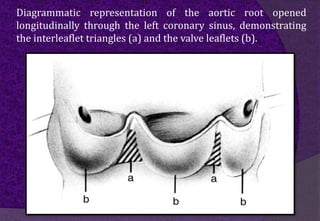
Diagrammatic representation of the aortic root opened
longitudinally through the left coronary sinus, demonstrating
the interleaflet triangles (a) and the valve leaflets (b).
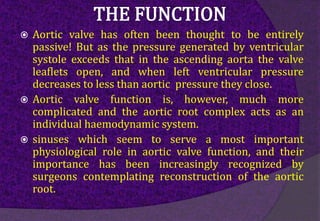
 Aortic valve has often been thought to be entirely
passive! But as the pressure generated by ventricular
systole exceeds that in the ascending aorta the valve
leaflets open, and when left ventricular pressure
decreases to less than aortic pressure they close.
 Aortic valve function is, however, much more
complicated and the aortic root complex acts as an
individual haemodynamic system.
 sinuses which seem to serve a most important
physiological role in aortic valve function, and their
importance has been increasingly recognized by
surgeons contemplating reconstruction of the aortic
root.
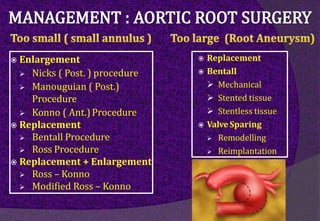
 Enlargement
 Nicks ( Post. ) procedure
 Manouguian ( Post.)
Procedure
 Konno ( Ant.)Procedure
 Replacement
 Bentall Procedure
 Ross Procedure
 Replacement + Enlargement
 Ross – Konno
 Modified Ross – Konno
 Replacement
 Bentall
 Mechanical
 Stented tissue
 Stentless tissue
 ValveSparing
 Remodelling
 Reimplantation
 Patient-Prosthesis Mismatch :
Residual gradient Progressive LV dysfunction
Hemolysis.
 Bulky bioprostheses /small annulus
 Effective orifice area index =
Effective orifice area/BSA(Sq.m)
2.0 or above is normal
0.67 Severe stenosis
Rahimtoola first described 1978
Pibarot and Dumensnil (1998) defined PPM to
be effective orifice area indexed to BSA of
0.85m2/m2 or less
 Root replacement
 Homografts
 Stentlessxenografts
 Ross operation alone.
 Posterior annular enlargement :
 Nicks’ technique.
 Manouguiantechnique.
 Anterior annular enlargement :
 Rastan-Konno operation.
 Konno-Ross operation.
 Apico-aortic conduit.
 It is usually taken by the surgeon operating and on
a feeling that the annular size is smaller than
required for that patient depending on :
 Pt age
 Comorbid conditions
 Anatomy of the aortic root
 Surgeon’s judgment
 Surgeon’s comfort level
Nicks technique
Manouguian technique
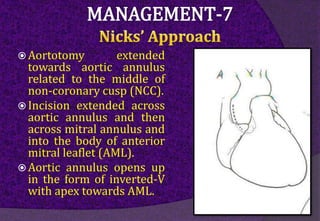
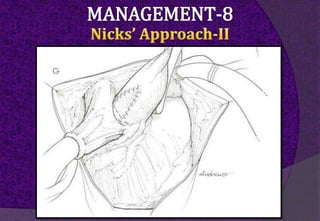
 Aortotomy extended
towards aortic annulus
related to the middle of
non-coronary cusp (NCC).
 Incision extended across
aortic annulus and then
across mitral annulus and
into the body of anterior
mitral leaflet (AML).
 Aortic annulus opens up
in the form of inverted-V
with apex towards AML.
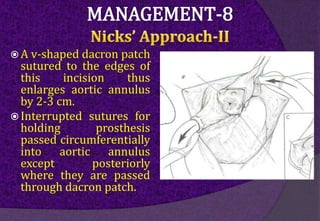
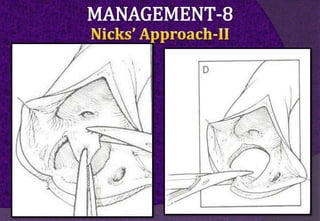
 A v-shaped dacron patch
sutured to the edges of
this incision thus
enlarges aortic annulus
by 2-3 cm.
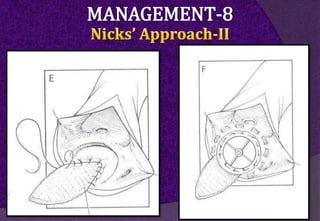
 Interrupted sutures for
holding prosthesis
passed circumferentially
into aortic annulus
except posteriorly
where they are passed
through dacron patch.
 Oblique aortotomy extended towards and
across the commissure between LCC and NCC,
thus dividing the annulus.
 Incision extended vertically across the
triangular area between two cusps and
thereafter into the aortic-mitral fibrous
continuity.
 Tear-drop shaped Dacron patch is sutured to
the defect to enlarge the posterior annulus.
 Valve sutures are brought from outside the
patch at annular level.
 Rest of the patch is used to close aortotomy
incision.
Challenging problem
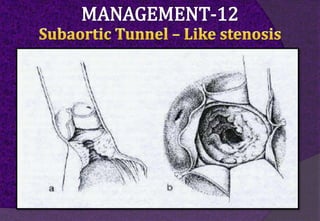
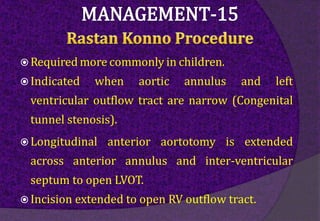
 Required more commonly in children.
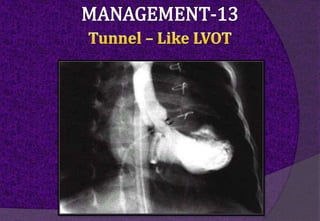
 Indicated when aortic annulus and left
ventricular outflow tract are narrow (Congenital
tunnel stenosis).
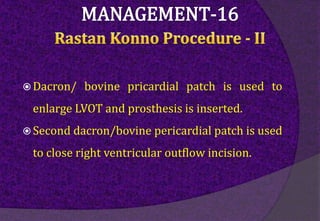
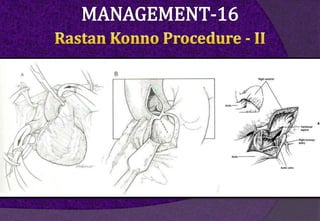
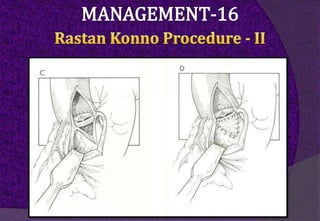
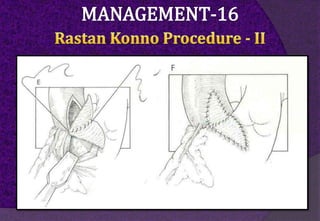
 Longitudinal anterior aortotomy is extended
across anterior annulus and inter-ventricular
septum to open LVOT.
 Incision extended to open RV outflow tract.
 Dacron/ bovine pricardial patch is used to
enlarge LVOT and prosthesis is inserted.
 Second dacron/bovine pericardial patch is used
to close right ventricular outflow incision.
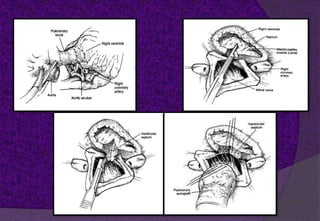
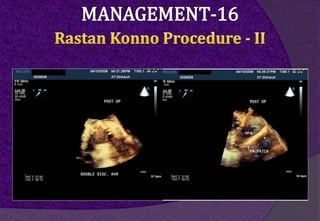
 For patients suitable for autograft aortic valve
replacement who have tunnel-type LVOT.
 Rastan-Konno approach is used to expose and
open LVOT.
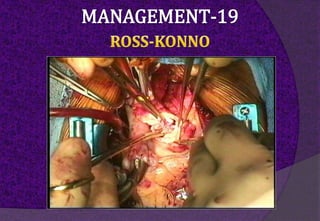
 Pulmonary autogaft is harvested and used as
in classical Ross procedure.
 LVOT tunnel like
 Aortic regurgitation after balloon angioplasty in
neonatal age with small annulus
 Mismatch in the aortic and pulmonary size.
 Pulmonary autograft ideal for:
 performance, growth potential, avoidance of
anticoagulation.
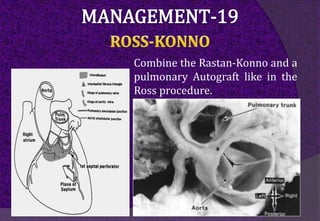
Combine the Rastan-Konno and a
pulmonary Autograft like in the
Ross procedure.
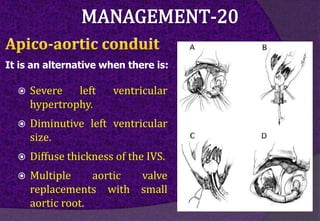
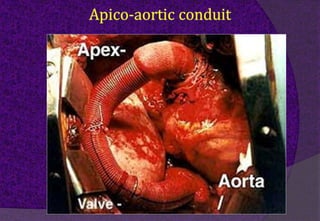
Apico-aortic valved conduit
It is an alternative when there is:
 Severe left ventricular
hypertrophy.
 Diminutive left ventricular
size.
 Diffuse thickness of the IVS.
 Multiple aortic valve
replacements with small
aortic root.
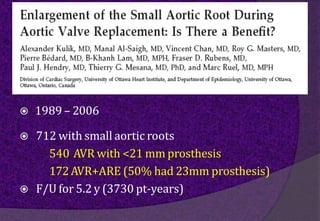
 1989 – 2006
 712 with small aortic roots
540 AVR with <21 mm prosthesis
172AVR+ARE (50% had 23mm prosthesis)
 F/U for 5.2 y (3730 pt-years)
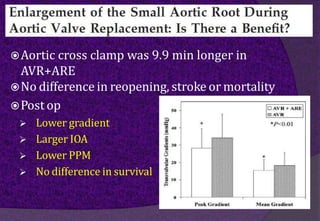
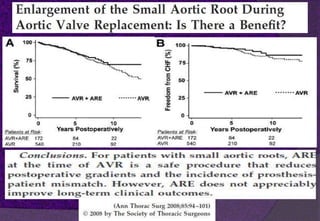
Aortic cross clamp was 9.9 min longer in
AVR+ARE
No difference in reopening, stroke or mortality
Post op
 Lower gradient
 Larger IOA
 Lower PPM
 No difference in survival
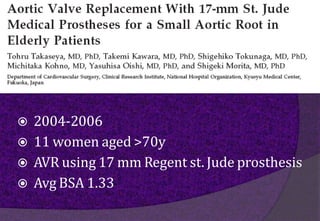
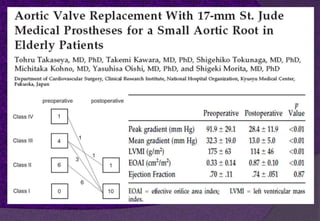
 2004-2006
 11 women aged >70y
 AVR using 17 mm Regent st. Jude prosthesis
 Avg BSA 1.33
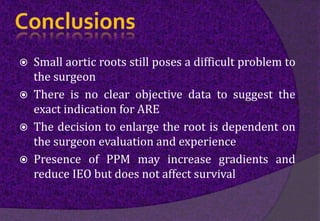
 Small aortic roots still poses a difficult problem to
the surgeon
 There is no clear objective data to suggest the
exact indication for ARE
 The decision to enlarge the root is dependent on
the surgeon evaluation and experience
 Presence of PPM may increase gradients and
reduce IEO but does not affect survival
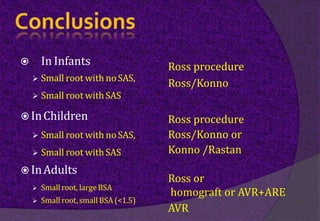
 In Infants
 Small root with noSAS,
 Small root withSAS
 InChildren
 Small root with noSAS,
 Small root withSAS
 InAdults
 Smallroot, largeBSA
 Smallroot, smallBSA (<1.5)
Ross procedure
Ross/Konno
Ross procedure
Ross/Konno or
Konno /Rastan
Ross or
homograft or AVR+ARE
AVR
Management of Small Aortic Root

Management of Small Aortic Root

  • 2.
     Walmsley (Quain’sElements of anatomy 1929) pointed out the difficulty of defining the Ventriculo—arterial boundry and supported Henle in replacing the term Arterial Ring to Arterial Root  McAlpine (1975) described the lack of rings in all 4 cardiac valve so that the so called Annulus (the fibrous attachment of the aortic and pulmonary leaflets) constitutes only a segment and not a circle or complete fibrous ring
  • 3.
     The AorticRoot, represents the outflow tract from the left ventricle, provides the supporting structures for the leaflets of the aortic valve, and forms the bridge between the left ventricle and the ascending aorta.  It extends from the basal attachments of the leaflets Within the left ventricle to the sinotubular junction
  • 4.
     Aortic annulus Aortic cusps  Aortic Sinuses  Sinotubular Junction (STJ) The Aortic Root Consists of
  • 5.
    The Aortic RootConsists of
  • 6.
    The Aortic RootConsists of
  • 7.
    The Aortic RootConsists of
  • 8.
    (A) sinotubular junction (B) basalring (surgical annulus) (C) the sinuses of Valsalva.) A C B
  • 9.
     Aortic valveinsufficiency may be caused by  abnormalities of the leaflets,  the root, or  combination of both.  In some patients, the primary pathology is confined to the aortic root itself, the leaflets remaining anatomically normal.  These patients have progressive dilatation of the aortic sinuses and, on occasion, dilatation and distortion of the annulus which results in valvar incompetence.
  • 10.
     Most casesare “idiopathic” (annuloaortic ectasia)  May be associated with a wide spectrum of pathological conditions :  Marfan syndrome  aortic dissection  Aortitis  rare systemic disorders such as Ehlers-Danlos syndrome.
  • 11.
     Aortic rootpathology has now been reported as the most common cause of aortic valve incompetence in the United States as RHD is in declining trend there.  The valve leaflets are the portions of the aortic root which separate, haemodynamically, the aorta and the left ventricle.  They are inserted into the wall of the root in a semilunar fashion, and the base of the aortic root is defined by the nadirs of attachment of these leaflets.
  • 12.
    Diagrammatic representation ofthe aortic root opened longitudinally through the left coronary sinus, demonstrating the interleaflet triangles (a) and the valve leaflets (b).
  • 13.
     Aortic valvehas often been thought to be entirely passive! But as the pressure generated by ventricular systole exceeds that in the ascending aorta the valve leaflets open, and when left ventricular pressure decreases to less than aortic pressure they close.  Aortic valve function is, however, much more complicated and the aortic root complex acts as an individual haemodynamic system.  sinuses which seem to serve a most important physiological role in aortic valve function, and their importance has been increasingly recognized by surgeons contemplating reconstruction of the aortic root.
  • 15.
     Enlargement  Nicks( Post. ) procedure  Manouguian ( Post.) Procedure  Konno ( Ant.)Procedure  Replacement  Bentall Procedure  Ross Procedure  Replacement + Enlargement  Ross – Konno  Modified Ross – Konno  Replacement  Bentall  Mechanical  Stented tissue  Stentless tissue  ValveSparing  Remodelling  Reimplantation
  • 16.
     Patient-Prosthesis Mismatch: Residual gradient Progressive LV dysfunction Hemolysis.  Bulky bioprostheses /small annulus
  • 17.
     Effective orificearea index = Effective orifice area/BSA(Sq.m) 2.0 or above is normal 0.67 Severe stenosis Rahimtoola first described 1978 Pibarot and Dumensnil (1998) defined PPM to be effective orifice area indexed to BSA of 0.85m2/m2 or less
  • 18.
     Root replacement Homografts  Stentlessxenografts  Ross operation alone.  Posterior annular enlargement :  Nicks’ technique.  Manouguiantechnique.
  • 19.
     Anterior annularenlargement :  Rastan-Konno operation.  Konno-Ross operation.  Apico-aortic conduit.
  • 20.
     It isusually taken by the surgeon operating and on a feeling that the annular size is smaller than required for that patient depending on :  Pt age  Comorbid conditions  Anatomy of the aortic root  Surgeon’s judgment  Surgeon’s comfort level
  • 21.
  • 22.
     Aortotomy extended towardsaortic annulus related to the middle of non-coronary cusp (NCC).  Incision extended across aortic annulus and then across mitral annulus and into the body of anterior mitral leaflet (AML).  Aortic annulus opens up in the form of inverted-V with apex towards AML.
  • 23.
     A v-shapeddacron patch sutured to the edges of this incision thus enlarges aortic annulus by 2-3 cm.  Interrupted sutures for holding prosthesis passed circumferentially into aortic annulus except posteriorly where they are passed through dacron patch.
  • 27.
     Oblique aortotomyextended towards and across the commissure between LCC and NCC, thus dividing the annulus.  Incision extended vertically across the triangular area between two cusps and thereafter into the aortic-mitral fibrous continuity.
  • 28.
     Tear-drop shapedDacron patch is sutured to the defect to enlarge the posterior annulus.  Valve sutures are brought from outside the patch at annular level.  Rest of the patch is used to close aortotomy incision.
  • 29.
  • 33.
     Required morecommonly in children.  Indicated when aortic annulus and left ventricular outflow tract are narrow (Congenital tunnel stenosis).  Longitudinal anterior aortotomy is extended across anterior annulus and inter-ventricular septum to open LVOT.  Incision extended to open RV outflow tract.
  • 34.
     Dacron/ bovinepricardial patch is used to enlarge LVOT and prosthesis is inserted.  Second dacron/bovine pericardial patch is used to close right ventricular outflow incision.
  • 41.
     For patientssuitable for autograft aortic valve replacement who have tunnel-type LVOT.  Rastan-Konno approach is used to expose and open LVOT.  Pulmonary autogaft is harvested and used as in classical Ross procedure.
  • 42.
     LVOT tunnellike  Aortic regurgitation after balloon angioplasty in neonatal age with small annulus  Mismatch in the aortic and pulmonary size.  Pulmonary autograft ideal for:  performance, growth potential, avoidance of anticoagulation.
  • 43.
    Combine the Rastan-Konnoand a pulmonary Autograft like in the Ross procedure.
  • 46.
  • 47.
    It is analternative when there is:  Severe left ventricular hypertrophy.  Diminutive left ventricular size.  Diffuse thickness of the IVS.  Multiple aortic valve replacements with small aortic root.
  • 49.
     1989 –2006  712 with small aortic roots 540 AVR with <21 mm prosthesis 172AVR+ARE (50% had 23mm prosthesis)  F/U for 5.2 y (3730 pt-years)
  • 50.
    Aortic cross clampwas 9.9 min longer in AVR+ARE No difference in reopening, stroke or mortality Post op  Lower gradient  Larger IOA  Lower PPM  No difference in survival
  • 52.
     2004-2006  11women aged >70y  AVR using 17 mm Regent st. Jude prosthesis  Avg BSA 1.33
  • 54.
     Small aorticroots still poses a difficult problem to the surgeon  There is no clear objective data to suggest the exact indication for ARE  The decision to enlarge the root is dependent on the surgeon evaluation and experience  Presence of PPM may increase gradients and reduce IEO but does not affect survival
  • 55.
     In Infants Small root with noSAS,  Small root withSAS  InChildren  Small root with noSAS,  Small root withSAS  InAdults  Smallroot, largeBSA  Smallroot, smallBSA (<1.5) Ross procedure Ross/Konno Ross procedure Ross/Konno or Konno /Rastan Ross or homograft or AVR+ARE AVR