Cyanotic Heart Disease
Classification of Congenital Heart Disease (CHD)
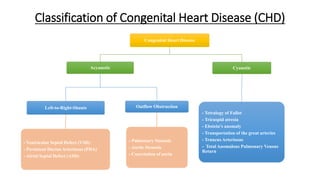
Congenital Heart Disease
Acyanotic
Left-to-Right-Shunts
- Ventricular Septal Defect (VSD)
- Persistent Ductus Arteriosus (PDA)
- Atrial Septal Defect (ASD)
Outflow Obstruction
- Pulmonary Stenosis
- Aortic Stenosis
- Coarctation of aorta
Cyanotic
- Tetralogy of Fallot
- Tricuspid atresia
- Ebstein's anomaly
- Transportation of the great arteries
- Truncus Arteriosus
- Total Anomalous Pulmonary Venous
Return
Classification of Congenital Heart Disease (CHD)
Cyanosis
• Cyanosis: A bluish discoloration of skin and mucous membrane due to excessive
concentration of reduced hemoglobin (deoxygenated) in the blood.
• These type of defects lead to either increased or decreased pulmonary blood flow
• The primary pathology arises either due to an obstructive lesion; or due to abnormal
anatomy or both.
• The shunt present is predominantly from Right to Left leading to shunting of venous
blood without passing through the lungs to be oxygenated.
• Unoxygenated blood circulates in arteries.
• cyanosis Example: Tetralogy of Fallot, TGV
Central vs Peripheral
• Central cyanosis:
 Seen on tongue as blue color
 Associated with a fall in arterial blood O2 tension.
 Clinically:
 reduced(deoxygenated) Hb >5g/dL
 SpO2= <85% by pulse oximetry test.
• Peripheral cyanosis:
 Blueness of hand and feet
 Due to cold or circulatory disorder (e.g: DVT)
 Can also occur in severe central cyanosis
Right to Left Shunts
1.Tetralogy of Fallot
2. Tricuspid atresia
3. Ebstein’s anomaly
4. Transportation of the great arteries
5. Truncus Arteriosus
6. Total Anomalous Pulmonary Venous Return (TAPVR)
5 T’s
1.Tetralogy of Fallot
2. Tricuspid atresia
3. Transportation of the great
arteries
4. Truncus Arteriosus
5. Total Anomalous Pulmonary
Venous Return
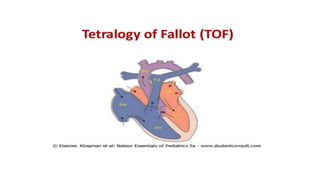
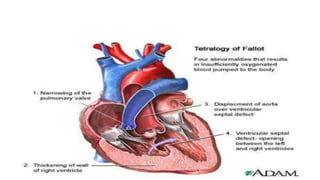
Tetralogy of Fallot (TOF)
• Tetralogy of Fallot is the most common cyanotic congenital heart
defect.
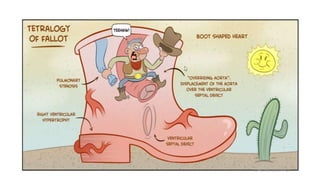
• Anatomically, there are four structural defects: VSD, pulmonary
stenosis, overriding aorta and right ventricular hypertrophy.
• Tetralogy of Fallot is believed to be due to abnormalities in the
septation of the truncus arteriosus into the aorta and pulmonary
arteries that occur early in gestation (3 to 4 weeks)
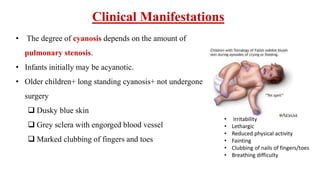
Clinical Manifestations
• The degree of cyanosis depends on the amount of
pulmonary stenosis.
• Infants initially may be acyanotic.
• Older children+ long standing cyanosis+ not undergone
surgery
 Dusky blue skin
 Grey sclera with engorged blood vessel
 Marked clubbing of fingers and toes
• Irritability
• Lethargic
• Reduced physical activity
• Fainting
• Clubbing of nails of fingers/toes
• Breathing difficulty
• A pulmonary stenosis murmur is the usual initial abnormal finding.
• If the pulmonary stenosis is more severe, or as it becomes more severe over
time, the amount of right- to-left shunting at the VSD increases, and the patient
becomes more cyanotic.
• With increasing severity of pulmonary stenosis, the murmur becomes shorter
and softer.
• single S2 and right ventricular impulse(heave) at the left sternal border are
typical findings.
• hypoxic ("Tet") spells
• Independent of hypoxic spells, patients with tetralogy are at increased risk for
cerebral thromboembolism and cerebral abscesses resulting in part from
their right-to-left intracardiac shunt.
• Hypoxic spells/ paroxysmal hypercyanotic attacks (1st 2years of life)
 Severe hypoxia  tissue acidosis  breathlessness and pallor
 Rapid increase in cyanosis
 Restless and agitated
 Inconsolable crying
 An ambulatory toddler may squat
 Severe spells:
 Prolonged unconsciousness and convulsions
 Hemiparesis
 OR death
Diagnosis
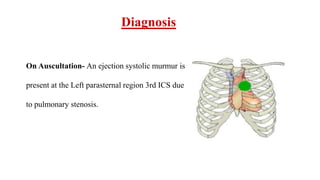
On Auscultation- An ejection systolic murmur is
present at the Left parasternal region 3rd ICS due
to pulmonary stenosis.
Imaging Studies
• The ECG usually has right axis deviation and right ventricular
hypertrophy.
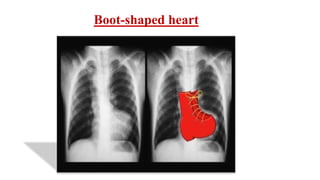
• The classic chest x-ray finding is a boot-shaped heart :
 Small heart
 Uptilted apex (boot shaped)
 pulmonary artery ‘bay’= concavity of L heart border
 Oligaemic lung fields
• Echocardiography: The diagnosis usually is made with echocardiography.
Boot-shaped heart
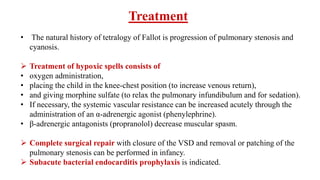
Treatment
• The natural history of tetralogy of Fallot is progression of pulmonary stenosis and
cyanosis.
 Treatment of hypoxic spells consists of
• oxygen administration,
• placing the child in the knee-chest position (to increase venous return),
• and giving morphine sulfate (to relax the pulmonary infundibulum and for sedation).
• If necessary, the systemic vascular resistance can be increased acutely through the
administration of an α-adrenergic agonist (phenylephrine).
• β-adrenergic antagonists (propranolol) decrease muscular spasm.
 Complete surgical repair with closure of the VSD and removal or patching of the
pulmonary stenosis can be performed in infancy.
 Subacute bacterial endocarditis prophylaxis is indicated.
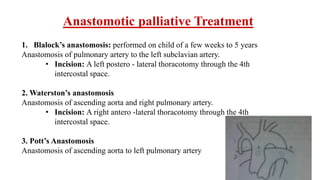
Anastomotic palliative Treatment
1. Blalock’s anastomosis: performed on child of a few weeks to 5 years
Anastomosis of pulmonary artery to the left subclavian artery.
• Incision: A left postero - lateral thoracotomy through the 4th
intercostal space.
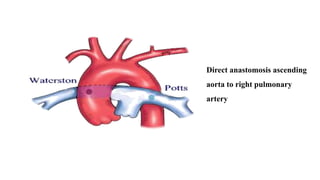
2. Waterston’s anastomosis
Anastomosis of ascending aorta and right pulmonary artery.
• Incision: A right antero -lateral thoracotomy through the 4th
intercostal space.
3. Pott’s Anastomosis
Anastomosis of ascending aorta to left pulmonary artery
Surgical Management
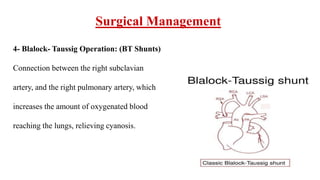
4- Blalock- Taussig Operation: (BT Shunts)
Connection between the right subclavian
artery, and the right pulmonary artery, which
increases the amount of oxygenated blood
reaching the lungs, relieving cyanosis.
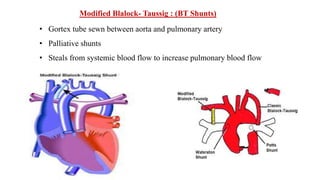
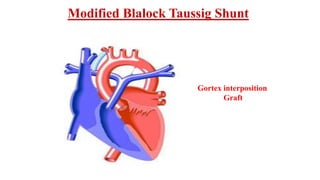
Modified Blalock- Taussig : (BT Shunts)
• Gortex tube sewn between aorta and pulmonary artery
• Palliative shunts
• Steals from systemic blood flow to increase pulmonary blood flow
• Total Correction: The hole in the ventricular septum is closed with a patch and
the obstruction to right ventricular outflow, pulmonic stenosis, is opened.
• These corrections allow blood flow to the lungs for oxygenation before being
pumped out into the body.
Complications
1. Brain abscess
2. Bacterial endocarditis
3. Ventricular arrhythmias
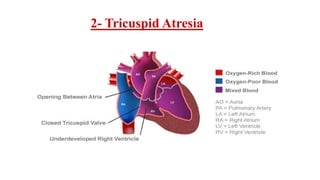
2- Tricuspid Atresia
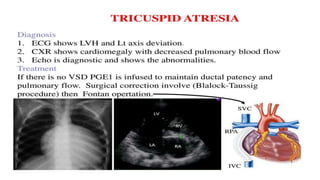
Tricuspid Atresia
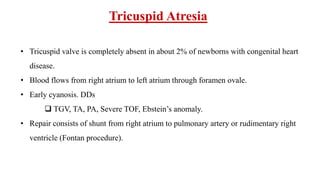
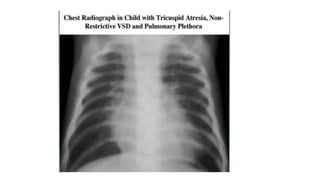
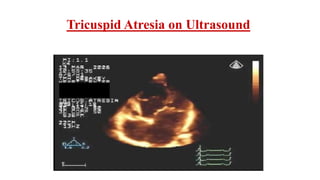
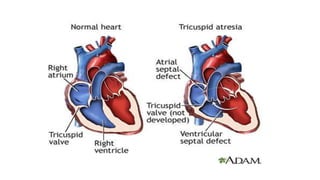
• Tricuspid valve is completely absent in about 2% of newborns with congenital heart
disease.
• Blood flows from right atrium to left atrium through foramen ovale.
• Early cyanosis. DDs
 TGV, TA, PA, Severe TOF, Ebstein’s anomaly.
• Repair consists of shunt from right atrium to pulmonary artery or rudimentary right
ventricle (Fontan procedure).
Tricuspid Atresia on Ultrasound
Management
• Physiologically ‘corrective’ surgery for tricuspid atresia and their modifications have
improved the prognosis of patients with tricuspid atresia.
• Such physiologic correction is usually performed in patients older than 2 years.
• most tricuspid atresia patients manifest symptoms in the neonatal period and should
be effectively palliated to enable them to reach the age at which surgical correction
could be undertake.
Surgical Management
Single Ventricle Palliation
 First stage : to establish a reliable source of PBF
 Aorta to pulmonary artery shunt ( BT shunt)
 Pulmonary arterial banding in cases of increased PBF
 Second stage: Glenn Anastomosis ( superior vena cava to pulmonary artery)
 Third stage : Fontan anastomosis ( Inferior vena cava to pulmonary artery)
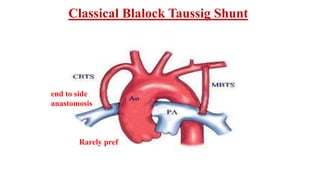
Classical Blalock Taussig Shunt
end to side
anastomosis
Rarely pref
Modified Blalock Taussig Shunt
Gortex interposition
Graft
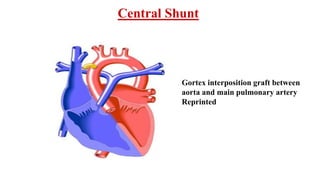
Central Shunt
Gortex interposition graft between
aorta and main pulmonary artery
Reprinted
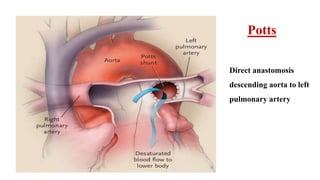
Direct anastomosis
descending aorta to left
pulmonary artery
Potts
Direct anastomosis ascending
aorta to right pulmonary
artery
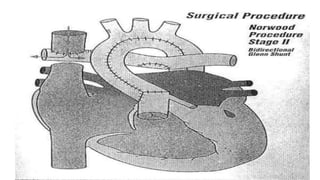
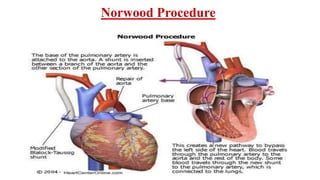
Norwood Procedure
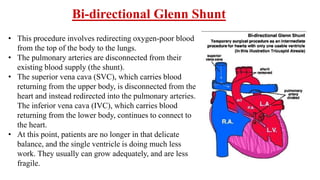
• This procedure involves redirecting oxygen-poor blood
from the top of the body to the lungs.
• The pulmonary arteries are disconnected from their
existing blood supply (the shunt).
• The superior vena cava (SVC), which carries blood
returning from the upper body, is disconnected from the
heart and instead redirected into the pulmonary arteries.
The inferior vena cava (IVC), which carries blood
returning from the lower body, continues to connect to
the heart.
• At this point, patients are no longer in that delicate
balance, and the single ventricle is doing much less
work. They usually can grow adequately, and are less
fragile.
Bi-directional Glenn Shunt
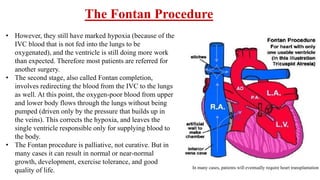
• However, they still have marked hypoxia (because of the
IVC blood that is not fed into the lungs to be
oxygenated), and the ventricle is still doing more work
than expected. Therefore most patients are referred for
another surgery.
• The second stage, also called Fontan completion,
involves redirecting the blood from the IVC to the lungs
as well. At this point, the oxygen-poor blood from upper
and lower body flows through the lungs without being
pumped (driven only by the pressure that builds up in
the veins). This corrects the hypoxia, and leaves the
single ventricle responsible only for supplying blood to
the body.
• The Fontan procedure is palliative, not curative. But in
many cases it can result in normal or near-normal
growth, development, exercise tolerance, and good
quality of life.
The Fontan Procedure
In many cases, patients will eventually require heart transplantation
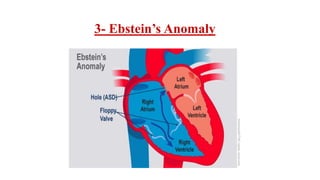
3- Ebstein’s Anomaly
Ebstein’s Anomaly
• Rare CCHD
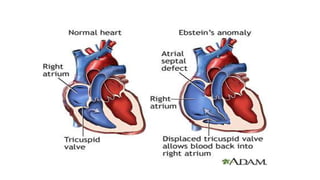
• Post and septal leaflet of TV –displaced downwards
• The upper part of the right ventricle is part of the right atrium – atralized rt ventricle
• Rt ventricle is too small and Rt. Atrium is too large
• Leaflets – malformed and fused – obstruction of flow to rt ventricle
Definition
• Congenital defect
• Origins of septal or posterior leaflets, or both, are displaced downward into RV
• Leaflets are variably deformed
• Arterialization of right ventricle
• Anterior leaflet is enlarged and sail- like
Ebstein’s Anomaly
• Often Associated with other heart lesions
 ASD
 Pulmonary Stenosis
 Pulmonary Atresia
Hemodynamics
Abnormal leaflets  obstruction to forward flow and regulation from Rt
ven to Rt atrium  atrium dilates  Patent FO / ASD allows R  L
shunt (cyanosis)  LT atrium (enlarged)  Lt ventricle (enlarged &
hypertrophied)
Clinical Presentation
Clinical Picture
 Cyanosis
 Effort intolerance
 Fatigue
 Paroxysmal attack of
tachycardia
 Clubbing
 Lt ventricular apical
impulse
 Systolic thrill may be
palpable LSB
May present at any age
• Fetal life:
• Diagnosed incidentally by echocardiography.
• Neonatal life and infancy:
• Cyanosis and severe heart failure
• SVT
• Improve as pulmonary vascular resistance
decreases.
• Adult life:
• Fatigue, exertional dyspnea, cyanosis, heart
failure, and palpitations arrhythmias are common.
Physical Examination
• Cyanosis - Varying degrees of cyanosis at various times in life and
transient worsening with arrhythmias.
• Clubbing
• Precordial asymmetry
• Usually left parasternal prominence and occasionally right
parasternal prominence.
JVP –
• The jugular pulse is normal except for a prominent C wave that coincides with
mobility of the anterior tricuspid leaflet.
• An attenuated X descent and a systolic venous V wave of tricuspid regurgitation
rarely appear despite severe regurgitate flow because of :
1. the damping effect of the commodious right atrium
2. the thin-walled toneless atralized right ventricle
3. tricuspid regurgitation is low-pressure and hypokinetic
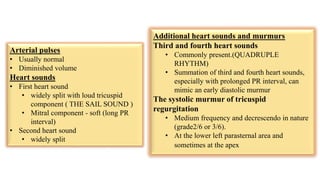
Additional heart sounds and murmurs
Third and fourth heart sounds
• Commonly present.(QUADRUPLE
RHYTHM)
• Summation of third and fourth heart sounds,
especially with prolonged PR interval, can
mimic an early diastolic murmur
The systolic murmur of tricuspid
regurgitation
• Medium frequency and decrescendo in nature
(grade2/6 or 3/6).
• At the lower left parasternal area and
sometimes at the apex
Arterial pulses
• Usually normal
• Diminished volume
Heart sounds
• First heart sound
• widely split with loud tricuspid
component ( THE SAIL SOUND )
• Mitral component - soft (long PR
interval)
• Second heart sound
• widely split
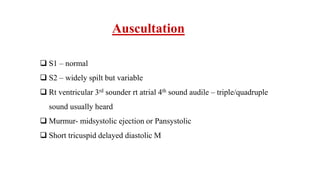
Auscultation
 S1 – normal
 S2 – widely spilt but variable
 Rt ventricular 3rd sounder rt atrial 4th sound audile – triple/quadruple
sound usually heard
 Murmur- midsystolic ejection or Pansystolic
 Short tricuspid delayed diastolic M
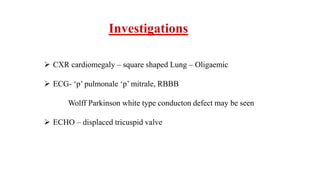
Investigations
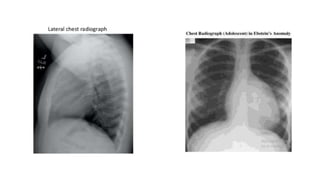
 CXR cardiomegaly – square shaped Lung – Oligaemic
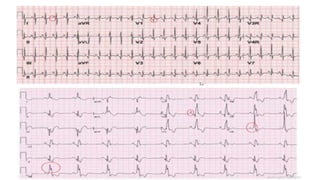
 ECG- ‘p’ pulmonale ‘p’ mitrale, RBBB
Wolff Parkinson white type conducton defect may be seen
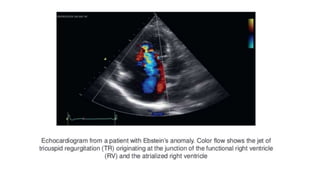
 ECHO – displaced tricuspid valve
Surgical Management
Principles of Surgical Management for Ebstein Anomaly
1. Complete or subtotal closure of intra-atrial communications
2. Tricuspid valve repair or replacement
3. Elimination of arrhythmias
4. Selective plication of the atralized RV
5. Right reduction arthroplasty
6. Repair of associated defects (VSD closure, relief of RVOT obstruction)
Neonatal Ebstein
• Most of the cases do not need surgical intervention.
• Severe forms with persistent cyanosis or important associated lesions will
require intervention.
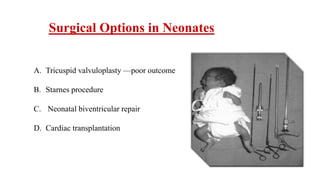
Surgical Options in Neonates
A. Tricuspid valvuloplasty —poor outcome
B. Starnes procedure
C. Neonatal biventricular repair
D. Cardiac transplantation
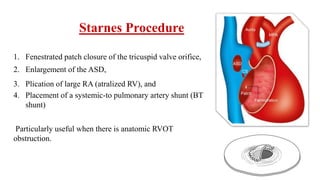
Starnes Procedure
1. Fenestrated patch closure of the tricuspid valve orifice,
2. Enlargement of the ASD,
3. Plication of large RA (atralized RV), and
4. Placement of a systemic-to pulmonary artery shunt (BT
shunt)
Particularly useful when there is anatomic RVOT
obstruction.
Neonatal biventricular repair
1. Partial closure of interatrial septum
2. Tricuspid valve repair
3. RA reduction
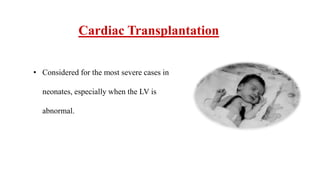
Cardiac Transplantation
• Considered for the most severe cases in
neonates, especially when the LV is
abnormal.
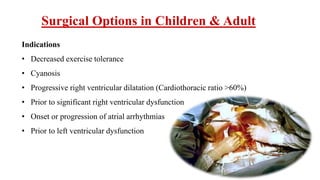
Surgical Options in Children & Adult
Indications
• Decreased exercise tolerance
• Cyanosis
• Progressive right ventricular dilatation (Cardiothoracic ratio >60%)
• Prior to significant right ventricular dysfunction
• Onset or progression of atrial arrhythmias
• Prior to left ventricular dysfunction
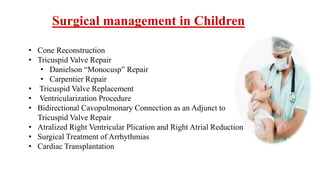
Surgical management in Children
• Cone Reconstruction
• Tricuspid Valve Repair
• Danielson “Monocusp” Repair
• Carpentier Repair
• Tricuspid Valve Replacement
• Ventricularization Procedure
• Bidirectional Cavopulmonary Connection as an Adjunct to
Tricuspid Valve Repair
• Atralized Right Ventricular Plication and Right Atrial Reduction
• Surgical Treatment of Arrhythmias
• Cardiac Transplantation
Cone Reconstruction
Procedure:
• Separation of adherent segment of tricuspid valve from anatomical
annulus and underlying RV.
• Cone created using released tricuspid valve tissue.
• Base of cone attached to AV junction
• Hinge point of tricuspid valve attached to AV junction.
• Atralized portion of RV reduced by elliptical resection or plication.
Cone Reconstruction
Most anatomically correct solution
Cone Reconstruction
Modified cone repair:
• Insertion of complete or partial annuloplasty ring.
• Selective application of Sebening stitch (approximation of anterior
papillary muscle to ventricular septum)
• BDCPA (bidirectional Cavopulmonary anastomosis, 1.5 ventricle
physiology)
Cone Reconstruction
Contraindication:
• Patient age >60 years,
• Moderate pulmonary hypertension,
• Severe LV dysfunction (EF <30%),
• Absent septal leaflet,
• Heavy mascularization of the anterior leaflet,
• Severe tricuspid valve annular dilation with massive RV enlargement
and systolic dysfunction.
Tricuspid Valve Repair
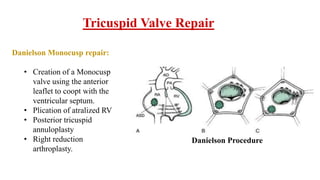
Danielson Monocusp repair:
• Creation of a Monocusp
valve using the anterior
leaflet to coopt with the
ventricular septum.
• Plication of atralized RV
• Posterior tricuspid
annuloplasty
• Right reduction
arthroplasty.
Danielson Procedure
Carpentier procedure:
• Detachment of anterior and septal leaflet
• Plication of atralized RV
• Posterior tricuspid annuloplasty
• Reposition of leaflet and cover the orifice
• Placement of prosthetic ring
Tricuspid Valve Replacement
• Porcine bioprosthetic valve
• Mechanical valve
The Ventriculization Procedure
• This is characterized by reintegration of the atralized portion of the RV
into the right ventricular cavity (Ventricularization).
• This can be obtained by orthotropic transposition of the detached septal and
posterior leaflets of the TV.
• The reimplanted septal leaflet serves as an opposing structure for cooptation
of the reconstructed AV valve.
Bidirectional Cavopulmonary Connection
• The BDCPA (bidirectional Cavopulmonary shunt) does two important things
in the setting of Ebstein’s anomaly.
1. Reduces venous return to the enlarged, dysfunctional RV by approx.
one-third.
2. Provides sufficient preload to the LV to sustain adequate systemic
perfusion when right-sided output is low.
BDCPA
Indications for BDCPA include:
• Severe RV enlargement and/or dysfunction,
• Compression of the LV due to shift of the interventricular septum,
• Moderate tricuspid valve stenosis (mean gradient >8 mm Hg) after CR, or
• RA to LA pressure ratio >1.5 (an indicator of poor RV function).
Arrhythmia Management
• The most common atrial tachyarrhythmia's in Ebstein’s anomaly are atrial
fibrillation and flutter.
• Most surgeons used successfully the right- sided cut-and-sew lesions of Cox-
maze III procedure in Ebstein’s anomaly.
• With the availability of newer devices such as radiofrequency or cryoablation,
the procedure time for maze procedure is shortened significantly.
• A bilateral maze procedure, performed particularly when there is chronic atrial
fibrillation, left atrial dilation, or concomitant mitral regurgitation.
Heart Transplantation
• Heart transplantation rarely is necessary for Ebstein’s anomaly.
• Indication for transplantation is usually the presence of severe biventricular dysfunction
(left ventricular ejection fraction <25%).
Definition
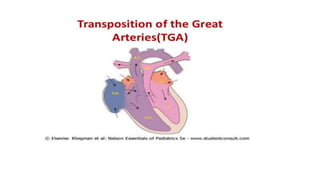
The transposition of the great arteries is ventriculo arterial discordance, in
which the aorta arises from the morphologic right ventricle and the pulmonary
artery arises from the morphologic left ventricle
Transposition of the Great Arteries
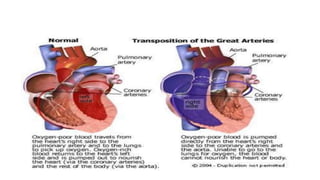
• It is the most common cyanotic lesion to present in the newborn period.
• TGA is ventriculoarterial discordance secondary to abnormalities of
septation of the truncus arteriosus.
• In TGA, the aorta arises from the right ventricle, anterior and to the right
of the pulmonary artery, which arises from the left ventricle.
• This transposition results in desaturated blood returning to the right heart
and being pumped back out to the body, while well-oxygenated blood
returning from the lungs enters the left heart and is pumped back to the
lungs.
• Without mixing of the two circulations, death occurs quickly.
• Mixing can occur at the atrial (ASD), ventricular (VSD), or great vessel
(PDA) level.
Incidence
 Transposition of the great arteries (TGA) is the most common cyanotic
congenital heart lesion that presents in neonates.
 This lesion presents in 5-7% of all patients with congenital heart disease.
 The overall annual incidence is 20-30 per 100,000 live births
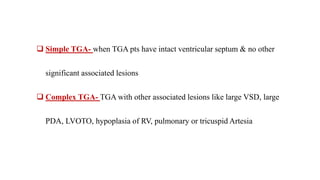
 Simple TGA- when TGA pts have intact ventricular septum & no other
significant associated lesions
 Complex TGA- TGA with other associated lesions like large VSD, large
PDA, LVOTO, hypoplasia of RV, pulmonary or tricuspid Artesia
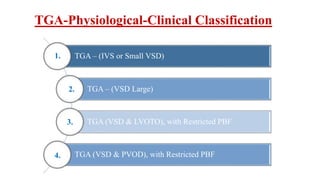
TGA-Physiological-Clinical Classification
TGA – (IVS or Small VSD)
TGA – (VSD Large)
TGA (VSD & LVOTO), with Restricted PBF
TGA (VSD & PVOD), with Restricted PBF
1.
2.
3.
4.
Etiology
 Etiology for transposition of the great arteries is unknown and is presumed
to be multifactorial.
 This congenital heart defect is more common in infants of diabetic mothers.
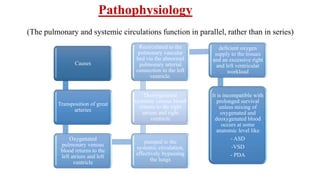
Causes
Transposition of great
arteries
Oxygenated
pulmonary venous
blood returns to the
left atrium and left
ventricle
pumped to the
systemic circulation,
effectively bypassing
the lungs
Deoxygenated
systemic venous blood
returns to the right
atrium and right
ventricle
Recirculated to the
pulmonary vascular
bed via the abnormal
pulmonary arterial
connection to the left
ventricle.
deficient oxygen
supply to the tissues
and an excessive right
and left ventricular
workload
It is incompatible with
prolonged survival
unless mixing of
oxygenated and
deoxygenated blood
occurs at some
anatomic level like
- ASD
-VSD
- PDA
Pathophysiology
(The pulmonary and systemic circulations function in parallel, rather than in series)
Clinical Features (History)
 M:F:::4:1
 More common in multiple pregnancies
 Neonates- normal to large birth weights
Clinical Manifestations
 Prominent and progressive cyanosis within the first 24 hours of life is the
usual finding in infants.
 Tachypnea
 Tachycardia
 Diaphoresis
 Failure to gain weight
Heart Sound
 S1- Normal
 S2- A single or narrowly split, diminished second heart sound.
 A2- palpable at the left base
 Systolic ejection murmur may be present.
Differential Diagnosis
 Pulm atresia with IVS
 TOF with absent pulm valve
 TOF with pulm atresia
 TAPVC
 Tricuspid atresia
 Truncus arteriosus
Diagnostic Evaluation
 History collection
 Physical examination
 ABG analysis
 Echocardiography
 Cardiac catheterization
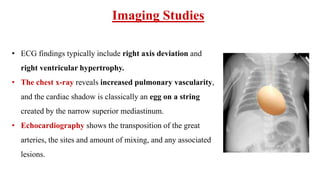
Imaging Studies
• ECG findings typically include right axis deviation and
right ventricular hypertrophy.
• The chest x-ray reveals increased pulmonary vascularity,
and the cardiac shadow is classically an egg on a string
created by the narrow superior mediastinum.
• Echocardiography shows the transposition of the great
arteries, the sites and amount of mixing, and any associated
lesions.
Treatment
 Medical Management
 Palliative
 Surgical Management
Medical Management
 Initial treatment consists of maintaining ductal patency with continuous
intravenous (IV) prostaglandin E1 infusion to promote pulmonary blood
flow.
 Antibiotic Prophylactic Regimens for Endocarditis.
 Fluid replacement
 Bicarbonate administration- Acidosis
 Mechanical ventilation
Palliative
 Rashkind balloon atrial septostomy.
(effective treatment in infants less than six weeks)
 Blalock-Hanlon operation.
(Treatment ranging from one day to five months of age.)
 Prostaglandin E1 -0.05-0.1mcg/kg/min
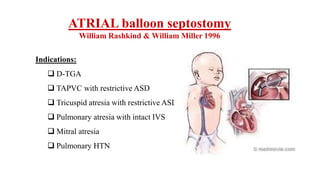
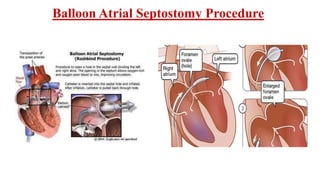
ATRIAL balloon septostomy
William Rashkind & William Miller 1996
Indications:
 D-TGA
 TAPVC with restrictive ASD
 Tricuspid atresia with restrictive ASD
 Pulmonary atresia with intact IVS
 Mitral atresia
 Pulmonary HTN
Balloon Atrial Septostomy Procedure
Techniques
o Balloon is placed in LA – bobbing movement of balloon over mitral valve
o Inflate till movement is lost
o Pull backward
o Interatrial septum gets displaced towards IVC
o Primum septum ruptures
o Immediately move the catheter cranially with deflation
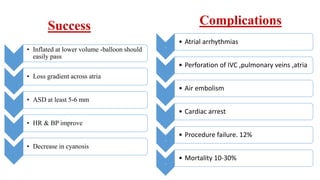
Success
.
• Inflated at lower volume -balloon should
easily pass
.
• Loss gradient across atria
.
• ASD at least 5-6 mm
.
• HR & BP improve
.
• Decrease in cyanosis
.
• Atrial arrhythmias
• Perforation of IVC ,pulmonary veins ,atria
• Air embolism
• Cardiac arrest
.
• Procedure failure. 12%
.
• Mortality 10-30%
Complications
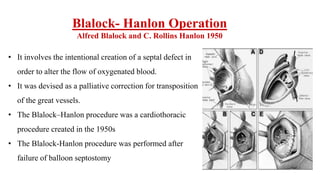
Blalock- Hanlon Operation
Alfred Blalock and C. Rollins Hanlon 1950
• It involves the intentional creation of a septal defect in
order to alter the flow of oxygenated blood.
• It was devised as a palliative correction for transposition
of the great vessels.
• The Blalock–Hanlon procedure was a cardiothoracic
procedure created in the 1950s
• The Blalock-Hanlon procedure was performed after
failure of balloon septostomy
Surgical Management
 ATRIAL LEVEL
 SENNING OPERATION
(more than 5 years of age)
 MUSTARD OPERATION
(3 months to 18 years , with a median age of 18 months)
 VENTRICULAR LEVEL
 RASTELLI OPERATION (between ages 1-2 years)
 GREAT ARTERY LEVEL
• ARTERIAL SWITCH OPERATION (within 6 months)
Surgery at
Atrial Level
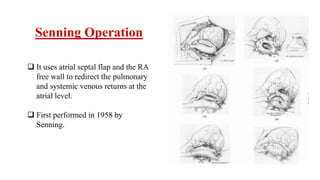
Senning Operation
 It uses atrial septal flap and the RA
free wall to redirect the pulmonary
and systemic venous returns at the
atrial level.
 First performed in 1958 by
Senning.
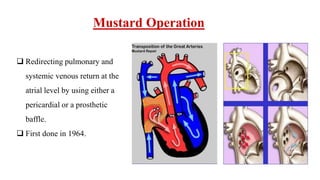
Mustard Operation
 Redirecting pulmonary and
systemic venous return at the
atrial level by using either a
pericardial or a prosthetic
baffle.
 First done in 1964.
Complications of Atrial Switch
 SVC obstruction < 5%.
 IVC obstruction 1%
 Pulm Venous obstruction < 5%.
 Residual intra atrial baffle-shunt < 20%.
 Leaks 1-2%
 Arrhythmias >50%, SVT.,sick sinus syndrome
 RV depression.
 Sudden death.
 PVOD
 TV regurgitation
Surgery at
Ventricular Level
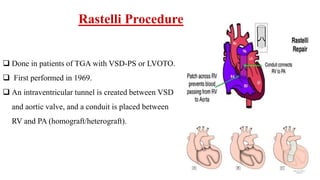
Rastelli Procedure
 Done in patients of TGA with VSD-PS or LVOTO.
 First performed in 1969.
 An intraventricular tunnel is created between VSD
and aortic valve, and a conduit is placed between
RV and PA (homograft/heterograft).
Complication of Rastelli Procedure
 Mortality 20-30%
 two year survival 92%
 Conduit obstruction.
 Needs a re-operation as child grows.
 Intervention-relieve RVOTO/LVOTO
 Myocardial dysfunction
Surgery at
Great Artery Level
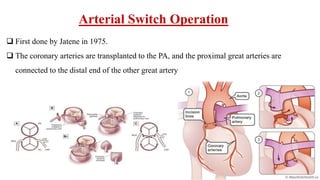
Arterial Switch Operation
 First done by Jatene in 1975.
 The coronary arteries are transplanted to the PA, and the proximal great arteries are
connected to the distal end of the other great artery
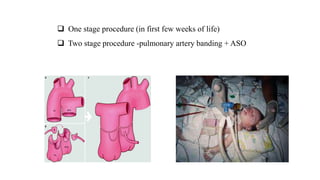
 One stage procedure (in first few weeks of life)
 Two stage procedure -pulmonary artery banding + ASO
Arterial Switch Mortality
 Simple TGA 5% to 15%
 Complex 10 % to 20%
 Survival rates (Kirklin & Barrat Boyes) 85% 5yrs & 81% 9 yrs
Complications of Arterial Switch
 Kinking & obstruction of coronary arteries- myocardial ischemia
 Haemorrhage at suture lines
 May require graft
 Asymtomatic ischemia
 Perfusion defects are common
 Low C.O. state
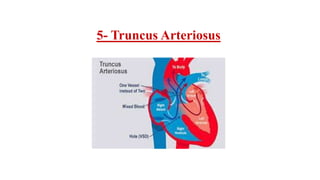
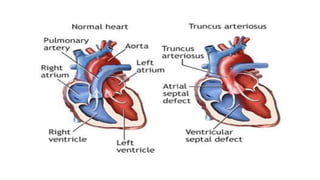
5- Truncus Arteriosus
Truncus Arteriosus
 A SINGLE GREAT VESSEL ARISES FROM THE HEART AND GIVES
OFF THE CA’S,PA’S AND AORTA
 embryological structure known as the truncus arteriosus not properly divides
into the pulmonary artery and aorta.
 Large VSD is present.
 Bounding pulses(it’s like a big PDA), There may be a continuous murmur if
the PA’s are tight
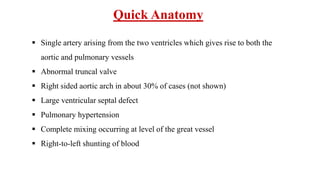
Quick Anatomy
 Single artery arising from the two ventricles which gives rise to both the
aortic and pulmonary vessels
 Abnormal truncal valve
 Right sided aortic arch in about 30% of cases (not shown)
 Large ventricular septal defect
 Pulmonary hypertension
 Complete mixing occurring at level of the great vessel
 Right-to-left shunting of blood
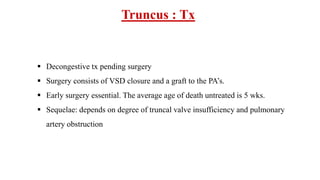
Truncus : Tx
 Decongestive tx pending surgery
 Surgery consists of VSD closure and a graft to the PA’s.
 Early surgery essential. The average age of death untreated is 5 wks.
 Sequelae: depends on degree of truncal valve insufficiency and pulmonary
artery obstruction
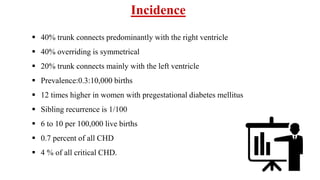
Incidence
 40% trunk connects predominantly with the right ventricle
 40% overriding is symmetrical
 20% trunk connects mainly with the left ventricle
 Prevalence:0.3:10,000 births
 12 times higher in women with pregestational diabetes mellitus
 Sibling recurrence is 1/100
 6 to 10 per 100,000 live births
 0.7 percent of all CHD
 4 % of all critical CHD.
Sign
 Cyanosis presents at birth
 Heart failure may occur within weeks
 Systolic ejection murmur is heard at the left sternal border
 Widened pulse pressure
 Bounding arterial pulses
 Loud second heart sound
 Biventricular hypertrophy
 Cardiomegaly
 Increased pulmonary vascularity
 Hypocalcemia (if associated with DiGeorge syndrome)
Symptoms
 Bluish skin (cyanosis)
 Delayed growth or growth failure
 Fatigue
 Lethargy
 Poor feeding
 Rapid breathing (tachypnea)
 Shortness of breath (dyspnoea)
 Widening of the finger tips (clubbing)
Differential Diagnosis
 Pulmonary atresia/intact IVS
 Tetralogy of Fallot
 large ventricular septal defect (VSD)
 pulmonary atresia with VSD
 Univentricular heart
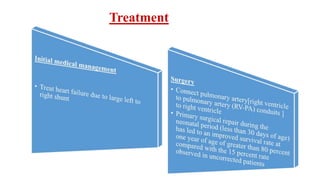
Treatment
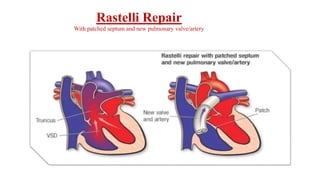
Rastelli Repair
With patched septum and new pulmonary valve/artery
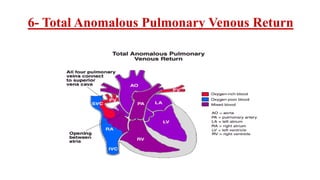
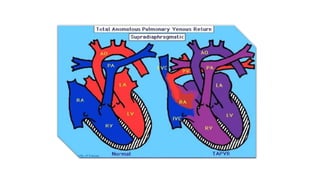
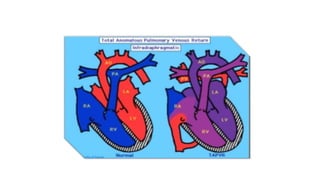
6- Total Anomalous Pulmonary Venous Return
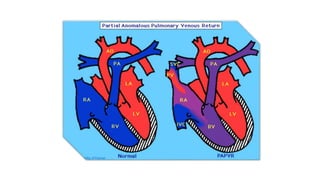
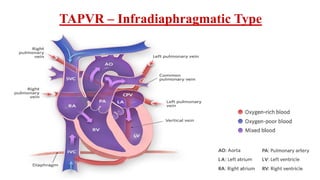
 Pulmonary veins do not make a direct connection with the left atrium.
 Blood reaches the left atrium only through an atrial septal defect or patent
foramen ovale.
 Pulmonary congestion, tachypnea, cardiac failure, and variable cyanosis.
 Operative repair in all cases
 Cyanosis variable and largely dependent on degree of pulmonary venous
obstruction.
 Snowman on CXR
 There is the mixing of the pulmonary circulation through a patent foramen
ovale
Total Anomalous Pulmonary Venous Return
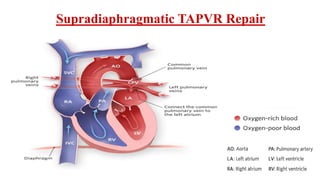
 Surgery is usually indicated soon after the diagnosis is confirmed. This
operation involves the anastomosis of the pulmonary veins to the left atrium,
closure of the ASD, and division of the anomalous connection.
 Without surgery, the prognosis is poor.
 Even if surgery is performed within days of birth, infants who have severe
cyanosis and poor cardiac output before repair have high postoperative
mortality. Connections above the diaphragm have a better prognosis than
connections below the diaphragm.
Surgery Management
TAPVR – Infradiaphragmatic Type
Supradiaphragmatic TAPVR Repair
Thank You..!!

Cyanotic heart disease complete ppts

  • 1.
  • 2.
    Classification of CongenitalHeart Disease (CHD) Congenital Heart Disease Acyanotic Left-to-Right-Shunts - Ventricular Septal Defect (VSD) - Persistent Ductus Arteriosus (PDA) - Atrial Septal Defect (ASD) Outflow Obstruction - Pulmonary Stenosis - Aortic Stenosis - Coarctation of aorta Cyanotic - Tetralogy of Fallot - Tricuspid atresia - Ebstein's anomaly - Transportation of the great arteries - Truncus Arteriosus - Total Anomalous Pulmonary Venous Return
  • 3.
    Classification of CongenitalHeart Disease (CHD)
  • 5.
    Cyanosis • Cyanosis: Abluish discoloration of skin and mucous membrane due to excessive concentration of reduced hemoglobin (deoxygenated) in the blood. • These type of defects lead to either increased or decreased pulmonary blood flow • The primary pathology arises either due to an obstructive lesion; or due to abnormal anatomy or both. • The shunt present is predominantly from Right to Left leading to shunting of venous blood without passing through the lungs to be oxygenated. • Unoxygenated blood circulates in arteries. • cyanosis Example: Tetralogy of Fallot, TGV
  • 6.
    Central vs Peripheral •Central cyanosis:  Seen on tongue as blue color  Associated with a fall in arterial blood O2 tension.  Clinically:  reduced(deoxygenated) Hb >5g/dL  SpO2= <85% by pulse oximetry test. • Peripheral cyanosis:  Blueness of hand and feet  Due to cold or circulatory disorder (e.g: DVT)  Can also occur in severe central cyanosis
  • 7.
    Right to LeftShunts 1.Tetralogy of Fallot 2. Tricuspid atresia 3. Ebstein’s anomaly 4. Transportation of the great arteries 5. Truncus Arteriosus 6. Total Anomalous Pulmonary Venous Return (TAPVR) 5 T’s 1.Tetralogy of Fallot 2. Tricuspid atresia 3. Transportation of the great arteries 4. Truncus Arteriosus 5. Total Anomalous Pulmonary Venous Return
  • 10.
    Tetralogy of Fallot(TOF) • Tetralogy of Fallot is the most common cyanotic congenital heart defect. • Anatomically, there are four structural defects: VSD, pulmonary stenosis, overriding aorta and right ventricular hypertrophy. • Tetralogy of Fallot is believed to be due to abnormalities in the septation of the truncus arteriosus into the aorta and pulmonary arteries that occur early in gestation (3 to 4 weeks)
  • 11.
    Clinical Manifestations • Thedegree of cyanosis depends on the amount of pulmonary stenosis. • Infants initially may be acyanotic. • Older children+ long standing cyanosis+ not undergone surgery  Dusky blue skin  Grey sclera with engorged blood vessel  Marked clubbing of fingers and toes • Irritability • Lethargic • Reduced physical activity • Fainting • Clubbing of nails of fingers/toes • Breathing difficulty
  • 12.
    • A pulmonarystenosis murmur is the usual initial abnormal finding. • If the pulmonary stenosis is more severe, or as it becomes more severe over time, the amount of right- to-left shunting at the VSD increases, and the patient becomes more cyanotic. • With increasing severity of pulmonary stenosis, the murmur becomes shorter and softer. • single S2 and right ventricular impulse(heave) at the left sternal border are typical findings. • hypoxic ("Tet") spells • Independent of hypoxic spells, patients with tetralogy are at increased risk for cerebral thromboembolism and cerebral abscesses resulting in part from their right-to-left intracardiac shunt.
  • 13.
    • Hypoxic spells/paroxysmal hypercyanotic attacks (1st 2years of life)  Severe hypoxia  tissue acidosis  breathlessness and pallor  Rapid increase in cyanosis  Restless and agitated  Inconsolable crying  An ambulatory toddler may squat  Severe spells:  Prolonged unconsciousness and convulsions  Hemiparesis  OR death
  • 14.
    Diagnosis On Auscultation- Anejection systolic murmur is present at the Left parasternal region 3rd ICS due to pulmonary stenosis.
  • 15.
    Imaging Studies • TheECG usually has right axis deviation and right ventricular hypertrophy. • The classic chest x-ray finding is a boot-shaped heart :  Small heart  Uptilted apex (boot shaped)  pulmonary artery ‘bay’= concavity of L heart border  Oligaemic lung fields • Echocardiography: The diagnosis usually is made with echocardiography.
  • 16.
  • 18.
    Treatment • The naturalhistory of tetralogy of Fallot is progression of pulmonary stenosis and cyanosis.  Treatment of hypoxic spells consists of • oxygen administration, • placing the child in the knee-chest position (to increase venous return), • and giving morphine sulfate (to relax the pulmonary infundibulum and for sedation). • If necessary, the systemic vascular resistance can be increased acutely through the administration of an α-adrenergic agonist (phenylephrine). • β-adrenergic antagonists (propranolol) decrease muscular spasm.  Complete surgical repair with closure of the VSD and removal or patching of the pulmonary stenosis can be performed in infancy.  Subacute bacterial endocarditis prophylaxis is indicated.
  • 19.
    Anastomotic palliative Treatment 1.Blalock’s anastomosis: performed on child of a few weeks to 5 years Anastomosis of pulmonary artery to the left subclavian artery. • Incision: A left postero - lateral thoracotomy through the 4th intercostal space. 2. Waterston’s anastomosis Anastomosis of ascending aorta and right pulmonary artery. • Incision: A right antero -lateral thoracotomy through the 4th intercostal space. 3. Pott’s Anastomosis Anastomosis of ascending aorta to left pulmonary artery
  • 20.
    Surgical Management 4- Blalock-Taussig Operation: (BT Shunts) Connection between the right subclavian artery, and the right pulmonary artery, which increases the amount of oxygenated blood reaching the lungs, relieving cyanosis.
  • 21.
    Modified Blalock- Taussig: (BT Shunts) • Gortex tube sewn between aorta and pulmonary artery • Palliative shunts • Steals from systemic blood flow to increase pulmonary blood flow
  • 22.
    • Total Correction:The hole in the ventricular septum is closed with a patch and the obstruction to right ventricular outflow, pulmonic stenosis, is opened. • These corrections allow blood flow to the lungs for oxygenation before being pumped out into the body.
  • 23.
    Complications 1. Brain abscess 2.Bacterial endocarditis 3. Ventricular arrhythmias
  • 24.
  • 25.
    Tricuspid Atresia • Tricuspidvalve is completely absent in about 2% of newborns with congenital heart disease. • Blood flows from right atrium to left atrium through foramen ovale. • Early cyanosis. DDs  TGV, TA, PA, Severe TOF, Ebstein’s anomaly. • Repair consists of shunt from right atrium to pulmonary artery or rudimentary right ventricle (Fontan procedure).
  • 29.
  • 30.
    Management • Physiologically ‘corrective’surgery for tricuspid atresia and their modifications have improved the prognosis of patients with tricuspid atresia. • Such physiologic correction is usually performed in patients older than 2 years. • most tricuspid atresia patients manifest symptoms in the neonatal period and should be effectively palliated to enable them to reach the age at which surgical correction could be undertake.
  • 31.
    Surgical Management Single VentriclePalliation  First stage : to establish a reliable source of PBF  Aorta to pulmonary artery shunt ( BT shunt)  Pulmonary arterial banding in cases of increased PBF  Second stage: Glenn Anastomosis ( superior vena cava to pulmonary artery)  Third stage : Fontan anastomosis ( Inferior vena cava to pulmonary artery)
  • 32.
    Classical Blalock TaussigShunt end to side anastomosis Rarely pref
  • 33.
    Modified Blalock TaussigShunt Gortex interposition Graft
  • 34.
    Central Shunt Gortex interpositiongraft between aorta and main pulmonary artery Reprinted
  • 35.
    Direct anastomosis descending aortato left pulmonary artery Potts
  • 36.
    Direct anastomosis ascending aortato right pulmonary artery
  • 38.
  • 40.
    • This procedureinvolves redirecting oxygen-poor blood from the top of the body to the lungs. • The pulmonary arteries are disconnected from their existing blood supply (the shunt). • The superior vena cava (SVC), which carries blood returning from the upper body, is disconnected from the heart and instead redirected into the pulmonary arteries. The inferior vena cava (IVC), which carries blood returning from the lower body, continues to connect to the heart. • At this point, patients are no longer in that delicate balance, and the single ventricle is doing much less work. They usually can grow adequately, and are less fragile. Bi-directional Glenn Shunt
  • 41.
    • However, theystill have marked hypoxia (because of the IVC blood that is not fed into the lungs to be oxygenated), and the ventricle is still doing more work than expected. Therefore most patients are referred for another surgery. • The second stage, also called Fontan completion, involves redirecting the blood from the IVC to the lungs as well. At this point, the oxygen-poor blood from upper and lower body flows through the lungs without being pumped (driven only by the pressure that builds up in the veins). This corrects the hypoxia, and leaves the single ventricle responsible only for supplying blood to the body. • The Fontan procedure is palliative, not curative. But in many cases it can result in normal or near-normal growth, development, exercise tolerance, and good quality of life. The Fontan Procedure In many cases, patients will eventually require heart transplantation
  • 42.
  • 43.
    Ebstein’s Anomaly • RareCCHD • Post and septal leaflet of TV –displaced downwards • The upper part of the right ventricle is part of the right atrium – atralized rt ventricle • Rt ventricle is too small and Rt. Atrium is too large • Leaflets – malformed and fused – obstruction of flow to rt ventricle
  • 44.
    Definition • Congenital defect •Origins of septal or posterior leaflets, or both, are displaced downward into RV • Leaflets are variably deformed • Arterialization of right ventricle • Anterior leaflet is enlarged and sail- like
  • 46.
    Ebstein’s Anomaly • OftenAssociated with other heart lesions  ASD  Pulmonary Stenosis  Pulmonary Atresia
  • 47.
    Hemodynamics Abnormal leaflets obstruction to forward flow and regulation from Rt ven to Rt atrium  atrium dilates  Patent FO / ASD allows R  L shunt (cyanosis)  LT atrium (enlarged)  Lt ventricle (enlarged & hypertrophied)
  • 48.
    Clinical Presentation Clinical Picture Cyanosis  Effort intolerance  Fatigue  Paroxysmal attack of tachycardia  Clubbing  Lt ventricular apical impulse  Systolic thrill may be palpable LSB May present at any age • Fetal life: • Diagnosed incidentally by echocardiography. • Neonatal life and infancy: • Cyanosis and severe heart failure • SVT • Improve as pulmonary vascular resistance decreases. • Adult life: • Fatigue, exertional dyspnea, cyanosis, heart failure, and palpitations arrhythmias are common.
  • 49.
    Physical Examination • Cyanosis- Varying degrees of cyanosis at various times in life and transient worsening with arrhythmias. • Clubbing • Precordial asymmetry • Usually left parasternal prominence and occasionally right parasternal prominence.
  • 50.
    JVP – • Thejugular pulse is normal except for a prominent C wave that coincides with mobility of the anterior tricuspid leaflet. • An attenuated X descent and a systolic venous V wave of tricuspid regurgitation rarely appear despite severe regurgitate flow because of : 1. the damping effect of the commodious right atrium 2. the thin-walled toneless atralized right ventricle 3. tricuspid regurgitation is low-pressure and hypokinetic
  • 51.
    Additional heart soundsand murmurs Third and fourth heart sounds • Commonly present.(QUADRUPLE RHYTHM) • Summation of third and fourth heart sounds, especially with prolonged PR interval, can mimic an early diastolic murmur The systolic murmur of tricuspid regurgitation • Medium frequency and decrescendo in nature (grade2/6 or 3/6). • At the lower left parasternal area and sometimes at the apex Arterial pulses • Usually normal • Diminished volume Heart sounds • First heart sound • widely split with loud tricuspid component ( THE SAIL SOUND ) • Mitral component - soft (long PR interval) • Second heart sound • widely split
  • 52.
    Auscultation  S1 –normal  S2 – widely spilt but variable  Rt ventricular 3rd sounder rt atrial 4th sound audile – triple/quadruple sound usually heard  Murmur- midsystolic ejection or Pansystolic  Short tricuspid delayed diastolic M
  • 53.
    Investigations  CXR cardiomegaly– square shaped Lung – Oligaemic  ECG- ‘p’ pulmonale ‘p’ mitrale, RBBB Wolff Parkinson white type conducton defect may be seen  ECHO – displaced tricuspid valve
  • 57.
    Surgical Management Principles ofSurgical Management for Ebstein Anomaly 1. Complete or subtotal closure of intra-atrial communications 2. Tricuspid valve repair or replacement 3. Elimination of arrhythmias 4. Selective plication of the atralized RV 5. Right reduction arthroplasty 6. Repair of associated defects (VSD closure, relief of RVOT obstruction)
  • 58.
    Neonatal Ebstein • Mostof the cases do not need surgical intervention. • Severe forms with persistent cyanosis or important associated lesions will require intervention.
  • 59.
    Surgical Options inNeonates A. Tricuspid valvuloplasty —poor outcome B. Starnes procedure C. Neonatal biventricular repair D. Cardiac transplantation
  • 60.
    Starnes Procedure 1. Fenestratedpatch closure of the tricuspid valve orifice, 2. Enlargement of the ASD, 3. Plication of large RA (atralized RV), and 4. Placement of a systemic-to pulmonary artery shunt (BT shunt) Particularly useful when there is anatomic RVOT obstruction.
  • 61.
    Neonatal biventricular repair 1.Partial closure of interatrial septum 2. Tricuspid valve repair 3. RA reduction
  • 62.
    Cardiac Transplantation • Consideredfor the most severe cases in neonates, especially when the LV is abnormal.
  • 63.
    Surgical Options inChildren & Adult Indications • Decreased exercise tolerance • Cyanosis • Progressive right ventricular dilatation (Cardiothoracic ratio >60%) • Prior to significant right ventricular dysfunction • Onset or progression of atrial arrhythmias • Prior to left ventricular dysfunction
  • 64.
    Surgical management inChildren • Cone Reconstruction • Tricuspid Valve Repair • Danielson “Monocusp” Repair • Carpentier Repair • Tricuspid Valve Replacement • Ventricularization Procedure • Bidirectional Cavopulmonary Connection as an Adjunct to Tricuspid Valve Repair • Atralized Right Ventricular Plication and Right Atrial Reduction • Surgical Treatment of Arrhythmias • Cardiac Transplantation
  • 65.
    Cone Reconstruction Procedure: • Separationof adherent segment of tricuspid valve from anatomical annulus and underlying RV. • Cone created using released tricuspid valve tissue. • Base of cone attached to AV junction • Hinge point of tricuspid valve attached to AV junction. • Atralized portion of RV reduced by elliptical resection or plication.
  • 66.
  • 67.
    Cone Reconstruction Modified conerepair: • Insertion of complete or partial annuloplasty ring. • Selective application of Sebening stitch (approximation of anterior papillary muscle to ventricular septum) • BDCPA (bidirectional Cavopulmonary anastomosis, 1.5 ventricle physiology)
  • 68.
    Cone Reconstruction Contraindication: • Patientage >60 years, • Moderate pulmonary hypertension, • Severe LV dysfunction (EF <30%), • Absent septal leaflet, • Heavy mascularization of the anterior leaflet, • Severe tricuspid valve annular dilation with massive RV enlargement and systolic dysfunction.
  • 69.
    Tricuspid Valve Repair DanielsonMonocusp repair: • Creation of a Monocusp valve using the anterior leaflet to coopt with the ventricular septum. • Plication of atralized RV • Posterior tricuspid annuloplasty • Right reduction arthroplasty. Danielson Procedure
  • 70.
    Carpentier procedure: • Detachmentof anterior and septal leaflet • Plication of atralized RV • Posterior tricuspid annuloplasty • Reposition of leaflet and cover the orifice • Placement of prosthetic ring
  • 71.
    Tricuspid Valve Replacement •Porcine bioprosthetic valve • Mechanical valve
  • 72.
    The Ventriculization Procedure •This is characterized by reintegration of the atralized portion of the RV into the right ventricular cavity (Ventricularization). • This can be obtained by orthotropic transposition of the detached septal and posterior leaflets of the TV. • The reimplanted septal leaflet serves as an opposing structure for cooptation of the reconstructed AV valve.
  • 73.
    Bidirectional Cavopulmonary Connection •The BDCPA (bidirectional Cavopulmonary shunt) does two important things in the setting of Ebstein’s anomaly. 1. Reduces venous return to the enlarged, dysfunctional RV by approx. one-third. 2. Provides sufficient preload to the LV to sustain adequate systemic perfusion when right-sided output is low.
  • 74.
    BDCPA Indications for BDCPAinclude: • Severe RV enlargement and/or dysfunction, • Compression of the LV due to shift of the interventricular septum, • Moderate tricuspid valve stenosis (mean gradient >8 mm Hg) after CR, or • RA to LA pressure ratio >1.5 (an indicator of poor RV function).
  • 75.
    Arrhythmia Management • Themost common atrial tachyarrhythmia's in Ebstein’s anomaly are atrial fibrillation and flutter. • Most surgeons used successfully the right- sided cut-and-sew lesions of Cox- maze III procedure in Ebstein’s anomaly. • With the availability of newer devices such as radiofrequency or cryoablation, the procedure time for maze procedure is shortened significantly. • A bilateral maze procedure, performed particularly when there is chronic atrial fibrillation, left atrial dilation, or concomitant mitral regurgitation.
  • 76.
    Heart Transplantation • Hearttransplantation rarely is necessary for Ebstein’s anomaly. • Indication for transplantation is usually the presence of severe biventricular dysfunction (left ventricular ejection fraction <25%).
  • 78.
    Definition The transposition ofthe great arteries is ventriculo arterial discordance, in which the aorta arises from the morphologic right ventricle and the pulmonary artery arises from the morphologic left ventricle
  • 80.
    Transposition of theGreat Arteries • It is the most common cyanotic lesion to present in the newborn period. • TGA is ventriculoarterial discordance secondary to abnormalities of septation of the truncus arteriosus. • In TGA, the aorta arises from the right ventricle, anterior and to the right of the pulmonary artery, which arises from the left ventricle. • This transposition results in desaturated blood returning to the right heart and being pumped back out to the body, while well-oxygenated blood returning from the lungs enters the left heart and is pumped back to the lungs. • Without mixing of the two circulations, death occurs quickly. • Mixing can occur at the atrial (ASD), ventricular (VSD), or great vessel (PDA) level.
  • 82.
    Incidence  Transposition ofthe great arteries (TGA) is the most common cyanotic congenital heart lesion that presents in neonates.  This lesion presents in 5-7% of all patients with congenital heart disease.  The overall annual incidence is 20-30 per 100,000 live births
  • 83.
     Simple TGA-when TGA pts have intact ventricular septum & no other significant associated lesions  Complex TGA- TGA with other associated lesions like large VSD, large PDA, LVOTO, hypoplasia of RV, pulmonary or tricuspid Artesia
  • 84.
    TGA-Physiological-Clinical Classification TGA –(IVS or Small VSD) TGA – (VSD Large) TGA (VSD & LVOTO), with Restricted PBF TGA (VSD & PVOD), with Restricted PBF 1. 2. 3. 4.
  • 85.
    Etiology  Etiology fortransposition of the great arteries is unknown and is presumed to be multifactorial.  This congenital heart defect is more common in infants of diabetic mothers.
  • 86.
    Causes Transposition of great arteries Oxygenated pulmonaryvenous blood returns to the left atrium and left ventricle pumped to the systemic circulation, effectively bypassing the lungs Deoxygenated systemic venous blood returns to the right atrium and right ventricle Recirculated to the pulmonary vascular bed via the abnormal pulmonary arterial connection to the left ventricle. deficient oxygen supply to the tissues and an excessive right and left ventricular workload It is incompatible with prolonged survival unless mixing of oxygenated and deoxygenated blood occurs at some anatomic level like - ASD -VSD - PDA Pathophysiology (The pulmonary and systemic circulations function in parallel, rather than in series)
  • 87.
    Clinical Features (History) M:F:::4:1  More common in multiple pregnancies  Neonates- normal to large birth weights
  • 88.
    Clinical Manifestations  Prominentand progressive cyanosis within the first 24 hours of life is the usual finding in infants.  Tachypnea  Tachycardia  Diaphoresis  Failure to gain weight
  • 89.
    Heart Sound  S1-Normal  S2- A single or narrowly split, diminished second heart sound.  A2- palpable at the left base  Systolic ejection murmur may be present.
  • 90.
    Differential Diagnosis  Pulmatresia with IVS  TOF with absent pulm valve  TOF with pulm atresia  TAPVC  Tricuspid atresia  Truncus arteriosus
  • 91.
    Diagnostic Evaluation  Historycollection  Physical examination  ABG analysis  Echocardiography  Cardiac catheterization
  • 92.
    Imaging Studies • ECGfindings typically include right axis deviation and right ventricular hypertrophy. • The chest x-ray reveals increased pulmonary vascularity, and the cardiac shadow is classically an egg on a string created by the narrow superior mediastinum. • Echocardiography shows the transposition of the great arteries, the sites and amount of mixing, and any associated lesions.
  • 93.
    Treatment  Medical Management Palliative  Surgical Management
  • 94.
    Medical Management  Initialtreatment consists of maintaining ductal patency with continuous intravenous (IV) prostaglandin E1 infusion to promote pulmonary blood flow.  Antibiotic Prophylactic Regimens for Endocarditis.  Fluid replacement  Bicarbonate administration- Acidosis  Mechanical ventilation
  • 95.
    Palliative  Rashkind balloonatrial septostomy. (effective treatment in infants less than six weeks)  Blalock-Hanlon operation. (Treatment ranging from one day to five months of age.)  Prostaglandin E1 -0.05-0.1mcg/kg/min
  • 96.
    ATRIAL balloon septostomy WilliamRashkind & William Miller 1996 Indications:  D-TGA  TAPVC with restrictive ASD  Tricuspid atresia with restrictive ASD  Pulmonary atresia with intact IVS  Mitral atresia  Pulmonary HTN
  • 97.
  • 98.
    Techniques o Balloon isplaced in LA – bobbing movement of balloon over mitral valve o Inflate till movement is lost o Pull backward o Interatrial septum gets displaced towards IVC o Primum septum ruptures o Immediately move the catheter cranially with deflation
  • 99.
    Success . • Inflated atlower volume -balloon should easily pass . • Loss gradient across atria . • ASD at least 5-6 mm . • HR & BP improve . • Decrease in cyanosis . • Atrial arrhythmias • Perforation of IVC ,pulmonary veins ,atria • Air embolism • Cardiac arrest . • Procedure failure. 12% . • Mortality 10-30% Complications
  • 100.
    Blalock- Hanlon Operation AlfredBlalock and C. Rollins Hanlon 1950 • It involves the intentional creation of a septal defect in order to alter the flow of oxygenated blood. • It was devised as a palliative correction for transposition of the great vessels. • The Blalock–Hanlon procedure was a cardiothoracic procedure created in the 1950s • The Blalock-Hanlon procedure was performed after failure of balloon septostomy
  • 101.
    Surgical Management  ATRIALLEVEL  SENNING OPERATION (more than 5 years of age)  MUSTARD OPERATION (3 months to 18 years , with a median age of 18 months)  VENTRICULAR LEVEL  RASTELLI OPERATION (between ages 1-2 years)  GREAT ARTERY LEVEL • ARTERIAL SWITCH OPERATION (within 6 months)
  • 102.
  • 103.
    Senning Operation  Ituses atrial septal flap and the RA free wall to redirect the pulmonary and systemic venous returns at the atrial level.  First performed in 1958 by Senning.
  • 104.
    Mustard Operation  Redirectingpulmonary and systemic venous return at the atrial level by using either a pericardial or a prosthetic baffle.  First done in 1964.
  • 105.
    Complications of AtrialSwitch  SVC obstruction < 5%.  IVC obstruction 1%  Pulm Venous obstruction < 5%.  Residual intra atrial baffle-shunt < 20%.  Leaks 1-2%  Arrhythmias >50%, SVT.,sick sinus syndrome  RV depression.  Sudden death.  PVOD  TV regurgitation
  • 106.
  • 107.
    Rastelli Procedure  Donein patients of TGA with VSD-PS or LVOTO.  First performed in 1969.  An intraventricular tunnel is created between VSD and aortic valve, and a conduit is placed between RV and PA (homograft/heterograft).
  • 108.
    Complication of RastelliProcedure  Mortality 20-30%  two year survival 92%  Conduit obstruction.  Needs a re-operation as child grows.  Intervention-relieve RVOTO/LVOTO  Myocardial dysfunction
  • 109.
  • 110.
    Arterial Switch Operation First done by Jatene in 1975.  The coronary arteries are transplanted to the PA, and the proximal great arteries are connected to the distal end of the other great artery
  • 111.
     One stageprocedure (in first few weeks of life)  Two stage procedure -pulmonary artery banding + ASO
  • 112.
    Arterial Switch Mortality Simple TGA 5% to 15%  Complex 10 % to 20%  Survival rates (Kirklin & Barrat Boyes) 85% 5yrs & 81% 9 yrs
  • 113.
    Complications of ArterialSwitch  Kinking & obstruction of coronary arteries- myocardial ischemia  Haemorrhage at suture lines  May require graft  Asymtomatic ischemia  Perfusion defects are common  Low C.O. state
  • 114.
  • 115.
    Truncus Arteriosus  ASINGLE GREAT VESSEL ARISES FROM THE HEART AND GIVES OFF THE CA’S,PA’S AND AORTA  embryological structure known as the truncus arteriosus not properly divides into the pulmonary artery and aorta.  Large VSD is present.  Bounding pulses(it’s like a big PDA), There may be a continuous murmur if the PA’s are tight
  • 117.
    Quick Anatomy  Singleartery arising from the two ventricles which gives rise to both the aortic and pulmonary vessels  Abnormal truncal valve  Right sided aortic arch in about 30% of cases (not shown)  Large ventricular septal defect  Pulmonary hypertension  Complete mixing occurring at level of the great vessel  Right-to-left shunting of blood
  • 118.
    Truncus : Tx Decongestive tx pending surgery  Surgery consists of VSD closure and a graft to the PA’s.  Early surgery essential. The average age of death untreated is 5 wks.  Sequelae: depends on degree of truncal valve insufficiency and pulmonary artery obstruction
  • 119.
    Incidence  40% trunkconnects predominantly with the right ventricle  40% overriding is symmetrical  20% trunk connects mainly with the left ventricle  Prevalence:0.3:10,000 births  12 times higher in women with pregestational diabetes mellitus  Sibling recurrence is 1/100  6 to 10 per 100,000 live births  0.7 percent of all CHD  4 % of all critical CHD.
  • 120.
    Sign  Cyanosis presentsat birth  Heart failure may occur within weeks  Systolic ejection murmur is heard at the left sternal border  Widened pulse pressure  Bounding arterial pulses  Loud second heart sound  Biventricular hypertrophy  Cardiomegaly  Increased pulmonary vascularity  Hypocalcemia (if associated with DiGeorge syndrome)
  • 121.
    Symptoms  Bluish skin(cyanosis)  Delayed growth or growth failure  Fatigue  Lethargy  Poor feeding  Rapid breathing (tachypnea)  Shortness of breath (dyspnoea)  Widening of the finger tips (clubbing)
  • 122.
    Differential Diagnosis  Pulmonaryatresia/intact IVS  Tetralogy of Fallot  large ventricular septal defect (VSD)  pulmonary atresia with VSD  Univentricular heart
  • 123.
  • 124.
    Rastelli Repair With patchedseptum and new pulmonary valve/artery
  • 125.
    6- Total AnomalousPulmonary Venous Return
  • 126.
     Pulmonary veinsdo not make a direct connection with the left atrium.  Blood reaches the left atrium only through an atrial septal defect or patent foramen ovale.  Pulmonary congestion, tachypnea, cardiac failure, and variable cyanosis.  Operative repair in all cases  Cyanosis variable and largely dependent on degree of pulmonary venous obstruction.  Snowman on CXR  There is the mixing of the pulmonary circulation through a patent foramen ovale Total Anomalous Pulmonary Venous Return
  • 130.
     Surgery isusually indicated soon after the diagnosis is confirmed. This operation involves the anastomosis of the pulmonary veins to the left atrium, closure of the ASD, and division of the anomalous connection.  Without surgery, the prognosis is poor.  Even if surgery is performed within days of birth, infants who have severe cyanosis and poor cardiac output before repair have high postoperative mortality. Connections above the diaphragm have a better prognosis than connections below the diaphragm. Surgery Management
  • 131.
  • 132.
  • 133.