INTRODUCTION
 AREAS INNERVARED
 BRANCHES
 COURSE OF THE NERVE
 GANGLION ASSOCIATED
 APPLIED ASPECT

Second

division- intermediate, in position / size,
between ophthalmic and mandibular.
Originates

from middle of the semilunar ganglion.
leaves the skull -foramen rotundum.
crosses the pterygopalatine fossa ,
enters the orbit through the inferior orbital fissure .
traverses

the infraorbital groove and canal in the floor
of the orbit, and appears upon the face at the infraorbital
foramen.
At

its termination-divides into branches-nose, the
lower eyelid, and the upper lip, joining with
filaments of the facial nerve.
Sensory innervation –
Lower eyelid and cheek
 Nose
 Upper lip
 Maxillary teeth,
 Nasal mucosa,
 Hard palate
 Pharynx, tonsil.
Maxillary, ethmoid and
sphenoid sinuses,
meninges.

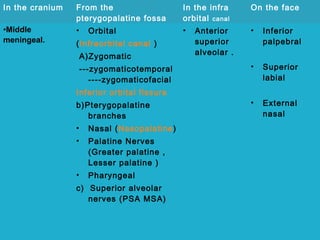
In the cranium

From the
pterygopalatine fossa

•Middle
meningeal.

•

Orbital

(Infraorbital canal )
A)Zygomatic
---zygomaticotemporal
----zygomaticofacial

In the infra
orbital canal
•

Anterior
superior
alveolar .

On the face
•

Inferior
palpebral

•

Superior
labial

•

External
nasal

Inferior orbital fissure
b)Pterygopalatine
branches
•

Nasal (Nasopalatine)

•

Palatine Nerves
(Greater palatine ,
Lesser palatine )

•

Pharyngeal

c) Superior alveolar
nerves (PSA MSA)
A. Zygoticaticotemporal
B. Zygomatico facial
C. Post. S. Alveolar
D. Naso palatine
E. Greater Palatine
F. Lesser Palatine
G. Mid & Ant. Alveolar
H. Infraorbital
The Middle Meningeal
 (Dural branch) -given off at origin from the
semilunar ganglion
 supplies the dura mater.
 





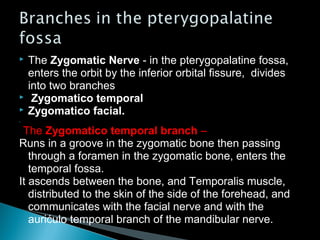
The Zygomatic Nerve - in the pterygopalatine fossa,
enters the orbit by the inferior orbital fissure, divides
into two branches
Zygomatico temporal
Zygomatico facial.

 



The Zygomatico temporal branch –
Runs in a groove in the zygomatic bone then passing
through a foramen in the zygomatic bone, enters the
temporal fossa.
It ascends between the bone, and Temporalis muscle,
distributed to the skin of the side of the forehead, and
communicates with the facial nerve and with the
aurićulo temporal branch of the mandibular nerve.
.

   


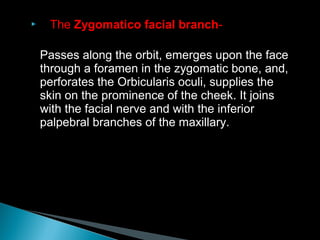
The Zygomatico facial branchPasses along the orbit, emerges upon the face
through a foramen in the zygomatic bone, and,
perforates the Orbicularis oculi, supplies the
skin on the prominence of the cheek. It joins
with the facial nerve and with the inferior
palpebral branches of the maxillary.
Nasal branches –
Enter the posterior part of the nasal cavity by the spheno
palatine foramen
supply the mucous membrane covering the superior and
middle nasal conchæ, posterior ethmoidal cells,
and the posterior part of the septum.
 Nasopalatine nerve. It enters the nasal cavity through the
sphenopalatine foramen,
 passes across the roof of the nasal cavity below the orifice
of the sphenoid sinus to reach the septum, and then runs
obliquely downward and forward between the periosteum
and mucous membrane of the lower part of the septum. It
descends to the roof of the mouth through the incisive
canal and communicates with the corresponding nerve of
the opposite side and with the anterior palatine nerve. It
furnishes a few filaments to the mucous membrane of the
nasal septum

They are three in number: anterior, middle, and
posterior.
 

anterior

palatine nerve - emerges upon the hard
palate through the greater palatine foramen, and
passes forward in a groove in the hard palate, nearly
as far as the incisor teeth.
 It supplies the gums, the mucous membrane and
glands of the hard palate, and communicates in front
with the terminal filaments of the nasopalatine
nerve.


The middle palatine nerve - emerges through one of the minor
palatine canals and distributes branches to the uvula, tonsil,
and soft palate. I



The posterior palatine nerve -it supplies the soft palate, tonsil,
and uvula. The middle and posterior palatine join with the
tonsillar branches of the glossopharyngeal to form a plexus
(circulus tonsillaris) around the tonsil.   


Mucous membrane of the nasal part of the
pharynx
arise from the trunk of the nerve just before it
enters the infraorbital groove.
 descend on the tuberosity of the maxilla and give
off several twigs to the gums and neighboring
parts of the mucous membrane of the cheek.
 enter the posterior alveolar canals on the infra
temporal surface of the maxilla, and, passing
from behind forward in the substance of the bone.
 communicate with the middle superior alveolar
nerve, and give off branches to the lining
membrane of the maxillary sinus and three twigs
to each molar tooth; these twigs enter the
foramina at the apices of the roots of the teeth.   



The Middle Superior Alveolar Branch ,
is given off from the nerve in the posterior part of
the infraorbital canal, and runs downward and
forward in a canal in the lateral wall of the
maxillary sinus to supply the two premolar teeth.
It forms a superior dental plexus with the anterior
and posterior superior alveolar branches.
 


Given off from the nerve just before its exit from the
infraorbital foramen; it descends in a canal in the
anterior wall of the maxillary sinus, and divides into
branches which supply the incisor and canine teeth. It
communicates with the middle superior alveolar
branch, and gives off a nasal branch, which passes
through a minute canal in the lateral wall of the inferior
meatus, and supplies the mucous membrane of the
anterior part of the inferior meatus and the floor of the
nasal cavity, communicating with the nasal branches
from the sphenopalatine ganglion.
Inferior Palpebral Branches –
supply the skin and conjunctiva of the lower eyelid.
External Nasal Branches –
supply the skin of the side of the nose and of the septum.
Superior Labial Branches –
The largest and most numerous,
Distributed to the skin of the upper lip,
The mucous membrane of the mouth, and labial glands.
They are joined, immediately beneath the orbit, by filaments
from the facial nerve, forming with them the infraorbital
plexus.
   
Sphenopalatine Ganglion (ganglion of Meckel) —
The Sphenopalatine ganglion, the largest of the
sympathetic ganglia associated with the branches of
the trigeminal nerve, is deeply placed in the
pterygopalatine fossa, close to the Sphenopalatine
foramen.
It is triangular or heart-shaped, of a reddish-gray color,
and is situated just below the maxillary nerve as it
crosses the fossa.
It receives a sensory, a motor, and a sympathetic root.

   
Trigeminal neuralgias
 Facial pain


References
 Grays anatomy
 Handbook of local anaesthesia –stanley malamed


Maxillary nerve dental surgery

  • 2.
    INTRODUCTION  AREAS INNERVARED BRANCHES  COURSE OF THE NERVE  GANGLION ASSOCIATED  APPLIED ASPECT 
  • 3.
    Second division- intermediate, inposition / size, between ophthalmic and mandibular. Originates from middle of the semilunar ganglion. leaves the skull -foramen rotundum. crosses the pterygopalatine fossa , enters the orbit through the inferior orbital fissure . traverses the infraorbital groove and canal in the floor of the orbit, and appears upon the face at the infraorbital foramen. At its termination-divides into branches-nose, the lower eyelid, and the upper lip, joining with filaments of the facial nerve.
  • 4.
    Sensory innervation – Lowereyelid and cheek  Nose  Upper lip  Maxillary teeth,  Nasal mucosa,  Hard palate  Pharynx, tonsil. Maxillary, ethmoid and sphenoid sinuses, meninges. 
  • 5.
    In the cranium Fromthe pterygopalatine fossa •Middle meningeal. • Orbital (Infraorbital canal ) A)Zygomatic ---zygomaticotemporal ----zygomaticofacial In the infra orbital canal • Anterior superior alveolar . On the face • Inferior palpebral • Superior labial • External nasal Inferior orbital fissure b)Pterygopalatine branches • Nasal (Nasopalatine) • Palatine Nerves (Greater palatine , Lesser palatine ) • Pharyngeal c) Superior alveolar nerves (PSA MSA)
  • 6.
    A. Zygoticaticotemporal B. Zygomaticofacial C. Post. S. Alveolar D. Naso palatine E. Greater Palatine F. Lesser Palatine G. Mid & Ant. Alveolar H. Infraorbital
  • 7.
    The Middle Meningeal (Dural branch) -given off at origin from the semilunar ganglion  supplies the dura mater.  
  • 8.
       The Zygomatic Nerve- in the pterygopalatine fossa, enters the orbit by the inferior orbital fissure, divides into two branches Zygomatico temporal Zygomatico facial.       The Zygomatico temporal branch – Runs in a groove in the zygomatic bone then passing through a foramen in the zygomatic bone, enters the temporal fossa. It ascends between the bone, and Temporalis muscle, distributed to the skin of the side of the forehead, and communicates with the facial nerve and with the aurićulo temporal branch of the mandibular nerve. .    
  • 9.
     The Zygomatico facialbranchPasses along the orbit, emerges upon the face through a foramen in the zygomatic bone, and, perforates the Orbicularis oculi, supplies the skin on the prominence of the cheek. It joins with the facial nerve and with the inferior palpebral branches of the maxillary.
  • 12.
    Nasal branches – Enterthe posterior part of the nasal cavity by the spheno palatine foramen supply the mucous membrane covering the superior and middle nasal conchæ, posterior ethmoidal cells, and the posterior part of the septum.  Nasopalatine nerve. It enters the nasal cavity through the sphenopalatine foramen,  passes across the roof of the nasal cavity below the orifice of the sphenoid sinus to reach the septum, and then runs obliquely downward and forward between the periosteum and mucous membrane of the lower part of the septum. It descends to the roof of the mouth through the incisive canal and communicates with the corresponding nerve of the opposite side and with the anterior palatine nerve. It furnishes a few filaments to the mucous membrane of the nasal septum 
  • 13.
    They are threein number: anterior, middle, and posterior.   anterior palatine nerve - emerges upon the hard palate through the greater palatine foramen, and passes forward in a groove in the hard palate, nearly as far as the incisor teeth.  It supplies the gums, the mucous membrane and glands of the hard palate, and communicates in front with the terminal filaments of the nasopalatine nerve.
  • 14.
     The middle palatinenerve - emerges through one of the minor palatine canals and distributes branches to the uvula, tonsil, and soft palate. I  The posterior palatine nerve -it supplies the soft palate, tonsil, and uvula. The middle and posterior palatine join with the tonsillar branches of the glossopharyngeal to form a plexus (circulus tonsillaris) around the tonsil.   
  • 15.
     Mucous membrane ofthe nasal part of the pharynx
  • 17.
    arise from thetrunk of the nerve just before it enters the infraorbital groove.  descend on the tuberosity of the maxilla and give off several twigs to the gums and neighboring parts of the mucous membrane of the cheek.  enter the posterior alveolar canals on the infra temporal surface of the maxilla, and, passing from behind forward in the substance of the bone.  communicate with the middle superior alveolar nerve, and give off branches to the lining membrane of the maxillary sinus and three twigs to each molar tooth; these twigs enter the foramina at the apices of the roots of the teeth.    
  • 18.
     The Middle SuperiorAlveolar Branch , is given off from the nerve in the posterior part of the infraorbital canal, and runs downward and forward in a canal in the lateral wall of the maxillary sinus to supply the two premolar teeth. It forms a superior dental plexus with the anterior and posterior superior alveolar branches.  
  • 19.
     Given off fromthe nerve just before its exit from the infraorbital foramen; it descends in a canal in the anterior wall of the maxillary sinus, and divides into branches which supply the incisor and canine teeth. It communicates with the middle superior alveolar branch, and gives off a nasal branch, which passes through a minute canal in the lateral wall of the inferior meatus, and supplies the mucous membrane of the anterior part of the inferior meatus and the floor of the nasal cavity, communicating with the nasal branches from the sphenopalatine ganglion.
  • 20.
    Inferior Palpebral Branches– supply the skin and conjunctiva of the lower eyelid. External Nasal Branches – supply the skin of the side of the nose and of the septum. Superior Labial Branches – The largest and most numerous, Distributed to the skin of the upper lip, The mucous membrane of the mouth, and labial glands. They are joined, immediately beneath the orbit, by filaments from the facial nerve, forming with them the infraorbital plexus.    
  • 21.
    Sphenopalatine Ganglion (ganglionof Meckel) — The Sphenopalatine ganglion, the largest of the sympathetic ganglia associated with the branches of the trigeminal nerve, is deeply placed in the pterygopalatine fossa, close to the Sphenopalatine foramen. It is triangular or heart-shaped, of a reddish-gray color, and is situated just below the maxillary nerve as it crosses the fossa. It receives a sensory, a motor, and a sympathetic root.    
  • 22.
    Trigeminal neuralgias  Facialpain  References  Grays anatomy  Handbook of local anaesthesia –stanley malamed 