Transposable Elements
 The Nobel Prize in Physiology or
Medicine 1983 was awarded to
Barbara McClintock "for her
discovery of mobile genetic
elements".
Barbara McClintock
Transposition = the movement of genetic
information from one chromosomal location,
the donor site, to another, the target site.
DNA sequences that can change their genomic
location intragenomically either autonomously
or non-autonomously are called transposable
elements.
“copy-and-paste”
“cut-and-paste”
6
Transposition may be replicative or
conservative.
Replicative transposition will result in two
copies of the element, one at the donor site and
one at the target site.
Following conservative transposition the
transposable element will only be found at the
target site, with no change in copy number.
7
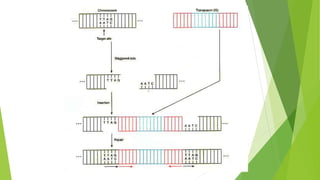
When a transposable element is inserted into a host
genome, a small segment of the host DNA (usually 4-12
bp) is duplicated at the insertion site.
• Most TEs are broken (cannot transpose; “fossils”).
• Active TEs evolved to insert into “safe-havens.”
• Host regulates TE movement.
• TEs can provide advantages.
How do organisms live with
TEs?
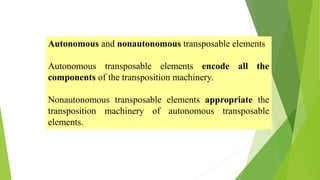
Autonomous and nonautonomous transposable elements
Autonomous transposable elements encode all the
components of the transposition machinery.
Nonautonomous transposable elements appropriate the
transposition machinery of autonomous transposable
elements.
Active and fossil transposable elements
A transposable element is defined as active if it contains
all the necessary sequence elements for either
autonomous or nonautonomous transposition.
Active elements may be rendered defective by different
types of mutation, in which case they are referred to as
fossil transposable elements.
Active and fossil transposable elements
A transposable-element family may contain different
combinations of active autonomous, active
nonautonomous, fossil autonomous, and fossil
nonautonomous transposable elements.
For example, the human genome contains approximately
50,000 fossil autonomous and 200,000 fossil
nonautonomous DNA transposons.
Intriguingly, the human genome seems to contain NO
active DNA transposons.
What are Transposons?
Transposons make up the major content of eukaryotic genomes
• ~50% of the genomes of human, chimp, mouse, ape
• ~75% of the maize genome
• ~85% of the barley genome
• ~98% of the iris genome
Iris brevicaulis Iris fulva
According to the numbers and kinds of
genes they contain, DNA-mediated
transposable elements are divided into
insertion sequences and transposons.
Autonomous
element
Nonautonomous
elements
Gene(
s)
• Plant genomes contain multiple transposon families.
• Each contains autonomous and non-autonomous elements.
• Class I transposons do not move, but are being copied.
• Class II transposons move, but can undergo copying, too (if
transposing during DNA replication)
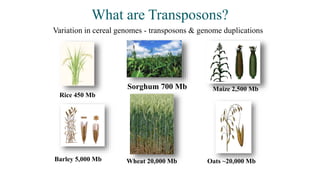
What are Transposons?
Sorghum 700 Mb
Barley 5,000 Mb
Maize 2,500 Mb
Oats ~20,000 Mb
Wheat 20,000 Mb
Rice 450 Mb
Variation in cereal genomes - transposons & genome duplications
What are Transposons?
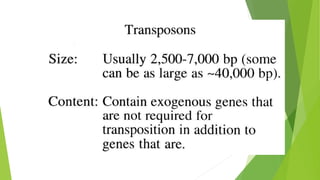
 Transposons and insertion sequences are known as mobile genetic elements.
 Transposons contain genes unrelated to the transposition of the genetic
material from one cell to another.
 For example, Class 1 transposons encode drug resistance genes.
 In contrast, insertion sequences encode only the functions involved in their
insertion into chromosomal DNA.
 Both transposons and insertion sequences can induce changes in chromosomal
DNA upon their exiting and insertions, and so can generate mutations.
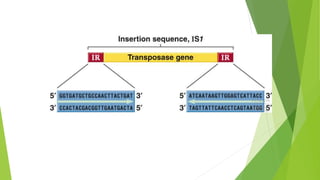
 An insertion sequence (also known as an IS, an insertion sequence element, or an IS
element) is a short DNA sequence that acts as a simple transposable element.
 Insertion sequences have two major characteristics: they are small relative to other transposable
elements and only code for proteins implicated in the transposition activity.
 They are thus different from transposons, which also carry accessory genes such as antibiotic resistance
genes.
26
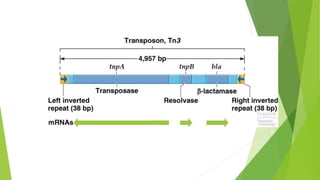
Hypercomposite transposons contain two or
more transposons.
Composite
Transposons
 Fall into two general classes with respect to how they move.
 The other class are related to retroviruses in that they
encode a reverse transcriptase for making DNA copies of
their RNA transcripts, which then integrate at new sites in
the genome. (Class I)
 Found only in eukaryotes.
 One class encodes proteins that move the DNA element
directly to a new position or replicate the DNA. (Class II)
 Found in both prokaryotes and eukaryotes
27
Transposons
Transposons

Transposons

  • 1.
  • 2.
     The NobelPrize in Physiology or Medicine 1983 was awarded to Barbara McClintock "for her discovery of mobile genetic elements". Barbara McClintock
  • 3.
    Transposition = themovement of genetic information from one chromosomal location, the donor site, to another, the target site.
  • 4.
    DNA sequences thatcan change their genomic location intragenomically either autonomously or non-autonomously are called transposable elements.
  • 5.
  • 6.
    6 Transposition may bereplicative or conservative. Replicative transposition will result in two copies of the element, one at the donor site and one at the target site. Following conservative transposition the transposable element will only be found at the target site, with no change in copy number.
  • 7.
    7 When a transposableelement is inserted into a host genome, a small segment of the host DNA (usually 4-12 bp) is duplicated at the insertion site.
  • 9.
    • Most TEsare broken (cannot transpose; “fossils”). • Active TEs evolved to insert into “safe-havens.” • Host regulates TE movement. • TEs can provide advantages. How do organisms live with TEs?
  • 10.
    Autonomous and nonautonomoustransposable elements Autonomous transposable elements encode all the components of the transposition machinery. Nonautonomous transposable elements appropriate the transposition machinery of autonomous transposable elements.
  • 11.
    Active and fossiltransposable elements A transposable element is defined as active if it contains all the necessary sequence elements for either autonomous or nonautonomous transposition. Active elements may be rendered defective by different types of mutation, in which case they are referred to as fossil transposable elements.
  • 12.
    Active and fossiltransposable elements A transposable-element family may contain different combinations of active autonomous, active nonautonomous, fossil autonomous, and fossil nonautonomous transposable elements. For example, the human genome contains approximately 50,000 fossil autonomous and 200,000 fossil nonautonomous DNA transposons. Intriguingly, the human genome seems to contain NO active DNA transposons.
  • 13.
    What are Transposons? Transposonsmake up the major content of eukaryotic genomes • ~50% of the genomes of human, chimp, mouse, ape • ~75% of the maize genome • ~85% of the barley genome • ~98% of the iris genome Iris brevicaulis Iris fulva
  • 14.
    According to thenumbers and kinds of genes they contain, DNA-mediated transposable elements are divided into insertion sequences and transposons.
  • 17.
    Autonomous element Nonautonomous elements Gene( s) • Plant genomescontain multiple transposon families. • Each contains autonomous and non-autonomous elements. • Class I transposons do not move, but are being copied. • Class II transposons move, but can undergo copying, too (if transposing during DNA replication) What are Transposons?
  • 18.
    Sorghum 700 Mb Barley5,000 Mb Maize 2,500 Mb Oats ~20,000 Mb Wheat 20,000 Mb Rice 450 Mb Variation in cereal genomes - transposons & genome duplications What are Transposons?
  • 19.
     Transposons andinsertion sequences are known as mobile genetic elements.  Transposons contain genes unrelated to the transposition of the genetic material from one cell to another.  For example, Class 1 transposons encode drug resistance genes.  In contrast, insertion sequences encode only the functions involved in their insertion into chromosomal DNA.
  • 20.
     Both transposonsand insertion sequences can induce changes in chromosomal DNA upon their exiting and insertions, and so can generate mutations.
  • 23.
     An insertionsequence (also known as an IS, an insertion sequence element, or an IS element) is a short DNA sequence that acts as a simple transposable element.  Insertion sequences have two major characteristics: they are small relative to other transposable elements and only code for proteins implicated in the transposition activity.  They are thus different from transposons, which also carry accessory genes such as antibiotic resistance genes.
  • 26.
    26 Hypercomposite transposons containtwo or more transposons. Composite
  • 27.
    Transposons  Fall intotwo general classes with respect to how they move.  The other class are related to retroviruses in that they encode a reverse transcriptase for making DNA copies of their RNA transcripts, which then integrate at new sites in the genome. (Class I)  Found only in eukaryotes.  One class encodes proteins that move the DNA element directly to a new position or replicate the DNA. (Class II)  Found in both prokaryotes and eukaryotes 27