Transposons
DNA transposons are DNA sequences, sometimes referred to "jumping genes", that
can move and integrate to different locations within the genome. They are class
II transposable elements (TEs) that move through a DNA intermediate, as opposed to
class I TEs, retrotransposons, that move through an RNA intermediate.
DNA transposons can move in the DNA of an organism via a single-or double-stranded
DNA intermediate.
DNA transposons have been found in both prokaryotic and eukaryotic organisms. They
can make up a significant portion of an organism's genome, particularly in eukaryotes.
In prokaryotes, TE's can facilitate the horizontal transfer of antibiotic resistance or
other genes associated with virulence. After replicating and propagating in a host, all
transposon copies become inactivated and are lost unless the transposon passes to a
genome by starting a new life cycle with horizontal transfer.
It is important to note that DNA transposons do not randomly insert themselves into
the genome, but rather show preference for specific sites. With regard to movement,
DNA transposons can be categorized as autonomous and nonautonomous.
Autonomous ones can move on their own, while nonautonomous ones require the
presence of another transposable element's gene, transposase, to move. There are
three main classifications for movement for DNA transposons: "cut and paste,"
"rolling circle" (Helitrons), and "self-synthesizing" (Polintons). These distinct
mechanisms of movement allow them to move around the genome of an organism.
Since DNA transposons cannot synthesize DNA, they replicate using the host
replication machinery. These three main classes are then further broken down into 23
different superfamilies characterized by their structure, sequence, and mechanism of
action.
DNA transposons are a cause of gene expression alterations. As newly inserted DNA
into active coding sequences, they can disrupt normal protein functions and cause
mutations. Class II TEs make up about 3% of the human genome. Today, there are no
active DNA transposons in the human genome. Therefore, the elements found in the
human genome are called fossils.
MECHANISM OF ACTION
CUT AND PASTE MECHANISM
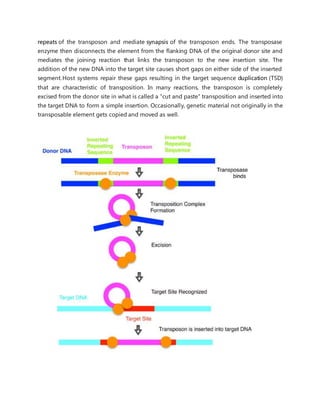
Traditionally, DNA transposons move around in the genome by a cut and paste method. The
system requires a transposase enzyme that catalyzes the movement of the DNA from its
current location in the genome and inserts it in a new location. Transposition requires
three DNA sites on the transposon: two at each end of the transposon called terminal
inverted repeats and one at the target site. The transposase will bind to the terminal inverted
repeats of the transposon and mediate synapsis of the transposon ends. The transposase
enzyme then disconnects the element from the flanking DNA of the original donor site and
mediates the joining reaction that links the transposon to the new insertion site. The
addition of the new DNA into the target site causes short gaps on either side of the inserted
segment.Host systems repair these gaps resulting in the target sequence duplication (TSD)
that are characteristic of transposition. In many reactions, the transposon is completely
excised from the donor site in what is called a "cut and paste" transposition and inserted into
the target DNA to form a simple insertion. Occasionally, genetic material not originally in the
transposable element gets copied and moved as well.
HELITRONS
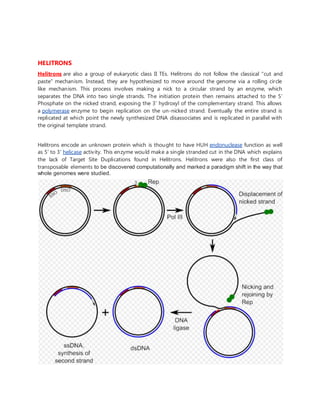
Helitrons are also a group of eukaryotic class II TEs. Helitrons do not follow the classical "cut and
paste" mechanism. Instead, they are hypothesized to move around the genome via a rolling circle
like mechanism. This process involves making a nick to a circular strand by an enzyme, which
separates the DNA into two single strands. The initiation protein then remains attached to the 5'
Phosphate on the nicked strand, exposing the 3' hydroxyl of the complementary strand. This allows
a polymerase enzyme to begin replication on the un-nicked strand. Eventually the entire strand is
replicated at which point the newly synthesized DNA disassociates and is replicated in parallel with
the original template strand.
Helitrons encode an unknown protein which is thought to have HUH endonuclease function as well
as 5' to 3' helicase activity. This enzyme would make a single stranded cut in the DNA which explains
the lack of Target Site Duplications found in Helitrons. Helitrons were also the first class of
transposable elements to be discovered computationally and marked a paradigm shift in the way that
whole genomes were studied.
Rolling circle replication of a circular DNA plasmid.
POLITRONS
Polintons are also a group of eukaryotic class II TEs. As one of the most complex known
DNA transposons in eukaryotes, they make up the genomes of protists, fungi, and animals, such as
the entamoeba, soybean rust, and chicken, respectively.
They contain genes with homology to viral proteins and which are often found in eukaryotic genomes,
like polymerase and retroviral integrase. However, there is no known protein functionally similarly to the
viral capsid or envelope proteins. They share their many structural characteristics with
linear plasmids, bacteriophages and adenoviruses, which replicate using protein-primed DNA
polymerases.
Polintons have been proposed to go through a similar self-synthesis by their polymerase. Polintons, 15–
20 kb long, encode up to 10 individual proteins. For replication, they utilize a protein-primed DNA
polymerase B, retroviral integrase, cysteine protease, and ATPase.
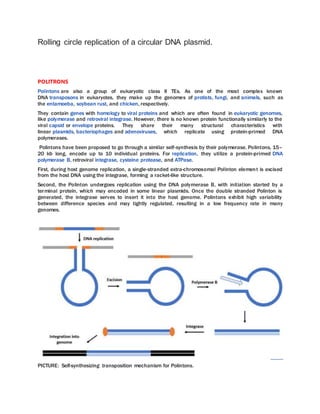
First, during host genome replication, a single-stranded extra-chromosomal Polinton element is excised
from the host DNA using the integrase, forming a racket-like structure.
Second, the Polinton undergoes replication using the DNA polymerase B, with initiation started by a
terminal protein, which may encoded in some linear plasmids. Once the double stranded Polinton is
generated, the integrase serves to insert it into the host genome. Polintons exhibit high variability
between difference species and may tightly regulated, resulting in a low frequency rate in many
genomes.
PICTURE: Self-synthesizing transposition mechanism for Polintons.

STRUCTURE OF TRANSPOSONS.docx

  • 1.
    Transposons DNA transposons areDNA sequences, sometimes referred to "jumping genes", that can move and integrate to different locations within the genome. They are class II transposable elements (TEs) that move through a DNA intermediate, as opposed to class I TEs, retrotransposons, that move through an RNA intermediate. DNA transposons can move in the DNA of an organism via a single-or double-stranded DNA intermediate. DNA transposons have been found in both prokaryotic and eukaryotic organisms. They can make up a significant portion of an organism's genome, particularly in eukaryotes. In prokaryotes, TE's can facilitate the horizontal transfer of antibiotic resistance or other genes associated with virulence. After replicating and propagating in a host, all transposon copies become inactivated and are lost unless the transposon passes to a genome by starting a new life cycle with horizontal transfer. It is important to note that DNA transposons do not randomly insert themselves into the genome, but rather show preference for specific sites. With regard to movement, DNA transposons can be categorized as autonomous and nonautonomous. Autonomous ones can move on their own, while nonautonomous ones require the presence of another transposable element's gene, transposase, to move. There are three main classifications for movement for DNA transposons: "cut and paste," "rolling circle" (Helitrons), and "self-synthesizing" (Polintons). These distinct mechanisms of movement allow them to move around the genome of an organism. Since DNA transposons cannot synthesize DNA, they replicate using the host replication machinery. These three main classes are then further broken down into 23 different superfamilies characterized by their structure, sequence, and mechanism of action. DNA transposons are a cause of gene expression alterations. As newly inserted DNA into active coding sequences, they can disrupt normal protein functions and cause mutations. Class II TEs make up about 3% of the human genome. Today, there are no active DNA transposons in the human genome. Therefore, the elements found in the human genome are called fossils. MECHANISM OF ACTION CUT AND PASTE MECHANISM Traditionally, DNA transposons move around in the genome by a cut and paste method. The system requires a transposase enzyme that catalyzes the movement of the DNA from its current location in the genome and inserts it in a new location. Transposition requires three DNA sites on the transposon: two at each end of the transposon called terminal inverted repeats and one at the target site. The transposase will bind to the terminal inverted
  • 2.
    repeats of thetransposon and mediate synapsis of the transposon ends. The transposase enzyme then disconnects the element from the flanking DNA of the original donor site and mediates the joining reaction that links the transposon to the new insertion site. The addition of the new DNA into the target site causes short gaps on either side of the inserted segment.Host systems repair these gaps resulting in the target sequence duplication (TSD) that are characteristic of transposition. In many reactions, the transposon is completely excised from the donor site in what is called a "cut and paste" transposition and inserted into the target DNA to form a simple insertion. Occasionally, genetic material not originally in the transposable element gets copied and moved as well.
  • 3.
    HELITRONS Helitrons are alsoa group of eukaryotic class II TEs. Helitrons do not follow the classical "cut and paste" mechanism. Instead, they are hypothesized to move around the genome via a rolling circle like mechanism. This process involves making a nick to a circular strand by an enzyme, which separates the DNA into two single strands. The initiation protein then remains attached to the 5' Phosphate on the nicked strand, exposing the 3' hydroxyl of the complementary strand. This allows a polymerase enzyme to begin replication on the un-nicked strand. Eventually the entire strand is replicated at which point the newly synthesized DNA disassociates and is replicated in parallel with the original template strand. Helitrons encode an unknown protein which is thought to have HUH endonuclease function as well as 5' to 3' helicase activity. This enzyme would make a single stranded cut in the DNA which explains the lack of Target Site Duplications found in Helitrons. Helitrons were also the first class of transposable elements to be discovered computationally and marked a paradigm shift in the way that whole genomes were studied.
  • 4.
    Rolling circle replicationof a circular DNA plasmid. POLITRONS Polintons are also a group of eukaryotic class II TEs. As one of the most complex known DNA transposons in eukaryotes, they make up the genomes of protists, fungi, and animals, such as the entamoeba, soybean rust, and chicken, respectively. They contain genes with homology to viral proteins and which are often found in eukaryotic genomes, like polymerase and retroviral integrase. However, there is no known protein functionally similarly to the viral capsid or envelope proteins. They share their many structural characteristics with linear plasmids, bacteriophages and adenoviruses, which replicate using protein-primed DNA polymerases. Polintons have been proposed to go through a similar self-synthesis by their polymerase. Polintons, 15– 20 kb long, encode up to 10 individual proteins. For replication, they utilize a protein-primed DNA polymerase B, retroviral integrase, cysteine protease, and ATPase. First, during host genome replication, a single-stranded extra-chromosomal Polinton element is excised from the host DNA using the integrase, forming a racket-like structure. Second, the Polinton undergoes replication using the DNA polymerase B, with initiation started by a terminal protein, which may encoded in some linear plasmids. Once the double stranded Polinton is generated, the integrase serves to insert it into the host genome. Polintons exhibit high variability between difference species and may tightly regulated, resulting in a low frequency rate in many genomes. PICTURE: Self-synthesizing transposition mechanism for Polintons.