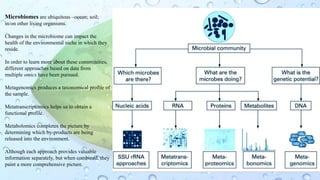

Microbiomes are ubiquitous –ocean; soil;
in/on other living organisms.
Changes in the microbiome can impact the
health of the environmental niche in which they
reside.
In order to learn more about these communities,
different approaches based on data from
multiple omics have been pursued.
Metagenomics produces a taxonomical profile of
the sample.
Metatranscriptomics helps us to obtain a
functional profile.
Metabolomics completes the picture by
determining which by-products are being
released into the environment.
Although each approach provides valuable
information separately, but when combined, they
paint a more comprehensive picture.
Metagenomics
• Only 1% microbes culturable – metagenomics bypasses the need
for isolation or cultivation of microbes . It allows:
functional and sequence-based analysis of collective microbial
communities inhabiting any habitat
• extreme and inhospitable environments- solfataric hot springs, hypersaline
basins and glacier ice, Antarctic desert, ground water
determination and comparison the biological diversity and the
functional activity of different microbial communities.
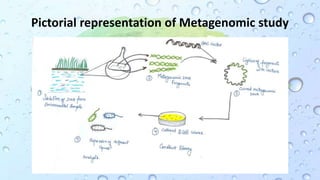
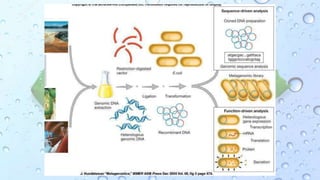
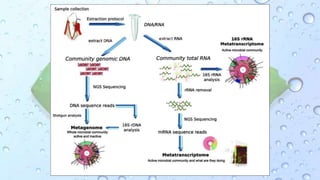
Pictorial representation of Metagenomic study
• Technological advances has allowed mapping of microbial
community metabolism onto environmental processes
• Genomes in the context of environment
Metagenomics
• “The application of modern genomics techniques to the study of
communities of microbial organisms directly in their natural environments,
bypassing the need for isolation and lab cultivation of individual species” -
Kevin Chen and Lior Pachter
• Study of metagenomes, genetic material recovered directly from
environmental samples.
• Also referred to as Environmental Genomics, Ecogenomics, or Community
Genomics.
• The term "metagenomics" was first used by Jo Handelsman, Jon Clardy,
Robert M. Goodman, and others, and first appeared in publication in 1998.
Types of Metagenomics
There are two basic types of Metagenomics studies:
1. Sequence-based Metagenomics
– involves sequencing and analysis of DNA from environmental
samples
2. Function-based Metagenomics
– involves screening for a particular function or activity
Sequence-based screening
• Design of DNA probes or primer from already known sequences.
• Novel variant of already known genes can be identified- genes
encoding dioxygenases, hydrazine oxido reductase, chitinase and
glycerol dehydratases.
• Gene targeted metagenomics- PCR based sequencing combined
with NGS sequence information to recover full length versions of
selected genes.
Sequence-based screening
• DNA from the environment of interest is sequenced and
subjected to computational analysis.
• The metagenomic sequences are compared to sequences
deposited in publicly available databases such as GENBANK.
• The genes are then collected into groups of similar predicted
function, and the distribution of various functions and types of
proteins that conduct those functions can be assessed.
Function-based screening
• No sequence information required.
Approaches–
• phenotypic detection
• Heterologous complementation
• Induced gene expression
• Substrate induced gene expression screening (SIGEX)
• Product induced gene expression (PIGEX)
• Metabolite-regulated expression (METREX)
Function-based screening
• The DNA extracted from the environment is also captured and
stored in a surrogate host, but instead of sequencing it,
scientists screen the captured fragments of DNA, or ‘clones’,
for a certain function.
• The function must be absent in the surrogate host so that
acquisition of the function can be attributed to the
metagenomic DNA.
LIMITATIONS OF TWO APPROACHES
• The sequence driven approach
– limited existing knowledge: if a metagenomic gene does not look like a
gene of known function deposited in the databases, then little can be
learned about the gene or its product from sequence alone.
• The function driven approach
– most genes from organisms in wild communities cannot be expressed
easily by a given surrogate host.
• Therefore, the two approaches are complementary and should be
pursued in parallel.
Applications of Metagenomics
Successful products
– Antibiotics
– Antibiotic resistance pathways
– Anti-cancer drugs
Degradation pathways
– Lipases, amylases, nucleases, haemolytic
Transport proteins
FUTURE OF METAGENOMICS
• To identify new enzymes and antibiotics.
• To assess the effects of age, diet, and pathologic states (e.g., inflammatory bowel diseases, obesity, and cancer)
on the distal gut microbiome of humans living in different environments.
• Study of more exotic habitats.
• Study antibiotic resistance in soil microbes.
• Improved bioinformatics will quicken analysis for library profiling.
• Investigating ancient DNA remnants.
• Discoveries such as phylogenic tags (rRNA genes, etc) will give momentum to the growing field.
• Learning novel pathways will lead to knowledge about the current nonculturable bacteria to then culture these
systems.
COMMUNITY TRANSCRIPTOMICS
• Also know as Metatranscriptomics.
• Metabolic and functional capacity of a microbial community.
• The complete collection of transcribed sequences in a microbial community:
– Protein coding RNA (mRNA)
– Non-coding RNA (rRNA, tRNA, regulatory RNA, etc.)
• Metatranscriptomics studies:
– Community functions
– Response to different environments
– Regulation of gene expression
Limitations
• processing of environmental RNA samples
• recovery of high-quality mRNA from environmental samples
• short half-lives of mRNA species
• separation of mRNA from other RNA species
• non coverage of low abundance transcript leading to non detection
Direct cDNA sequencing employing next-generation sequencing
technologies is practised.
METAPROTEOMICS
• The proteomic analysis of mixed microbial communities to assess
the immediate catalytic potential of a microbial community.
• Detect and identify all proteins produced by a complex
environmental microbial community.
• Has a huge potential to link the genetic diversity and activities of
microbial communities with their impact on ecosystem function.
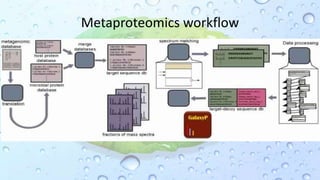
Metaproteomics workflow
Applications
• Diversity patterns of microorganisms can be used for monitoring and predicting
environmental conditions and change.
• Genes/operons for desirable enzyme candidates (cellulases, chitinases, lipases,
antibiotics, other natural products of industrial or medical applications.
• Examining secretory, regulatory and signal transduction mechanisms associated
with samples or genes of interest.
• Examining potential lateral gene transfer events. Knowledge of genome plasticity
may give us an idea of selective pressures for gene capture and evolution within
a habitat
• Allow identification of novel metabolic pathways.
• Directed approach towards designing culture media for the growth of
previously uncultured microbes.
• Identification of genes that predominate in a given environment compared
to others.
• Designing low- and high-throughput experiments focused on defining the
roles of genes and microorganisms in the establishment of a dynamic
microbial community
Limitations
• Often fragmentary
• Often highly divergent
• Rarely any known activity
• No chromosomal placement
• No organism of origin
• Ab initio ORF predictions
• Huge data
• Computationally bioinformatics tools not very easy
• Substantial database biases toward model organisms
Metatranscriptomics and Metaproteomics have the potential to
improve understanding the functional dynamics of microbial
communities.
Improve our understanding of ecosystem functions of microbial
communities.
Molecular analysis of Microbial Community

Molecular analysis of Microbial Community

  • 2.
    Microbiomes are ubiquitous–ocean; soil; in/on other living organisms. Changes in the microbiome can impact the health of the environmental niche in which they reside. In order to learn more about these communities, different approaches based on data from multiple omics have been pursued. Metagenomics produces a taxonomical profile of the sample. Metatranscriptomics helps us to obtain a functional profile. Metabolomics completes the picture by determining which by-products are being released into the environment. Although each approach provides valuable information separately, but when combined, they paint a more comprehensive picture.
  • 3.
    Metagenomics • Only 1%microbes culturable – metagenomics bypasses the need for isolation or cultivation of microbes . It allows: functional and sequence-based analysis of collective microbial communities inhabiting any habitat • extreme and inhospitable environments- solfataric hot springs, hypersaline basins and glacier ice, Antarctic desert, ground water determination and comparison the biological diversity and the functional activity of different microbial communities.
  • 4.
    Pictorial representation ofMetagenomic study
  • 5.
    • Technological advanceshas allowed mapping of microbial community metabolism onto environmental processes • Genomes in the context of environment
  • 6.
    Metagenomics • “The applicationof modern genomics techniques to the study of communities of microbial organisms directly in their natural environments, bypassing the need for isolation and lab cultivation of individual species” - Kevin Chen and Lior Pachter • Study of metagenomes, genetic material recovered directly from environmental samples. • Also referred to as Environmental Genomics, Ecogenomics, or Community Genomics. • The term "metagenomics" was first used by Jo Handelsman, Jon Clardy, Robert M. Goodman, and others, and first appeared in publication in 1998.
  • 7.
    Types of Metagenomics Thereare two basic types of Metagenomics studies: 1. Sequence-based Metagenomics – involves sequencing and analysis of DNA from environmental samples 2. Function-based Metagenomics – involves screening for a particular function or activity
  • 9.
    Sequence-based screening • Designof DNA probes or primer from already known sequences. • Novel variant of already known genes can be identified- genes encoding dioxygenases, hydrazine oxido reductase, chitinase and glycerol dehydratases. • Gene targeted metagenomics- PCR based sequencing combined with NGS sequence information to recover full length versions of selected genes.
  • 10.
    Sequence-based screening • DNAfrom the environment of interest is sequenced and subjected to computational analysis. • The metagenomic sequences are compared to sequences deposited in publicly available databases such as GENBANK. • The genes are then collected into groups of similar predicted function, and the distribution of various functions and types of proteins that conduct those functions can be assessed.
  • 11.
    Function-based screening • Nosequence information required. Approaches– • phenotypic detection • Heterologous complementation • Induced gene expression • Substrate induced gene expression screening (SIGEX) • Product induced gene expression (PIGEX) • Metabolite-regulated expression (METREX)
  • 12.
    Function-based screening • TheDNA extracted from the environment is also captured and stored in a surrogate host, but instead of sequencing it, scientists screen the captured fragments of DNA, or ‘clones’, for a certain function. • The function must be absent in the surrogate host so that acquisition of the function can be attributed to the metagenomic DNA.
  • 13.
    LIMITATIONS OF TWOAPPROACHES • The sequence driven approach – limited existing knowledge: if a metagenomic gene does not look like a gene of known function deposited in the databases, then little can be learned about the gene or its product from sequence alone. • The function driven approach – most genes from organisms in wild communities cannot be expressed easily by a given surrogate host. • Therefore, the two approaches are complementary and should be pursued in parallel.
  • 14.
    Applications of Metagenomics Successfulproducts – Antibiotics – Antibiotic resistance pathways – Anti-cancer drugs Degradation pathways – Lipases, amylases, nucleases, haemolytic Transport proteins
  • 15.
    FUTURE OF METAGENOMICS •To identify new enzymes and antibiotics. • To assess the effects of age, diet, and pathologic states (e.g., inflammatory bowel diseases, obesity, and cancer) on the distal gut microbiome of humans living in different environments. • Study of more exotic habitats. • Study antibiotic resistance in soil microbes. • Improved bioinformatics will quicken analysis for library profiling. • Investigating ancient DNA remnants. • Discoveries such as phylogenic tags (rRNA genes, etc) will give momentum to the growing field. • Learning novel pathways will lead to knowledge about the current nonculturable bacteria to then culture these systems.
  • 16.
    COMMUNITY TRANSCRIPTOMICS • Alsoknow as Metatranscriptomics. • Metabolic and functional capacity of a microbial community. • The complete collection of transcribed sequences in a microbial community: – Protein coding RNA (mRNA) – Non-coding RNA (rRNA, tRNA, regulatory RNA, etc.) • Metatranscriptomics studies: – Community functions – Response to different environments – Regulation of gene expression
  • 18.
    Limitations • processing ofenvironmental RNA samples • recovery of high-quality mRNA from environmental samples • short half-lives of mRNA species • separation of mRNA from other RNA species • non coverage of low abundance transcript leading to non detection Direct cDNA sequencing employing next-generation sequencing technologies is practised.
  • 19.
    METAPROTEOMICS • The proteomicanalysis of mixed microbial communities to assess the immediate catalytic potential of a microbial community. • Detect and identify all proteins produced by a complex environmental microbial community. • Has a huge potential to link the genetic diversity and activities of microbial communities with their impact on ecosystem function.
  • 20.
  • 21.
    Applications • Diversity patternsof microorganisms can be used for monitoring and predicting environmental conditions and change. • Genes/operons for desirable enzyme candidates (cellulases, chitinases, lipases, antibiotics, other natural products of industrial or medical applications. • Examining secretory, regulatory and signal transduction mechanisms associated with samples or genes of interest. • Examining potential lateral gene transfer events. Knowledge of genome plasticity may give us an idea of selective pressures for gene capture and evolution within a habitat
  • 22.
    • Allow identificationof novel metabolic pathways. • Directed approach towards designing culture media for the growth of previously uncultured microbes. • Identification of genes that predominate in a given environment compared to others. • Designing low- and high-throughput experiments focused on defining the roles of genes and microorganisms in the establishment of a dynamic microbial community
  • 23.
    Limitations • Often fragmentary •Often highly divergent • Rarely any known activity • No chromosomal placement • No organism of origin • Ab initio ORF predictions • Huge data • Computationally bioinformatics tools not very easy • Substantial database biases toward model organisms
  • 24.
    Metatranscriptomics and Metaproteomicshave the potential to improve understanding the functional dynamics of microbial communities. Improve our understanding of ecosystem functions of microbial communities.

Editor's Notes

  • #2 Impact Factor- 5.715 This work was supported by the State of Mexico University
  • #3 Small subunit ribosomal ribonucleic acid (SSU rRNA)
  • #4 Solfataric: relating to, caused by, or denoting the transfer of mineral substances within the earth by sublimation or by the chemical and transporting action of steam.
  • #5 bacterial artificial chromosome (BAC)
  • #7 Metagenomics defined as “the genomics analysis of microorganism by direct extraction and cloning DNA from an assemblage of microorganism.” In Greek, meta means “transcendent” (combination of separate analysis) Genomics refers to the study of the genome.
  • #10 Next-Generation Sequencing (NGS)
  • #19 Complementary DNA (cDNA) is DNA synthesized from a single-stranded RNA (e.g., messenger RNA (mRNA) or microRNA) template in a reaction catalyzed by the enzyme reverse transcriptase. cDNA is often used to clone eukaryotic genes in prokaryotes.
  • #24 Ab Initio Gene Prediction. A method in which genomic DNA is systematically searched for potential coding genes, based on signal detection—which indicates the presence of coding regions in the vicinity—and prediction, based on the sequence information only.