TRANSFER RNA (tRNA)
By
Dr. Ichha Purak
University Professor
Department of Botany
Ranchi Women’s College,Ranchi
http://www.dripurak.com
Robert Holley (1965) and his colleagues were the first to deduce base
sequence of Yeast Alanine transfer RNA which possess Anticodon IGC.
The anticodon IGC can recognize three codons for Alanine (GCA, GCU, and
GCC).
Holley received the 1968 Nobel Prize for this work .The structure was
represented as the cloverleaf conformation in which intrastrand base pairing is
maximal. This tRNA has 76 nucleotides.
It has high content of unusual bases e.g. Inosine (I) Psuedouridine
(ψ),Dihydrouridine (D), Ribothymidine (T), methyle Guanosine (m2G,) and
methyle Inosine(m1I) .
Intrastrand base pairing shows Watson-Crick base pair pattern. In RNAs,
guanosine is often base-paired with uridine, although the G=U pair is not as
stable as the Watson-Crick G≡C pair.
HISTORY
Figure : Lehninger,Principles of Biochemistry
Nucleotide sequence of yeast tRNAAla
TRANSFER RNA (tRNA ) or Soluble RNA
Transfer RNA is a small RNA chain (73-95 nucleotides ) that transfers a
specific amino acid to a growing polypeptide chain at ribosome during
translation.
It acts as a adapter molecule because it can recognise both a specific
Amino Acid as well as its codon on mRNA. For loading 20 different protein
Amino Acids there are different tRNAs.(1-20)
It acquires a clover shaped three dimensional structure due to having
many unusual or minor bases
It is single stranded but is folded on itself and has some helical regions
and some loops.
All tRNAs share some common features :
4
Appendix
3/18/2022
5
Appendix
3/18/2022
tRNA has a tertiary structure that is L-shaped. one end attaches
to the amino acid and the other binds to the mRNA by a 3-base
complimentary sequence Anticodon
Pairing relationship of codon and anticodon.
Alignment of the two RNAs is antiparallel.
The tRNA is shown in the traditional cloverleaf configuration.
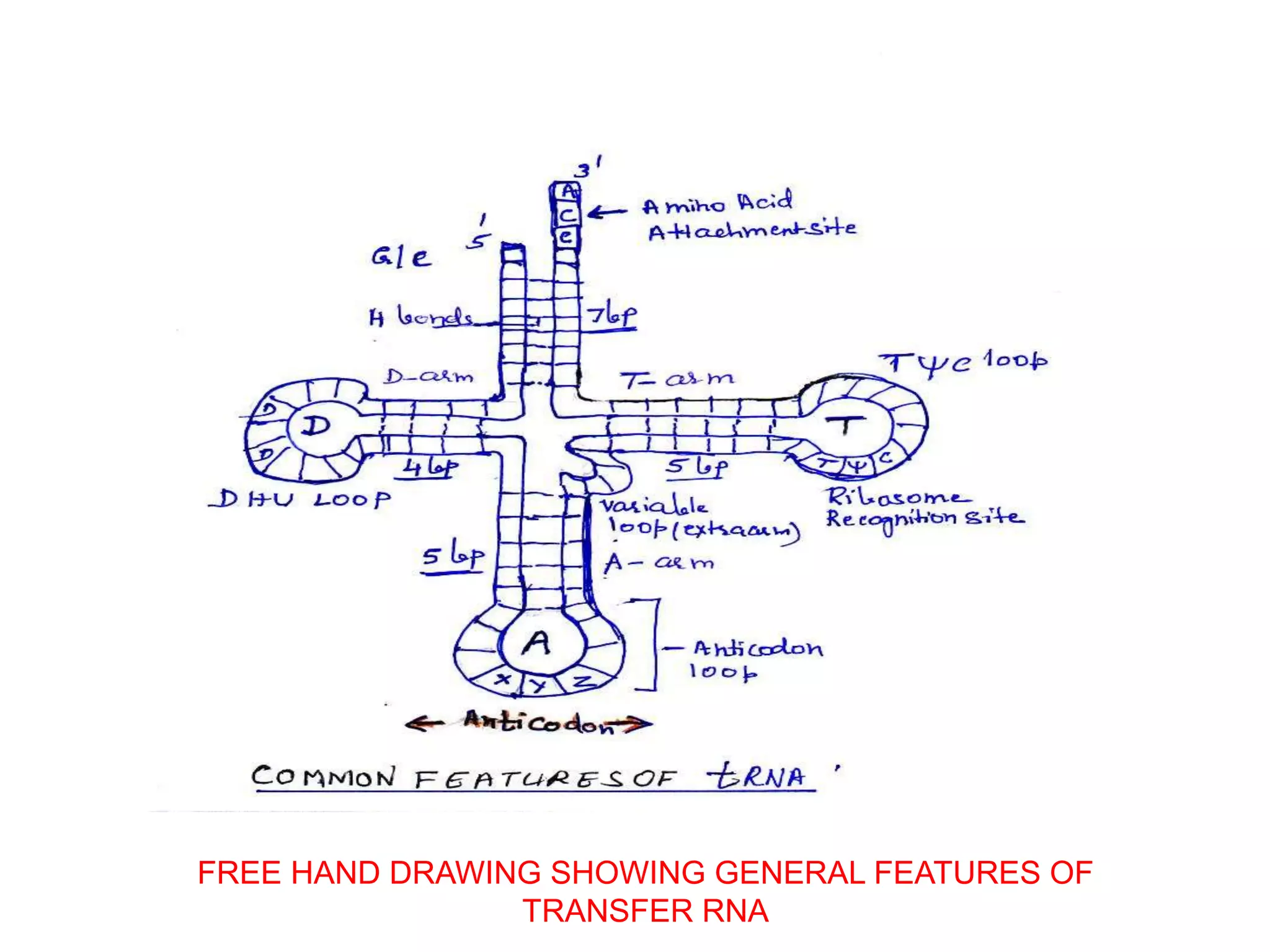
FREE HAND DRAWING SHOWING GENERAL FEATURES OF
TRANSFER RNA
• tRNAs are single stranded RNA having 73-95 ribonucleotides
• Many unusual bases are present. Some bases are methylated
• 5’ end generally has Guanine (80%) or Cytosine ( 20% )
• Base sequence at 3’end is CCA. The activated Amino Acid is attached to 3’OH
group of ribose of terminal Adenosine
• About half nucleotides in tRNA molecule form helical structures by
complementary base pairing forming 4 arms
• Group of unpaired bases form a loop TψC loop at the end of T 5 bp arm
• The anticodon arm is a 5-bp stem whose loop contains the Anticodon
• The Anticodon loop has 7 bases with following sequence
• 5’ Py-Py –X-Y-Z- Modified Pu- variable bases 3’. X-Y-Z act as Anticodon and is
variable
• There is an extra or variable arm
8
Appendix
3/18/2022
• A 4 bp D arm ends in DHU loop ,to this loop amino acyl synthetase
enzyme binds. This loop has several dihydrouracil residues
tRNAs have following Recognition sites
 Amino Acid attachment site at 3’end CCA terminity
 Ribosome Recognition site (TψC ) loop
 The Anticodon site 3 middle unpaired bases X-Y-Z form Anticodon
. By presence of Anticodon tRNA recognises complmentary codon on
mRNA and is also able to pick up specific Amino Acid
 Enzyme Recognition site ( DHU loop )
 Variable loop or Extra Arm ( Its function is yet not known )
9
Appendix
3/18/2022
Amino Acid binds to 3’CCA terminity by establishing ester bond between
COOH group of Amino Acid and OH of Ribose of Adenine
The crystal structure of tRNA elucidates other important
points:
tRNAs all have an inverted L structure
tRNAs have conserved structural features: 5'P, D arm, anticodon arm, variable
arm, TyC arm, 3' amino acid acceptor stem
tRNAs contain unusual bases
tRNAs are made up of a single chain of RNA yet have considerable tertiary
structure arising from base pairing within the chain
there are several non-Watson-Crick base pairs that take part in cross-linking
tRNAs are narrow so as to be able to sit next to one another on adjacent
mRNA codons in the P and A sites
the anticodon arm and amino acid acceptor stems are solvent accessible
regions of the molecule
Anticodon showing 3rd Nucleotide
giving Wobble nature
Only the first 2 nucleotides in the tRNA anticodon loop are strictly
required for the decoding of the mRNA codon into an amino acid. The
third nucleotide in the anticodon is less stringent in its base-pairing to the
codon, and is referred to as the "wobble" base. Since the genetic code is
degenerate, meaning that more than one codon can specify a single
amino acid, the anticodon of tRNA can pair with more than one mRNA
codon and still be specific for a single amino acid.
The diagram represents a single stranded transfer
RNA molecule. The dots represent the nucelotides of
the RNA. The three red dots at the bottom represent
the anticondon region of the RNA. The region depicted
by the green dots represent the place on the tRNA
where the amino acids form a covalent bond with the
transfer RNA.
Symbolic
representation of
tRNA
General cloverleaf secondary
structure of tRNAs
The large dots on the backbone
represent nucleotide residues
The blue lines represent base
pairs.
 Residues common to all tRNAs
are shaded in pink
Transfer RNAs vary in length
from 73 to 93 nucleotides.
 Extra nucleotides occur in the
extra arm or in the D arm.
 At the end of the anticodon arm
is the anticodon loop, which
always contains seven unpaired
nucleotides.
 The D arm contains two or
three D (5,6-dihydrouridine)
residues, depending on the
tRNA.
 In some tRNAs, the D arm has
only three hydrogen-bonded
base pairs.
tRNA loaded with Amino Acid Phenylalanine has
Anticodon AAA and so can recognise the codon UUU on
messenger RNA during Protein Synthesis
FIGURE 27-18 a & b Three-dimensional structure of yeast tRNAPhe
deduced from x-ray diffraction analysis. The shape resembles a
twisted L.
Aminoacylation (Loading of Amino Acid to tRNA )
Each tRNA is aminoacylated or charged with a specific amino acid by an
aminoacyl tRNA synthetase. There is normally a single aminoacyl tRNA
synthetase for each amino acid , despite the fact that there can be more than
one codon for an amino acid.Amino acyl tRNA synthetase enzyme
recognises the appropriate tRNA by mediation of anticodon and acceptor
stem
Amino Acid + ATP → Aminoacyl-AMP +PP
Aminoacyl-AMP + tRNA →Aminoacyl-tRNA +AMP
O=C-OH (AA) + OH(tRNA) → O=C- O (Ester linkage )
FIGURE 27-20 Lehninger,Principles of Biochemistry
The aminoacyl group is esterified to the 3′ position of the terminal A residue.
The ester linkage that both activates the amino acid and joins it to the tRNA
is shaded pink.
General structure of aminoacyl-tRNAs.
Attachment of a specific amino acid to its corresponding
tRNA by aminoacyl acyl-tRNA synthetase
3/18/2022 Protein Synthesis 20
Loading of Activated Amino Acid to tRNA by formation of ester
bond between COOH of AA and OH of Ribose of Adenine of tRNA
Ester
bond
3/18/2022 Protein Synthesis 21
Involvement of tRNA in protein synthesis
Transfer RNA brings the correct amino acid to the ribosome which is site of protein
synthesis. For this to occur a specific tRNA must form a covalent bond with a
specific amino acid. With regard to protein synthesis the different tRNA have three
important regions:
Anticodon
Amino acid attachment site
Amino acyl tRNA synthetase recognition site
20 Amino acids take part in protein synthesis. For each specific amino acid there
is specific tRNA having a particular anticodon which is comlementary to the codon
(present on mRNA) for that amino acid
Some amino acids can be recognised by more than one codon. In such cases
generally the third base is flexible . ( Degeneracy of Genetic Code )
tRNA is involved in the translation of the nucleic acid message into the amino
acids of proteins. tRNA itself is an RNA molecule with a conserved inverted L
structure. One end of the tRNA contains an anticodon loop which pairs with a
mRNA specifying a certain amino acid. The other end of the tRNA has the amino
acid attached to the 3' OH group via an ester linkage.
The anticodon of tRNA may have unusual base which can manage to recognise
any of bases present at third position of codon so in reality number of tRNAs are
less than codons (61) assigned to 20 amino acids.
Transfer RNA loads amino acid at the amino acid attachment site (3’CCA
terminity) by making an ester bond between COOH group of Amino Acid and OH
of ribose of adenine of tRNA. After loading the tRNA can help in adding the amino
acid for polypeptide at a position dictated by its codon on mRNA
FIGURE :Lehninger, Principles of Biochemistry
Anticodon is specific in a perticular tRNA so can be
recognised by specific aminoacyl tRNA synthetase enzyme
FIGURE 27-25 Formation of the initiation complex in bacteria.
The complex forms in three steps (described in the text) at the expense of the
hydrolysis of GTP to GDP and Pi. IF-1, IF-2, and IF-3 are initiation factors.
P designates the peptidyl site, A the aminoacyl site, and E the exit site
A
E
Charged tRNAs pair with the mRNA codons in the P and A sites of the 70S
Ribosomal complex
Peptide chain elongation proceeds when the attached amino acid of the tRNA in
the P site forms a peptide bond with the amino acid of the tRNA in the A site
STEPS IN PROTEIN SYNTHESIS
Synthesis of tRNAs
In eukaryotic cells, tRNA are transcribed by RNA polymerase III as pre-
tRNA in the nucleus. The genes for transcription of tRNA are present in
the nucleus. Promoter sequence of these genes are present either within
or outside the coding sequence. tRNA gene have promoter having two
elements each 10bp long separated by 30-120 bp and are located
downstream of Initiation site of transcription and are called box A and box
B Different organisms vary in number of tRNA genes in their genome.
Sacchromyces cerevisae(Yeast) has 275 tRNA genes in its genome.
Post Transcriptional modification of tRNA
Both eukaryotic and prokaryotic transfer RNAs are transcribed as longer
precursor molecule that undergoes some modifications
•Removal of intron from anticodon loop
•Both 5’(16 nucleotides ) and 3’ (2-3 nucleotides) end are trimmed
•Addition of –CCA sequence (tail ) by nucleotidyltransferase to the 3’-
terminal end of tRNA before export to cytoplasm
•Modification of bases at specific (restricted ) positions to form unusual
bases as Acetylcytosine, dihydrouracil and dimethyle adenine. The presence
of unusual base in a nucleotide sequence may help in its recognition by
specific enzymes .The first base in the anticodon , the wobble position ,
often contains modified bases that allow formation of unusual base pairs
with third base (flexible ) in the mRNA codon
POST TRANSCRITIONAL PROCESSING OF TRANSFER RNA
Diagram taken from Lippincott’s Illustrated Reviews:Biochemistry
Figure 39.16 Page 423
Transfer rna final

Transfer rna final

  • 1.
    TRANSFER RNA (tRNA) By Dr.Ichha Purak University Professor Department of Botany Ranchi Women’s College,Ranchi http://www.dripurak.com
  • 2.
    Robert Holley (1965)and his colleagues were the first to deduce base sequence of Yeast Alanine transfer RNA which possess Anticodon IGC. The anticodon IGC can recognize three codons for Alanine (GCA, GCU, and GCC). Holley received the 1968 Nobel Prize for this work .The structure was represented as the cloverleaf conformation in which intrastrand base pairing is maximal. This tRNA has 76 nucleotides. It has high content of unusual bases e.g. Inosine (I) Psuedouridine (ψ),Dihydrouridine (D), Ribothymidine (T), methyle Guanosine (m2G,) and methyle Inosine(m1I) . Intrastrand base pairing shows Watson-Crick base pair pattern. In RNAs, guanosine is often base-paired with uridine, although the G=U pair is not as stable as the Watson-Crick G≡C pair. HISTORY
  • 3.
    Figure : Lehninger,Principlesof Biochemistry Nucleotide sequence of yeast tRNAAla
  • 4.
    TRANSFER RNA (tRNA) or Soluble RNA Transfer RNA is a small RNA chain (73-95 nucleotides ) that transfers a specific amino acid to a growing polypeptide chain at ribosome during translation. It acts as a adapter molecule because it can recognise both a specific Amino Acid as well as its codon on mRNA. For loading 20 different protein Amino Acids there are different tRNAs.(1-20) It acquires a clover shaped three dimensional structure due to having many unusual or minor bases It is single stranded but is folded on itself and has some helical regions and some loops. All tRNAs share some common features : 4 Appendix 3/18/2022
  • 5.
    5 Appendix 3/18/2022 tRNA has atertiary structure that is L-shaped. one end attaches to the amino acid and the other binds to the mRNA by a 3-base complimentary sequence Anticodon
  • 6.
    Pairing relationship ofcodon and anticodon. Alignment of the two RNAs is antiparallel. The tRNA is shown in the traditional cloverleaf configuration.
  • 7.
    FREE HAND DRAWINGSHOWING GENERAL FEATURES OF TRANSFER RNA
  • 8.
    • tRNAs aresingle stranded RNA having 73-95 ribonucleotides • Many unusual bases are present. Some bases are methylated • 5’ end generally has Guanine (80%) or Cytosine ( 20% ) • Base sequence at 3’end is CCA. The activated Amino Acid is attached to 3’OH group of ribose of terminal Adenosine • About half nucleotides in tRNA molecule form helical structures by complementary base pairing forming 4 arms • Group of unpaired bases form a loop TψC loop at the end of T 5 bp arm • The anticodon arm is a 5-bp stem whose loop contains the Anticodon • The Anticodon loop has 7 bases with following sequence • 5’ Py-Py –X-Y-Z- Modified Pu- variable bases 3’. X-Y-Z act as Anticodon and is variable • There is an extra or variable arm 8 Appendix 3/18/2022
  • 9.
    • A 4bp D arm ends in DHU loop ,to this loop amino acyl synthetase enzyme binds. This loop has several dihydrouracil residues tRNAs have following Recognition sites  Amino Acid attachment site at 3’end CCA terminity  Ribosome Recognition site (TψC ) loop  The Anticodon site 3 middle unpaired bases X-Y-Z form Anticodon . By presence of Anticodon tRNA recognises complmentary codon on mRNA and is also able to pick up specific Amino Acid  Enzyme Recognition site ( DHU loop )  Variable loop or Extra Arm ( Its function is yet not known ) 9 Appendix 3/18/2022
  • 10.
    Amino Acid bindsto 3’CCA terminity by establishing ester bond between COOH group of Amino Acid and OH of Ribose of Adenine
  • 11.
    The crystal structureof tRNA elucidates other important points: tRNAs all have an inverted L structure tRNAs have conserved structural features: 5'P, D arm, anticodon arm, variable arm, TyC arm, 3' amino acid acceptor stem tRNAs contain unusual bases tRNAs are made up of a single chain of RNA yet have considerable tertiary structure arising from base pairing within the chain there are several non-Watson-Crick base pairs that take part in cross-linking tRNAs are narrow so as to be able to sit next to one another on adjacent mRNA codons in the P and A sites the anticodon arm and amino acid acceptor stems are solvent accessible regions of the molecule
  • 12.
    Anticodon showing 3rdNucleotide giving Wobble nature
  • 13.
    Only the first2 nucleotides in the tRNA anticodon loop are strictly required for the decoding of the mRNA codon into an amino acid. The third nucleotide in the anticodon is less stringent in its base-pairing to the codon, and is referred to as the "wobble" base. Since the genetic code is degenerate, meaning that more than one codon can specify a single amino acid, the anticodon of tRNA can pair with more than one mRNA codon and still be specific for a single amino acid.
  • 14.
    The diagram representsa single stranded transfer RNA molecule. The dots represent the nucelotides of the RNA. The three red dots at the bottom represent the anticondon region of the RNA. The region depicted by the green dots represent the place on the tRNA where the amino acids form a covalent bond with the transfer RNA. Symbolic representation of tRNA
  • 15.
    General cloverleaf secondary structureof tRNAs The large dots on the backbone represent nucleotide residues The blue lines represent base pairs.  Residues common to all tRNAs are shaded in pink Transfer RNAs vary in length from 73 to 93 nucleotides.  Extra nucleotides occur in the extra arm or in the D arm.  At the end of the anticodon arm is the anticodon loop, which always contains seven unpaired nucleotides.  The D arm contains two or three D (5,6-dihydrouridine) residues, depending on the tRNA.  In some tRNAs, the D arm has only three hydrogen-bonded base pairs.
  • 16.
    tRNA loaded withAmino Acid Phenylalanine has Anticodon AAA and so can recognise the codon UUU on messenger RNA during Protein Synthesis
  • 17.
    FIGURE 27-18 a& b Three-dimensional structure of yeast tRNAPhe deduced from x-ray diffraction analysis. The shape resembles a twisted L.
  • 18.
    Aminoacylation (Loading ofAmino Acid to tRNA ) Each tRNA is aminoacylated or charged with a specific amino acid by an aminoacyl tRNA synthetase. There is normally a single aminoacyl tRNA synthetase for each amino acid , despite the fact that there can be more than one codon for an amino acid.Amino acyl tRNA synthetase enzyme recognises the appropriate tRNA by mediation of anticodon and acceptor stem Amino Acid + ATP → Aminoacyl-AMP +PP Aminoacyl-AMP + tRNA →Aminoacyl-tRNA +AMP O=C-OH (AA) + OH(tRNA) → O=C- O (Ester linkage )
  • 19.
    FIGURE 27-20 Lehninger,Principlesof Biochemistry The aminoacyl group is esterified to the 3′ position of the terminal A residue. The ester linkage that both activates the amino acid and joins it to the tRNA is shaded pink. General structure of aminoacyl-tRNAs.
  • 20.
    Attachment of aspecific amino acid to its corresponding tRNA by aminoacyl acyl-tRNA synthetase 3/18/2022 Protein Synthesis 20
  • 21.
    Loading of ActivatedAmino Acid to tRNA by formation of ester bond between COOH of AA and OH of Ribose of Adenine of tRNA Ester bond 3/18/2022 Protein Synthesis 21
  • 22.
    Involvement of tRNAin protein synthesis Transfer RNA brings the correct amino acid to the ribosome which is site of protein synthesis. For this to occur a specific tRNA must form a covalent bond with a specific amino acid. With regard to protein synthesis the different tRNA have three important regions: Anticodon Amino acid attachment site Amino acyl tRNA synthetase recognition site 20 Amino acids take part in protein synthesis. For each specific amino acid there is specific tRNA having a particular anticodon which is comlementary to the codon (present on mRNA) for that amino acid Some amino acids can be recognised by more than one codon. In such cases generally the third base is flexible . ( Degeneracy of Genetic Code )
  • 23.
    tRNA is involvedin the translation of the nucleic acid message into the amino acids of proteins. tRNA itself is an RNA molecule with a conserved inverted L structure. One end of the tRNA contains an anticodon loop which pairs with a mRNA specifying a certain amino acid. The other end of the tRNA has the amino acid attached to the 3' OH group via an ester linkage. The anticodon of tRNA may have unusual base which can manage to recognise any of bases present at third position of codon so in reality number of tRNAs are less than codons (61) assigned to 20 amino acids. Transfer RNA loads amino acid at the amino acid attachment site (3’CCA terminity) by making an ester bond between COOH group of Amino Acid and OH of ribose of adenine of tRNA. After loading the tRNA can help in adding the amino acid for polypeptide at a position dictated by its codon on mRNA
  • 24.
    FIGURE :Lehninger, Principlesof Biochemistry Anticodon is specific in a perticular tRNA so can be recognised by specific aminoacyl tRNA synthetase enzyme
  • 25.
    FIGURE 27-25 Formationof the initiation complex in bacteria. The complex forms in three steps (described in the text) at the expense of the hydrolysis of GTP to GDP and Pi. IF-1, IF-2, and IF-3 are initiation factors. P designates the peptidyl site, A the aminoacyl site, and E the exit site A E
  • 26.
    Charged tRNAs pairwith the mRNA codons in the P and A sites of the 70S Ribosomal complex Peptide chain elongation proceeds when the attached amino acid of the tRNA in the P site forms a peptide bond with the amino acid of the tRNA in the A site
  • 27.
  • 28.
    Synthesis of tRNAs Ineukaryotic cells, tRNA are transcribed by RNA polymerase III as pre- tRNA in the nucleus. The genes for transcription of tRNA are present in the nucleus. Promoter sequence of these genes are present either within or outside the coding sequence. tRNA gene have promoter having two elements each 10bp long separated by 30-120 bp and are located downstream of Initiation site of transcription and are called box A and box B Different organisms vary in number of tRNA genes in their genome. Sacchromyces cerevisae(Yeast) has 275 tRNA genes in its genome.
  • 29.
    Post Transcriptional modificationof tRNA Both eukaryotic and prokaryotic transfer RNAs are transcribed as longer precursor molecule that undergoes some modifications •Removal of intron from anticodon loop •Both 5’(16 nucleotides ) and 3’ (2-3 nucleotides) end are trimmed •Addition of –CCA sequence (tail ) by nucleotidyltransferase to the 3’- terminal end of tRNA before export to cytoplasm •Modification of bases at specific (restricted ) positions to form unusual bases as Acetylcytosine, dihydrouracil and dimethyle adenine. The presence of unusual base in a nucleotide sequence may help in its recognition by specific enzymes .The first base in the anticodon , the wobble position , often contains modified bases that allow formation of unusual base pairs with third base (flexible ) in the mRNA codon
  • 30.
    POST TRANSCRITIONAL PROCESSINGOF TRANSFER RNA Diagram taken from Lippincott’s Illustrated Reviews:Biochemistry Figure 39.16 Page 423