RNA
Differences between RNA and DNA ?
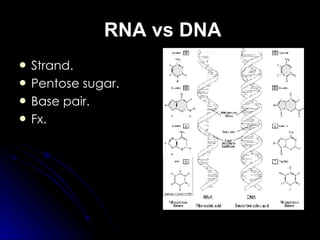
RNA vs DNA Strand. Pentose sugar. Base pair. Fx.
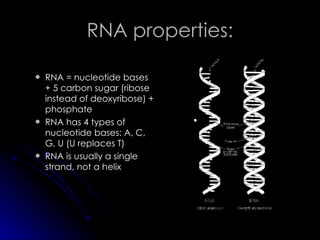
RNA properties: RNA = nucleotide bases + 5 carbon sugar (ribose instead of deoxyribose) + phosphate  RNA has 4 types of nucleotide bases: A, C, G, U (U replaces T)  RNA is usually a single strand, not a helix
RNA nucleotide bases + 5 carbon sugar (ribose instead of deoxyribose) + phosphate  RNA has 4 types of nucleotide bases: A, C, G, U (U replaces T)  RNA is usually a single strand, not a helix
Types of RNA   Messenger RNA ( m-RNA ) = An RNA copy of a gene  Transfer RNA ( t-RNA ) Transfer amino acids to ribosome; have anticodons which match the m-RNA codons.  Ribosomal RNA ( r-RNA ) Ribosomal structure; also includes the enzyme peptidyl transferase (makes peptide bonds)
The transcribed code is carried from the nucleus to the ribosomes by messenger RNA (m-RNA)  The ribosomes contain ribosomal RNA (r-RNA). This type is structural and also acts as an enzyme when the protein is lengthened  Transfer RNA (t-RNA) carries amino acids to the ribosomes: there must be at least 20 types of t-RNA
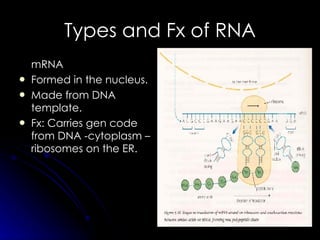
Types and Fx of RNA mRNA  Formed in the nucleus. Made from DNA template.  Fx: Carries gen code from DNA -cytoplasm –  ribosomes on the ER.
Structure of mRNA the longest of the RNA molecules Before entering the cytoplasm on its way to the ribosomes, an mRNA molecule is modified. A 7-methylguanosine "head" is added which serves to help attach the mRNA to a ribosome during protein synthesis.  A poly-A "tail" ( 200 adenosine residues) is attached to the end of the mRNA molecule to prevent it getting destroyed by enzymes in the cytoplasm.
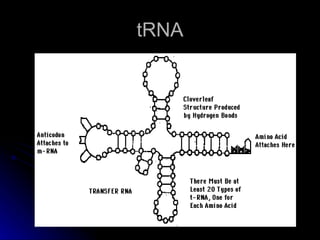
tRNA molecule which transfers the amino acid to the ribosome. There are at least 20 kinds of t-RNA because there are 20 different amino acids Fx: Bonds to a2,  transports them to ribosomes for assembly into polypeptides. I t  is used in the synthesis of proteins
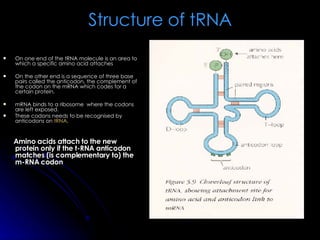
Structure of tRNA On one end of the tRNA molecule is an area to which a specific amino acid attaches On the other end is a sequence of three base pairs called the anticodon, the complement of the codon on the mRNA which codes for a certain protein. mRNA binds to a ribosome  where the codons are left exposed. These codons needs to be recognised by anticodons on  tRNA . Amino acids attach to the new protein only if the t-RNA anticodon matches (is complementary to) the m-RNA codon
tRNA
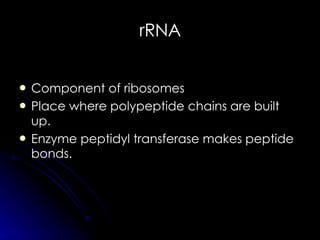
rRNA Component of ribosomes Place where polypeptide chains are built up. Enzyme peptidyl transferase makes peptide bonds.
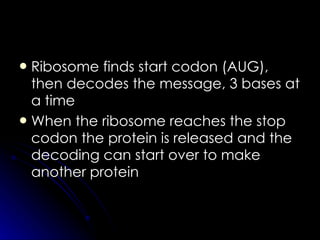
Ribosome finds start codon (AUG), then decodes the message, 3 bases at a time  When the ribosome reaches the stop codon the protein is released and the decoding can start over to make another protein
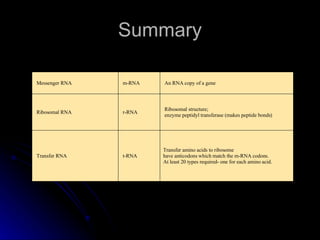
Summary Transfer amino acids to ribosome have anticodons which match the m-RNA codons.  At least 20 types required- one for each amino acid.   t-RNA   Transfer RNA   Ribosomal structure;  enzyme peptidyl transferase (makes peptide bonds)   r-RNA   Ribosomal RNA   An RNA copy of a gene   m-RNA   Messenger RNA

Rna

  • 1.
  • 2.
  • 3.
    RNA vs DNAStrand. Pentose sugar. Base pair. Fx.
  • 4.
    RNA properties: RNA= nucleotide bases + 5 carbon sugar (ribose instead of deoxyribose) + phosphate RNA has 4 types of nucleotide bases: A, C, G, U (U replaces T) RNA is usually a single strand, not a helix
  • 5.
    RNA nucleotide bases+ 5 carbon sugar (ribose instead of deoxyribose) + phosphate RNA has 4 types of nucleotide bases: A, C, G, U (U replaces T) RNA is usually a single strand, not a helix
  • 6.
    Types of RNA  Messenger RNA ( m-RNA ) = An RNA copy of a gene  Transfer RNA ( t-RNA ) Transfer amino acids to ribosome; have anticodons which match the m-RNA codons. Ribosomal RNA ( r-RNA ) Ribosomal structure; also includes the enzyme peptidyl transferase (makes peptide bonds)
  • 7.
    The transcribed codeis carried from the nucleus to the ribosomes by messenger RNA (m-RNA) The ribosomes contain ribosomal RNA (r-RNA). This type is structural and also acts as an enzyme when the protein is lengthened Transfer RNA (t-RNA) carries amino acids to the ribosomes: there must be at least 20 types of t-RNA
  • 8.
    Types and Fxof RNA mRNA Formed in the nucleus. Made from DNA template. Fx: Carries gen code from DNA -cytoplasm – ribosomes on the ER.
  • 9.
    Structure of mRNAthe longest of the RNA molecules Before entering the cytoplasm on its way to the ribosomes, an mRNA molecule is modified. A 7-methylguanosine "head" is added which serves to help attach the mRNA to a ribosome during protein synthesis. A poly-A "tail" ( 200 adenosine residues) is attached to the end of the mRNA molecule to prevent it getting destroyed by enzymes in the cytoplasm.
  • 10.
    tRNA molecule whichtransfers the amino acid to the ribosome. There are at least 20 kinds of t-RNA because there are 20 different amino acids Fx: Bonds to a2, transports them to ribosomes for assembly into polypeptides. I t is used in the synthesis of proteins
  • 11.
    Structure of tRNAOn one end of the tRNA molecule is an area to which a specific amino acid attaches On the other end is a sequence of three base pairs called the anticodon, the complement of the codon on the mRNA which codes for a certain protein. mRNA binds to a ribosome where the codons are left exposed. These codons needs to be recognised by anticodons on tRNA . Amino acids attach to the new protein only if the t-RNA anticodon matches (is complementary to) the m-RNA codon
  • 12.
  • 13.
    rRNA Component ofribosomes Place where polypeptide chains are built up. Enzyme peptidyl transferase makes peptide bonds.
  • 14.
    Ribosome finds startcodon (AUG), then decodes the message, 3 bases at a time When the ribosome reaches the stop codon the protein is released and the decoding can start over to make another protein
  • 15.
    Summary Transfer aminoacids to ribosome have anticodons which match the m-RNA codons. At least 20 types required- one for each amino acid.   t-RNA   Transfer RNA   Ribosomal structure; enzyme peptidyl transferase (makes peptide bonds)   r-RNA   Ribosomal RNA   An RNA copy of a gene   m-RNA   Messenger RNA