TRANSLATION
Prepared By:
Dr. Asit Prasad Dash
Assistant Professor
DEPARTMENT OF PLANT BREEDING AND GENETICS
INSTITUTE OF AGRICULTURAL SCIENCES
SIKSHA ‘O’ ANUSANDHAN (DEEMED TO BE UNIVERSITY), BHUBANESWAR,
751029
INTRODUCTION
v A protein consists of of smaller building blocks: the amino acids.
v Amino acids are joined with each other by peptide bond.
v The base sequence of mRNA is converted into the amino acid
sequence of the protein; this process is known as translation.
THE GENETIC CODE
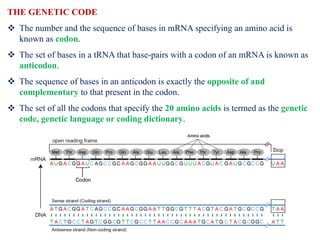
v The number and the sequence of bases in mRNA specifying an amino acid is
known as codon.
v The set of bases in a tRNA that base-pairs with a codon of an mRNA is known as
anticodon.
v The sequence of bases in an anticodon is exactly the opposite of and
complementary to that present in the codon.
v The set of all the codons that specify the 20 amino acids is termed as the genetic
code, genetic language or coding dictionary.
Characteristics of the Genetic Code
v The code is a triplet code.
v The code is comma free; that is, it is continuous.
v The code is nonoverlapping.
v The code is almost universal.
v The code is “degenerate.” i.e. more than one codon occurs for each
amino acid; (the exceptions are AUG, which alone codes for
methionine, and UGG, which alone codes for tryptophan.) This
multiple coding is called the degeneracy or redundancy of the code.
v Ambiguity in the Genetic Code: (Ambiguity denotes that a single
codon may code for more than one amino acid.) There is no
evidence that the genetic code is ambiguous in vivo.
(The only exception appears to be the AUG codon in prokaryotes, and
in chloroplasts and mitochondria; it codes for formylmethionine at the
initiation site, while at other positions it specifies methionine.)
v The code has start and stop signals.
v In both eukaryotes and prokaryotes, AUG (which codes for
methionine) is almost always the start codon for protein
synthesis.
v Only 61 of the 64 codons code for 20 amino acids; these codons
are called sense codons.
v The other three codons—UAG, UAA, and UGA do not specify an
amino acid, hence these three codons are called the stop codons/
nonsense codons/ chain-terminating codons.
v The base at the 5’ end of the anticodon can pair with more than one
type of base at the 3’ end of the codon in other words, the 5’-base of
the anticodon can wobble.
v According to the wobble hypothesis proposed by Crick, the
complete set of 61 sense codons can be read by fewer than 61
distinct tRNAs, because of pairing properties of the bases in the
anticodon.
The process of translation requires the
following major components:
(1)mRNA,
(2)tRNA,
(3)ribosome (containing rRNA) and
(4)many translation factors.
MESSENGER RNA
v All mRNA molecules have a translation initiation site (AUG) close
to their 5'- end and a chain termination site (UAA/ UAG/ UGA)
towards the 3'-end.
v In prokaryotes, ribosomes attach to the 5'-end of mRNA. The
group of ribosomes together with the single mRNA molecule they are
translating is called polysome.
v The 5' leader of bacterial mRNAs has a consensus sequence, called
Shine-Dalgarno sequence, located -7 bases upstream of the AUG
(initiation) codon; the sequence of this consensus is 5' AGGAGG 3'.
Diagram of a polysome—a number of ribosomes, each translating the same mRNA
sequentially.
RIBOSOMES AND RIBOSOMAL RNA
v Prokaryotic (70S) ribosome consist of a 50S and a 30S subunit.
v The 30 S subunit of prokaryotic ribosomes has a single 16S rRNA
molecule which is associated with 21 different proteins.
v The bacterial 16 S rRNA has near it 3'-end, a hexamer sequence 3'
UCCUCC 5’, which is complementary to and base-pairs with the
Shine-Dalgarno sequence of mRNA.
v This base pairing allows the smaller subunit of ribosomes to bind
mRNA during translation.
Functional Sites on Ribosomes
(1) an aminoacyl attachment site (site A): for the attachment
of aminoacyl-tRNAs (amino acid carrying tRNA),
(2) a peptidyl site (site P) and
(3) an exit site (site E).
TRANSFER RNA
It is a class of RNA of small size,
generally having 76 - 95 bases,
which brings amino acids to
ribosomes. Extensive pairing
among the nucleotides produces a
clover leaf secondary structure,
which has:
(1)Amino acid acceptor
region CCA at 3'-end
(2)A thymine loop
(3)Anticodon loop
(4)DHU loop (toward 5'-
end).
(5)An extra loop between
thymine and anticodon
loops.
Charging of tRNA:
v It refers to the attachment of amino acids to specific tRNAs.
v This is comprised of two reactions catalysed by the enzyme
aminoacyl tRNA synthetase.
First Step. It consists of amino acid activation, in which the amino
acid molecule reacts with an ATP molecule to yield an aminoacyl -
AMP (aminoacyl adenylate) molecule.
Amino acid + ATP Aminoacyl-AMP + 2 Pi.
Second Step. The amino acid from aminoacyl-AMP molecule is then
transferred to a tRNA molecule that is specific for the amino acid,
and AMP is released.
Aminoacyl - AMP + tRNA Aminoacyl - tRNA + AMP.
Aminoacylation (charging) of a tRNA molecule by aminoacyl–tRNA synthetase to
produce an aminoacyl–tRNA (charged tRNA).
THE TRANSLATION PROCESS
vTranslation begins near the 5'-end of mRNA and
progresses toward its 3'-end.
vThe process of translation may be divided into the
following 3 steps:
(1) Initiation
(2) Elongation
(3) Termination
Initiation
Initiation comprises all the events that precede the formation of the
first peptide bond.
It includes the following events:
(1) binding of the smaller subunit (30S) of ribosome to mRNA and
(2) binding of the first or initiator aminoacyl-tRNA (fmet-tRNAf) to
the P site of ribosome. Only fmet-tRNAf can enter the P site; all
other tRNAs can not gain a direct access to the P site.
(3) The 50S subunit of ribosome now joins the 30S subunit. The
initiation complex is now complete with an active ribosome in
which A-site is vacant, while the P site is occupied by fmet -
tRNAf.
Initiation of protein synthesis in
bacteria. A 30S ribosomal subunit,
mRNA, initiator f Met–tRNA, and
initiation factors form a 30S initiation
complex. Next, the 50S ribosomal
subunit binds, forming a 70S initiation
complex. During this event, the
initiation factors are released and GTP
is hydrolyzed.
Elongation
It includes
(i) binding of the Aminoacyl–tRNA (charged tRNA) to the
ribosome in the A site
(ii) formation of peptide bond between the amino acids and
(iii) translocation of the ribosome along the mRNA
v Because the ribosome has moved, the uncharged tRNA moves from
the P site and then binds transiently to the E site and finally
released from the ribosome.
v The peptidyl–tRNA is now located in the P site (hence the name
peptidyl site).
v After the completion of translocation, the A site is vacant. An
aminoacyl–tRNA with the correct anticodon binds to the newly
exposed codon in the A site, reiterating the process already
described.
v The whole process is repeated until translation terminates at a stop
codon.
The formation of a peptide bond between the first two amino acids (fMet and Ser)
of a polypeptide chain is catalyzed on the ribosome by peptidyl transferase.
Elongation stage of translation
(in bacteria)
Termination
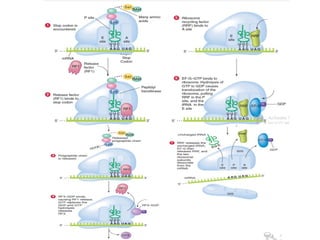
When the A site of a ribosome reaches a nonsense codon (UAA,
UAG, UGA), the specific release factor enters A site.
As a result of this, the following three simultaneous events occur:
(1) the polypeptide chain detaches from the tRNA located at P
site,
(2) immediate release of tRNA from the P site, and
(3) the release of ribosome from the mRNA. The two subunits of
ribosomes may dissociate after their release.
Thank You

Gene Expression: Translation

  • 1.
    TRANSLATION Prepared By: Dr. AsitPrasad Dash Assistant Professor DEPARTMENT OF PLANT BREEDING AND GENETICS INSTITUTE OF AGRICULTURAL SCIENCES SIKSHA ‘O’ ANUSANDHAN (DEEMED TO BE UNIVERSITY), BHUBANESWAR, 751029
  • 2.
    INTRODUCTION v A proteinconsists of of smaller building blocks: the amino acids. v Amino acids are joined with each other by peptide bond. v The base sequence of mRNA is converted into the amino acid sequence of the protein; this process is known as translation.
  • 4.
    THE GENETIC CODE vThe number and the sequence of bases in mRNA specifying an amino acid is known as codon. v The set of bases in a tRNA that base-pairs with a codon of an mRNA is known as anticodon. v The sequence of bases in an anticodon is exactly the opposite of and complementary to that present in the codon. v The set of all the codons that specify the 20 amino acids is termed as the genetic code, genetic language or coding dictionary.
  • 6.
    Characteristics of theGenetic Code v The code is a triplet code. v The code is comma free; that is, it is continuous. v The code is nonoverlapping. v The code is almost universal. v The code is “degenerate.” i.e. more than one codon occurs for each amino acid; (the exceptions are AUG, which alone codes for methionine, and UGG, which alone codes for tryptophan.) This multiple coding is called the degeneracy or redundancy of the code. v Ambiguity in the Genetic Code: (Ambiguity denotes that a single codon may code for more than one amino acid.) There is no evidence that the genetic code is ambiguous in vivo. (The only exception appears to be the AUG codon in prokaryotes, and in chloroplasts and mitochondria; it codes for formylmethionine at the initiation site, while at other positions it specifies methionine.)
  • 7.
    v The codehas start and stop signals. v In both eukaryotes and prokaryotes, AUG (which codes for methionine) is almost always the start codon for protein synthesis. v Only 61 of the 64 codons code for 20 amino acids; these codons are called sense codons. v The other three codons—UAG, UAA, and UGA do not specify an amino acid, hence these three codons are called the stop codons/ nonsense codons/ chain-terminating codons. v The base at the 5’ end of the anticodon can pair with more than one type of base at the 3’ end of the codon in other words, the 5’-base of the anticodon can wobble. v According to the wobble hypothesis proposed by Crick, the complete set of 61 sense codons can be read by fewer than 61 distinct tRNAs, because of pairing properties of the bases in the anticodon.
  • 10.
    The process oftranslation requires the following major components: (1)mRNA, (2)tRNA, (3)ribosome (containing rRNA) and (4)many translation factors.
  • 11.
    MESSENGER RNA v AllmRNA molecules have a translation initiation site (AUG) close to their 5'- end and a chain termination site (UAA/ UAG/ UGA) towards the 3'-end. v In prokaryotes, ribosomes attach to the 5'-end of mRNA. The group of ribosomes together with the single mRNA molecule they are translating is called polysome. v The 5' leader of bacterial mRNAs has a consensus sequence, called Shine-Dalgarno sequence, located -7 bases upstream of the AUG (initiation) codon; the sequence of this consensus is 5' AGGAGG 3'.
  • 12.
    Diagram of apolysome—a number of ribosomes, each translating the same mRNA sequentially.
  • 13.
    RIBOSOMES AND RIBOSOMALRNA v Prokaryotic (70S) ribosome consist of a 50S and a 30S subunit. v The 30 S subunit of prokaryotic ribosomes has a single 16S rRNA molecule which is associated with 21 different proteins. v The bacterial 16 S rRNA has near it 3'-end, a hexamer sequence 3' UCCUCC 5’, which is complementary to and base-pairs with the Shine-Dalgarno sequence of mRNA. v This base pairing allows the smaller subunit of ribosomes to bind mRNA during translation. Functional Sites on Ribosomes (1) an aminoacyl attachment site (site A): for the attachment of aminoacyl-tRNAs (amino acid carrying tRNA), (2) a peptidyl site (site P) and (3) an exit site (site E).
  • 15.
    TRANSFER RNA It isa class of RNA of small size, generally having 76 - 95 bases, which brings amino acids to ribosomes. Extensive pairing among the nucleotides produces a clover leaf secondary structure, which has: (1)Amino acid acceptor region CCA at 3'-end (2)A thymine loop (3)Anticodon loop (4)DHU loop (toward 5'- end). (5)An extra loop between thymine and anticodon loops.
  • 16.
    Charging of tRNA: vIt refers to the attachment of amino acids to specific tRNAs. v This is comprised of two reactions catalysed by the enzyme aminoacyl tRNA synthetase. First Step. It consists of amino acid activation, in which the amino acid molecule reacts with an ATP molecule to yield an aminoacyl - AMP (aminoacyl adenylate) molecule. Amino acid + ATP Aminoacyl-AMP + 2 Pi. Second Step. The amino acid from aminoacyl-AMP molecule is then transferred to a tRNA molecule that is specific for the amino acid, and AMP is released. Aminoacyl - AMP + tRNA Aminoacyl - tRNA + AMP.
  • 17.
    Aminoacylation (charging) ofa tRNA molecule by aminoacyl–tRNA synthetase to produce an aminoacyl–tRNA (charged tRNA).
  • 18.
    THE TRANSLATION PROCESS vTranslationbegins near the 5'-end of mRNA and progresses toward its 3'-end. vThe process of translation may be divided into the following 3 steps: (1) Initiation (2) Elongation (3) Termination
  • 19.
    Initiation Initiation comprises allthe events that precede the formation of the first peptide bond. It includes the following events: (1) binding of the smaller subunit (30S) of ribosome to mRNA and (2) binding of the first or initiator aminoacyl-tRNA (fmet-tRNAf) to the P site of ribosome. Only fmet-tRNAf can enter the P site; all other tRNAs can not gain a direct access to the P site. (3) The 50S subunit of ribosome now joins the 30S subunit. The initiation complex is now complete with an active ribosome in which A-site is vacant, while the P site is occupied by fmet - tRNAf.
  • 20.
    Initiation of proteinsynthesis in bacteria. A 30S ribosomal subunit, mRNA, initiator f Met–tRNA, and initiation factors form a 30S initiation complex. Next, the 50S ribosomal subunit binds, forming a 70S initiation complex. During this event, the initiation factors are released and GTP is hydrolyzed.
  • 21.
    Elongation It includes (i) bindingof the Aminoacyl–tRNA (charged tRNA) to the ribosome in the A site (ii) formation of peptide bond between the amino acids and (iii) translocation of the ribosome along the mRNA v Because the ribosome has moved, the uncharged tRNA moves from the P site and then binds transiently to the E site and finally released from the ribosome. v The peptidyl–tRNA is now located in the P site (hence the name peptidyl site). v After the completion of translocation, the A site is vacant. An aminoacyl–tRNA with the correct anticodon binds to the newly exposed codon in the A site, reiterating the process already described. v The whole process is repeated until translation terminates at a stop codon.
  • 22.
    The formation ofa peptide bond between the first two amino acids (fMet and Ser) of a polypeptide chain is catalyzed on the ribosome by peptidyl transferase.
  • 23.
    Elongation stage oftranslation (in bacteria)
  • 25.
    Termination When the Asite of a ribosome reaches a nonsense codon (UAA, UAG, UGA), the specific release factor enters A site. As a result of this, the following three simultaneous events occur: (1) the polypeptide chain detaches from the tRNA located at P site, (2) immediate release of tRNA from the P site, and (3) the release of ribosome from the mRNA. The two subunits of ribosomes may dissociate after their release.
  • 27.